
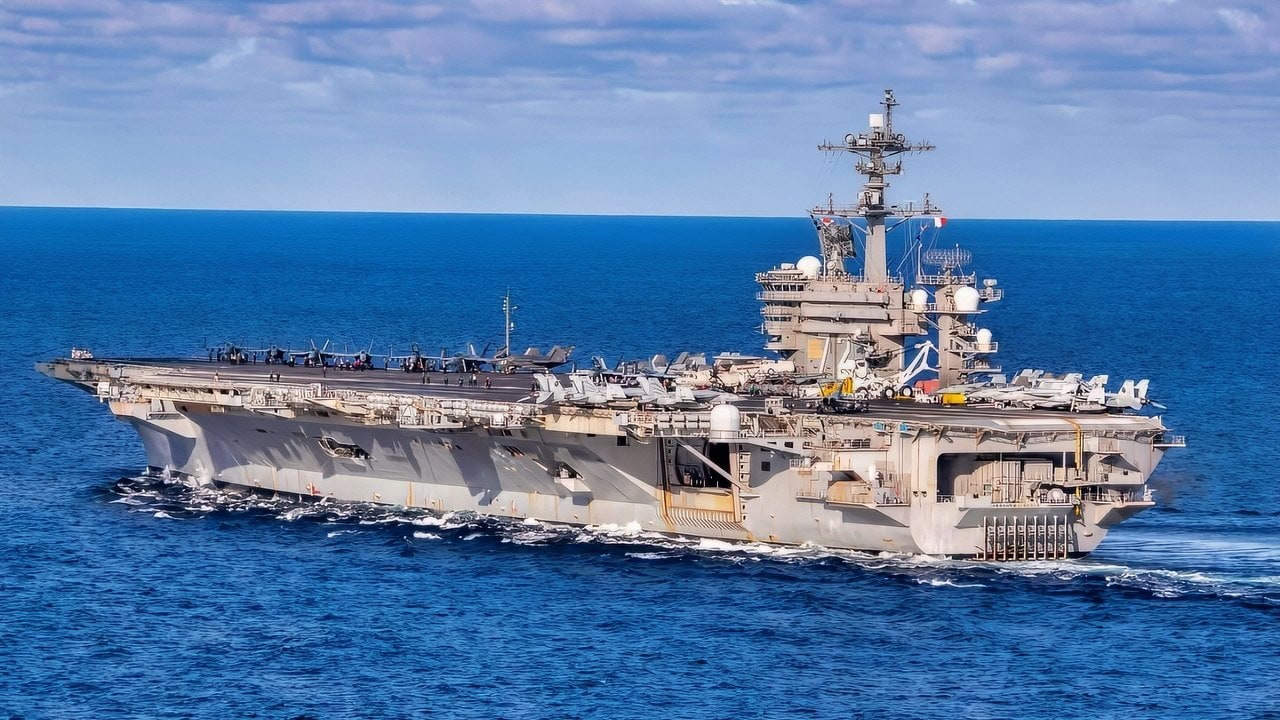
Synopsis: The Navy is rebuilding sustained Indo-Pacific mass after years of Middle East rotations, pairing a forward-deployed carrier in Japan with additional surge forces.
-USS George Washington’s return to Yokosuka after its midlife refueling restores a standing capital-ship presence tied to allied reassurance and faster crisis response.
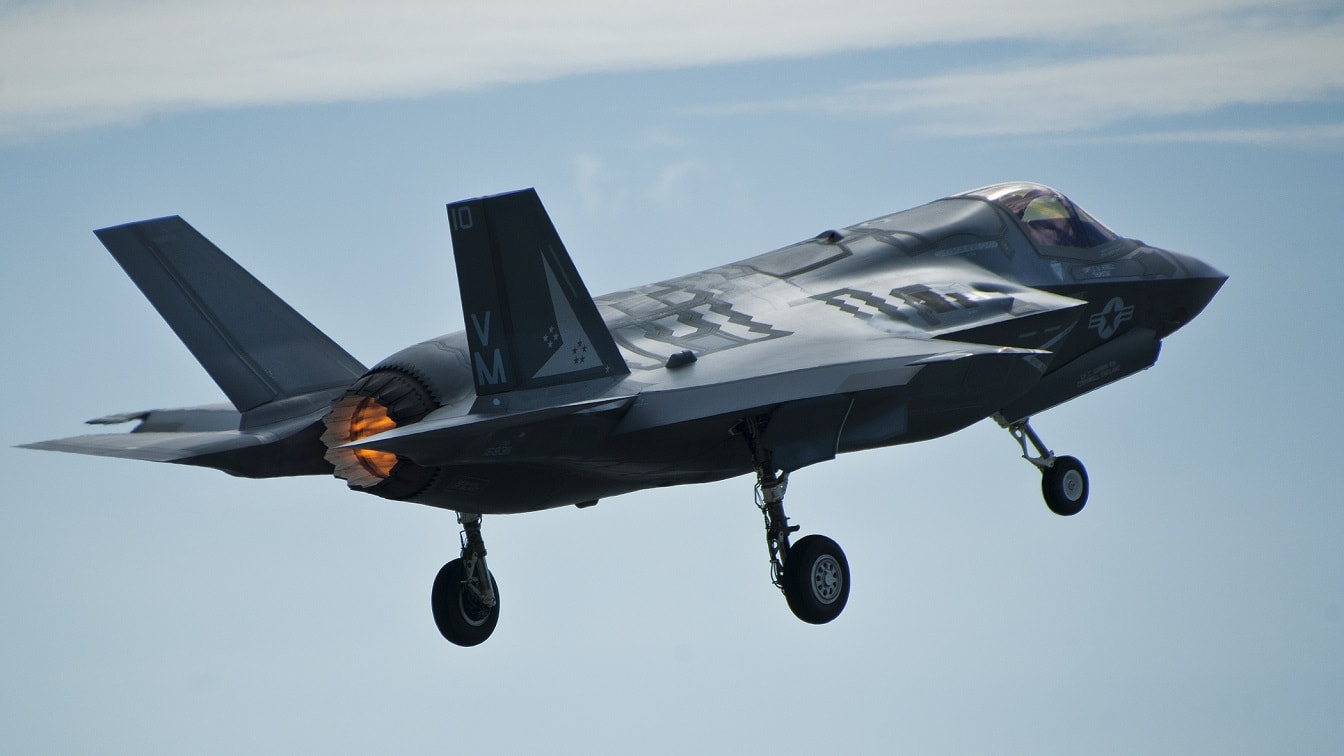
A Marine F-35B Lightning II takes off from the Eglin Air Force Base runway for a local sortie. The 33rd Fighter Wing’s integrated training center for the joint strike fighter hosts squadrons for Air Force, Navy, Marines and partner nations. (U.S. Air Force photo/Samuel King Jr.)
-USS Abraham Lincoln’s arrival in Guam adds overlap, logistics depth, and deterrent weight. The carrier group is now operating in the Philippine Sea.
-Forward-deployed USS Tripoli brings an expeditionary aviation option, now in the East China Sea, including F-35B sorties, complementing carrier-based F-35Cs.
-Together the deployments signal layered naval airpower—while underscoring constraints from maintenance cycles, crew strain, and operating inside China’s A2/AD threat envelope. Expect more pacing moves ahead soon.
USS George Washington Returns to Yokosuka—And Sends a Clear Signal in Asia
The US Navy is reasserting a sustained warship presence in the Indo-Pacific after a long focus on the Middle East. Recent deployments of the USS George Washington (CVN-73) to Japan and the USS Abraham Lincoln (CVN-72) to Guam and now the Philippine Sea, and the forward-deployment of the USS Tripoli (LHA-7) in the East China Sea suggest a shift in force posture.
The U.S. is visibly constituting layered naval power in the Pacific as competition with China picks up.
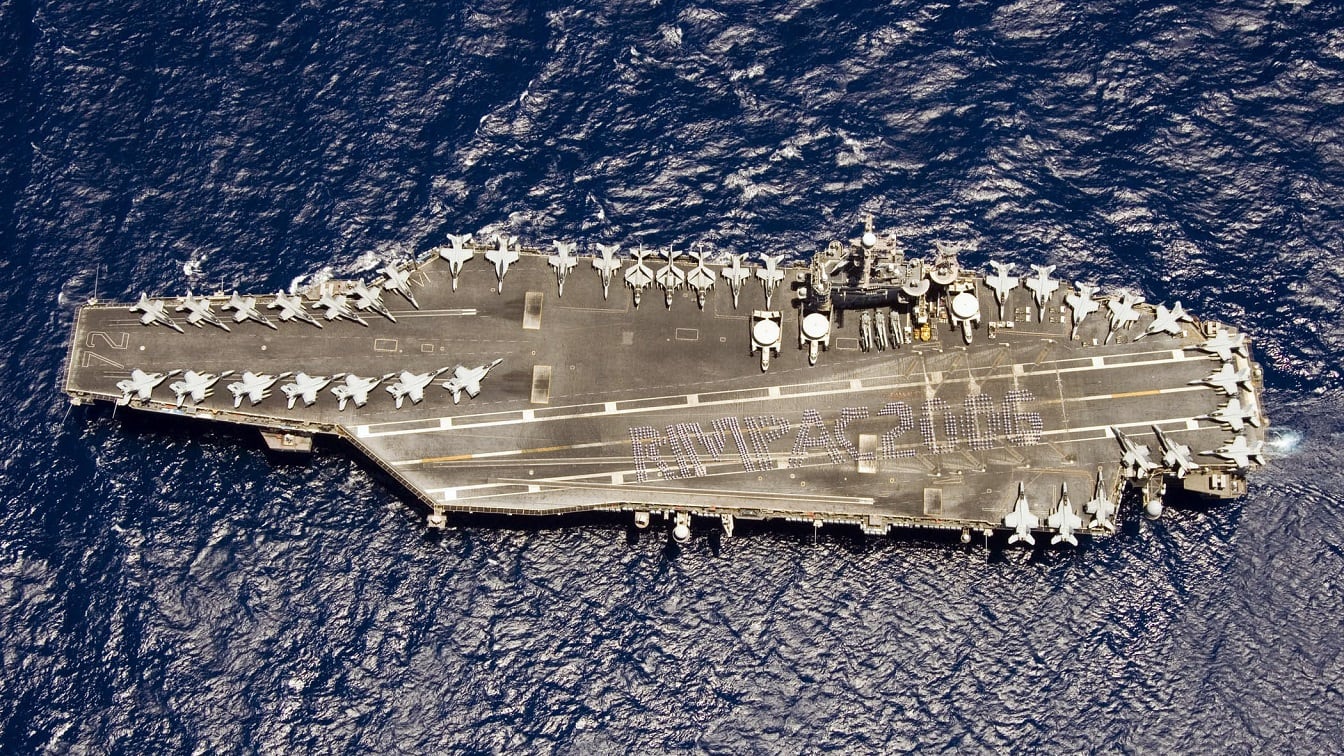
Aerial overhead view of US Navy (USN) Sailors aboard the USN Nimitz Class Aircraft Carrier USS ABRAHAM LINCOLN (CVN 72) spelling out RIMPAC 2006 on the flight deck of the ship during a photo exercise during Exercise Rim of the Pacific (RIMPAC) 2006 in the Pacific Ocean (POC). The exercise is designed to increase the tactical proficiency of participating units in a wide array of combined sea operations. RIMPAC 2006 brings together military forces from Australia (AUS), Canada (CAN), Chile (CHL), Peru (PER), Japan (JPN), the Republic of Korea (KOR), United Kingdom (UK) and the United States (US).
U.S. Navy photo by Mass Communication Specialist Seaman James R. Evans (RELEASED)
New Developments
The George Washington recently completed a complex midlife refueling and additional modernizations. It returned to Yokosuka after its first full post-refit Indo-Pacific deployment, during which it participated in multinational exercises such as Talisman Sabre with Australia and the United Kingdom.
As a forward-deployed capital vessel, the Washington will provide a constant regional presence, offering faster response times and political reassurance to allies in the region that are increasingly wary of Chinese assertiveness.
The Washington’s presence at Yokosuka is especially significant. The U.S. Navy’s presence there became strategically critical during the Korean War and was crucial to Cold War containment efforts in the Pacific. The USS Midway (CV-41) was first forward-deployed to Yokosuka in the 1970s, and the Washington held the role from 2008-2014, before its midlife refueling.
Today, Yokosuka remains one of the most important U.S. overseas naval hubs.
The Abraham Lincoln’s arrival in Guam and now in the Philippine Sea was intentionally staggered with the Washington’s return to Yokosuka. Guam serves a vital purpose as a logistics hub, command-and-control nexus, and power-projection platform.
The Lincoln recently departed San Diego after participating in Northern Edge exercises near Alaska. The overlapping carrier presence provided by the Lincoln and the Washington suggests heightened readiness and deterrence through mass, and their simultaneous deployment shows the Navy knows that one forward-deployed carrier might not be enough in a Pacific crisis.
In addition to the two carriers, the US has forward-deployed the USS Tripoli, now in the East China Sea, which is not a true carrier but a Marine Corps asset that can deploy up to 2,200 Marines and operate the F-35B Short Takeoff and Vertical Landing (STOVL) fighter.
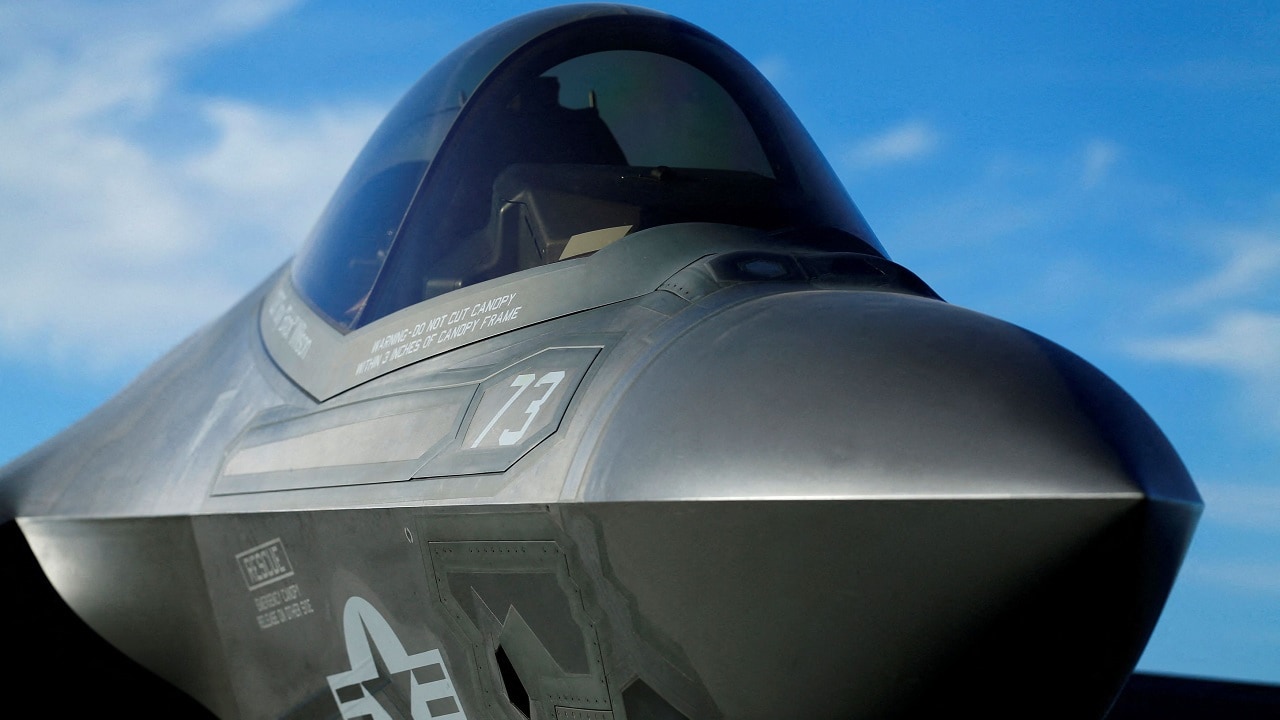
A Lockheed Martin Corp’s F-35C Joint Strike Fighter is shown on the deck of the USS Nimitz aircraft carrier after making the plane’s first ever carrier landing using its tailhook system, off the coast of California, November 3, 2014. REUTERS/Mike Blake (UNITED STATES – Tags: TRANSPORT MILITARY)/File Photo
The Tripoli can function as an expeditionary strike platform, especially with the addition of the F-35B fifth-generation fighter.
The F-35B differs from the F-35C, which operates from the Washington and the Lincoln. Whereas the F-35B performs STOVL, the F-35C is a carrier-capable fighter with a longer range and larger payload. The F-35B, while conceding range and payload, has more flexibility thanks to its short takeoff and vertical landing abilities.
Together, the two F-35 variants overlap to provide layered fifth-generation coverage and redundancy.
Strategic Implications
The surface vessel deployments signal a reprioritization toward the Indo-Pacific after years of focus on the Middle East. The shift is bolstered by regional allies who contribute to multinational exercises to improve interoperability among partners such as Australia, the UK, Japan, and Vietnam.
However, the deployments also highlight structural challenges, including limited carrier availability, the pace of maintenance cycles, and the strain that forward deployments place on crews and ships.
While not explicitly stated, the Navy’s movements are clearly aimed at deterring a revisionist China, which has become increasingly assertive in the region. The U.S. carrier presence supports freedom of navigation, grants regional reassurances and improves crisis response times.
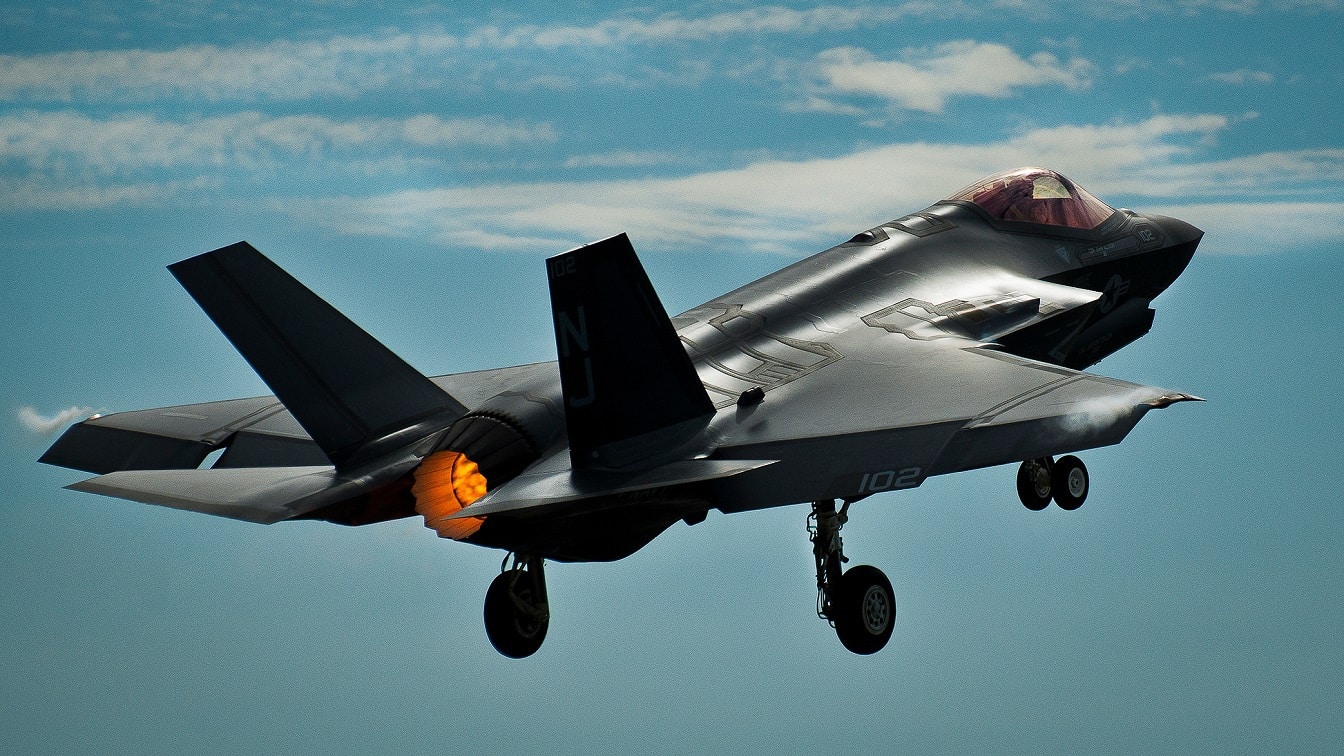
The first F-35C Lightning II sortie takes off from the U.S. Navy F-35 Strike Fighter Squadron VFA 101 at Eglin Air Force Base, Fla. Aug. 14. Sailors have been on station for two years ready for the day they would launch a carrier variant of the military’s joint strike fighter. The Navy’s first pilot training course at Eglin was concluded in January and the second course began June with seven pilots soon to begin training flight operations in two of the squadron’s F-35Cs. (U.S. Air Force photo/Samuel King Jr.)
The movements also raise questions about carrier survivability in missile-dense environments. Can carriers survive within China’s anti-access/area denial (A2/AD) bubble? And have advancements in missile technology made fixed bases such as Yokosuka and Guam obsolete?
Regardless, the various deployments suggest the Navy is betting on layered force packages rather than just single platforms, offering important redundancy in an increasingly contested environment.
The convergence of carriers and amphibious aviation platforms in the Indo-Pacific reflects a Navy that is returning to its primary theater of concern.
The message is not subtle: The U.S. Navy intends to remain a resident naval power in the Pacific, even as the costs and risks of doing so continue to rise.
China for their part won’t seek a symmetrical response; Beijing knows it can’t achieve carrier parity with the U.S.
Instead, the People’s Liberation Army will likely interpret the expanded U.S. carrier presence as validation of its A2/AD strategy—perhaps motivation to continue development of anti-ship ballistic missiles and long-range intelligence, surveillance, and reconnaissance capabilities.
About the Author: Harrison Kass
Harrison Kass is an attorney and journalist covering national security, technology, and politics. Previously, he was a political staffer and candidate, and a US Air Force pilot selectee. He holds a JD from the University of Oregon and a master’s in global journalism and international relations from NYU.
NOTE: This piece was recently updated.