
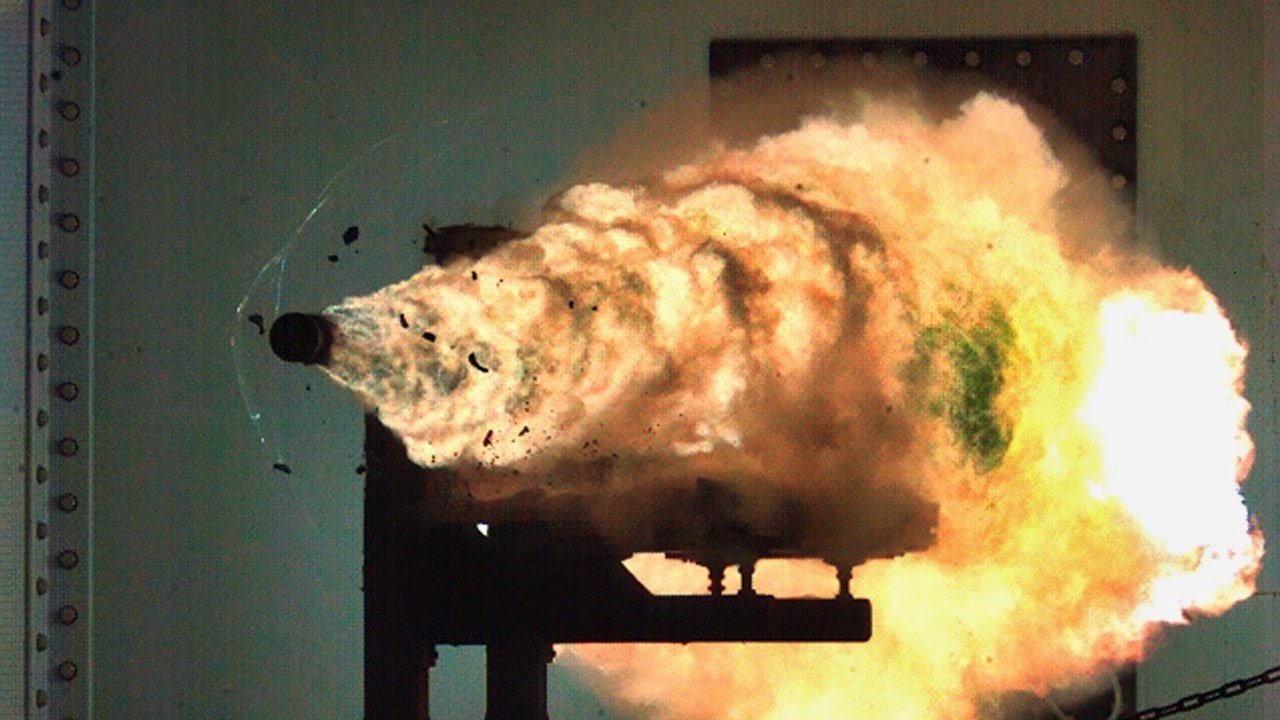
Key Points and Summary – The U.S. Navy once touted the electromagnetic railgun as a game-changing ship weapon: Mach 7 shots, 100-nautical-mile range, and cheap, gunpowder-free ammo.
-After 15 years and more than $500 million, the program was shelved in 2021.
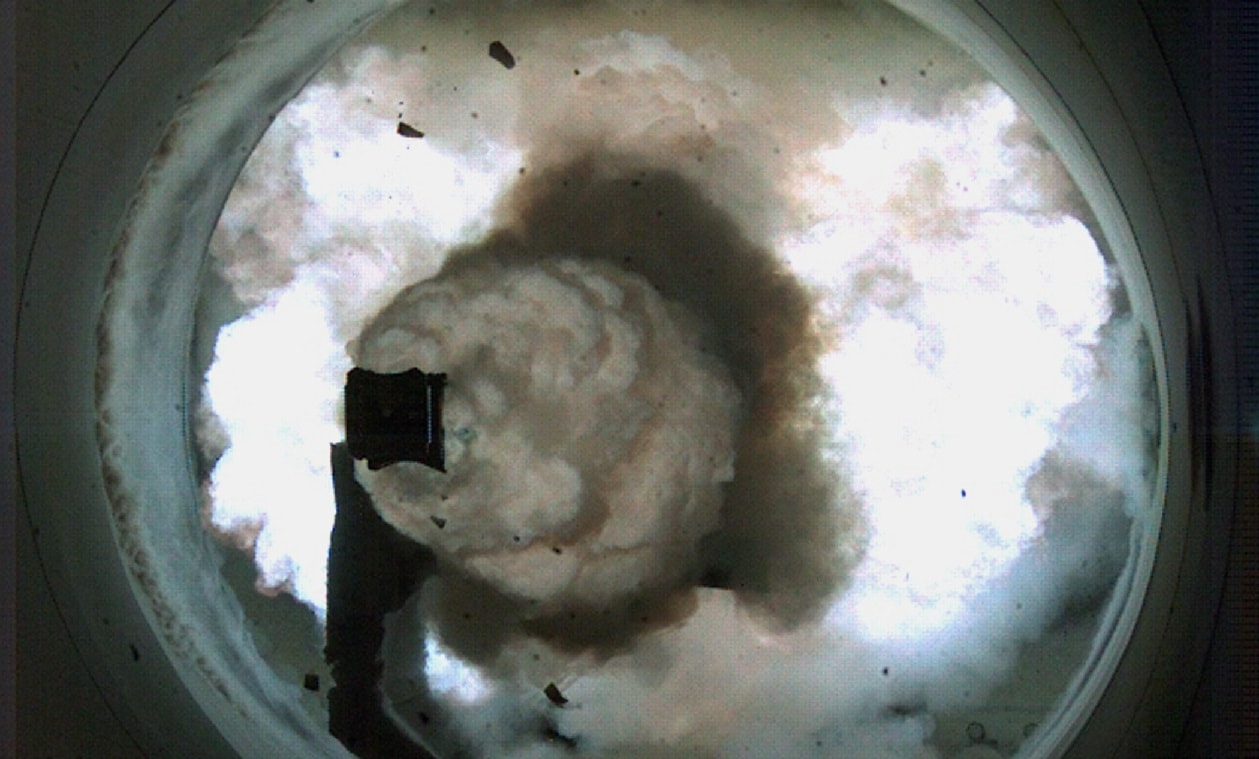
DAHLGREN, Va. (Dec. 10, 2010) High-speed camera image of the Office of Naval Research Electromagnetic Railgun located at the Naval Surface Warfare Center Dahlgren Division, firing a world-record setting 33 mega-joule shot, breaking the previous record established Jan. 31, 2008. The railgun is a long-range, high-energy gun launch system that uses electricity rather than gunpowder or rocket motors to launch projectiles capable of striking a target at a range of more than 200 nautical miles with Mach 7 velocity. A future tactical railgun will hit targets at ranges almost 20 times farther than conventional surface ship combat systems. (U.S. Navy photo/Released)
-Engineering reality killed the dream: barrels that burned out after a few dozen rounds, brutal heat and cooling demands, and enormous power requirements only ships like Zumwalt could marginally support.
-Meanwhile, China fielded long-range hypersonic anti-ship missiles that outranged any railgun concept. The Navy shifted to hypersonics, lasers, and hypervelocity projectiles, leaving the railgun as a textbook case of a “revolutionary” idea that couldn’t cross the Valley of Death.
The U.S. Navy Is Still Smarting from the Railgun Failure
The railgun or “electro-magnetic launcher” was supposed to revolutionize warfare for the U.S. Navy. The service branch sunk more than $500 million into the weapon that could hurl projectiles at MACH 7 speed with a range of 100 nautical miles. But the railgun failed to create such a broad makeover of naval weaponry. It was cancelled in 2021 to focus on fielding hypersonic missiles and other technological advances, such as directed energy systems, that had a more promising future.
The Navy had been working on the railgun since 2005. It was seen as the harbinger of modern maritime gunnery, ushering in a new era of combat and helping ships such as destroyers and frigates better eliminate enemy vessels, shoot down aircraft, defend against incoming missiles, and destroy ground targets to support soldiers and Marines fighting on shore.
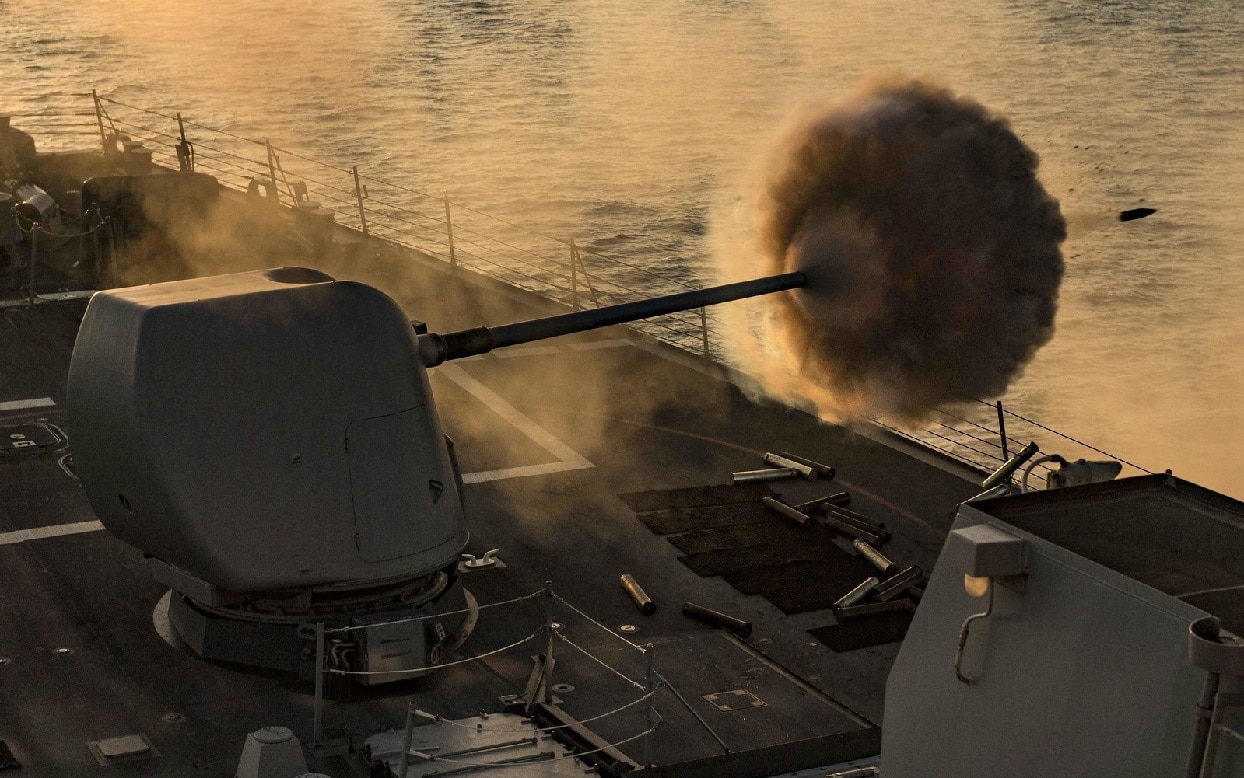
MEDITERRANEAN SEA (Sept. 24, 2018) The Arleigh Burke-class guided-missile destroyer USS Carney (DDG 64) fires its 5-inch gun during a live-fire exercise, Sept. 24, 2018. Carney, forward-deployed to Rota, Spain, is on its fifth patrol in the U.S. 6th Fleet area of operations in support of regional allies and partners as well as U.S. national security interests in Europe and Africa.
Let’s Pull The Plug on This System
With a railgun, gunpowder or chemical propellants are not used; magnetic fields are used instead.
The Navy said four years ago that “given fiscal constraints, combat system integration challenges and the prospective technology maturation of other weapon concepts, the Navy decided to pause research and development of the Electromagnetic Railgun [EMRG] at the end of 2021,” Military.com noted.
The railgun never saw the light of day, even though Japan later developed its own working model. The American railgun was going to fire the Gun-Launched Guided Projectile that was more than three feet long.
The Navy decided to focus instead on laser programs, modernizing electronic warfare systems and hypersonic weapons.
The Navy Admitted to Congress That the Railgun Was Struggling
By 2018, the railgun had not been delivered to the Navy as a workable weapon. Then-Chief of Naval Operations Admiral John Richardson had some bad news for Congress. “The barrel itself is probably the limiting case, the engineering on that, the materials required to sustain that power pulse, and the heat and pressure that’s involved in launching those projectiles,” Richardson told lawmakers.
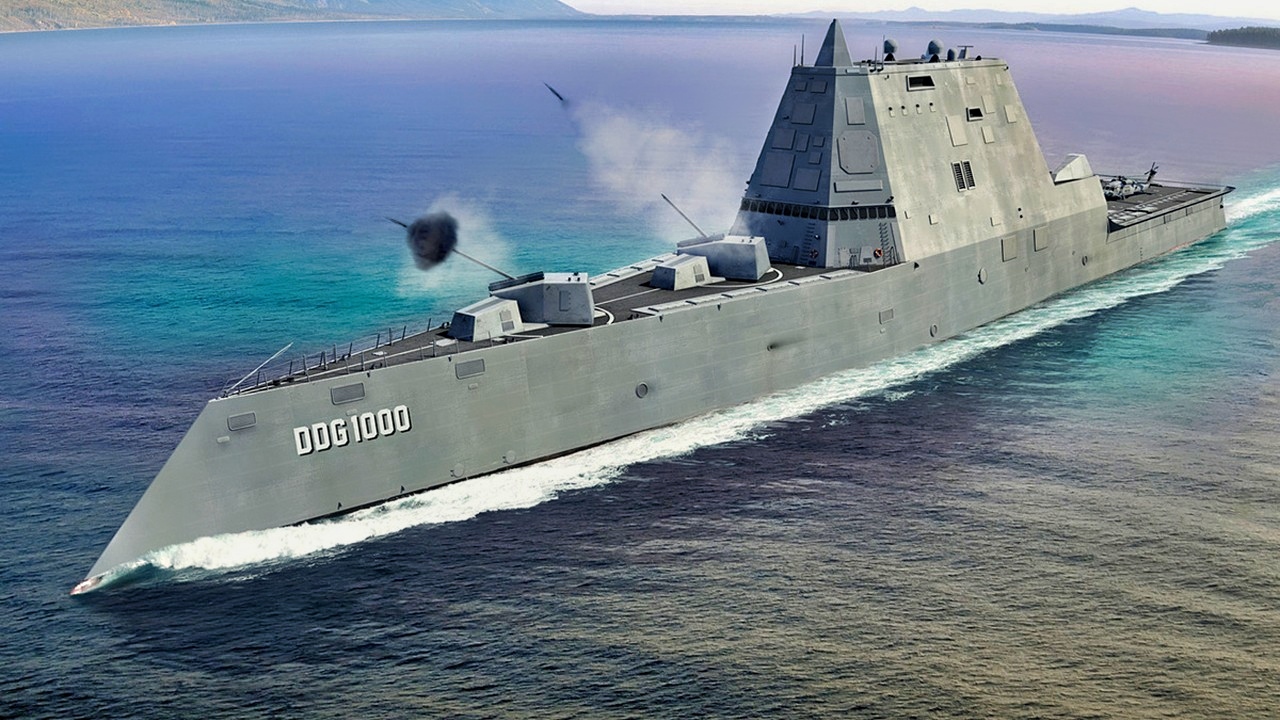
Zumwalt-Class U.S. Navy Destroyer. Image Credit: Creative Commons.
Electrical Power Needs Were Difficult For Many Ships to Provide
The railgun required an inordinate amount of electricity that most naval ships could not supply. The Zumwalt-class of destroyers might have been able to provide the power, but that would have come at the expense of other weapons systems.
Plow Money Into Hypersonic Missiles Instead
Plus, hypersonic missiles were seen as having the long-range capability that would give the Navy a greater advantage in future fights against Russia or China.
The Office of Naval Research did the most work on the railgun project, and some of the research and development analysis could be transferred to hypersonic programs, the Navy hoped.
The main idea behind the railgun was that it could fire unlimited “shots” using ammunition without gunpowder that was cheaper than missiles or other types of projectiles fired from conventional guns onboard ships. The railgun kinetic energy was believed to be the weapon of the future against an assortment of targets the Navy would face in next-generation warfare.
Naval Ships Would Have Been Outclassed By Enemy Ship-Killing Missiles
However, as the railgun underwent research and development, adversaries like China had created their own hypersonic weapons that could outrange the railgun’s 100 nautical mile combat radius.
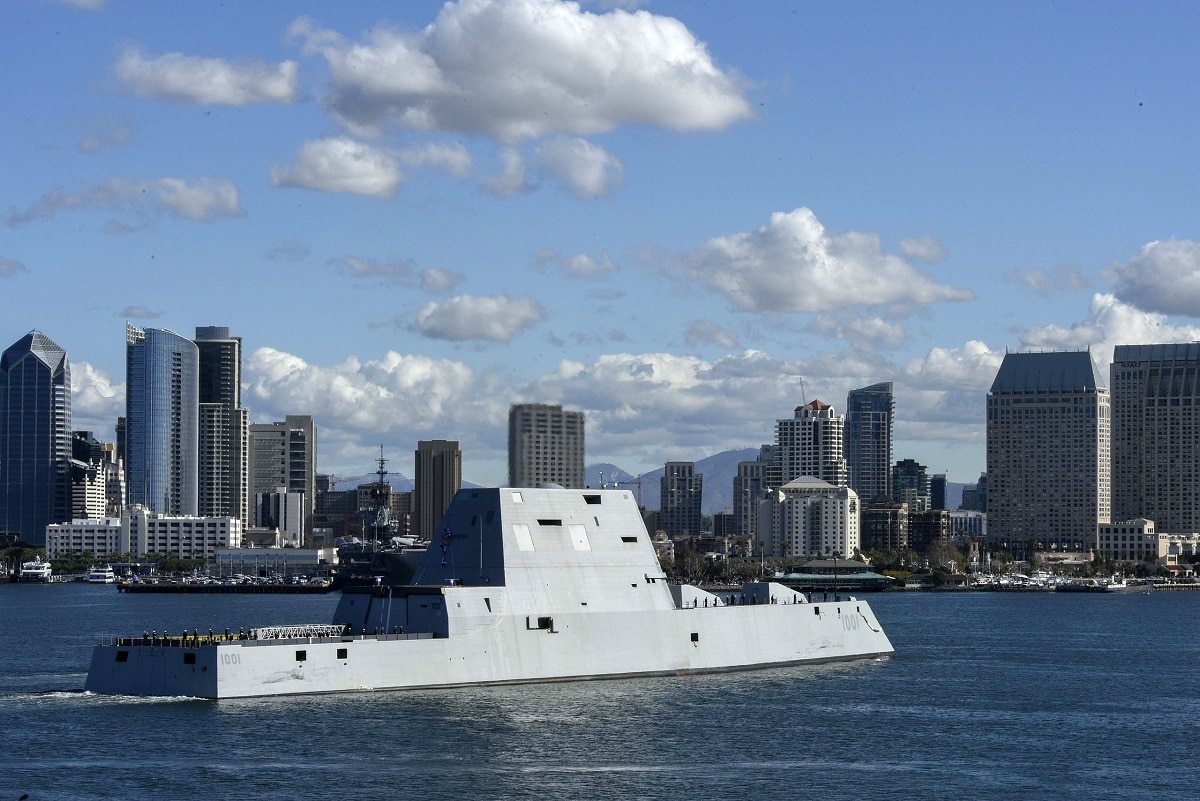
SAN DIEGO (Dec. 7, 2018) The Pre-Commissioning Unit (PCU) Michael Monsoor (DDG 1001) arrives in homeport of San Diego. The future USS Michael Monsoor is the second ship in the Zumwalt-class of guided- missile destroyers and will undergo a combat availability and test period. The ship is scheduled to be commissioned into the U.S. Navy Jan 26, 2019 in Coronado, Cailf. (U.S. Navy photo by Mass Communication Specialist Seaman Apprentice Nicholas Huynh/Released) 181207-N-IW125-1021
Not only were the technology and power requirements unworkable, but the guns would be ineffective as ships would need to be closer in to fire the railgun at targets. This would make vessels liable to destruction by long-range anti-ship hypersonic missiles such as the Chinese YJ-series.
The rate of fire was also slower than that of shipboard weapons using conventional gunpowder. The gun itself was not considered strong enough to make a continuous volley of shots. The magnetic force could have broken the gun apart during use.
Conventional guns can fire about 600 times before the barrel must be changed, according to Defense News. The railgun’s barrel would have to be refurbished after only 12 to 24 rounds were fired, the media outlet said.
The Navy thought about placing a railgun on the Zumwalt-class USS Lyndon B. Johnson. The ship’s marine turbines can generate 78 megawatts of electricity.
Since Lyndon B. Johnson had lost its cancelled Advanced Gun System there was room on the deck for a railgun.
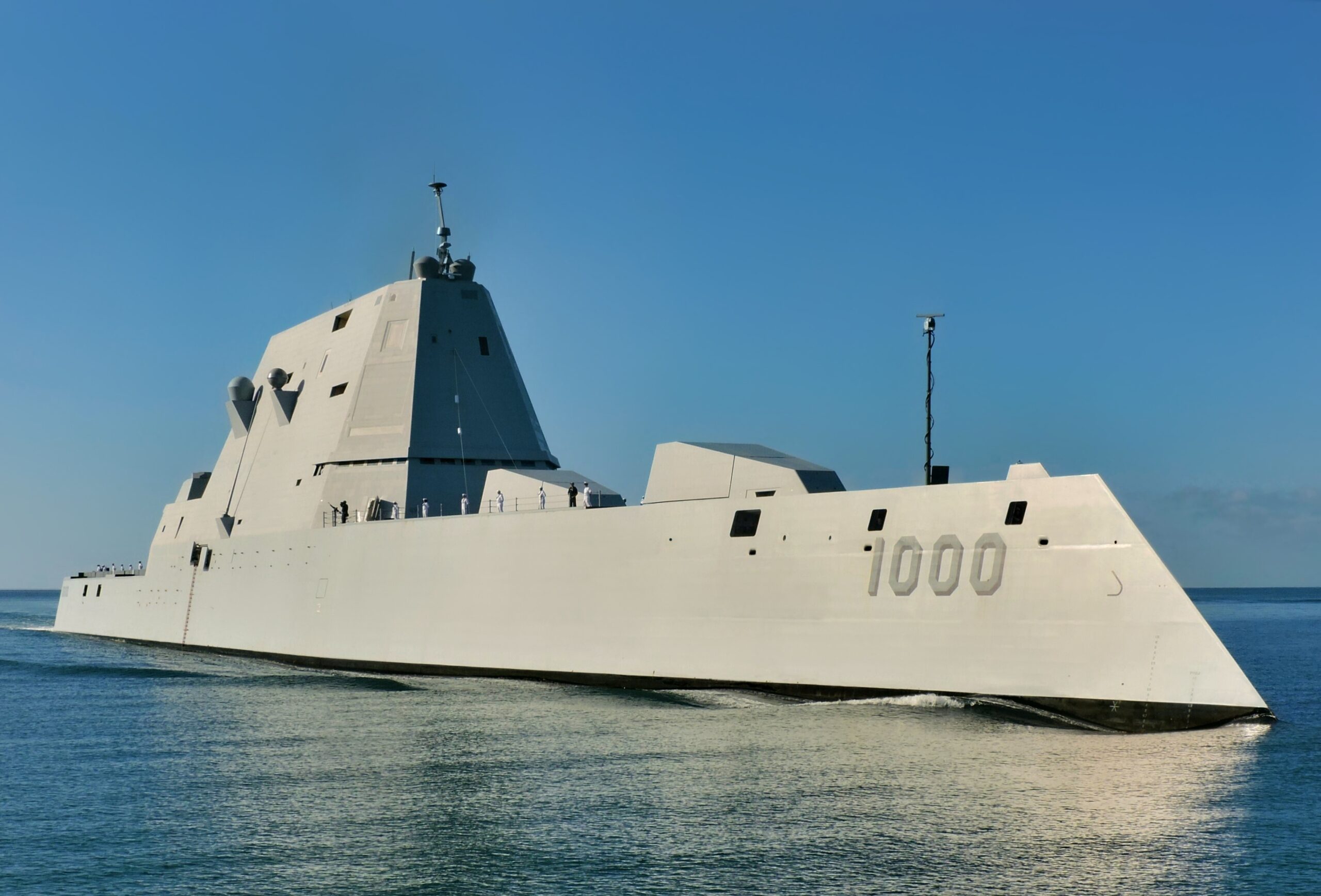
Zumwalt-Class Destroyer U.S. Navy. Image Credit: Creative Commons.
The Navy decided instead to change the ammunition on existing conventional 5-inch guns to the “hypervelocity projectile.”
The railgun also generated substantial heat, and the ships would need cooling systems for the gun. This would have required much more weight than destroyers and cruisers could sustain.
Why the Railgun Failed for the U.S. Navy
The railgun was going to be expensive to maintain, with lengthy down periods, as components like the barrel needed frequent replacement. After that $500 million investment over 15 years, the Navy realized that the railgun had too many significant drawbacks. The idea seemed like a winner in 2005, but threats changed and enemy capabilities evolved, including hypersonic weapons. The railgun was unwieldy and created more problems than it solved.
The railgun is no longer a priority for the Navy, and it likely made the correct decision, even though Japan was able to see the project through at a lower cost and in less time.
The railgun should be seen as a cautionary tale of defense acquisition efforts gone awry.
The weapon did not pass through the “Valley of Death” successfully, and it was overwhelmed by events that led to a large-scale waste of money.
About the Author: Brent M. Eastwood
Author of now over 3,000 articles on defense issues, Brent M. Eastwood, PhD is the author of Don’t Turn Your Back On the World: a Conservative Foreign Policy and Humans, Machines, and Data: Future Trends in Warfare plus two other books. Brent was the founder and CEO of a tech firm that predicted world events using artificial intelligence. He served as a legislative fellow for US Senator Tim Scott and advised the senator on defense and foreign policy issues. He has taught at American University, George Washington University, and George Mason University. Brent is a former US Army Infantry officer. He can be followed on X @BMEastwood.