
Summary and Key Points: In retaliation to President Trump’s expanded travel bans now affecting 39 countries, West African nations Mali, Burkina Faso, and Niger have imposed full visa bans on U.S. citizens.
-These “reciprocity” measures follow Trump’s December order restricting entry from several African and Sahelian states citing national security concerns.
-With the U.S. set to co-host the 2026 FIFA World Cup, the White House has carved out exemptions for athletes and staff, though fans from affected qualifying nations like Senegal and Ivory Coast may still face significant entry barriers.
3 West African Nations Ban US Travelers After Trump’s Visa Restrictions
During both of his terms as president, Donald Trump has imposed several travel bans to prevent people from certain countries from traveling to the United States.
Last January, after he arrived back in office, Trump signed an executive order titled “Protecting the United States From Foreign Terrorists and Other National Security and Public Safety Threats.”
That order did not mention specific countries, but rather called on the Secretaries of State and Homeland Security, the Director of National Intelligence and the Attorney General to “identify all resources that may be used to ensure that all aliens seeking admission to the United States, or who are already in the United States, are vetted and screened to the maximum degree possible,” and to “determine the information needed from any country to adjudicate any visa, admission, or other benefit under the INA for one of its nationals, and to ascertain whether the individual seeking the benefit is who the individual claims to be and that the individual is not a security or public-safety threat,” among other actions.
Another order, in June, got more specific, as Trump announced that the U.S. would “fully restrict and limit the entry of nationals of the following 12 countries: Afghanistan, Burma, Chad, Republic of the Congo, Equatorial Guinea, Eritrea, Haiti, Iran, Libya, Somalia, Sudan, and Yemen.” Trump also revealed plans to “partially restrict and limit the entry of nationals” from several other countries: Burundi, Cuba, Laos, Sierra Leone, Togo, Turkmenistan, and Venezuela.
More restrictions came into effect in December, when Trump announced “full restrictions and entry limitations” on Burkina Faso, Mali, Niger, South Sudan, and Syria, as well as to “individuals holding Palestinian-Authority-issued travel documents.” Also in December, Trump added full restrictions on Laos and Sierra Leone, which were previously only partially, while restrictions were relaxed for Turkmenistan because, as the White House said, that country had “engaged productively with the United States and demonstrated significant progress since the previous Proclamation.”
Partial restrictions were also added in December for 15 more countries: Angola, Antigua and Barbuda, Benin, Côte d’Ivoire, Dominica, Gabon, The Gambia, Malawi, Mauritania, Nigeria, Senegal, Tanzania, Tonga, Zambia, and Zimbabwe.
In total, 39 countries are affected by U.S. travel bans.
Now, it turns out that those travel bans can go both ways.
Banned From Burkina Faso
According to Al Jazeera, two countries in West Africa, Mali and Burkina Faso, have announced full visa bans on U.S. citizens, in retaliation for the U.S. restrictions. The retaliation was announced just before the new year.
“In accordance with the principle of reciprocity, the Ministry of Foreign Affairs and International Cooperation informs the national and international community that, with immediate effect, the Government of the Republic of Mali will apply the same conditions and requirements to US nationals as those imposed on Malian citizens,” the Malian ministry said in a statement.
Burkina Faso’s foreign minister, Karamoko Jean-Marie Traore, made a similar statement to Al Jazeera.
Niger, which is part of the Alliance of Sahel States along with Mali and Burkina Faso, announced a similar ban last week. Another country in Africa, Chad, stopped issuing visas last June.
Per the BBC, the three countries are all “ruled by military juntas which seized power in coups” and that “they have formed their own regional bloc, and have pivoted towards Russia after relations with other West African states and Western powers became strained.”
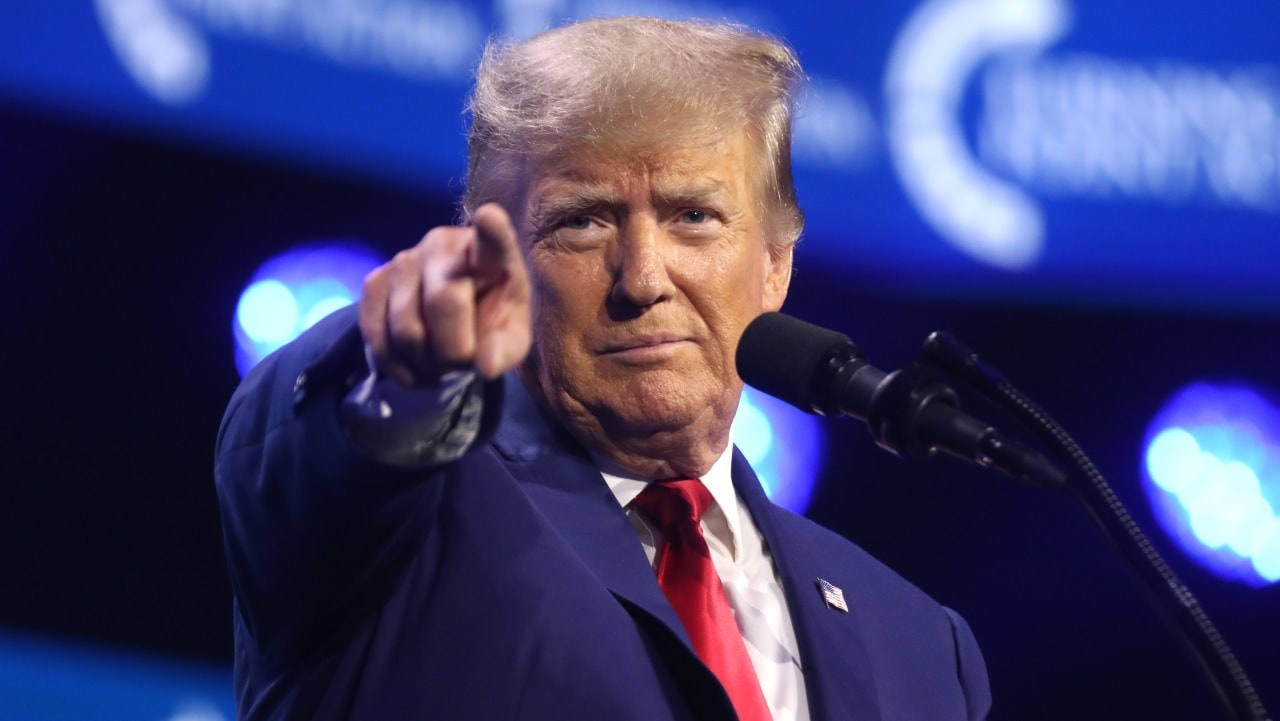
Former President of the United States Donald Trump speaking with attendees at the 2023 Turning Point Action Conference at the Palm Beach County Convention Center in West Palm Beach, Florida. By Gage Skidmore.
Donald Trump – Image by Gage Skidmore
According to a UN Security Council report last November, West Africa and the Sahel are “now the global epicentre of violent extremism.” United Nations Secretary-General António Guterres warned at the time that the situation in that part of the world is “growing more critical by the day.”
“While this is likely to further constrain relations, it will also displace Washington’s influence” in West Africa’s Sahel region, Beverly Ochieng, an analyst at Control Risk, told the New York Times.
The Times added that “it was not immediately clear how many Americans travel regularly to Niger, Mali, and Burkina Faso.”
What About the World Cup?
The United States is scheduled to co-host the FIFA World Cup this summer, meaning that athletes, as well as coaches, support staff, and fans, will be traveling to the country from all over the world for the prestigious soccer tournament. In 2028, the Summer Olympics will take place in Los Angeles.
What will the current immigration restrictions mean for those events?
In the White House’s immigration order in December, there is language stating that previously announced restrictions will not apply to “any athlete or member of an athletic team, including the coaches, persons performing a necessary support role, and immediate relatives, traveling for the World Cup, Olympics, or other major sporting event as determined by the Secretary of State.”
The State Department website has a page with travel and visa application information for those planning to come to the United States for the World Cup.
The Athletic reported in December about which World Cup countries might be affected.
Fans from Senegal and Ivory Coast, two countries that are playing in the tournament, are affected by the December announcements. Nationals from Iran and Haiti were already restricted since the June travel ban announcement.
That outlet also interviewed the head of the White House Task Force on the FIFA World Cup 2026, who is Andrew Giuliani, the son of the former New York mayor.
“First and foremost, safety and security is the No. 1 thing when it comes to this World Cup. Every visa decision is a national security decision. That’s key to highlight,” Giuliani told The Athletic.
“The president, even in his restricted countries order, still gave an exemption to players, direct support staff and to immediate family for those countries on the list. So specifically, Iran and Haiti right now would still be able to compete while understanding that we want to make sure that this is a safe and secure World Cup.”
About the Author: Stephen Silver
Stephen Silver is an award-winning journalist, essayist, and film critic, and contributor to the Philadelphia Inquirer, the Jewish Telegraphic Agency, Broad Street Review, and Splice Today. The co-founder of the Philadelphia Film Critics Circle, Stephen lives in suburban Philadelphia with his wife and two sons. For over a decade, Stephen has authored thousands of articles that focus on politics, national security, technology, and the economy. Follow him on X (formerly Twitter) at @StephenSilver, and subscribe to his Substack newsletter.