

Key Points and Summary – Alexander the Great is often remembered for conquering Persia, but his first test was closer to home: securing Macedonia’s throne and keeping Greece in line after Philip II’s assassination.
-Raised inside a martial dynasty, Alexander was already battle-tested at Chaeronea and understood the difference between prestige and control.
-Once crowned, he moved quickly—eliminating rivals, reinforcing alliances, and demanding loyalty from the Greek city-states.
-When Thebes revolted, he answered with overwhelming force, making an example that stabilized his rear before any eastern campaign could begin. Only after Greece was locked down could Alexander turn outward and chase immortality.
Alexander the Great Has a Quote Message: Kindness Was Part of His Conquest Plan
“Whatever possession we gain by our sword cannot be sure or lasting, but the love gained by kindness and moderation is certain and durable…”—That quote belongs to Alexander III, better known as Alexander the Great.
One good Alexander the Great quote deserves another, right?
Modern-day military emulations of Alexander’s words of wisdom can be seen in (1) General Douglas MacArthur’s magnanimity towards the defeated Japanese people after World War II and (2) America’s enduring friendship with Iraq 22 years after the overthrow of Saddam Hussein.
Alexander’s exhortations for kindness and moderation may explain at least in part why he succeeded as a world conqueror. (In the immortal words of the late great Alan Rickman as Hans Gruber in “Die Hard” [the ultimate Christmas movie]: “When Alexander saw the breadth of his domain, he wept, for there were no more worlds to conquer.”)
But before he could become a world conqueror, he had to take control of his own native ancient Greece. And before he could conquer ancient Greece, he had to become king.
Casting the Die and Setting the Stage
Alexander the Great was certainly raised in a strong martial family tradition, as his father, Philip II of the Argead dynasty, the king of Macedon, was himself a warrior king.
Indeed, when Alexander was just 16 years of age, his father left the country to do battle, leaving the teenage lad as regent, or temporary ruler of Macedonia.
As an additional act of being groomed for his future greatness, Alexander was “blooded” in battle at the age of 18, serving under his father in the decisive Battle of Chaeronea in 338 BC, which brought all the Greek city-states (except Sparta) under Philip’s leadership.
Therein, Alexander commanded the Macedonian left wing at Chaeronea and annihilated the famous Sacred Band of the Thebans (no small feat, as this elite “sacred” unit had helped bring an end to Spartan hegemony and established Thebes as a dominant military power in ancient Greece.
Circa October 25, 336 BC, Philip II was assassinated by the captain of his bodyguards, Pausanias, who was also rumored to have been Phillip’s lover.
To add la ayer of intrigue to the Philip II assassination story, Alexander’s mother, Olympias, one of Philip’s seven or eight wives, probably plotted his death.
Pausanias murdered his liege with a stab wound to the ribs—quoth Ralph Waldo Emerson, “When you strike at a king, you must kill him”—and in turn was killed by his fellow bodyguards after his horse tripped on a vine during his escape attempt.
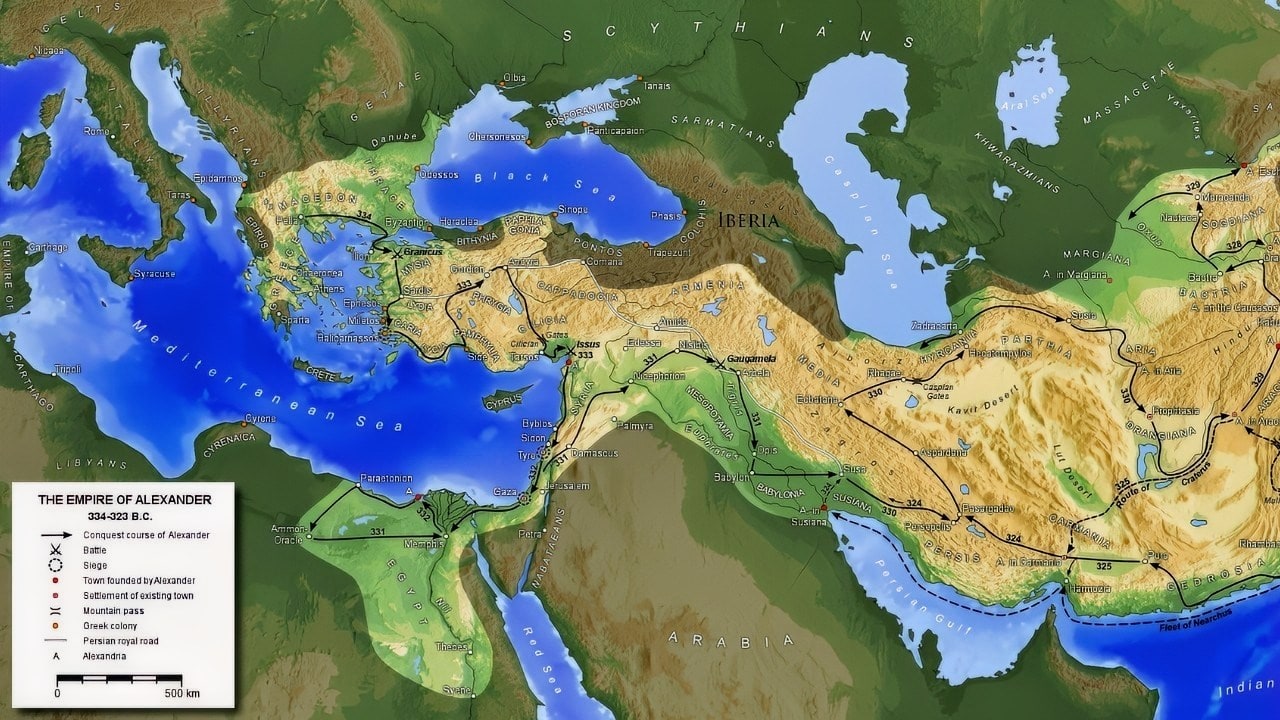
Alexander the Great Empire. Image Credit: Creative Commons.
Regardless of any supposed ancient royal scandals, Alexander was proclaimed on the spot by the nobles and the army alike as his father’s successor to the throne of Macedon at the age of 20, thus setting the stage for him to embark upon his path of conquest and thus immortalize himself as Alexander the Great.
The young, newly crowned Macedonian king’s first order of business. Reaffirm, solidify, and maintain the loyalty of the Greek city-states, lest any of them try to take advantage of any perceived power vacuum left by his father’s violent death.
Accordingly, Alexander embarked upon a bloody internal purge (though not on the scale of Joseph Stalin’s purges in the Soviet Union 22 centuries later).
The victims of his purge included the following:
-His cousin, the former Amyntas IV
-Two Macedonian princes from the region of Lyncestis who had been conspirators in his father’s assassination
-Attalus, commander of the advance guard of the army in Asia Minor and uncle of Cleopatra Eurydice (the last of Philip II’s wives; not to be confused with the Egyptian queen immortalized in cinema by Liz Taylor)
Alexander the Great Internal Conquest: Thebes Reprise and Reprisal
Having taken care of that bloody bit of business, Alexander marched southward into Corinth, whereupon the Greek city-states (except ever-recalcitrant Sparta) swore allegiance to him, and took the title of Hegemon (“leader;” in modern-day international relations scholarship, the word “hegemon” is generally applied more towards nation-states as opposed to individual human beings).
However, Thebes, apparently not having thoroughly learned the painful lessons inflicted by then-prince Alexander in 338 BC, chose to revolt in 335 BC.
Alexander was not going to let the Thebans off easy.
As noted by Hayden Chakra in a July 29, 2025 article for About History: “The battle and destruction of Thebes in 335 BC by Alexander the Great, destroyed the strongest city-state in Greece at that time and allowed him to control all of Greece. Thebes was, if not geographically, then strategically in the center of Greece…In this battle, 6,000 Thebans were killed, and 30,000 were captured. The fierce resistance of the Thebans on the day of the assault is evidenced by the number of dead Macedonians: 500.”
With his grip on power within Greece finally solidified, Alexander could now concentrate on conquering the Persian Empire and thus earning “The Great” sobriquet. The rest is history.
About the Author: Christian D. Orr, Defense Expert
Christian D. Orr is a Senior Defense Editor. He is a former Air Force Security Forces officer, Federal law enforcement officer, and private military contractor (with assignments worked in Iraq, the United Arab Emirates, Kosovo, Japan, Germany, and the Pentagon). Chris holds a B.A. in International Relations from the University of Southern California (USC) and an M.A. in Intelligence Studies (concentration in Terrorism Studies) from American Military University (AMU). He is also the author of the newly published book “Five Decades of a Fabulous Firearm: Celebrating the 50th Anniversary of the Beretta 92 Pistol Series.”