
Key Points and Summary – Even if Iran’s current protests intensify, a clean democratic transition is unlikely. Like Syria’s early uprisings, hope can outrun political reality—especially when a regime retains a loyal core, commands vast patronage networks, and fears retribution.
-The most destabilizing scenario is not reform but succession collapse: rival clerical factions, competing security units, and opportunists scrambling for institutions, media outlets, arms depots, oil revenue, and provincial control.
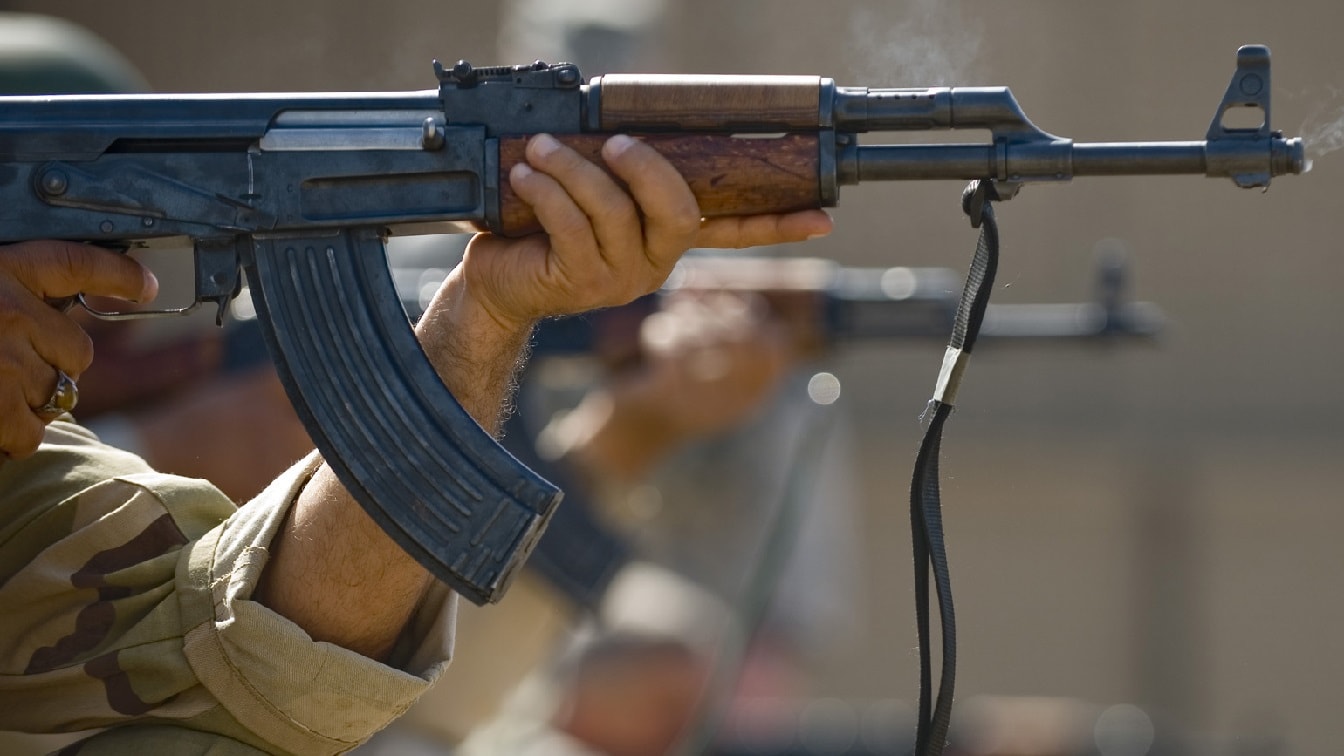
Iraqi airmen fire AK-47s during firing drills March 29, 2011. Members of the 447th Expeditionary Security Forces Squadron trained Iraqi security forces airmen ensuring weapons qualification and teaching defensive tactics, vehicle searches and other force protection measures. (U.S. Air Force photo/Staff Sgt. Levi Riendeau)
-With no unified opposition leader and a fragmented diaspora, outside actors could amplify separatism and proxy dynamics.
-The result could be nationwide conflict without clear safe zones.
Why Iran Won’t Be Syria—and Why That May Be Worse
The Syrian civil war began on March 15, 2011, when Syrian security forces kidnapped and tortured young teens in the southern town of Deraa who allegedly defaced images of Syrian President Bashar al-Assad. Outraged Syrians poured into the streets in protests that quickly spread across the country.
By the time Assad fled into exile in 2024, the civil war he helped spark had killed more than 600,000 Syrians and created more than 6 million refugees.
Beyond losing the presidency, Assad suffered no personal consequences. He reportedly spends his days playing video games in a luxury penthouse in Moscow.
The optimism that surrounds widespread protests in Iran today mirrors that which surrounded the demonstrations before the outbreak of the Syrian Civil War.
Now as then, democracy is likely not around the corner.
Illegitimate Regimes Do Not Always Fall
While the Islamic Republic long ago lost the support of Iranian nationalists and liberals, a core 20–25 percent of the population remained fiercely loyal to Supreme Leader Ali Khamenei and his regime.
Surveys matter in Iran. Iranians like to talk and often opine, especially on more technical topics. When interviewers take every telephone exchange in Tehran, randomize the last four digits, and ask households about their economic concerns and experiences, they find widespread consensus that life has grown more difficult, and most Iranians believe their children will experience a lower standard of living than they did.
According to a commissioned Tarrance Group poll from more than a decade ago, 10 percent of Iranians identified with Khamenei’s hardline vision; another 15 percent thought the Islamic Revolution was a good thing but needed reform. The final 75 percent of Iranians had given up on the system.
Most of these respondents were apathetic rather than revolutionary. After all, when many Iranians endorsed the 1979 revolution, they ended up not only with a dictatorship, but also with a war that killed almost 1 million people.
But even governments that lose legitimacy may continue as zombie regimes. Before the 1994 Agreed Framework, the Clinton administration figured that North Korea would collapse much as every other Communist state had.
Three decades later, it remains as dangerous as ever.
Cleric versus Cleric in Iran
For many within the regime, the stakes could not be higher.
The last leadership transition in Iran occurred in June 1989 when Khamenei succeeded Ayatollah Ruhollah Khomeini. At the time, Iranian powerbrokers saw Khamenei as malleable and weak, a valid compromise candidate who would not threaten any political faction.
Over the past 36 years, however, Khamenei has consolidated control, often imprisoning, torturing, or murdering rivals. Many Iranians—and regional intelligence services—believe the May 2024 helicopter crash that killed President Ebrahim Raisi, an aspirant to the supreme leadership, was no accident.
With both the Office of the Supreme Leader and the Islamic Revolutionary Guard Corps amassing fortunes of $100 billion or more, sitting members of these bureaucracies are not going to forfeit their positions readily. Leaders know that just as they benefited from the imprisonment and murder of rivals, successors could consolidate control at the expense of their predecessors’ freedom or lives.
At the same time, aspirants for power might view Khamenei’s fall as an opportunity to win the lottery. Capture of a $100 billion real estate empire can lead numerous claimants to take their shot at power, perhaps believing they will be no worse off if they fail—especially if they can escape to the periphery of the country or abroad.
General vs General
The Islamic Revolutionary Guard Corps, meanwhile, is not homogeneous.
While many Iranians facing conscription into the army join the Corps for its comparative benefits, many others join its feeder organizations as young as eight years old and become true believers in its ideology. These ideologues are less likely to abandon their beliefs just because they become inconvenient; indeed, if they believe that martyrdom brings rewards, they may choose to fight to the death.
Compounding the situation is the opposition’s state. The protests today reflect spontaneous outrage, but they have no clear leader. This itself is not without precedent. The 1905-1909 Constitutional Revolution also lacked a single charismatic leader and ushered in the truest period of parliamentary democracy Iran has ever experienced.
That said, the same period was replete with violence, culminating in an attempt at counter-revolution, and then ushered in a period of chaos and dissolution of state control that only ended in 1925 when Reza Khan, a Persian Cossack brigade leader and the grandfather of the current crown prince, seized the reins of power and anointed himself shah.
If Khamenei falls, Iranians will face several challenges. In a worst-case situation, a power vacuum would materialize with no consensus figure to fill it. The Revolutionary Guards or Iranian Army might declare martial law; indeed, they might shed a few tears at the collapse of the clerical regime.
But it is unlikely that either the Guard Corps or the Iranian Army is unified enough to appoint an influential leader. Instead, multiple military units might contest leadership and perhaps even skirmish in the streets of Tehran. Different military units could assert control over other provinces, not as separatist forces but rather as contenders seeking the ultimate prize.
The Failure of Diaspora Politics
Compounding this problem would be the failures of diaspora groups. The Mohajedin-e Khalq has its share of problems, to put it kindly. Reza Pahlavi, while popular in Iran, has faltered because of his indecisiveness, the weakness of his own organization, and the thin skin of aides who punish dissent rather than build bridges. Pahlavi and his supporters mirror the mistakes of the White Russians, who enjoyed too much the comforts of exile, and Jordanian Crown Prince Hassan, who was too fearful to commit to Iraq, rather than show strength of purpose. In recent weeks, the inability of monarchists to rise above their own politics and advocate for Narges Mohammadi, a Nobel laureate arrested in Iran, was an opportunity lost.
Foreign Interference
Iran’s neighbors would not allow it to sort its own affairs in isolation.
Whenever Iran entered periods of civil war or state collapse, security forces concentrated on the capital and allowed the periphery greater autonomy.
History will repeat. Azerbaijan will encourage ethnic separatism among Iran’s Azerbaijani population. Kurds are organized, but Turkey might intervene to prevent any Kurdish empowerment or the establishment of a federal entity. Saudi Arabia has previously supported Baluch groups and may do so again, if only to assert their own power against a rival and have a useful future wedge against Pakistan. Israel, too, may pick favorites. Saddam Hussein did not create Iraqi revanchism toward Khuzestan, and his death did not make it disappear. Iran could very easily become the object of a proxy war reminiscent of British and Russian moves in the 19th and first decade of the 20th centuries—only with more actors.
While the Syrian Civil War was bad, different groups enjoyed ethnic or sectarian safe havens that provided some relief and predictability. Bashar al-Assad and his supporters could retreat to the Alawite-dominated Latakia province, while Hay’at Tahrir al-Sham enjoyed Turkish support in Idlib, and Kurds dominated the northeast. An Iranian conflict would have no such ethnic or sectarian logic. The current regime is multi-ethnic; Khamenei himself is Azerbaijani. The Islamic State represents a majority rule, unlike Assad’s minority rule. As a result, there is no notion of a regional safe zone. Should fighting erupt, it will be nationwide.
The Scramble for Control and an Iran Civil War
If civil war erupts, there will be several obvious targets: Khamenei’s Beit-e Rahbat in central Tehran and the parliament. Seizing the Islamic Republic of Iran Broadcasting will be a major goal for every competing faction. Various politicians and military groups will replay the battle for Tehran in every single province, seeking to raise their own banners and flags over governors’ houses and municipal headquarters. Oil fields and ports will be significant sources of revenue that Khamenei’s opponents will seek to seize for their own power.
Iranian targets go deeper. When the Libyan Civil War erupted, the country’s ample arms caches were among the primary targets for competing forces. No group consolidated control over these weapons, which fed the chaos that followed not only in Libya but also in the Sahel, from Mali to Niger. In 2007, the Islamic Revolutionary Guard Corps reorganized to put a unit in every province. ]
An arms depot accompanies each of these units. What seemed two decades ago as a means of security, protecting the regime against provincial uprisings, now could become a catalyst for civil war as local forces make a mad dash to arm themselves, and each base’s quartermaster general becomes a potential shah-maker.
Proponents of regime change may cheer Khamenei’s fall, but the future for Iran is not bright. Indeed, Iranian history suggests there could be a bloody, perhaps decades-long struggle before Iranians fulfill their democratic aspirations.
About the Author: Dr. Michael Rubin
Michael Rubin is a senior fellow at the American Enterprise Institute and director of policy analysis at the Middle East Forum. The opinions and views expressed are his own. A former Pentagon official, Dr. Rubin has lived in post-revolution Iran, Yemen, and both pre- and postwar Iraq. He also spent time with the Taliban before 9/11. For more than a decade, he taught classes at sea on the Horn of Africa and the Middle East, covering conflicts, culture, and terrorism to deployed US Navy and Marine units. The views expressed are the author’s own.