
Boeing X-32: The Fighter America Didn’t Choose
The Pentagon did not choose the better fighter when it rejected Boeing’s X-32 in favor of Lockheed Martin’s F-35. It chose something else entirely. The X-32 pointed to an Air Force predicated on simplicity and ease of maintenance.

Boeing X-32 Taken by Harry J. Kazianis for 19FortyFive.com
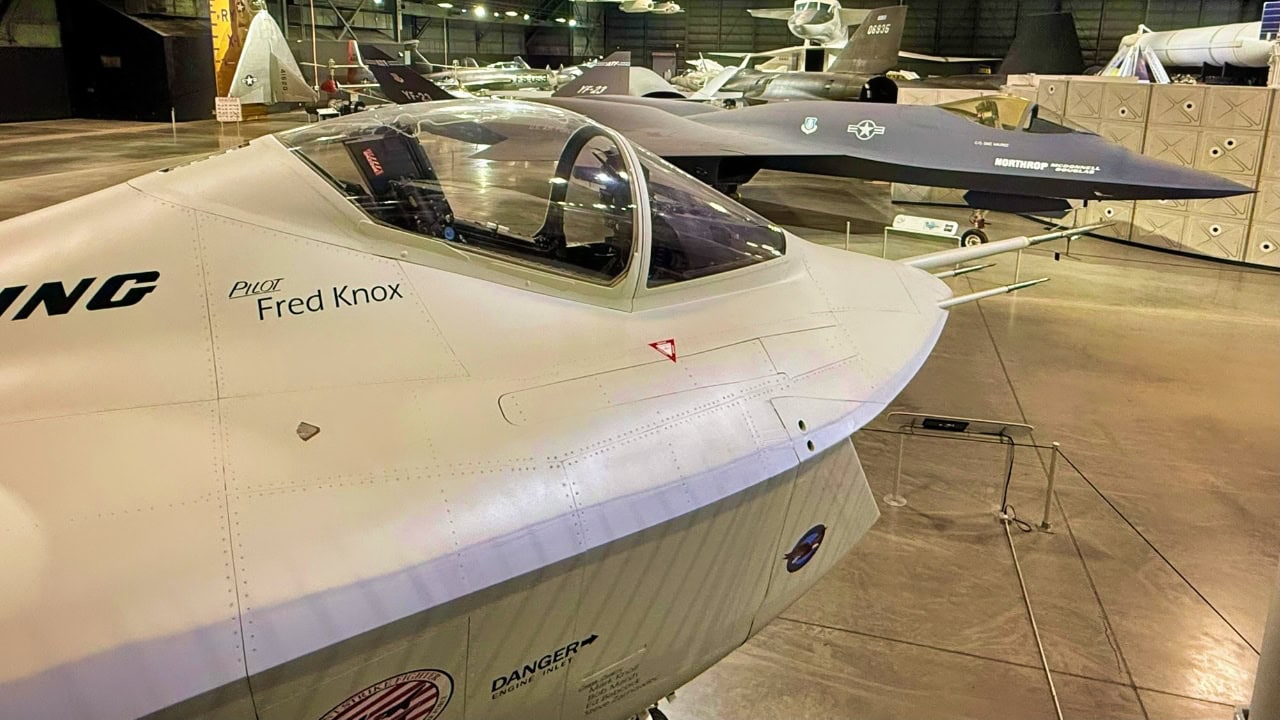
X-32 and YF-23 Together at U.S. Air Force Museum. 19FortyFive.com Image.
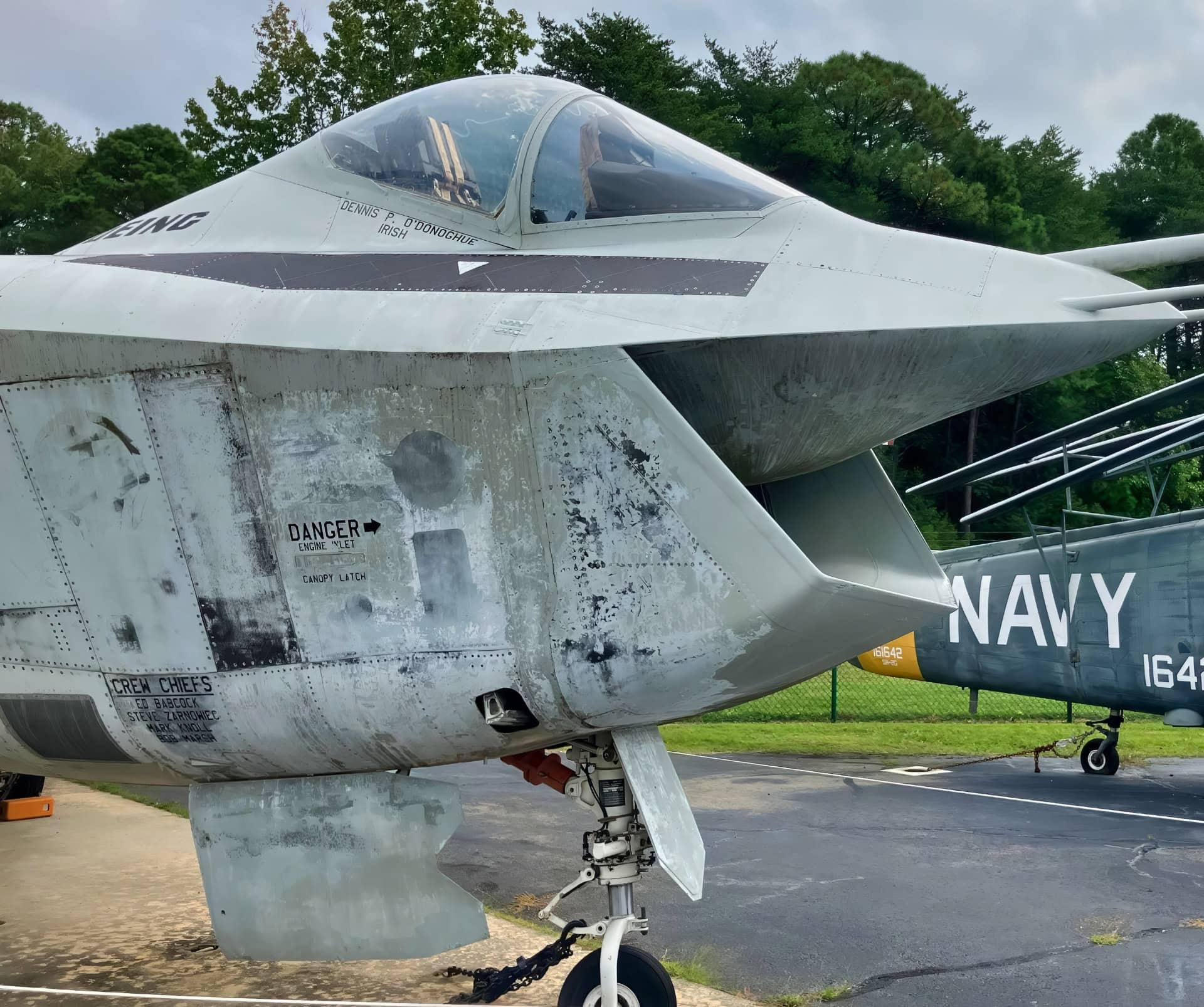
Sideview of Boeing X-32B In Maryland. Image Credit: 19FortyFive.com
The F-35 represented a bet on something else entirely: an American military that put network integration at its center and embraced complexity as the price to pay. That bet changed how America wages war. More importantly, it changed how America thinks about winning in contested environments. It also explains why the Joint Strike Fighter program never really came down to selecting an aircraft. It was about deciding what kind of military America wanted to build.
What the X-32 Was Built to Do
The X-32 reached the final round of the Joint Strike Fighter competition in the late 1990s with a deliberately restrained design philosophy. Boeing emphasized mechanical solutions where they made sense. The airframe relied on materials chosen for durability rather than novelty.
Sustainment planning assumed the continuation of familiar logistics practices rather than wholesale reinvention.
Those choices mattered at the operational level. Maintenance was intended to remain close to the squadron. Diagnostics were designed to be direct. Availability was treated as a design objective rather than an afterthought. The aircraft accepted friction as an unavoidable feature of combat aviation and sought to contain it.
This did not make the X-32 timid. It met demanding performance requirements. It incorporated low-observable shaping. It supported modern sensors. What it did not attempt was to reorganize airpower around information dominance. The aircraft was designed to fight within existing institutional boundaries. That restraint proved fatal.
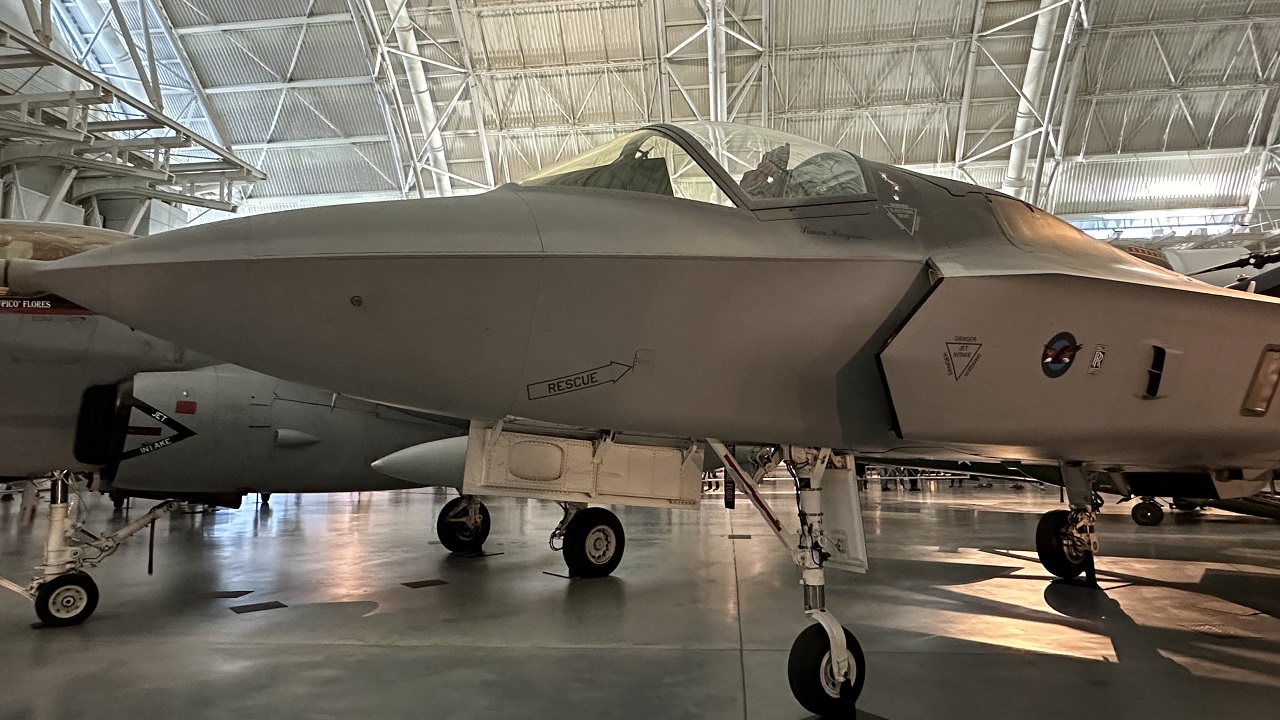
X-35B Joint Strike Fighter. Image taken on October 1, 2022 at National Air and Space Museum.
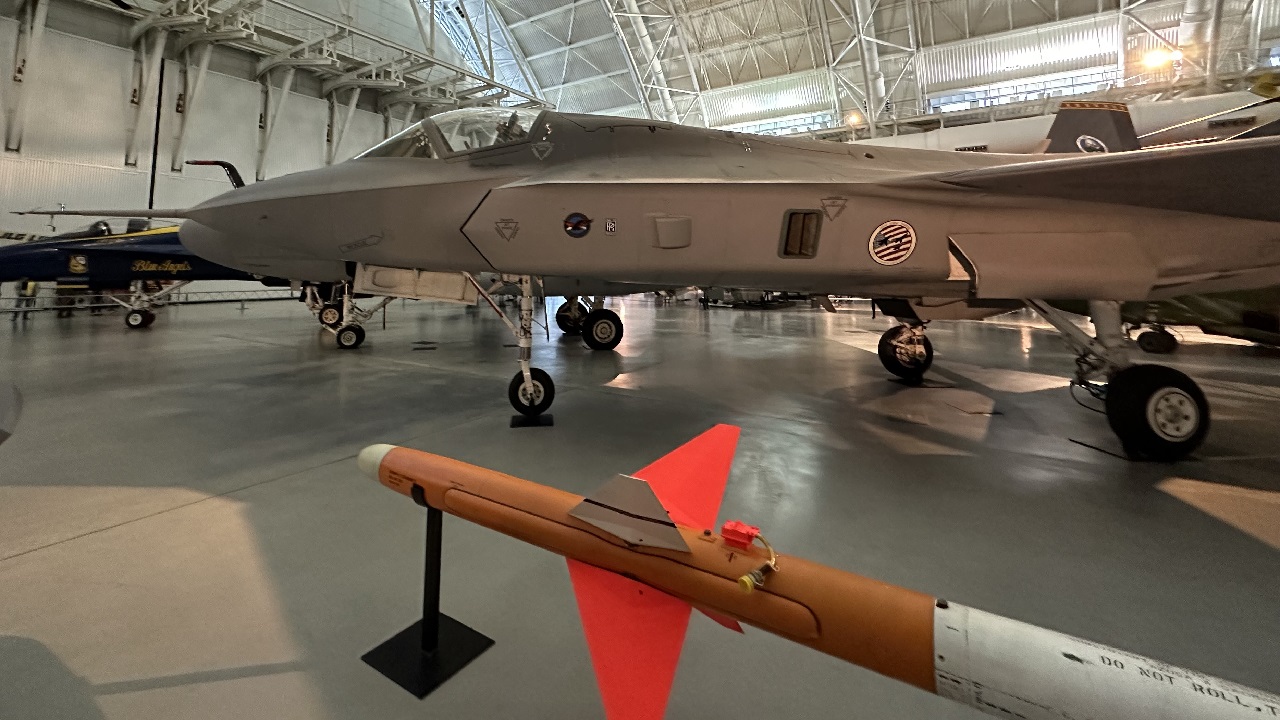
X-35B Joint Strike Fighter. Image taken on October 1, 2022 at National Air and Space Museum.

X-35B Joint Strike Fighter. Image taken on October 1, 2022 at National Air and Space Museum.
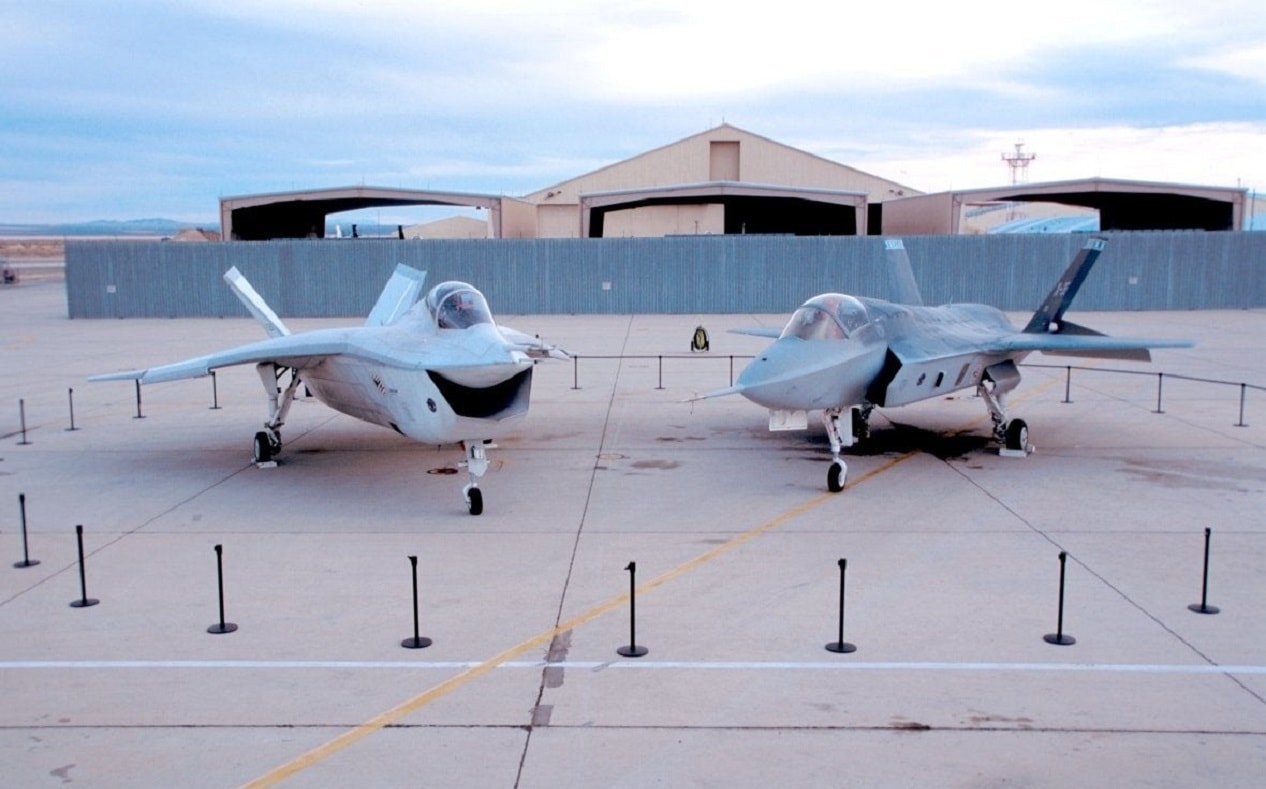
Boeing X-32 vs. Lockheed Martin then X-35. Image Credit: US Government.
The Decision Beneath the Competition
The Joint Strike Fighter outcome cannot be understood solely from test results. By the end of the 1990s, the Pentagon had already committed itself to a broader vision of warfare. Confidence born of the post–Cold War era encouraged the belief that networking and integration could compensate for scale. Information promised to tame uncertainty. Networks appeared capable of reshaping command.
The F-35 fits that ambition. It was conceived as a sensor-rich node whose value lay in what it connected rather than what it replaced. Data fusion became central to its purpose. Connectivity shaped how it would be employed. Sustainment systems were built to serve that vision, even as readiness suffered during the early years.
The X-32 could not anchor this project. Its design did not force institutional change. It would have slipped into existing patterns rather than bending them. In a competition shaped by ambition rather than adequacy, that difference outweighed ease of sustainment.
What Was Gained
The F-35 delivered advantages that no previous fighter offered. Commanders gained a clearer view of contested environments. Coordination across domains accelerated. Early phases of conflict could be shaped with greater precision. These effects were real, and they mattered.
They also carried costs that were visible from the start. Software updates became operational events. Sustainment pipelines grew sensitive to digital health. Availability fluctuated as backend systems matured. These outcomes were not accidents. They followed from the decision to build a system rather than field a stand-alone aircraft.

Boeing X-32 Fighter image taken by 19FortyFive back in July 2025.
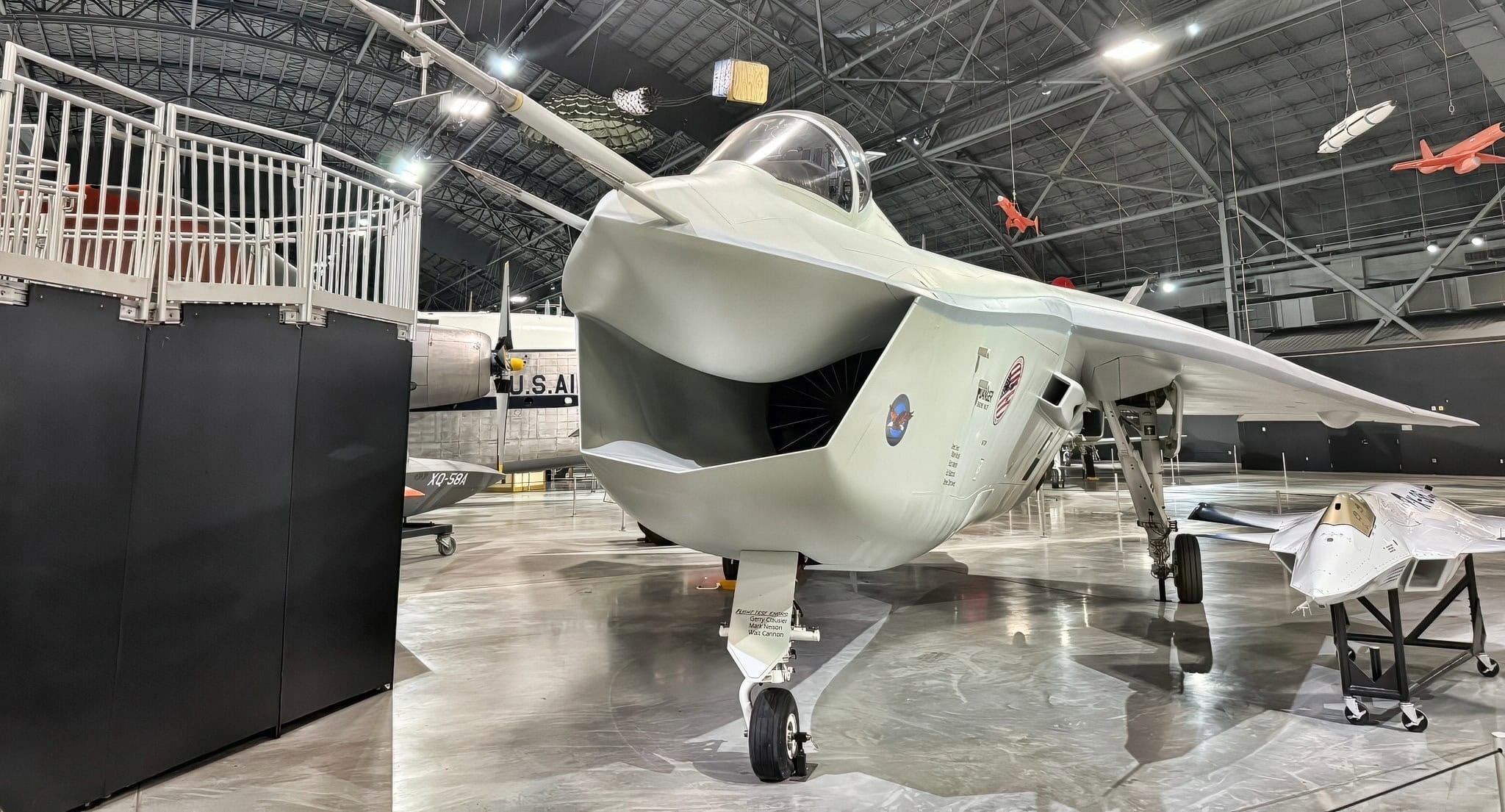
Boeing X-32 Fighter image taken by 19FortyFive back in July 2025.
The Pentagon accepted those burdens because the payoff sat above the tactical level. The F-35 enabled a form of dominance rooted in integration. That dominance did not depend on endurance at the flight line. It depended on the architecture’s coherence surrounding the aircraft.
What an X-32 Force Would Have Implied
A force built around the X-32 would have evolved along a different path. Planning would assume limits on awareness rather than its steady expansion. Operations would rely more heavily on redundancy. Sustainment would tolerate disruption with a lower risk of cascading failures.
Such a force might have adjusted sooner to the demands of long conflict. Units would retain greater autonomy under stress. Maintenance would remain closer to the aircraft. Commanders would expect uncertainty and plan within it.
The trade would appear elsewhere. Early dominance in heavily contested environments would be harder to achieve. The ability to orchestrate effects across domains would be reduced. The United States would give up some control in exchange for greater resilience. That is not a small concession. It reflects the magnitude of the choice the Pentagon made.
The Enterprise That Followed
The most durable effects of the Joint Strike Fighter decision sit above the flight line. Acquisition practices changed. Training pipelines adjusted. Maintenance became inseparable from software management. Industry and government grew tightly coupled around a shared framework.
Allies were drawn into that framework. Interoperability improved while dependence deepened. The aircraft became a gateway into a broader system rather than a discrete capability. This outcome was intentional. The F-35 was designed to reshape the enterprise as much as the force.
The X-32 could not have produced this result. Its design did not require a structural change. It would have preserved familiar arrangements rather than forcing adaptation. From an institutional perspective, that limitation mattered more than operational simplicity.
What the Counterfactual Clarifies
The X-32 didn’t lose because it couldn’t do the job. It lost because it pointed toward a future the Pentagon had already decided not to pursue. A more reliable aircraft was available, but the institution chose reach. It turned away from simplicity and committed itself to an architecture built for superiority in contested environments.
Had the decision gone the other way, the United States might now operate a fighter fleet that is easier to sustain under pressure. It would also lack the system-level dominance that defines American airpower today. That outcome would reflect a different vision of war rather than a procurement failure.
The lesson of the X-32 lies beyond the aircraft itself. The program was never really about a fighter. It was about committing to a system that would define how the United States fights.
About the Author: Dr. Andrew Latham
Andrew Latham is a non-resident fellow at Defense Priorities and a professor of international relations and political theory at Macalester College in Saint Paul, MN. You can follow him on X: @aakatham.


Richard Parker
January 22, 2026 at 3:01 pm
Your whole article is premised on non-factuals. The ‘connectivity’ concept had nothing at all to do with which airframe would’ve been chosen. There were literally no requirements at all assigned to the JSF program. This is a fact stated by the man who tested both airframes. The whole point of JSF was to provide an airframe that could satisfy the needs of 3 services. Full stop.
If the X-32 had been chosen, it would’ve been packed with all the gubbins the F-35 was eventually packed with, and the maintenance concept would’ve been exactly the same. Those things aren’t chosen by the manufacturer. They were chosen by the USAF.
The X-32 lost because Boeing was overly cautious in their testing, changed their design in mid-stream from tailless delta to tailed-delta, and failed the critical STOVL operations test. They couldn’t take off and land vertically in hot/high conditions, while the X-35 could.