Boeing’s X-32 vs. X-35 (Or F-35): The STOVL Problem That Sank the JSF Bid
The F-35, the winner of the Joint Strike Fighter competition, holds the unique distinction of being the most expensive and most-produced stealth fighter in history. Built primarily by Lockheed Martin, the jet beat out Boeing’s entrant to the JSF competition, the X-32. The reasons why the X-32 lost to the X-35 are complex and numerous, but stem largely from both operational issues and technical compromises — reasons that are, retrospectively, clear, but at the time were far from obvious.
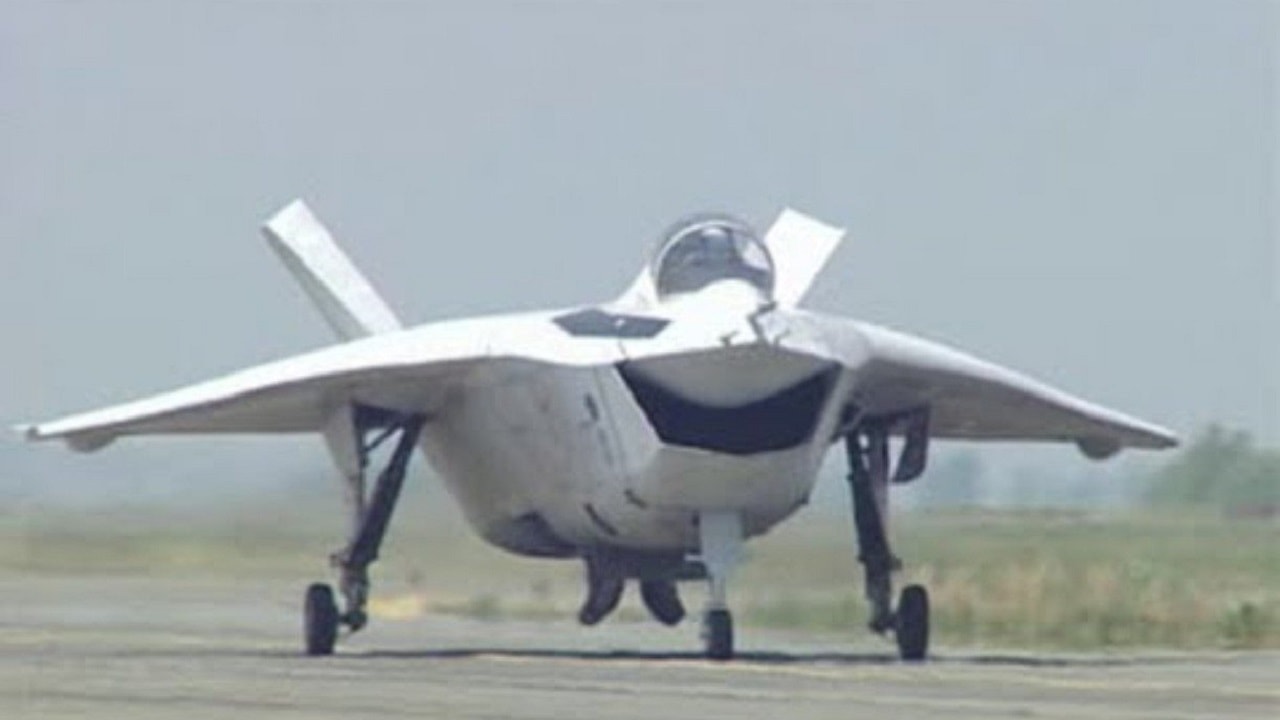
Boeing X-32 stealth fighter. Image Credit: Creative Commons.
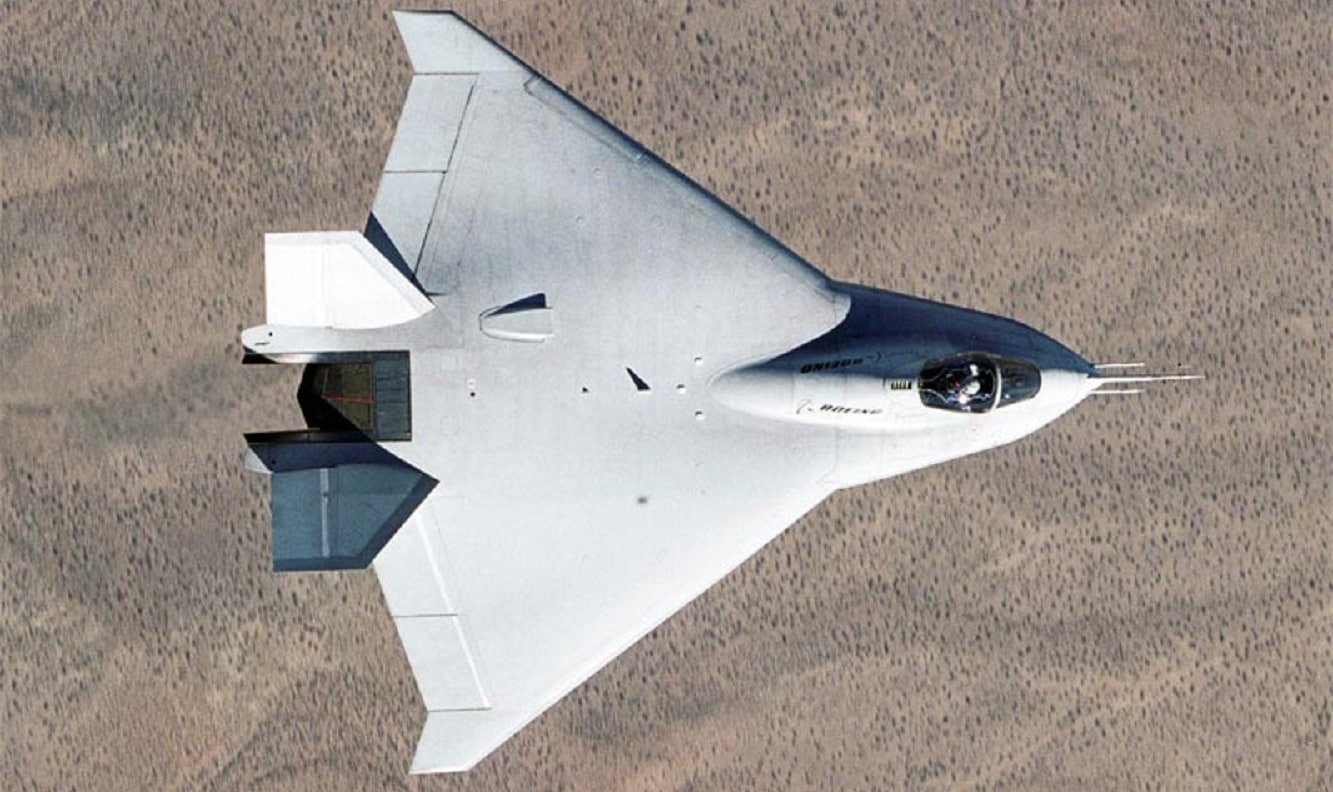
Boeing X-32. Image Credit: Creative Commons.
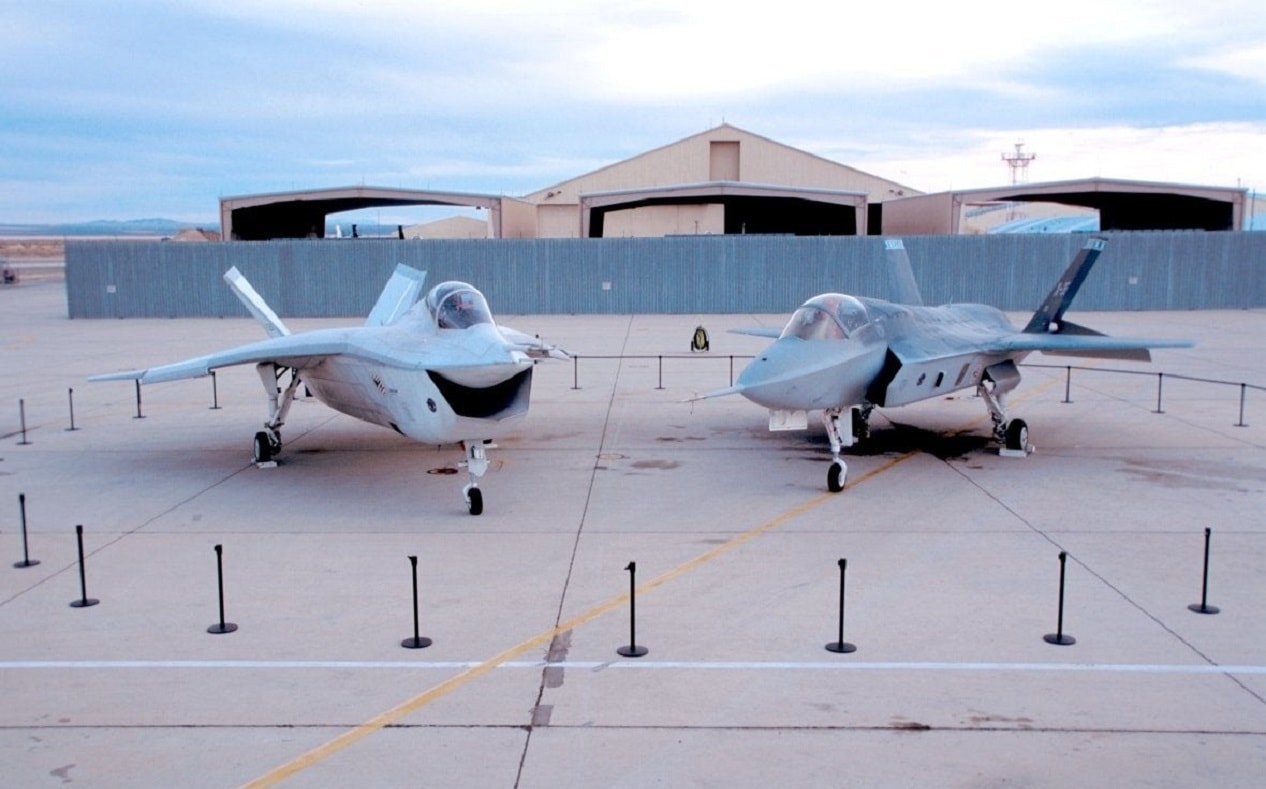
Boeing X-32 vs. Lockheed Martin then X-35. Image Credit: US Government.
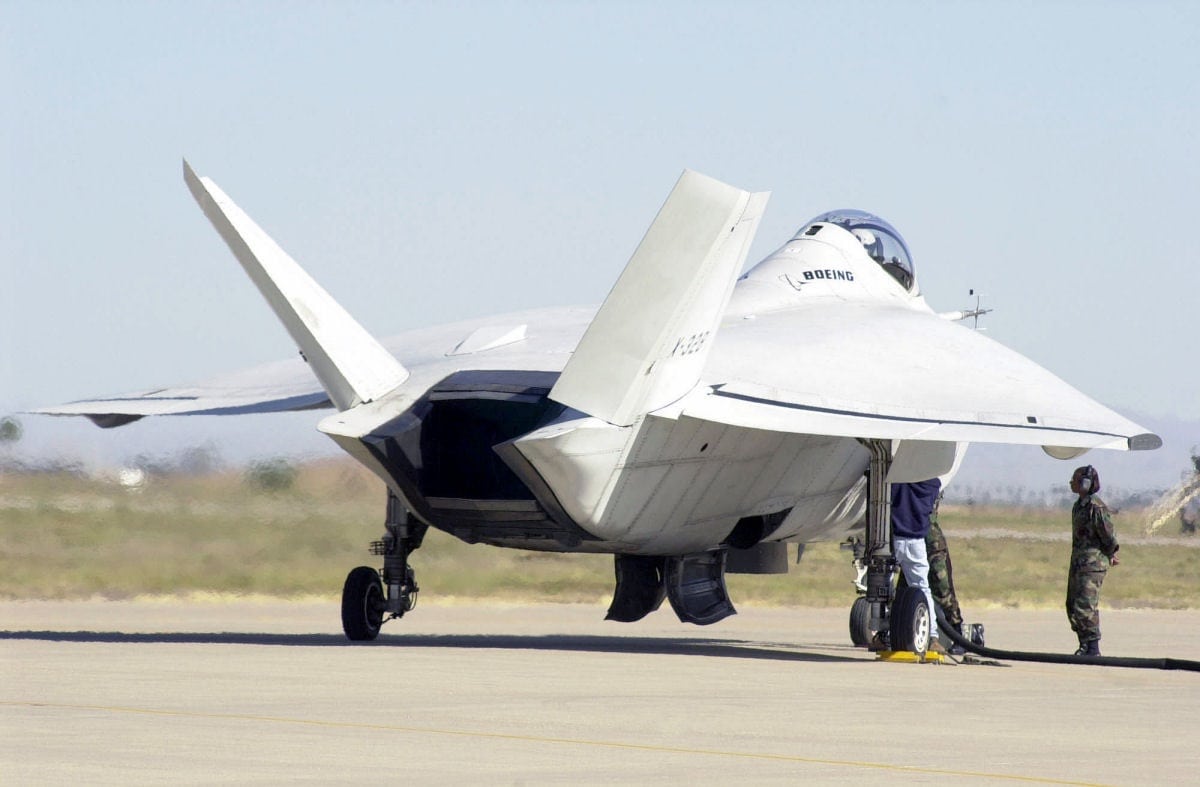
The Boeing Joint Strike Fighter (JSF) X-32B fills-up at a “hot pit” refueling station at Luke AFB during a cross-country trip. The X-32B is making a trip across the United States, making other stops along the way.
Tight Cooperation and Fair Compromises
One of the primary drivers of the Joint Strike Fighter competition, besides fielding a capable stealth fighter, was keeping costs to a minimum.
Rather than building three pristine, cutting-edge fighters for the three service branches, the JSF competition sought to build either a single fighter or a family of three very closely related fighters to meet the different operational needs of the branches.
Digital testing and modeling, though now a common practice, was forecast to save significant amounts of cash before either of the X-planes were built, a major source of cost savings.
“The last few years have been spent in perhaps the most intense process of requirements definition and risk reduction yet seen in aircraft development,” one report from the era explained. “There have been thousands of hours of simulated combat to determine the optimum mix of stealth, speed, range, and weapons. New manufacturing processes have been invented. Specifications–which often lead to unnecessary weight and cost–have been all but abolished. Commercial practices have been substituted for the old, lumbering style of federal procurement. “Streamlining” has taken on a whole new meaning, and the process isn’t over yet.”
Tight cooperation between the service branches and reaching compromises on what the JSF should be and what it should do was imperative. “There has been unprecedented cooperation among the armed services. Since commonality is the No. 1 cost-cutter on the JSF, each service has had to refrain from demanding capabilities in the airplane that can’t be reconciled with those of the other branches, lest the price get out of hand or one of the partners break ranks. So well has the interlocking Air Force and Navy management of the program worked so far that its director, Maj. Gen. Leslie F. Kenne, reports that other programs have come calling to watch and learn “how you do a good joint acquisition.”’
Positive Outlook
Going into the new millennium, Boeing seemed upbeat about the prospects for the Joint Strike Fighter competition.
“For the Boeing Joint Strike Fighter team, 2000 was a year of unprecedented accomplishments culminating in a record-setting supersonic flight, Boeing wrote. “Frank Statkus, Boeing vice president and JSF program general manager, called 2000 “a year that will go down in aviation history books as one of the most significant because of what our JSF team has done.” Hopes were seemingly flying high for Boeing’s entrant into the Joint Strike Fighter competition.
The X-32’s maiden flight was, according to Boeing JSF chief test pilot Fred Knox, overwhelmingly positive.
Knocked heaped praise on the jet’s “outstanding flying qualities” despite a somewhat curtailed first flight. During the evaluation, the F/A-18 Hornet chase aircraft needed “a lot of afterburner” to keep pace with the X-32 jet during its first climb. Knox explained to Flight Global that the jet’s general handling was “very similar to the Hornet, because we designed it that way.”
Differing Design and Development Approaches
Boeing’s approach to the Joint Strike Fighter Competition was fundamentally different than that of Lockheed’s: instead of building three closely-related but distinct fighters for the U.S. Air Force, Navy, and Marine Corps, Boeing instead hoped to keep production costs to a minimum by building just a single fighter that could cater to the needs of all three branches.
And while that was notionally a sound strategy, in practice it proved to be a tall order for a single platform to fill, forcing design compromises that the three aircraft that would ultimately form the F-35 family did not have to make.
The X-32 sported a delta-wing design, and a large, single-engine inlet fed the jet’s engine, which aided carrier operations. But the trade-off was curtailed maneuverability and poorer performance compared to the X-35.
Boeing built the jet in two variants, the X-32A and X-32B, but both relied on a single fuselage and wing design, one of the program’s more limiting factors. In contrast, what would become the F-35 is today built with three slightly different wing sizes and fuselage shapes, each optimized for its respective branch.
The X-35 simply looked more like what a conventional stealth fighter was imagined to be — but it also demonstrated a viable short take-off and landing (STOVL) capability, something that Boeing’s X-32 could not.
Ultimately Unsuccessful
Ultimately, one of the most significant factors that doomed Boeing’s bid was that its Joint Strike Fighter entrantcould not demonstrate mature STOVL capability, a clear JSF program requirement for the U.S. Marine Corps. Lockheed Martin’s X-32, on the other hand, had more future growth potential and was viewed as a more reliable design.
The X-32’s airframe was not representative of a production aircraft, with flight geometry that was not production-representative.
This raised questions about the X-32’s ability to conduct low-speed landings as well as how it would perform on aircraft carriers.
Ultimately, the X-35 proved that it has much more room for future growth and upgrades as newer technologies became available.
The Pentagon realized that incorporating upgrades into the X-35 would be more feasible in the coming decades. Overall, the X-35 had far fewer unknowns, was less risky, performed better earlier in the JSF program, and was clearly more scalable.
About the Author: Caleb Larson
Caleb Larson is an American multiformat journalist based in Berlin, Germany. His work covers the intersection of conflict and society, focusing on American foreign policy and European security. He has reported from Germany, Russia, and the United States. Most recently, he covered the war in Ukraine, reporting extensively on the war’s shifting battle lines from Donbas and writing on the war’s civilian and humanitarian toll. Previously, he worked as a Defense Reporter for POLITICO Europe. You can follow his latest work on X.