
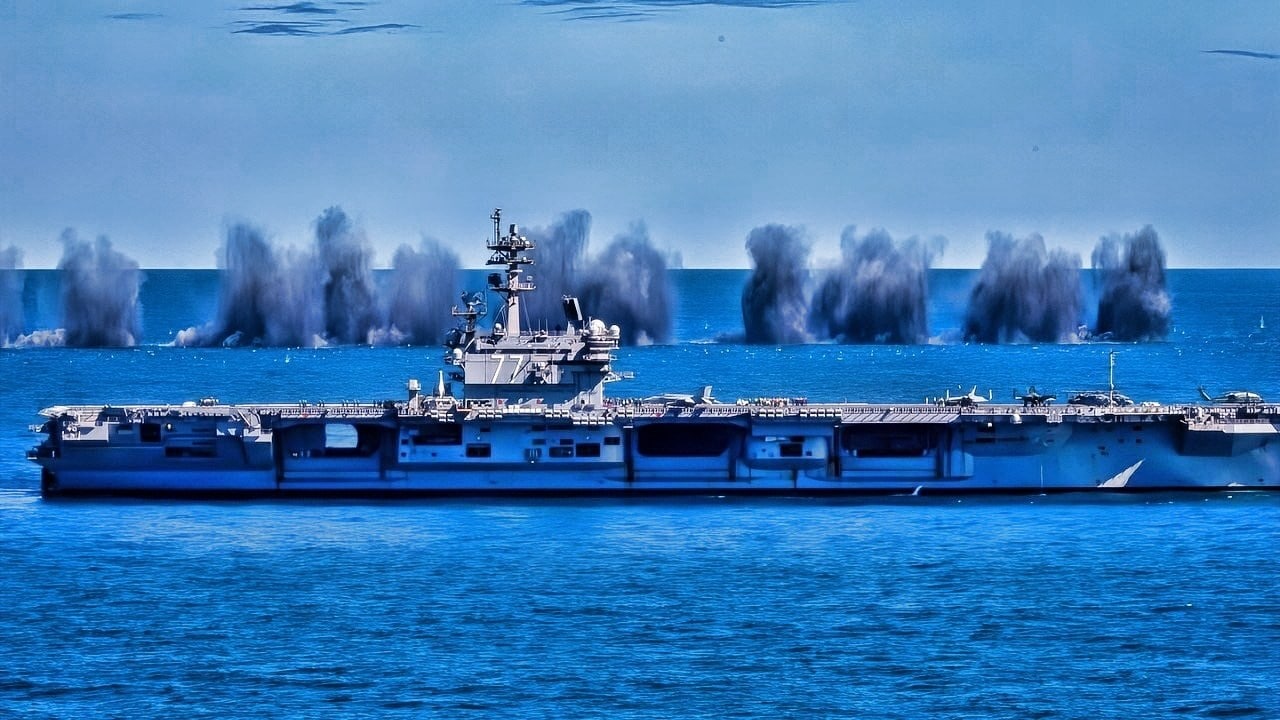
15 Hypersonic Missiles, 10 Supercarriers, 20 Minutes: Is The U.S. Navy In Trouble?
U.S. Secretary of Defense Pete Hegseth has raised questions about the survivability of the U.S. Navy’s supercarrier fleet in a potential conflict with China.
Quote: “If 15 hypersonic missiles can take out our 10 aircraft carriers in the first 20 minutes of a conflict, what does that look like?” Hegseth recently asked.
He continued, explaining that China was designing and fielding hypersonic missiles “specifically dedicated to defeating the United States of America.”
Is this alarmism? Or is it a realistic worst-case scenario?
Hypersonic era
Hypersonic missiles are capable of achieving speeds above Mach 5 with maneuvering glide vehicles that complicate interception.
China is developing multiple hypersonic options. The DF-17 is a medium-range missile with a ballistic booster and hypersonic glide vehicle. It is designed to hit bases and fleets in the western Pacific. The DF-27 is a longer-range option with the ability to carry land-attack, conventional anti-ship, or nuclear payloads. China also has some non-glide (but still very fast) options, such as the DF-21D “carrier killer” and the DF-26.
These missiles are the sentries of China’s anti-access/area denial (A2/AD) bubble, within which big surface vessels, especially supercarriers, can be prohibited, in theory, from operating.
Supercarrier vulnerability
Are supercarriers vulnerable to hypersonic missiles?
Carriers are large, at about 1,000 feet long.
They are also slow, relative to missiles, and they are one of the highest-value assets in the history of warmaking. Were U.S. carriers to operate within the ranges of launchers on the Chinese mainland, they might face large salvos of ballistic, cruise, and hypersonic missiles.
But “20 minutes and they’re all dead?” That’s unlikely.
The carriers would not be parked neatly in a row—they would be dispersed across wide swathes of ocean, where each would be very difficult to find.
And the carriers would not be defenseless. The U.S. Navy protects them layered defenses, including Aegis destroyers with missile interceptors, electronic warfare platforms, and decoys.
For China to successfully strike a U.S. carrier, its operators would need to detect, identify, and track the vessel; then communicate, update mid-course guidance, and hit a moving ship at sea. This is difficult. Each link in that kill chain can be jammed, spoofed, or broken. And if one link fails, the missile strike fails.
Is Hegseth correct?
Hegseth’s description lacked nuance and seemed to assume perfect Chinese targeting and execution. It would also require that all U.S. carriers be within range and exposed simultaneously. The truth is that destroying just one carrier would require operational brilliance, with large, coordinated salvos dependent upon sustained Intelligence, Surveillance, and Reconnaissance for detection and guidance.
But Hegseth wasn’t wrong. Carriers are in fact vulnerable, especially when they transit within the first island chain. Hypersonic missiles absolutely make traditional carrier-centric power projection more dangerous. U.S. procurement gaps exacerbate the issue; China is fielding new missiles faster than the U.S. can field counter-systems.
In reality, the loss of just one carrier would be catastrophic; carriers cost several billion dollars a piece, carry several dozen aircraft, and many thousands of sailors. One sinking would shock the consciousness of the entire American public. It would be an event with no post-World War II equivalent.
Why keep building?
Carriers do more for the United States than simply deter or prepare to fight China. They are mobile airfields, effective for worldwide deterrence patrols, crisis response, and presence missions. Most carrier deployments are not into the A2/AD zone, where hypersonic missiles are a viable threat.
For every scenario involving exposure to Chinese defense systems, there are many more lower-intensity missions in which carriers are still a tool without match.
The United States is already modifying its doctrine and tactics to account for hypersonic missile exposure. Specifically, the U.S. plans to operate farther outside of the A2/AD envelope, making missile strikes less likely. Simultaneously, longer-range air wings are being developed, so that carriers can launch their aircraft from farther away.
And the United States is likely going to begin relying more on submarines and land-based air assets from within the A2/AD bubble, while carriers serve as the outer-ring strike and command platforms—distributed nodes in a larger environment.
Unfortunately, every option has vulnerabilities in a conflict with China; there is no clean-cut alternative to carriers.
Mass drones, arsenal ships, land bases—all of these have shortcomings of their own.
In short, Hegseth is correct to raise concerns about China’s growing arsenal of hypersonic missiles.
But the mere presence of a hypersonic arsenal does not automatically render the U.S. carrier fleet moot.
About the Author: Harrison Kass
Harrison Kass is an attorney and journalist covering national security, technology, and politics. Previously, he was a political staffer and candidate, and a US Air Force pilot selectee. He holds a JD from the University of Oregon and a master’s in global journalism and international relations from NYU.