

Is America Falling Behind on Hypersonic Missiles?
In this day and age of renewed Great Power competition against so-called “near-peer” rivals (which some would reasonably argue is tantamount to a de facto new Cold War), much of the talk revolves around hypersonic weapons (particularly missiles), i.e. weapons that travel at speeds above Mach 5 (3,836 mph; 6,174 km/h) or greater than 1 mile per second.
Based on recent reports we’ve come across, the scary question must be asked: Is America falling behind its adversaries on hypersonic weapons?
Bottom Line Up Front (BLUF)
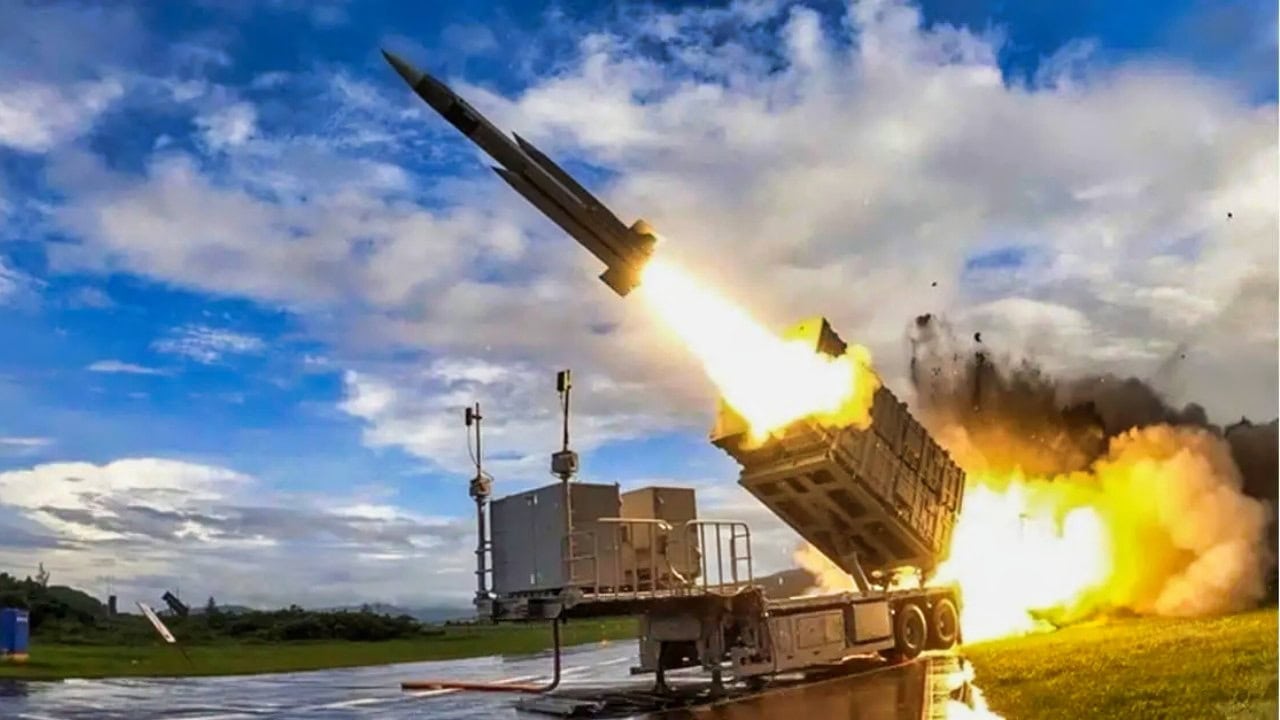
Qingtian Hypersonic Cruise Missile. Screenshot.

Mako Hypersonic Missile. Image Credit: Creative Commons.
One such recent report of particular concern comes to us from via Bloomberg staff writer Anthony Capaccio in a January 17, 2026, article titled “Army Hypersonic Missile Fielding Falters on Missed Deadline.”
To wit: “[W]hile the Army as recently as last month told Bloomberg News that it planned to field the weapon by the end of 2025, the Army acknowledged this week that it missed that deadline. ‘Fielding activities include the required integration, safety, and readiness steps to ensure soldiers receive a system that is reliable, sustainable, and effective in operational environments and are on track for completion in early 2026,’ the Army statement said. ‘As the Army moves toward completion of fielding, it remains focused on rigorous testing, training, and system maturity to support successful operational employment.'”
To make matters even more concerning, this isn’t the first time the Army has missed a hypersonics fielding-related deadline; they missed one back on September 30, 2023, and blew past another this past September.
The program has a current price tag of $10.4 billion USD (not to mention the $12 billion the Pentagon has already invested since 2018), with $2.7 billion worth of those taxpayers’ dollars going into the first battery alone, according to the General Accountability Office (GAO).
The basic missile, known as Dark Eagle, is being built by Lockheed Martin (who, of course, is best known for the warplanes from its famed “Skunk Works” division, especially its F-22 Raptor and F-35 Lightning II 5th-Generation stealth fighters).
Signore Capaccio concludes his article on this ominous note: “The Pentagon’s test office told Bloomberg in October it still had ‘not conducted an end-to-end operational assessment’ of the system and that it didn’t have data to evaluate the weapon’s ‘operational effectiveness, lethality, suitability, and survivability.’”
Two Experts’ Opinions
This writer is honored and privileged to have the friendship and professional acquaintanceship of Mr. Riki Ellison (a fellow alumnus of the USC School of International Relations), founder and chairman of the Missile Defense Advocacy Alliance (MDAA). (Fellow old-school football fans will also recognize Riki’s name as a three-time Super Bowl winner with the San Francisco 49ers and one-time college football national championship winner with the USC Trojans).
Here’s what Riki had to say on his LinkedIn page about America’s hypersonic missile situation, in turn citing RADM [USN, Ret.] Mark Montgomery)“The Pentagon warned in its annual report to Congress last year that China already possesses ‘the world’s leading hypersonic arsenal’ and is sprinting to field even more advanced offensive capabilities. These weapons would give Beijing a capability to conduct a prompt strike that paralyzes America’s command-and-control and missile-defense capabilities.”
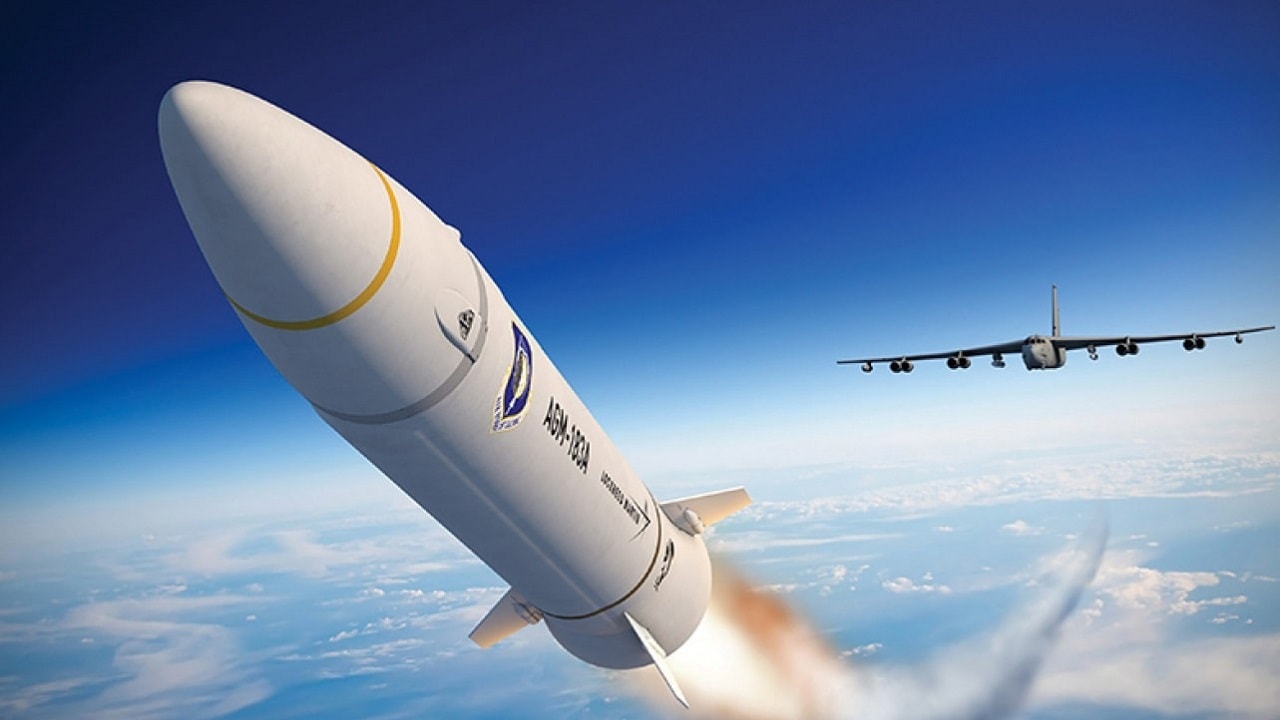
Hypersonic missile artist rendering. Image Credit: Creative Commons.
From there, Messrs. Ellison add, “The good news is that the United States is making progress on its own offensive hypersonic weapons.
The bad news is that American efforts to develop systems that can defend against Chinese hypersonic capabilities are not keeping pace.
If Washington does not act quickly to expedite the Pentagon’s fielding of hypersonic missile defense capabilities, deterrence may fail in the Pacific.”
Two Hopeful Signs: “BUFF” and “BONE”
Thankfully, there are a couple of other tidbits of good news out there.
Though not enough to completely mitigate the concerns over the U.S. Army’s missteps, there are at least some hopeful signs that the U.S. Air Force is making some progress on hypersonic missiles, and ironically, two of its venerable, old-school (as in second half of the 20th century vintage) warbirds are being used as the launching platforms: the B-52 Stratofortress (AKA the “BUFF”) and the B-1B Lancer (AKA the “BONE”) bombers.
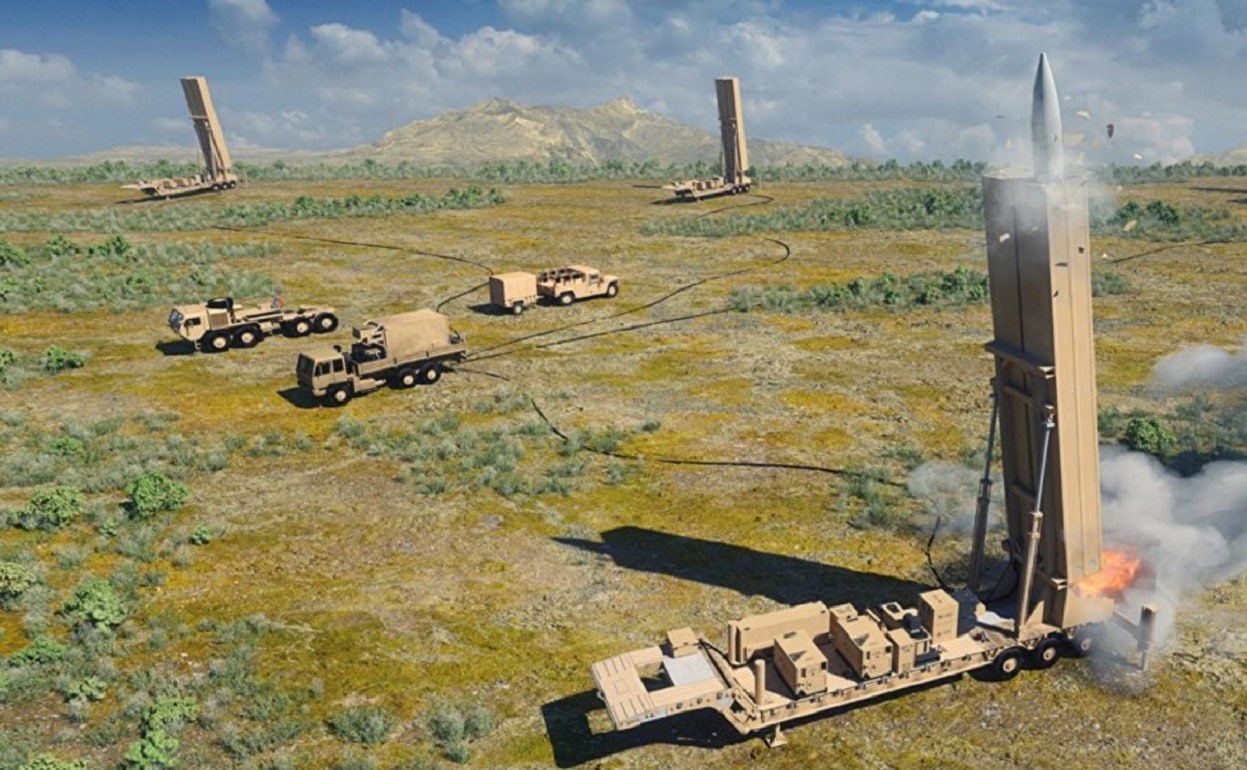
Image: Creative Commons.
-The “BONE” is getting Load Adaptable Modular (LAM) external pylons that reopen six long-dormant hardpoints and add up to a dozen missiles outside—on top of its 24 internal stations; as Jennifer Wong, Senior Director, Bombers Programs at Boeing, elaborated, “The whole point of this is for the B-1 to become the Air Force’s hypersonic testbed. Because of all the modernization efforts on the B-52, we cannot divert resources from what we’re doing today to test hypersonics. So, we will be doing hypersonics testing on the B-1.”
-As for the “BUFF,” back in March 2024, a B-52H carried out the USAF’s first hypersonic missile test in the Western Pacific; the specific missile in question was the AGM-183A Air-launched Rapid Response Weapon (ARRW), which was test-fired over the Reagan test site on Kwajalein Atoll in the Marshall Islands.
About the Author: Christian D. Orr, Defense Expert
Christian D. Orr is a Senior Defense Editor. He is a former Air Force Security Forces officer, Federal law enforcement officer, and private military contractor (with assignments worked in Iraq, the United Arab Emirates, Kosovo, Japan, Germany, and the Pentagon). Chris holds a B.A. in International Relations from the University of Southern California (USC) and an M.A. in Intelligence Studies (concentration in Terrorism Studies) from American Military University (AMU). He is also the author of the newly published book “Five Decades of a Fabulous Firearm: Celebrating the 50th Anniversary of the Beretta 92 Pistol Series.”