
Key Points and Summary – Trump’s BBG(X) “Trump-class” would revive the battleship label with a guided-missile surface combatant, starting with USS Defiant, and potentially add a nuclear-capable cruise-missile option.
-But the concept risks becoming a boutique program—costly, slow, and strategically narrow—rather than a fleet-changing answer to China.
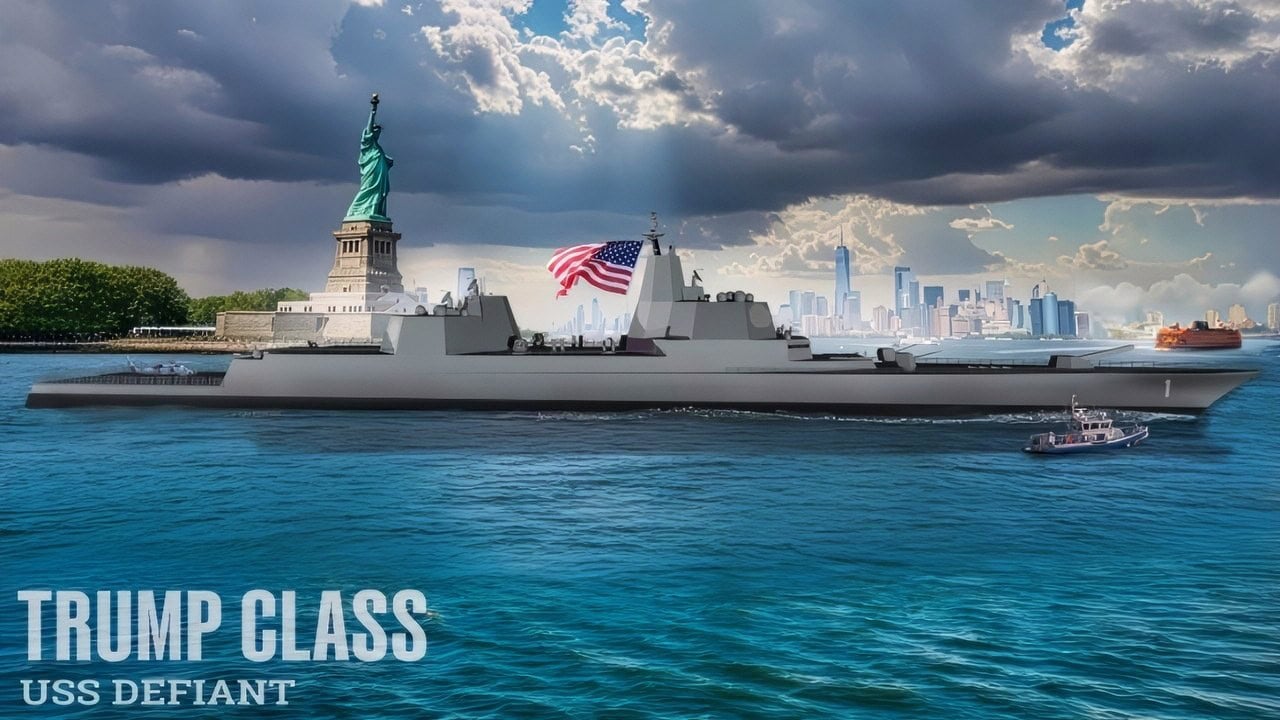
Trump-Class Battleship. Image Credit: Creative Commons/White House.
-The cautionary tale is Russia’s Kirov-class refit, especially Admiral Nakhimov: a huge ship rebuilt for deterrence and power projection, yet plagued by long delays, ballooning costs, and the reality that large, conspicuous surface combatants are hard to protect.
-The core critique is opportunity cost—one showpiece hull can crowd out escorts, logistics ships, and munitions that matter more.
The Trump-Class Battleship BBG(X) Summed Up in 1 Word: Boutique
In a press conference on December 22, U.S. President Donald Trump announced a U.S. Navy guided-missile warship would be classed as a battleship.
The future Trump-class is also known as BBG(X) in some Navy documents and is intended to initially comprise a lead ship, the USS Defiant, and another vessel. The class is envisioned to add a nuclear-capable cruise-missile option to the U.S. Navy surface fleet.
But the project is more of a boutique ship, rather than a true game-changer for the Navy. And if it moves toward procuring the class, the U.S. should pay attention to the ongoing mistake the Russians are making with their Kirov-class battlecruisers.
Why Is Russia Bringing The Kirov Out Of Mothballs?
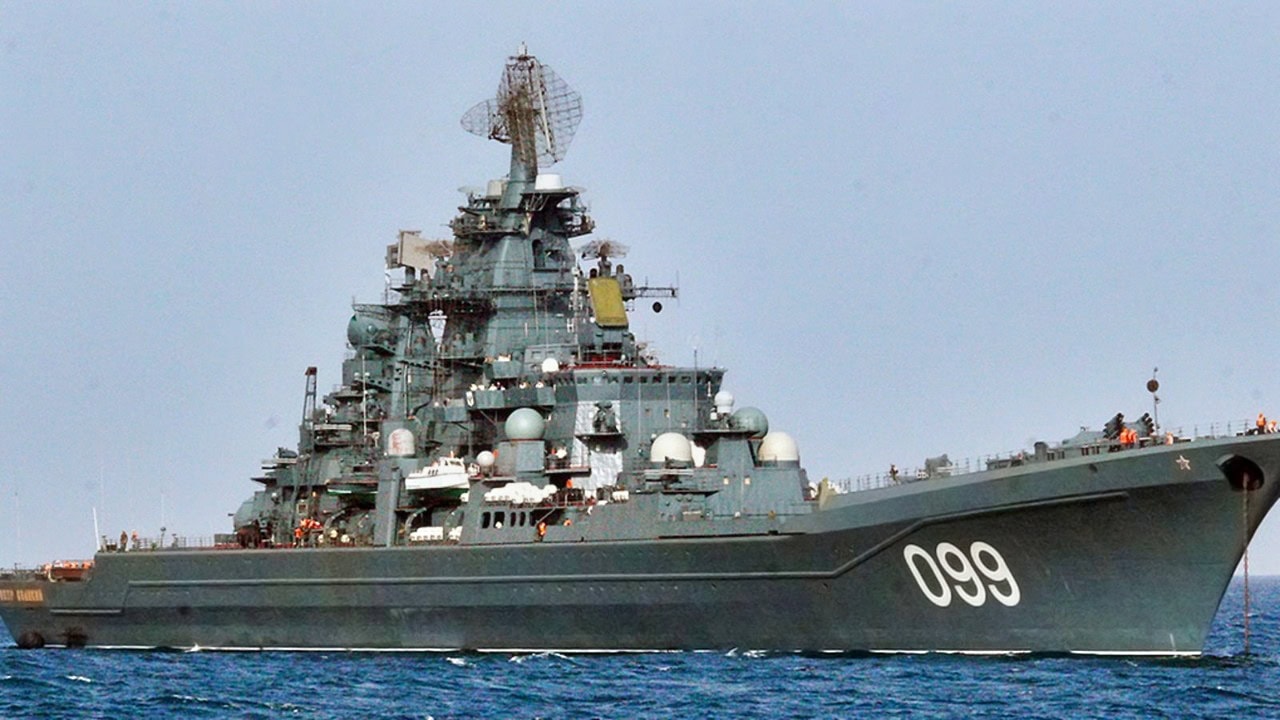
Russia is bringing back the Kirov-class, specifically the Admiral Nakhimov, primarily as a strategic deterrent and power-projection tool.
The Kirov-class was a formidable foe when it first became operational during the late Cold War years. The Russians had proved they could not build carriers to rival the United States, so instead they built the Kirov-class to act as “carrier killers.”
These ships were designed to shadow NATO carrier groups, launch massive salvos of supersonic anti-ship missiles, and stay at sea for months thanks to nuclear power. They were the only surface combatants that could look a U.S. battleship in the eye and not blink.
The U.S. Navy didn’t have anything as big as the Kirov-class ships. There was a gap in large surface warfare ships, and during the Cold War, there was always a lot of talk about “gaps.” (See Dr. Strangelove.)
But the big ships are well past their prime, and while they pack a powerful punch, the 30,000-ton battlecruisers mostly provide an easy target to adversaries on today’s oceans.
Russia’s Trump-Class: Is The Kirov-class Admiral Nakhimov Still A Credible Threat?
The Admiral Nakhimov was built as a threat to U.S. aircraft carriers. Modernized with hypersonic Zircon missiles, it remains a powerful anti-ship platform.
Russia wants the ship for power projection and deterrence. The Kirov-class is a vast, impressive-looking warship powered by nuclear propulsion, which offers unlimited range, and equipped with magazines of long-range missiles. In theory, it allows Russia to project influence in vital areas such as the Arctic and to challenge Western naval dominance.
The Admiral Nakhimov is heavily armed with a mix of Kalibr, Oniks, and Zircon missiles with a new firing system. The Russians claim the Zircon travels at Mach 8.0. That would make it the world’s fastest missile. But as always, a heavy dose of skepticism is required when Russian claims reach sky-high.
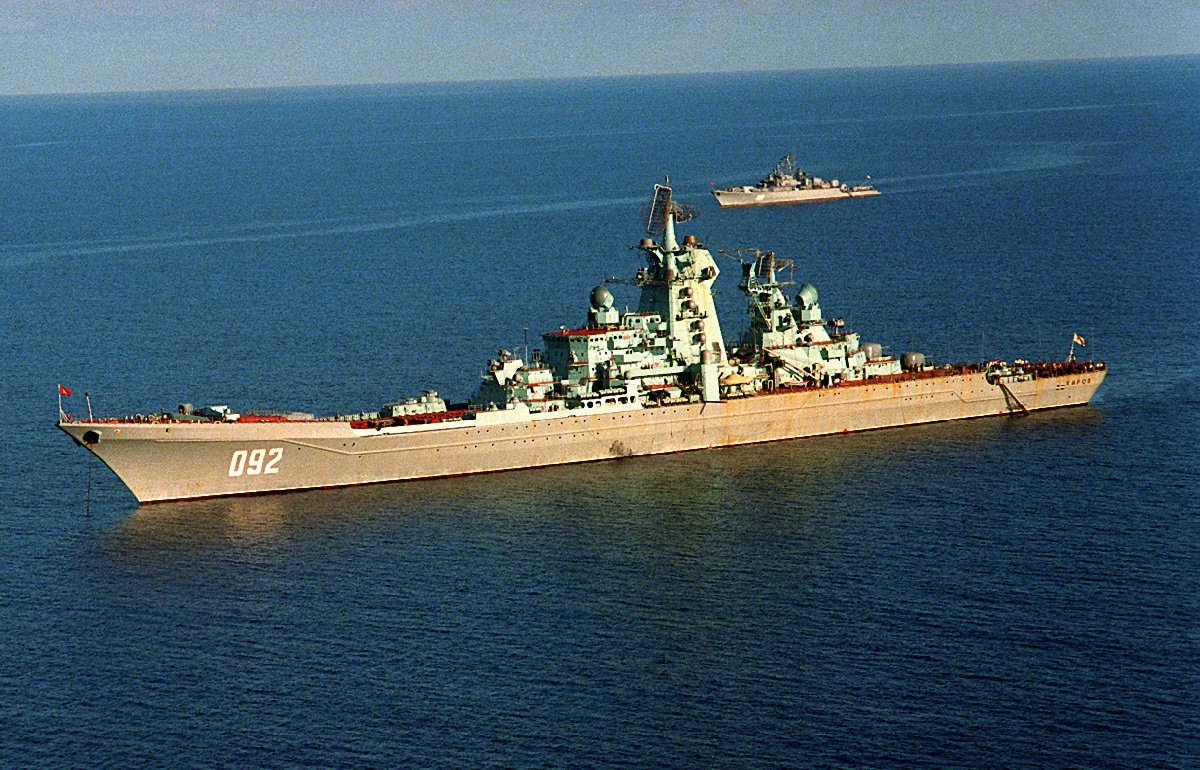
A port view of the Soviet nuclear-powered guided missile cruiser KIROV at anchor. In the background is a Soviet Krivak I-class guided missile frigate.
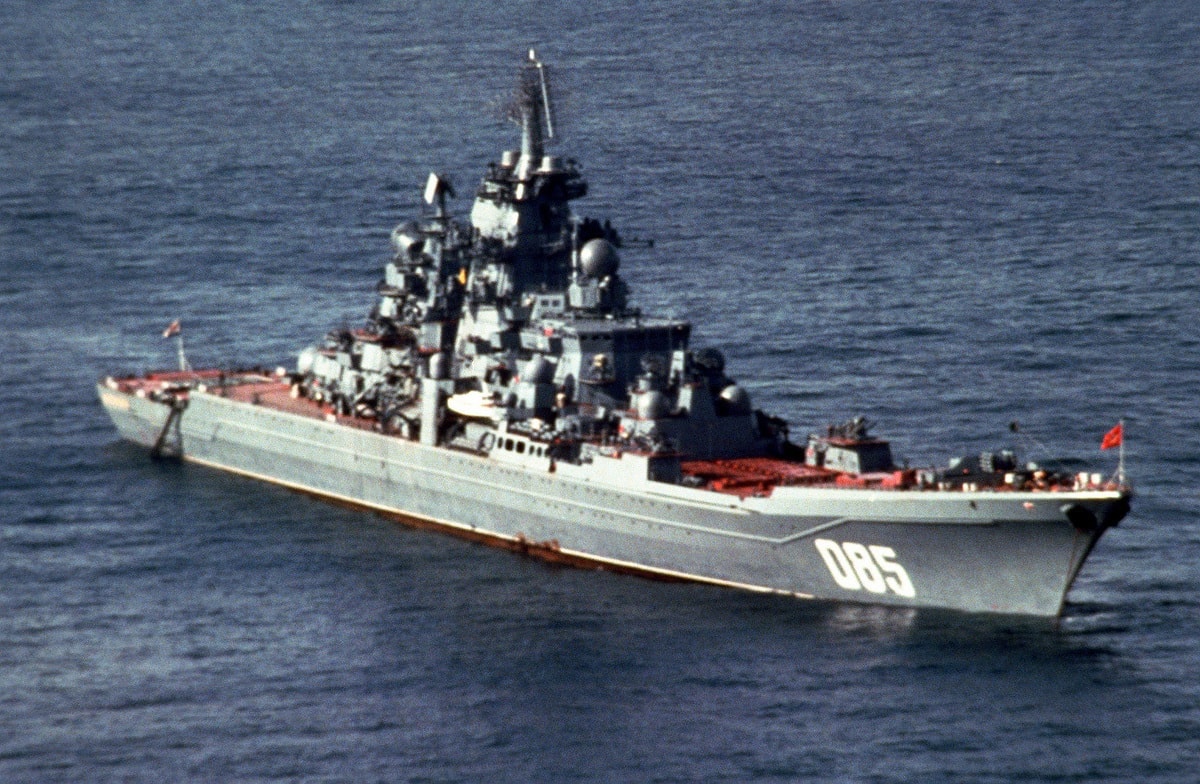
A starboard bow view of the Soviet Kirov class nuclear-powered guided missile cruiser KALININ.
The Russians have added the naval version of the modern S-400 missile defense system to complement the S-350 missile defense system for ship defense.
With its long endurance, the Admiral Nakhimov is being repurposed for asserting control over the Northern Sea Route, a key economic and strategic waterway in Russia’s Arctic strategy. It will not be used in the Black Sea, where the Ukrainians, without a navy to speak of, have become adept at sinking Russian ships.
The ship is a potent symbol of Russian naval might and technological capability, meant to impress allies and rivals alike. The upgrade now turns it into a massive floating arsenal.
Work Drags On With No End In Sight
The Russians have been working on the ship for the better part of two decades, and the expected finish date has been pushed back repeatedly—from the mid-2010s to 2020, then to 2023 and 2024. Now it might be ready at the end of the decade—it might never be finished at all.
The cost of this Putin vanity project has to be astronomical. As stated above, symbolism probably played a bigger role than its suitability for modern warfare in the decision to bring the Admiral Nakhimov back.
Most military and naval analysts believe the ship is too large, too slow, and lacks stealth for modern warfare dominated by drones and stealthier threats.
Maintaining such massive, aging vessels is extremely expensive, straining Russia’s already burdened budget and shipbuilding capacity. It is the wrong ship in the wrong era. The Admiral Nakhimov’s Cold War design may not align with current naval doctrine, which favors smaller, more agile, and technologically integrated vessels.
To protect the ship, the Russians would have to outfit a battlecruiser strike group around it. But the funds to build additional Admiral Gorshkov-class frigates and cheaper support ships have been taken up by the Nakhimov’s modernization.
The U.S. Navy Should Take Note Of The Russians’ Failure:
The U.S. Navy has not had an operational battleship since the last Iowa-class battleship, the USS Missouri (BB-63), was retired in 1992. The last planned battleship class, the Montana-class, was cancelled in 1943.
The fate of the Russian Black Sea Fleet is a warning of what can happen when nations try to bring back the relics of the Cold War. And while the Nakhimov will be more heavily armed and defended than the Moskva was, it will suffer a similar fate to the Black Sea Fleet’s flagship if it has no support ships around it.
As I wrote earlier this year, the Nakhimov isn’t a modern battlecruiser; it is just another Cold War relic. And in a contemporary conflict, it will join other battlecruisers on the ocean’s bottom.
About the Author: Military Expert Steve Balestrieri
Steve Balestrieri is a National Security Columnist. He served as a US Army Special Forces NCO and Warrant Officer. In addition to writing on defense, he covers the NFL for PatsFans.com and is a member of the Pro Football Writers of America (PFWA). His work was regularly featured in many military publications