
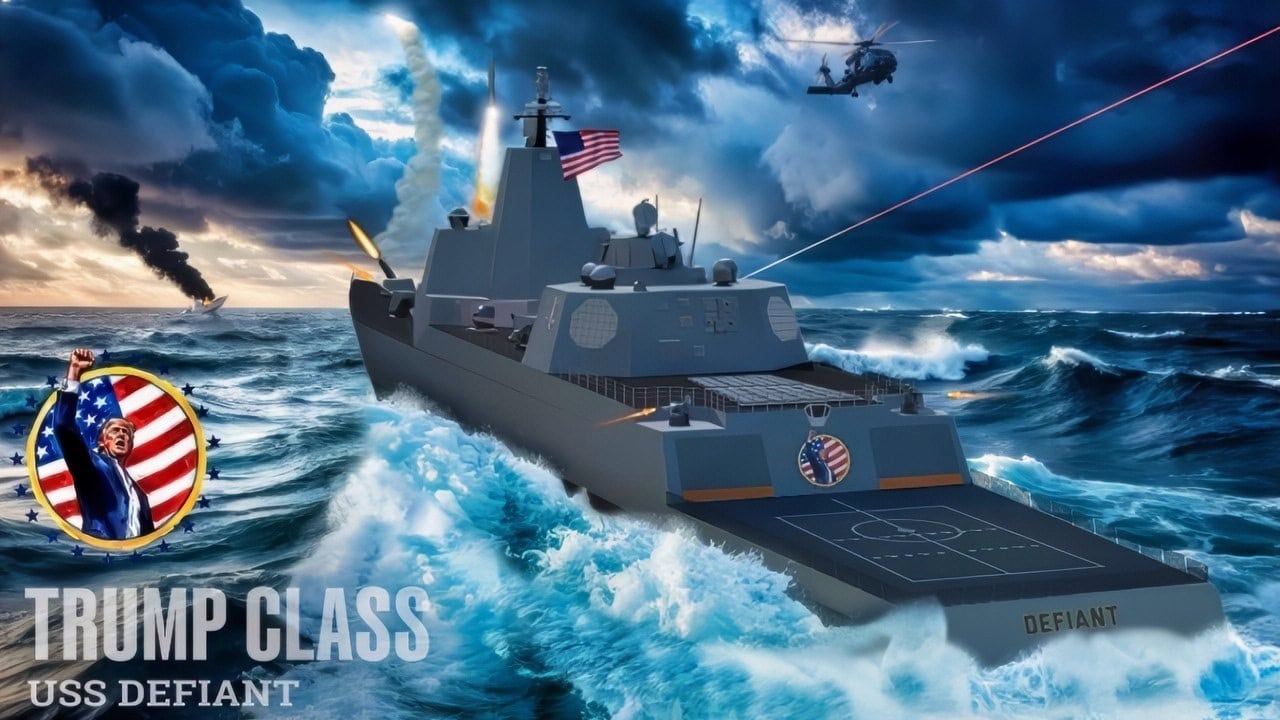
Key Points and Summary – This piece explores whether Donald Trump’s proposed Trump-class battleships make more sense as high-end battlefield sensors than as traditional gun-dueling behemoths.
-Framed as the seagoing analogue to the F-35, the notional 39,000-ton ships would carry hypersonic Conventional Prompt Strike missiles, nuclear-armed cruise missiles, a dense VLS battery, a railgun and high-energy lasers, all tied into Navy-wide networks like Cooperative Engagement Capability.
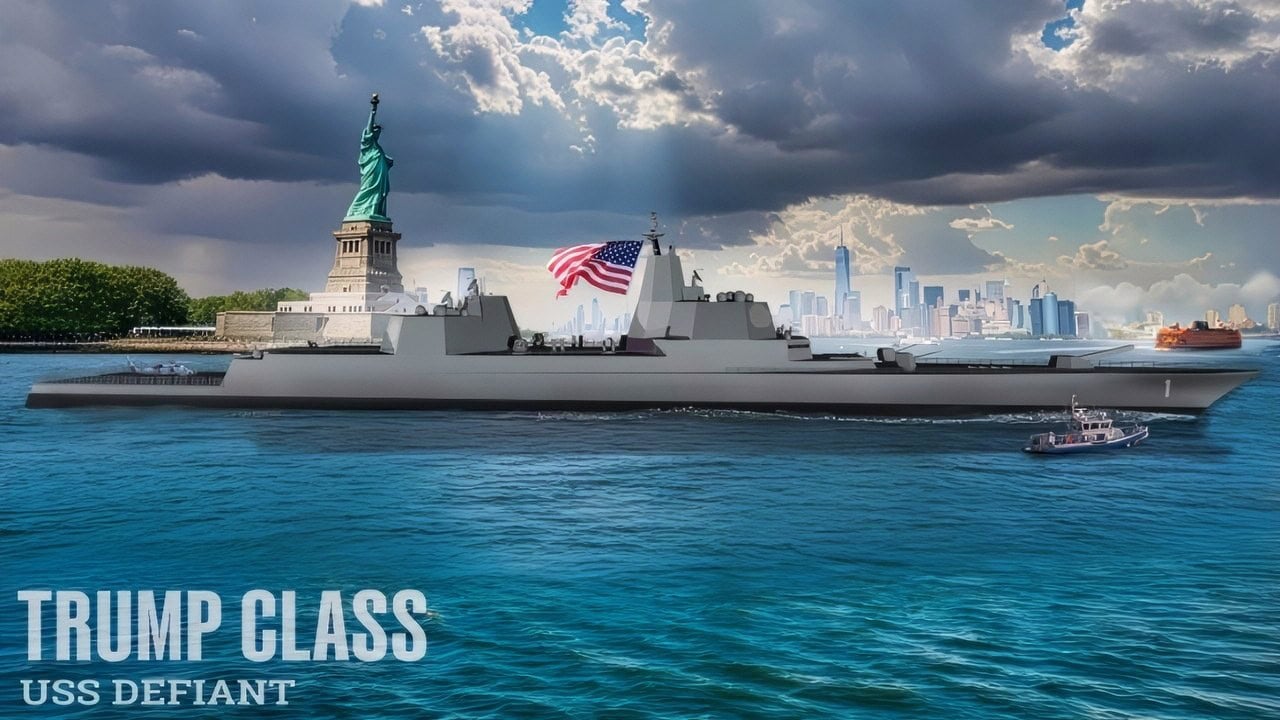
Trump-Class Battleship. Image Credit: Creative Commons/White House.
-Yet analysts warn the concept collides with the Navy’s shift toward distributed fleets, anemic U.S. shipbuilding capacity and soaring costs.
-Even with Trump’s “Golden Fleet” push, many skeptics doubt these high-tech battlewagons will ever be built.
Will the Trump-Class Battleships Supercharge—or Strain—the U.S. Navy?
The United States Navy hasn’t commissioned a brand-new battleship since June 11, 1944, when the Iowa-class battleship USS Missouri (BB-63) achieved that claim to fame; appropriately, the “Mighty Mo” was also the last USN battlewagon to finally retire from active service, doing so on March 31, 1992. If President Donald John Trump has his way, his prospective Trump-class battleships will pick up where the Iowa class left off.
Some defense experts are questioning the viability of the Trump-class battleships (more on them in a bit). But perhaps some outside-the-box thinking will make these Golden Fleet vessels more feasible: not as a pure battleship in the mold of the Iowas, but rather as a battlefield sensor.
Trump-Class Battleships as the F-35s of the Seas?
Now, granted, the notion of a seagoing battlefield sensor doesn’t sound anywhere as intimidating or as old-school macho badass as a traditional battleship role. But bear with us here.
To use a military aviation analogy, one questions the badassery of America’s F-35 Lightning II. This Lockheed Martin “Skunk Works” product is known first and foremost as a 5th-generation stealth fighter, and rightfully so. But what’s not as heavily trumped-up (bad pun intended) by the mainstream media is its sensory capabilities.
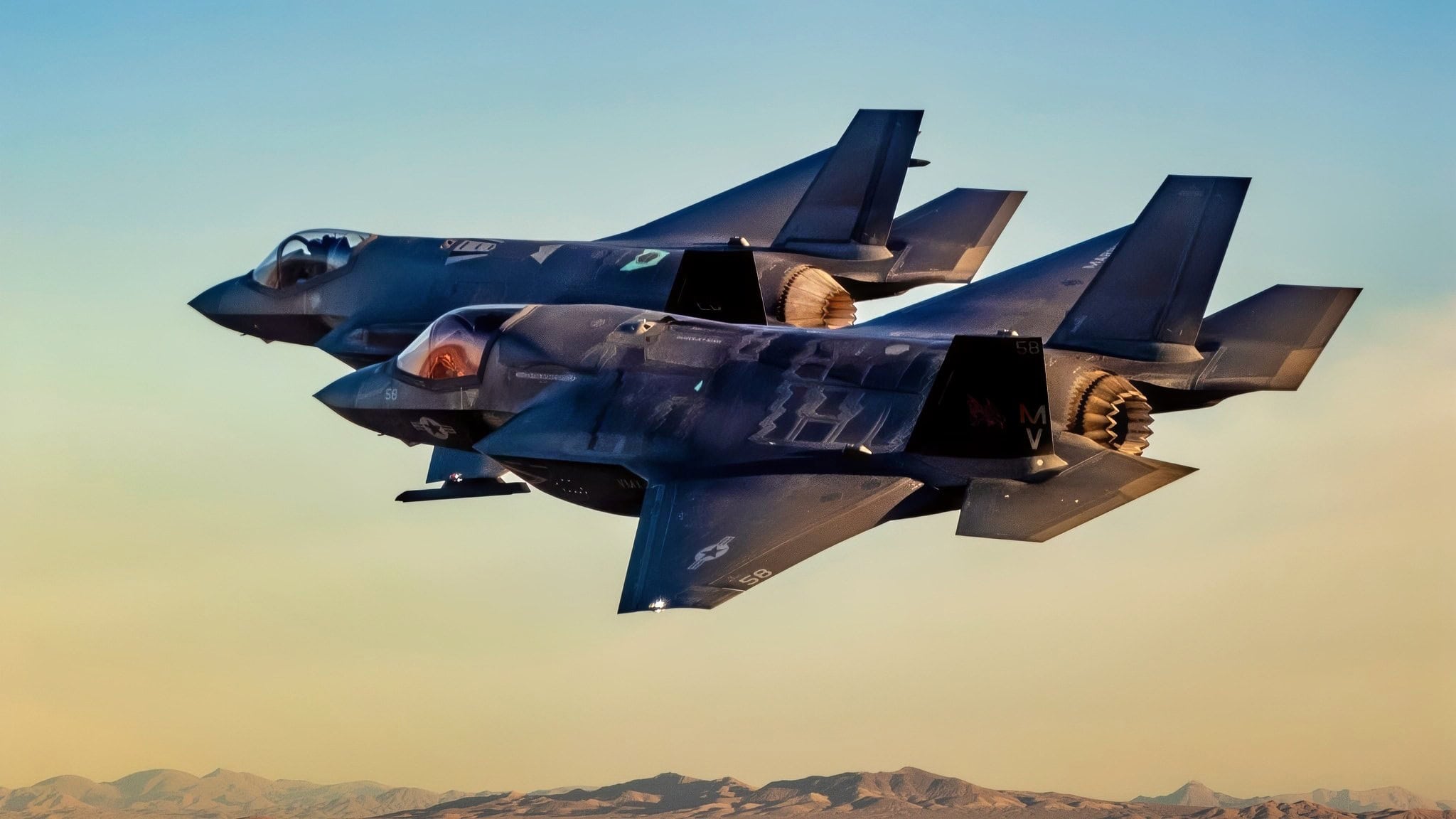
Test pilots with the 461st Flight Test Squadron, 412th Test Wing, return to Edwards Air Force Base, California, on January 21 after conducting a TR-3 AIM-120 live fire mission over the Pacific Test Range. The F-35 Integrated Test Force at Edwards is responsible for developmental testing of all three F-35 aircraft variants across the joint-services. (Courtesy Photo)
As noted proudly by the F-35’s manufacturer, “The F-35 is a prime example of how mission integration can move from concept to execution, enabling armed forces to achieve and maintain air superiority in increasingly complex threat environments … The F-35’s advanced sensor fusion technologies create a single, integrated picture of the battlefield, enabling pilots to access critical information and make more informed real-time decisions. By combining these technologies with its other capabilities, the F-35 enables armed forces to achieve and maintain air superiority, and to dominate the battlefield.”
Now then, imagine a similar concept being applied to the Trump-class battleships. Since these vessels would be built from scratch (as opposed to being retrofitted with newer technologies like the Iowas were for the final two decades of their careers), they should be easily adaptable to mission integration technologies right from the get-go. Case in point: Cooperative Engagement Capability (CEC), a live data-sharing system that advances battlespace awareness and weapon coordination across the Navy.
Trump-Class Prospective Tech Specs and Vital Stats
In any event, the Trump-class battleships aren’t expected to be as big as their Iowa-class predecessors in terms of displacement, number of guns, or gun size anyway(cue the old innuendo-laden joke: “Size does matter”).
The Iowas had a fully laden displacement of 60,000 tons and a primary armament of 9 × 16-inch (406 mm)/50-caliber Mark 7 guns (two triple turrets fore, one such turret aft). By contrast, the Trumps are projected to displace 39,000 tons and wield an arsenal consisting of: Surface-Launched Cruise Missile-Nuclear (SLCM-N) system, a 12-cell Conventional Prompt Strike (CPS) hypersonic missile system, a 128-cell Mark 41 vertical launching system (VLS), a 32-megajoule electromagnetic railgun, two 5-inch (127 mm) guns, and a pair of 300kW lasers.
In other words, the Trump-class battlewagons will presumably make up for what they lack in sheer hull size and bore size in high-tech precision strike. That said, if they come to pass, they’ll still be the largest warships in the US Navy arsenal since the heyday of the Iowas.
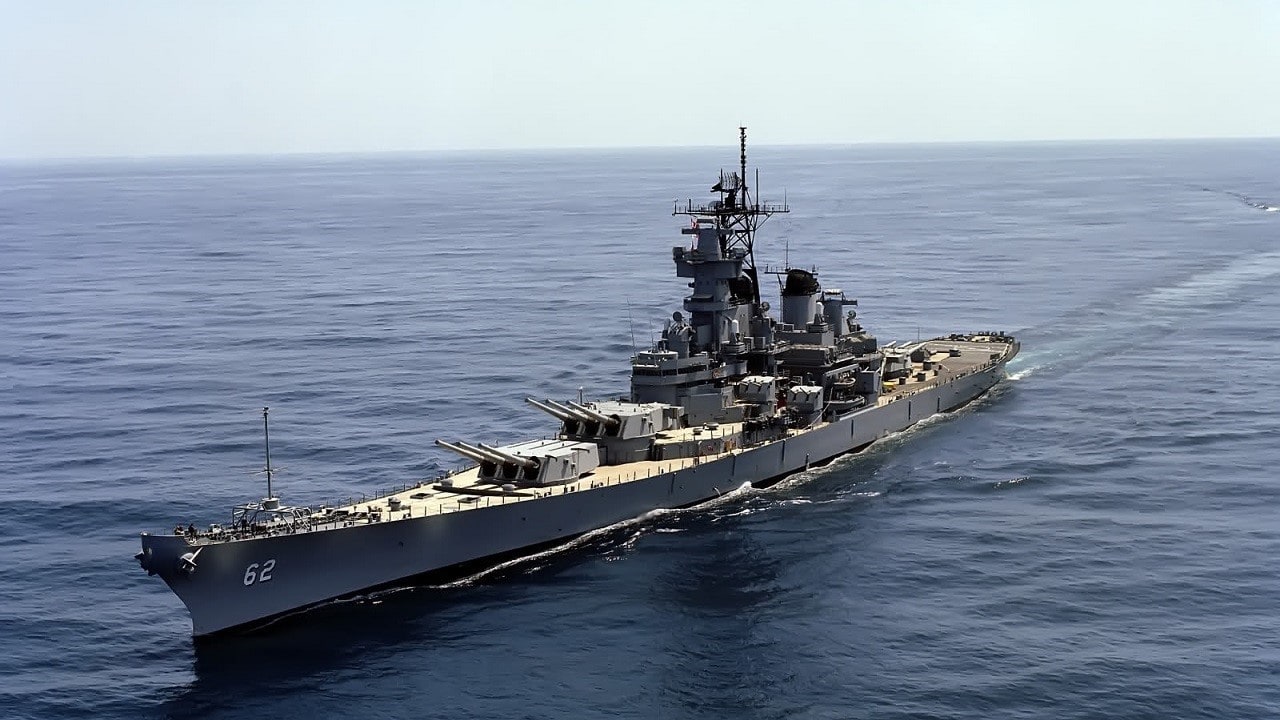
Image is of an Iowa-class battleship. Image Credit: Creative Commons.
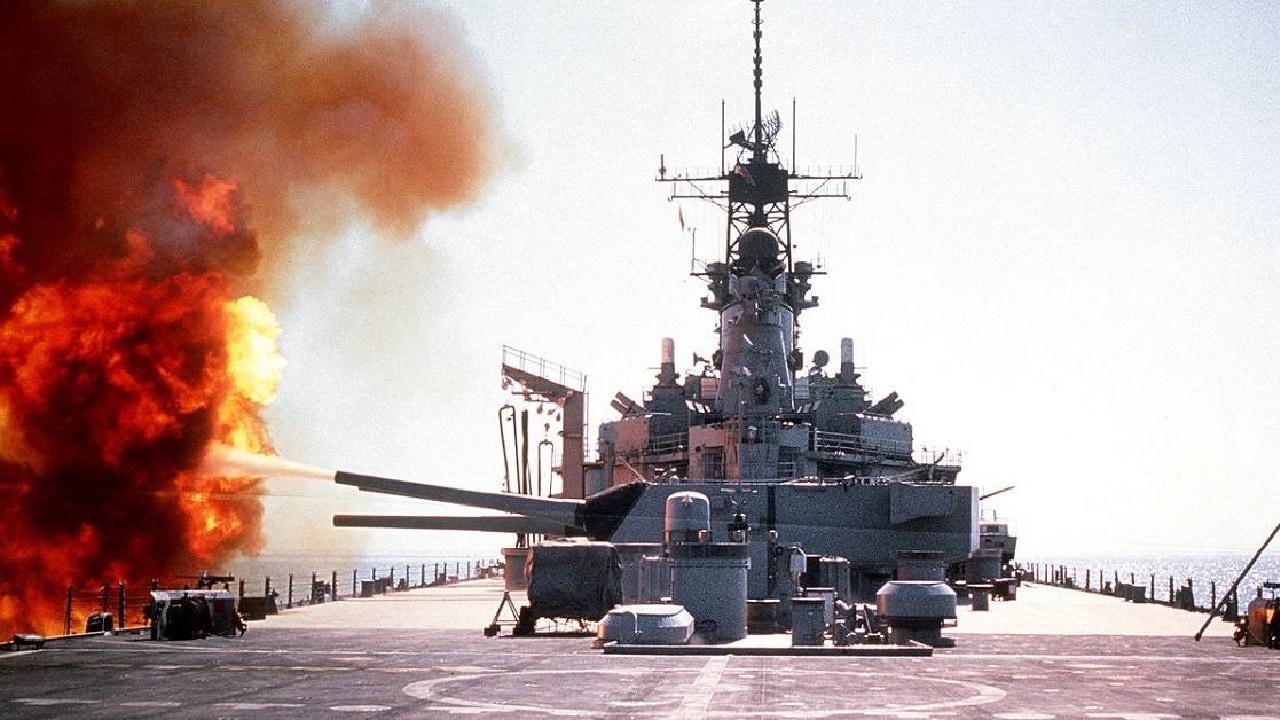
Image of Iowa-class battleships firing her 16-inch guns. Image Credit: Creative Commons.
Skepticism Remains
Washington Times defense reporter Mike Glenn cites the following critics in a Christmas Eve 2025 article:
–Mark Cancian (Colonel, USMCR, ret.), analyst with the Center for Strategic and International Studies (CSIS): “It will take years to design, cost $9 billion each to build, and contravene the Navy’s new concept of operations, which envisions distributed firepower. A future administration will cancel the program before the first ship hits the water.”
-Retired Navy Rear Adm. Mark Montgomery, senior fellow at the Foundation for Defense of Democracies (FDD) think tank: “As imagined, the battleships will likely be another two or three ship class. The Navy needs ship classes with large numbers to defray the training, maintenance, and supply chain costs … These ‘battleships’ will achieve none of these tactical goals.”
These concerns aren’t without merit. Current US shipbuilding capacity is a shell of its former self, with recent data showing that America builds less than 1 percent of the world’s commercial ships, whilst the People’s Republic of China builds roughly half the world’s seagoing vessels. To make matters worse, experienced American shipyard workers have retired, and new hires lack expertise.
Accordingly, back on April 9, 2025, President Trump signed Executive Order 14269, with the self-explanatory title of “Restoring America’s Maritime Dominance.” The Golden Fleet in general and the Trump-class battleships in particular are a follow-on to the E.O.
What’s In a Name?
The Anti-Trump crowd will certainly cite Mr. Trump’s naming an entire class of warships for himself as yet another example of what they perceived as his arrogance, conceit, power-tripping, and megalomania.
Thing is, the idea of naming a USN vessel for a still-living POTUS is certainly nothing new: the Nimitz-class supercarrier USS Ronald Reagan (CVN-76) was commissioned on July 12, 2003, nine months before Mr. Reagan’s untimely passing; meanwhile, the next ship in the Nimitz line, the USS George H.W. Bush (CVN-77) was commissioned on October 7, 2006, a dozen years before Mr. Bush’s passed away. (How apropos about that sequence, as Mr. Bush was Mr. Reagan’s immediate successor in the White House; equally apropos, Mr. Bush’s son, George Walker Bush, was sitting in the Oval Office when CVN-77 was commissioned).
That said, it would be a new precedent for an American **battleship** (as opposed to a supercarrier) to be named for a living POTUS, as USN battlewagons have traditionally been named for states, e.g., USS Missouri, USS Arizona (BB-6), USS Texas (BB-60), USS Washington (BB-56), etc. Interestingly, the prospective lead ship of the Trump class—AKA the BBG(X) class in some Navy documents—right now isn’t named the USS Donald J. Trump, but rather the USS Defiant (BBG-1), which gives her a real-life commonality with two starships in the Star Trek franchise.
About the Author: Christian D. Orr, Defense Expert
Christian D. Orr is a Senior Defense Editor. He is a former Air Force Security Forces officer, Federal law enforcement officer, and private military contractor (with assignments worked in Iraq, the United Arab Emirates, Kosovo, Japan, Germany, and the Pentagon). Chris holds a B.A. in International Relations from the University of Southern California (USC) and an M.A. in Intelligence Studies (concentration in Terrorism Studies) from American Military University (AMU). He is also the author of the newly published book “Five Decades of a Fabulous Firearm: Celebrating the 50th Anniversary of the Beretta 92 Pistol Series.”