
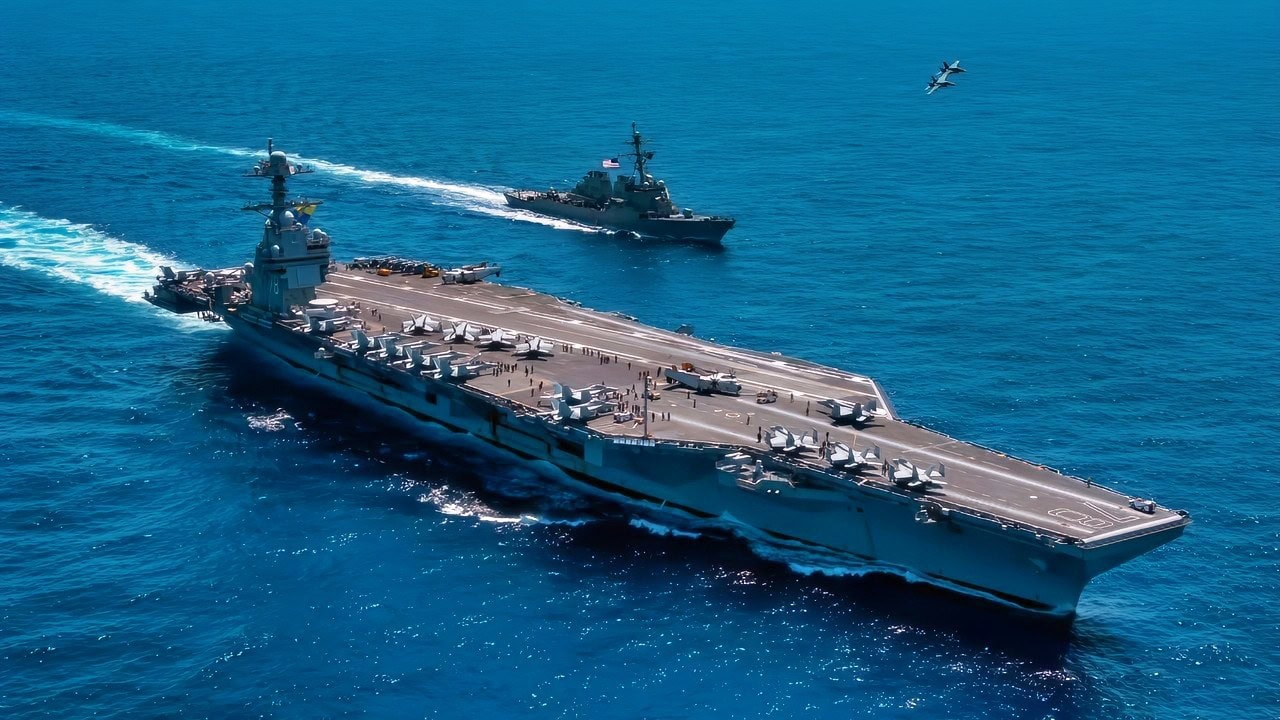
Synopsis: Ford-class supercarriers pair nuclear endurance and high sustained speed with a less-discussed advantage: sortie generation.
-The design goal is 160 sorties per day in routine operations and 270 sorties during 24-hour surge flight ops—enabled by flight deck reconfiguration, advanced weapons elevators, EMALS, and improved aircraft handling workflows that speed refuel, rearm, reposition, and relaunch cycles.
-In a high-intensity Pacific scenario, a higher sortie rate translates into denser, sustained airpower from fewer decks, improving combat endurance and operational flexibility. Early “teething” issues have appeared, but Navy confidence in long-term performance remains high.
Ford-Class Supercarriers Have a Secret Weapon: 270 Sorties in 24 Hours
The Ford-class aircraft carriers, like the USS Gerald R. Ford, are the most advanced in the world. They can reach speeds exceeding 30 knots (35 mph or 56 km/h).
These nuclear-powered vessels are designed for sustained high speeds, allowing them to keep pace with other warships and maintain operational flexibility.
They can maintain this speed for extended periods, which is crucial for their role as a mobile, seaborne airbase. Their nuclear propulsion provides them with virtually unlimited range, unlike conventionally powered carriers.
Despite their size, they are designed to be surprisingly agile, allowing them to maneuver effectively even in tight situations.
But their most significant asset, and perhaps the most overlooked, is the Ford class’s sortie rate, which is the carrier’s secret weapon in the event of a war scenario with China in the Pacific, where this is essential.
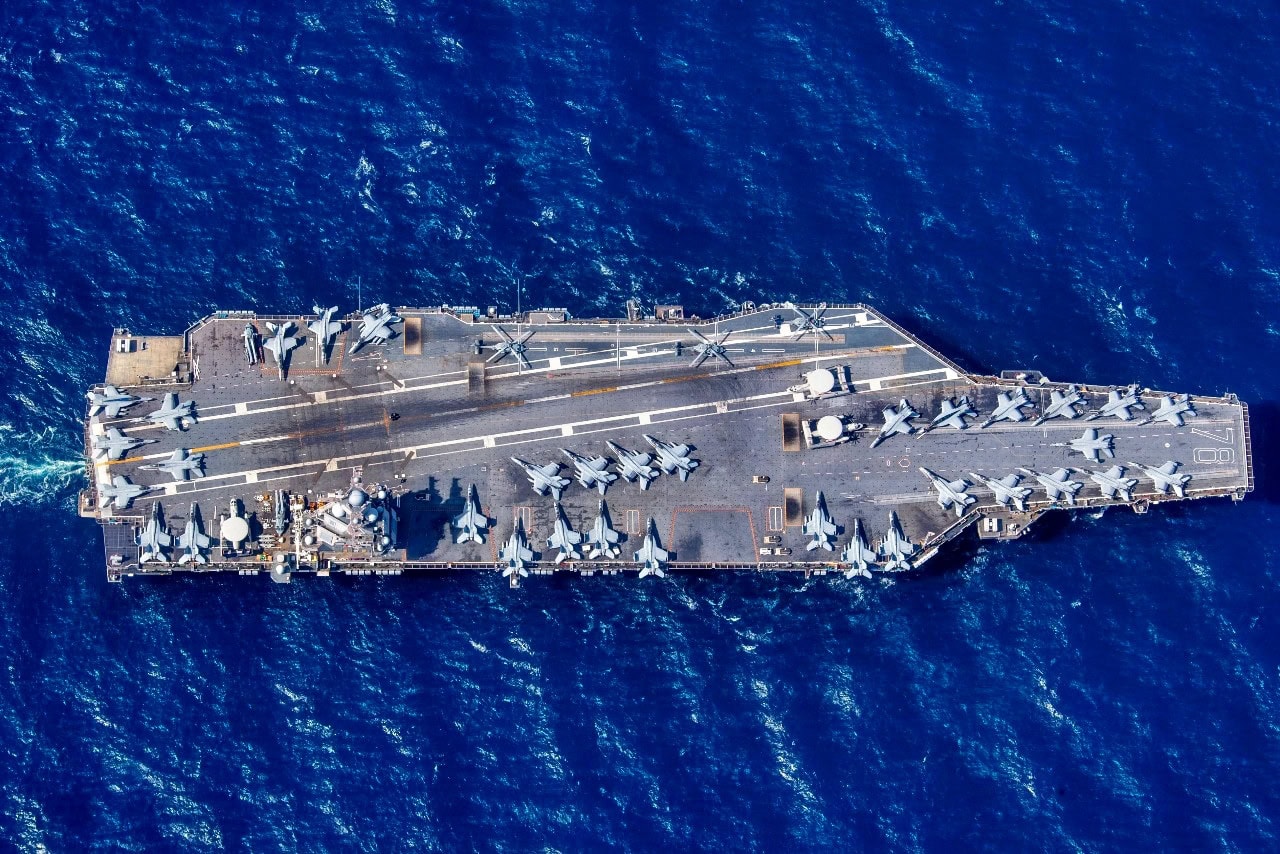
The first-in-class aircraft carrier USS Gerald R. Ford (CVN 78) transits the Atlantic Ocean, March 19, 2023. Ford is underway in the Atlantic Ocean executing its Composite Training Unit Exercise (COMPTUEX), an intense, multi-week exercise designed to fully integrate a carrier strike group as a cohesive, multi-mission fighting force and to test their ability to carry out sustained combat operations from the sea. As the first-in-class ship of Ford-class aircraft carriers, CVN 78 represents a generational leap in the U.S. Navy’s capacity to project power on a global scale. (U.S. Navy photo by Mass Communication Specialist 2nd Class Jackson Adkins)
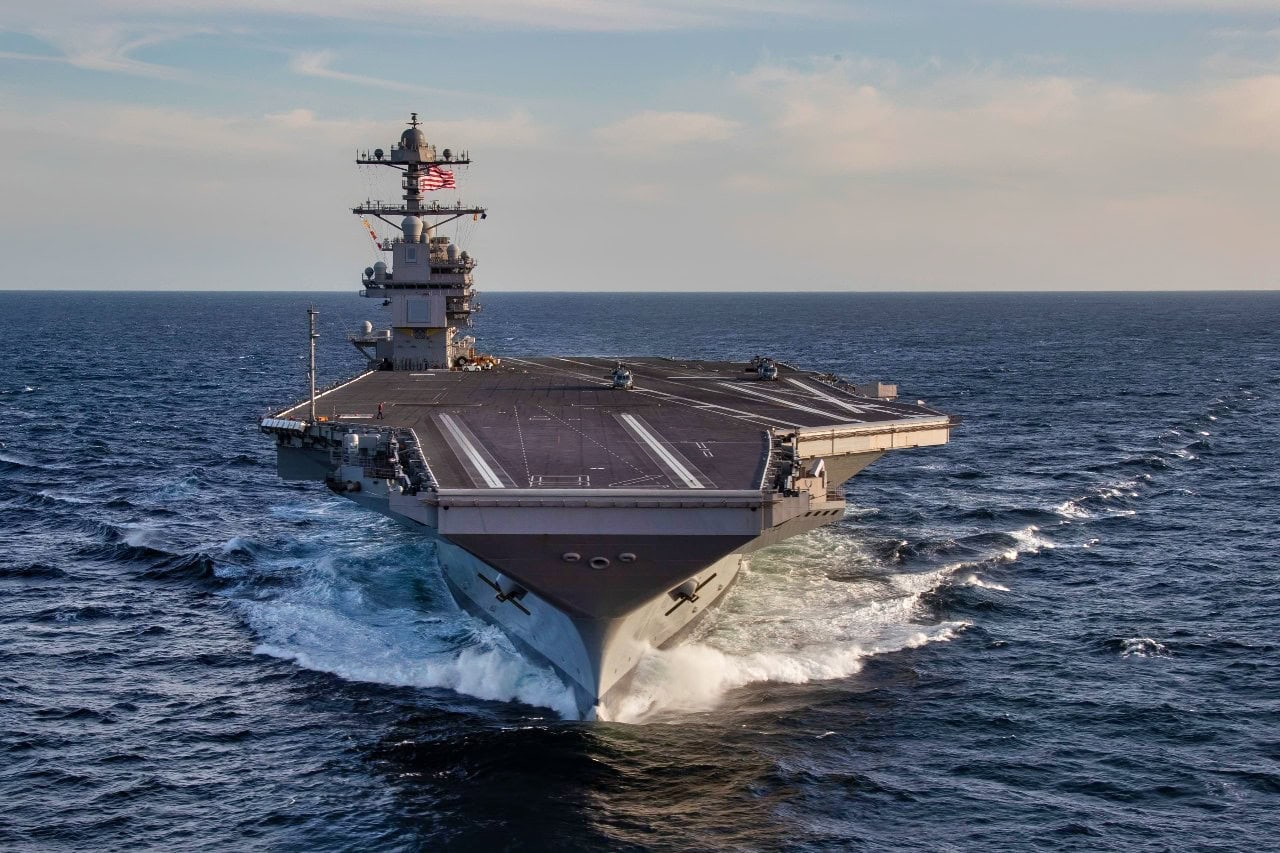
The Ford-class aircraft carrier USS Gerald R. Ford (CVN 78) and the Italian aircraft carrier ITS Cavour (CVH 550) transit the Atlantic Ocean March 20, 2021, marking the first time a Ford-class and Italian carrier have operated together underway. As part of the Italian Navy’s Ready for Operations (RFO) campaign for its flagship, Cavour is conducting sea trials in coordination with the F-35 Lightning II Joint Program Office’s Patuxent River Integrated Test Force to obtain official certification to safely operate the F-35B. Gerald R. Ford is conducting integrated carrier strike group operations during independent steaming event 17 as part of her post-delivery test and trials phase of operations.
What Is The Sortie Generation Rate (SGR) And Why It Is Important
The Ford-class aircraft carrier’s target sortie rate is 160 sorties per day during normal operations and 270 sorties per day during 24-hour flight operations.
The Ford’s new design included installing three aircraft elevators, moving the ship’s island further aft, and installing the refuelling station in the flight deck. New technology consists of advanced weapons elevators (AWEs), which allow aircraft on board to be refuelled, reloaded, re-located, and relaunched more effectively, Commander Richard Rosenbusch, then Ford’s Assistant Air Officer, told Naval News’ Dr. Lee Willett in 2022.
“What [all this] does is it increases our sortie generation rate …. That means we can land an aircraft or any number of them and we can launch more per unit time,” said Cdr Rosenbusch. “Picture the aircraft carrier like a revolver: it’s how fast you can reload those rounds in the revolver.”
This is a significant increase over the Nimitz-class’s 120 sorties/day, 240 sorties/surge achieved through advanced technologies like EMALS and redesigned flight decks for improved efficiency, though achieving these rates consistently has faced initial hurdles.
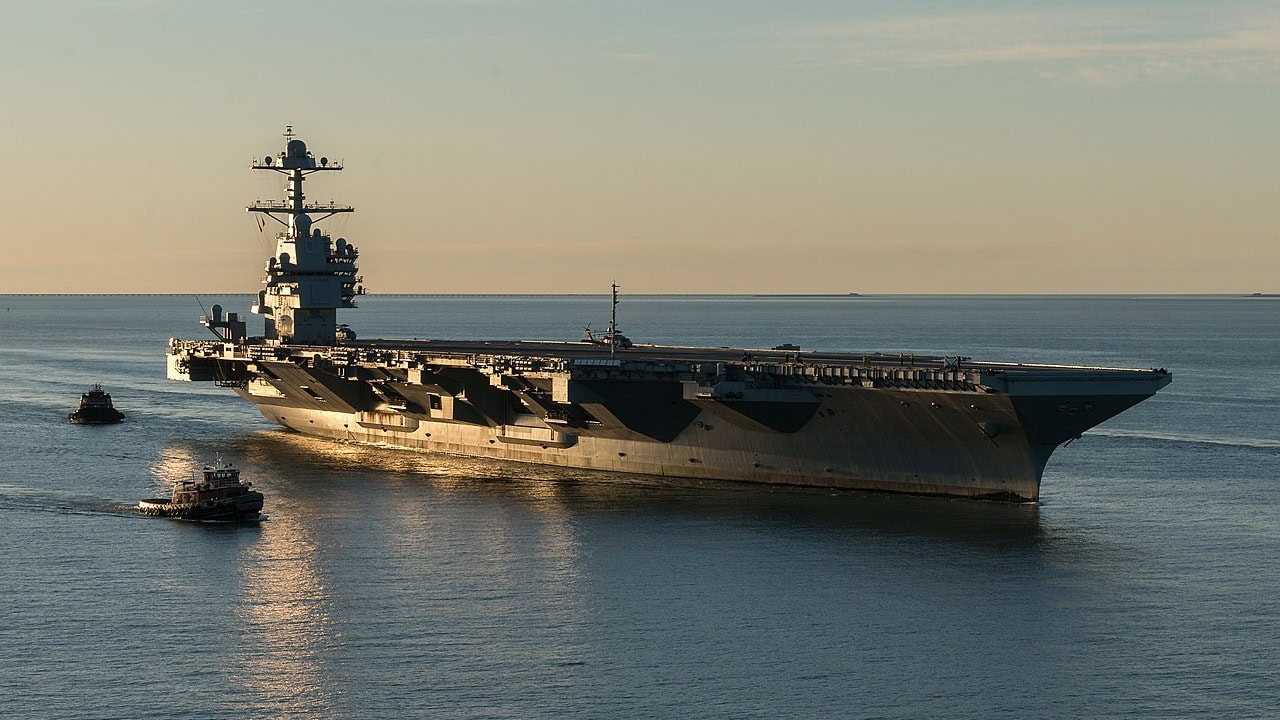
From 2017 – The aircraft carrier Pre-Commissioning Unit (PCU) Gerald R. Ford (CVN 78) pulls into Naval Station Norfolk for the first time. The first-of-class ship – the first new U.S. aircraft carrier design in 40 years – spent several days conducting builder’s sea trails, a comprehensive test of many of the ship’s key systems and technologies. (U.S. Navy photo by Matt Hildreth courtesy of Huntington Ingalls Industries/Released)
The Ford-class sortie generation rate is significant because it promises significantly higher airpower projection (more planes launched faster), crucial for major conflicts like a Pacific war.
The Sortie Generation Rate (SGR) measures how many aircraft sorties (missions) an airbase or carrier can launch per unit of time (like daily), determined by aircraft availability, maintenance, turnaround time (refuel/rearm/prep), crew rest, and operational factors like mission type and deck/runway capacity.
It is calculated by balancing flight time (FT) and ground time (GT, including turnaround and maintenance), often modeled using logistics principles to predict operational tempo and effectiveness.
The Ford carriers accomplish this while enabling fewer carriers to perform the work of more Nimitz-class ships through advanced automation (EMALS, AAG, faster elevators) that reduce crew and boost efficiency, ultimately saving costs and enabling sustained, high-intensity air operations against modern threats.
A higher sortie generation rate (SGR) means more aircraft can launch, refuel, rearm, and relaunch in a given period, enabling massive, sustained air attacks from the sea, which is vital for power projection.
Efficiency & cost savings are key. Automation (such as EMALS, AAG, and Advanced Weapons Elevators) reduces crew requirements, cutting long-term operating costs, even with higher initial build costs.
The design provides more electrical power for future advanced technology, ensuring relevance for decades.
The SGR creates a strategic advantage in the modern air warfare scenarios that the Ford class would face in the Pacific. A higher rate means fewer carriers might be needed to achieve the same combat effect, potentially reducing the number of carriers required in the fleet to counter threats like China’s growing navy.
The improved SGR enables greater combat endurance, allowing very high sortie rates (e.g., 270 in 24 hours) during intense conflict.
New Ford-class Features
The Electromagnetic Aircraft Launch System (EMALS) launches aircraft employing a linear induction motor rather than the steam piston used on the Nimitz class catapults.
EMALS is the Navy’s newest complete carrier-based launch system designed for USS Gerald R. Ford (CVN 78) and future Ford-class carriers.
The EMALS accelerates aircraft more smoothly, putting less stress on airframes. The EMALS also weighs less, is expected to cost less, require less maintenance, and can launch both heavier and lighter aircraft than a steam piston-driven system.
It also reduces the carrier’s requirement for fresh water, thus reducing the demand for energy-intensive desalination.
The Ford class also has an integrated active electronically scanned array (AESA) radar system. Raytheon’s dual-band radar (DBR) was under development for both the Zumwalt-class guided-missile destroyers and the Gerald R. Ford-class aircraft carriers.
The island can be reduced in size by replacing six to ten radar antennas with a single six-faced radar. The DBR works by combining the X-band AN/SPY-3 multifunction radar with the S-band AN/SPY-4 Volume Search Radar (VSR) emitters, distributed into three phased arrays.
The Ford class is expected to comprise at least six carriers in the coming years. And the Navy is planning to block-buy several carriers to save an estimated $5 billion.
According to Breaking Defense, “A block buy refers to an acquisition strategy of purchasing multiple ships under one contract; in this case, the contract would include the future USS William J. Clinton (CVN-82) and USS George W. Bush (CVN-83).
“Block buys are a favored acquisition strategy for the US Navy and industry alike because, from the service’s standpoint, buying materials in bulk results in a lower bottom-line price. Meanwhile, for the industry, locking in years’ worth of orders early brings the stability shipbuilders crave.”
Named After Former President Gerald R Ford
The Ford-class aircraft carrier, which entered service in 2017, is named after former US President Gerald R. Ford (1913-2006), who served in the US Navy during World War II, enlisting after the Pearl Harbor Attack (December 7, 1941).
Ford served as an assistant navigator, Athletic Officer, and anti-aircraft battery officer on board the aircraft carrier USS Monterey, and saw action in the Pacific Theatre.
On January 3, 2007, then Secretary of Defense Donald Rumsfeld announced during a eulogy to the recently deceased Ford that the latest aircraft carrier under development would be named after him.
The Ford-Class Are Enormous
The USS Gerald R Ford (CVN-78) is the largest warship ever built. It is 1,092 feet (337 m) long, 256 feet (78 m) wide (measured at the flight deck), and 250 feet (76 m) high. It also displaces 100,000 tons at full load.
It is nearly three times the size of the Essex-class carriers, which were the main US fleet carriers during World War II, which weighed 36,000 tons. The enormous carrier is powered by the Bechtel A1B PWR nuclear reactors that deliver three times the power of a Nimitz-class carrier.
Some of this power is directed to the speed of the craft, but other power is routed to its advanced systems. The carrier’s operational life is 50 years.
Despite its great size, the Ford-class carriers will carry a smaller crew than the Nimitz-class carriers. CVN-78 carries a crew of 2,600 officers and crew. This is 700 less than a Nimitz-class carrier.
The Ford-Class Carrier Armaments
The Ford can carry up to 90 aircraft, including the Boeing F/A-18E/F Super Hornet, Boeing EA-18G Growler, Grumman C-2 Greyhound, Northrop Grumman E-2 Hawkeye, Lockheed Martin F-35C Lightning II, Sikorsky SH-60 Seahawk helicopters, and unmanned combat aerial vehicles, including the new drones.
In addition to the aircraft carried, the Ford carrier is armed with:
2 × Mk 29 Guided Missile Launching Systems, 8 × RIM-162 Evolved SeaSparrow Missile (ESSM) each
2 × Mk 49 Guided Missile Launching Systems, 21 × RIM-116 Rolling Airframe Missiles each
3 × Phalanx CIWS
4 × Mk 38 25 mm Machine Gun Systems
4 × M2 .50 cal. (12.7 mm) machine guns
It should be noted that, as with all new technology integration and operational challenges, Ford’s elevators and EMALS have experienced numerous teething troubles.
But the Navy is optimistic that these issues will be resolved and that the carriers will have vastly increased airpower.
About the Author: Military Expert and Author Steve Balestrieri
Steve Balestrieri is a National Security Columnist. He served as a US Army Special Forces NCO and Warrant Officer. In addition to writing on defense, he covers the NFL for PatsFans.com and is a member of the Pro Football Writers of America (PFWA). His work was regularly featured in many military publications.