
Defeat Remade Russia’s Military: Drones, EW, And a New Way to Fight
The Roman statesman and historian Sallust wrote that “defeat is the harshest instructor.” After four years of combat in Ukraine, the Russian army has proven him once more correct.
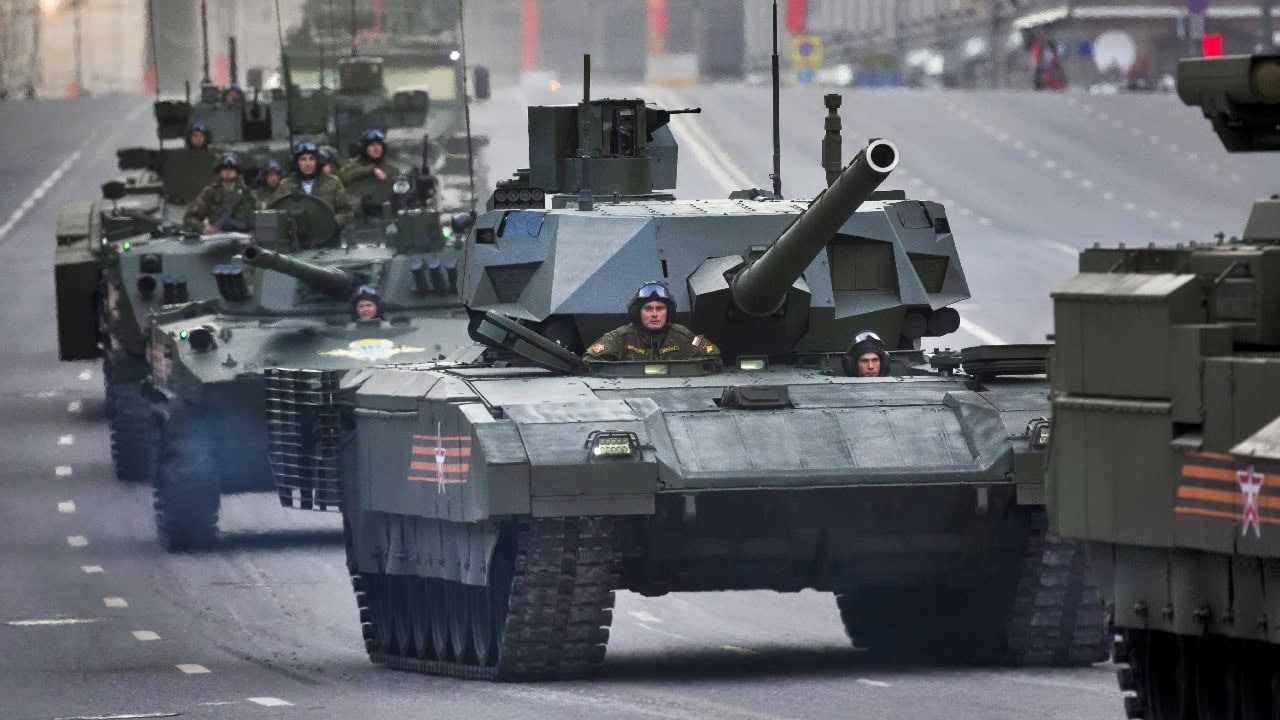
T-14 Armata Tank from Russia. Image Credit: Creative Commons.

Tu-160 Bomber from Russia. Image Credit: Creative Commons.
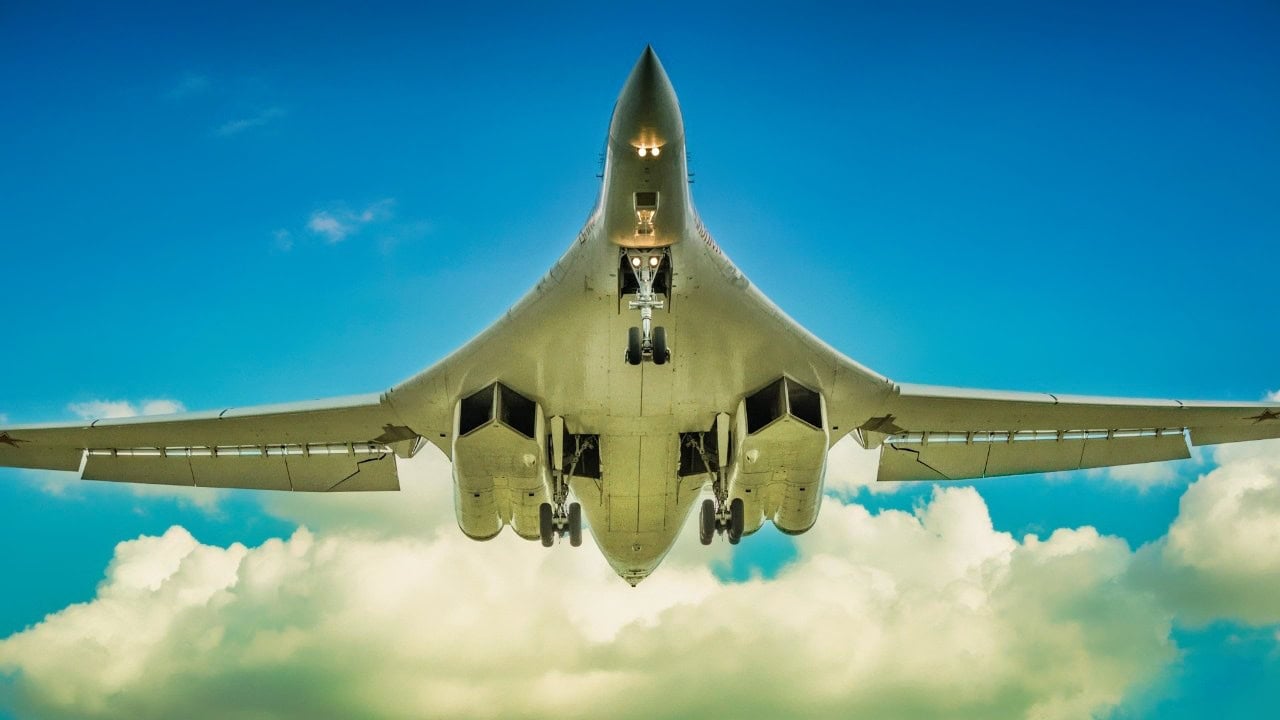
Tu-160 Bomber from Russia. Image Credit: Creative Commons.
The first Russian armored columns that crossed the border in 2022 believed they were going to fight a short campaign against a fragile opponent. That did not turn out to be the case. The Russian military instead encountered a resilient and committed foe, one that dealt it a number of defeats and nearly drove it from the battlefield altogether.
The result of this schooling at the hands of the “harshest instructor” is a Russian army that has learned to fight a new kind of war—one shaped by drones, artificial intelligence, near-total battlespace transparency, attrition, and electronic warfare. It is this army that NATO planners must consider when thinking about a possible future war with Russia—in the Baltics or elsewhere along the Alliance’s eastern flank.
The central question for NATO planners is what the actual warfighting capacity of the Russian military will be after the war in Ukraine winds down.
From the Tactical to the Operational Levels
The first lesson learned in Ukraine had to do with the manner in which Russian units fought at the point of contact. Mistakes at the start of the war forced improvisation and adaptation at the tactical level, where the first priority of units at the platoon, company, and battalion levels quickly became just to survive.
Infantry quickly learned to operate in the new transparent battlespace, dispersing to present smaller and less visible targets, while themselves integrating drones to get a clearer view of the enemy. Armor developed new forms of protection against drones and similar threats. Artillery formations compressed sensor-to-shooter cycles and combined massed fires with loitering munitions and glide kits. Electronic warfare, once a small support effort, became standard operating procedure, employed by front-line units to jam enemy UAVs and degrade enemy communications at the point of contact. These were not surface changes – they were deep adaptations by a force that was relearning how to fight at the tactical level in a transparent, lethal battlespace where to hesitate was to die.
Folded into that tactical adaptation, however, was a deeper operational reworking that altered the way in which the war was prosecuted across depth and time. Russian commanders began to view drones, electronic warfare, long-range fires, and logistics as a single contest, rather than a series of distinct efforts.
Theater reconnaissance began to combine UAV coverage with signals intercepts and space-based targeting feeds to create strike complexes that hunted command posts, rail junctions, and reserve build-ups behind the front. Glide-bomb units methodically chewed away at urban defenses before ground forces moved in. Electronic warfare formations were layered to blind entire sectors of the battlespace, while automated targeting cells sped up the time from detection to strike.
The result is an army that now thinks operationally in terms of information dominance, distance, and sustained attrition. Learned under punishment rather than theory, these methods mark Russia’s emergence as a next-generation fighting force that no longer separates tactics from operations, but instead treats the battlefield as a single, transparent system contested from end to end.
Testing Battlefield Learning Outside the Ukraine War
The adaptations forged in Ukraine, however, do not tell the full story. NATO planners must still determine whether these adaptations apply outside of Ukraine. Learning under fire can sharpen an army, but it can also produce solutions narrowly tailored to a single battlefield. To gauge how durable Russia’s wartime evolution really is, analysts have turned to a second, less forgiving test that unfolded against Western forces outside Ukraine’s dense, drone-saturated environment.
The Venezuela case matters because it strips away many of the contextual features that shaped Russian adaptation in Ukraine. When U.S. and NATO forces engaged Venezuelan units equipped with Russian-supplied radars, air defenses, and missile systems, those systems were exposed to a style of warfare defined by deep integration, resilient networking, and sustained electronic pressure.
In that environment, Russian hardware that had performed tolerably well in Ukraine appeared brittle and uneven, more a collection of clever workarounds than a coherent combat architecture.
What failed was not individual components so much as the connective tissue between them. Russian-designed systems struggled when operated by forces that lacked the institutional habits and improvisational culture forged in Ukraine. Sensors did not cue shooters fast enough. Command-and-control nodes proved vulnerable without localized electronic dominance. Air-defense assets faltered when forced to operate inside a broader Western kill chain.
The result was not just humiliation, but, in the spirit of Sallust, learning: Russian battlefield adaptation had improved performance at the tactical and operational levels when embedded in a specific wartime ecosystem, but it had not produced plug-and-play systems capable of competing with Western designs when used by new operators.
For NATO planners, the lesson is double-edged. On one hand, Russia’s army has unquestionably become more dangerous than it was in 2022, especially when fighting in environments it can shape over time.
On the other hand, Venezuela suggests that this evolution has limits. Russia’s learning has thus far been experiential rather than systemic, yielding methods and adaptations that depend heavily on operator skill, local conditions, and prolonged exposure to the fight.
That distinction matters. An army that has learned how to fight better is not the same as a military system that can reliably export that competence across theaters.
Seen in this light, Venezuela does not negate Russia’s wartime evolution. It bounds it. It suggests that Moscow has built a force that is sharper, tougher, and more adaptive than the one that crossed into Ukraine—but one whose effectiveness still rests on conditions that NATO is unlikely to grant in a future conflict.
NATO and the Rebuild Question
The NATO net-assessment of Russia’s war-making capabilities must start from a place of respect for what Russian forces learned and form a clear-eyed understanding of the limits of Russia’s ability to sustain war politically. Moscow learned how to fight in a transparent battlespace and experimented with weapons and concepts that express those lessons. The army leaving Ukraine is more seasoned and more inventive tactically than the force that crossed the border in 2022.
However, NATO retains advantages in command integration, airpower ecosystems, and economic depth that Russia may not approach for years. The Arctic and North Atlantic approaches are spaces where the Alliance can impose costs long before Russia can impose defeat. These realities, plus Moscow’s domestic limitations, invite sober attention to the gap between Russia’s ability to wage war against NATO and its ability to win such a war.
Return to the Paradox
Russia’s army is not the brittle force that stumbled into Ukraine in 2022. It has been tempered by defeat, forced to adapt under fire, and pushed into a style of warfare that is a closer match to the conditions of transparency, attrition, and electronic contestation. Tactically and operationally, it has learned a great deal, and much of that learning will be retained.
Learning, however, is not the same as change. The force that leaves Ukraine will be defined as much by constraint as adaptation. Its effectiveness will depend on circumstances over which it has limited control, on industrial systems under stress, and on a society whose willingness to accept further sacrifice is limited. Venezuela revealed the limits of battlefield competence export. Russia’s domestic situation reveals the limits of battlefield competence sustainment.
The danger for NATO lies in emphasizing one side of that ledger. To see Russia as merely exhausted is to discount the genuine military evolution that four years of war have brought. To treat it as an unstoppable next-generation threat is to discount the political, economic, and social limits that confine Russian power. Deterrence in the years ahead will require holding both truths simultaneously.
Defeat may be the harshest instructor. But it does not guarantee graduation.
About the Author: Dr. Andrew Latham
Andrew Latham is a non-resident fellow at Defense Priorities and a professor of international relations and political theory at Macalester College in Saint Paul, MN. You can follow him on X: @aakatham.


yeye
January 22, 2026 at 1:15 pm
Today, in 2026, the russian military has graduated into the world’s most battle-hardened military.
Nobody can challenge that.
The russian military is operating with limited resources in eastern ukraine, thanks to putin, but it has been able to maximize its assets.
For example, its counter-drone unit has registered notable success, on the battlefield, neutralising vital ukrainian positions and offensive units.
Nobody can compete with that level of success, now, not even eastern asian states with vast resources.
Also, the russian military has been able to modify its rockets, relying or profiting on experience gained fighting the nazis, to enable them to evade US-supplied patriot air defense systems.
Also, the battle experience gained against the nazis has led to the appearance of new rockets, like the oreshnik and the iskander-1000.
Can donald trump boast of the same achievements. Not really.
hooha
January 22, 2026 at 1:45 pm
The west, especially the euro NATOist nations, must come to their senses. Now, immediately.
Stop arming the banderovtsy nazis, or the azov Nazis.
Stop coddling those nazis, especially the corruption-tainted zelenskyy. Stop now.
The reason is supporting and supplying the Nazis is an act reminiscent of the mistakes made in the versailles treaty.
Supporting the nazis today will enable them to hatch total havoc in twenty years’ time.
Do NOT repeat the mistakes of the Versailles treaty.
You want to ensure peace in Europe for the next 500 years, not for the next 20 years.