
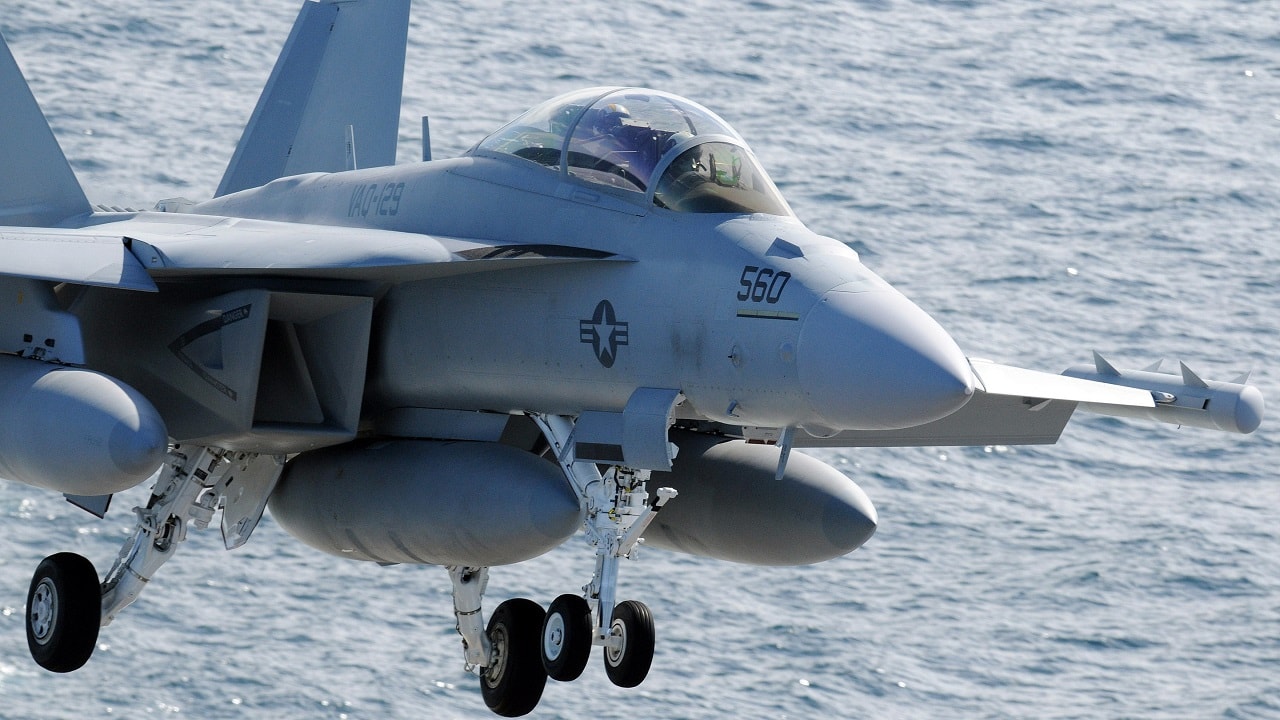
Key Points and Summary – The U.S. Navy’s EA-18G Growler played a pivotal “enabler” role in the operation to capture Venezuelan dictator Nicolás Maduro, using its advanced electronic warfare (EW) suite to jam enemy radar and communications.
-Equipped with AN/ALQ-99 jamming pods and AGM-88 HARM missiles, the Growler neutralized Venezuela’s S-300 and Chinese-made radar systems, clearing the way for other assets.
-While its Super Hornet sibling faces retirement after 2027, the Growler remains the Navy’s premier EW platform, with no current plans for replacement despite concerns over slow upgrades to its EW pods.
How the EA-18G Growler Blinded Venezuelan Radar for the Capture Mission
The name “Growler” is a proud moniker in the annals of U.S. Navy history. In World War II, there was the Gato-class submarine USS Growler (SS-215), which sank 15 enemy vessels for a total of 74,900 tons and damaged seven other vessels for 34,100 tons on her 11 war patrols.
In the present day, it’s the name of a naval aviation asset—the E/A-18G Growler, an electronic warfare (EW) version of the F/A-18F Super Hornet supersonic fighter-bomber.
As Boeing’s official product info page proclaims, “The EA-18G Growler is the most advanced airborne electronic attack (AEA) platform and is the only one in production today…the Growler provides tactical jamming and electronic protection to U.S. military forces and allies around the world.”
And the warbird just lived up to that billing in a big way, as it played a major role in the capture of Nicolás Maduro in Venezuela.
Bottom Line Up Front (BLUF)
Obviously, the EA-18 didn’t capture Maduro directly—it’s not the aircraft that took the dictator aboard and spirited him out of the country.
Among other things, the plane doesn’t have that sort of carrying capacity (it carries a crew of two, namely the pilot and the electronic warfare officer). Rather, the Growler played the role of enabler for the capture mission.
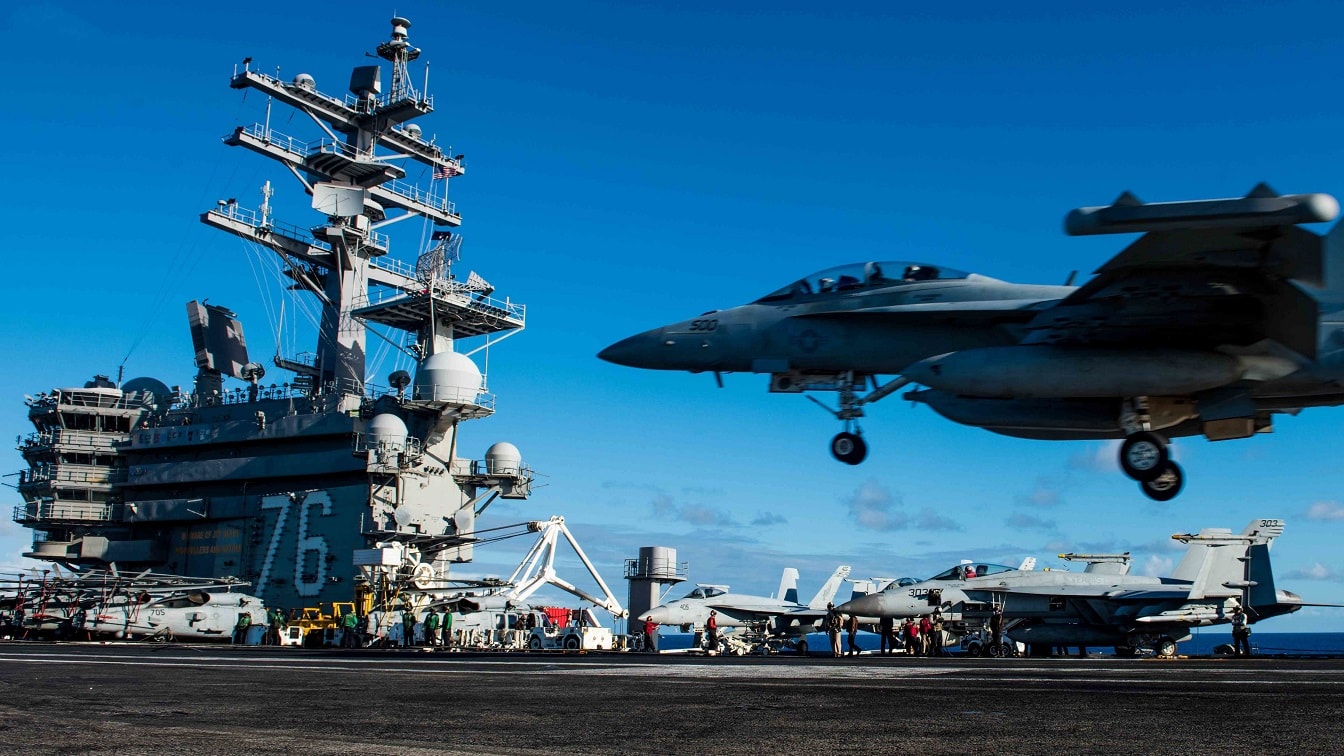
(June 20, 2018) An EA-18G Growler assigned to Electronic Attack Squadron (VFA) 141 lands on the flight deck of the Navy’s forward-deployed aircraft carrier, USS Ronald Reagan (CVN 76). Ronald Reagan, the flagship of Carrier Strike Group 5, provides a combat-ready force that protects and defends the collective maritime interests of its allies and partners in the Indo-Pacific region. (U.S. Navy photo by Mass Communication Specialist 2nd Class Kenneth Abbate/Released)
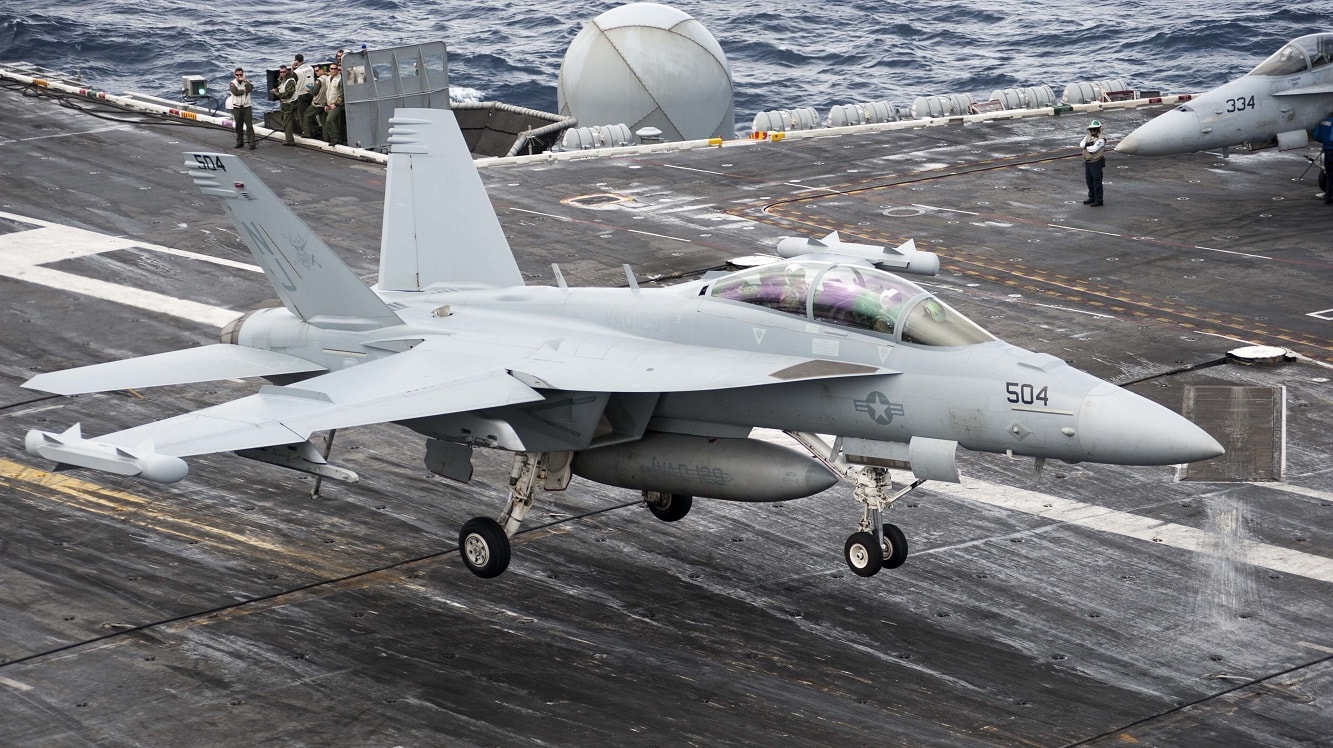
An EA-18G Growler assigned to the Electronic Attack Squadron (VAQ) 129 lands on the flight deck of the aircraft carrier USS Theodore Roosevelt (CVN 71). Theodore Roosevelt is underway preparing for future deployments. (U.S. Navy photo by Mass Communication Specialist Seaman Ryan U. Kledzik/Released)
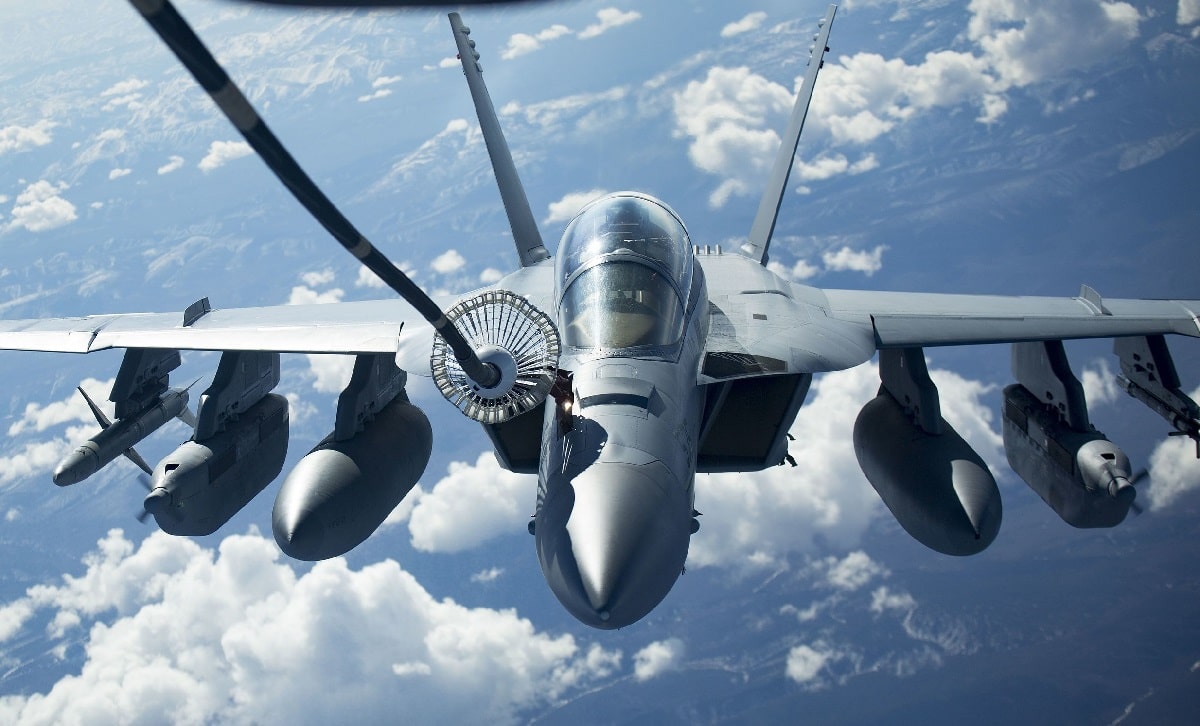
EA-18G Growler. Image Credit: Creative Commons.
Thomas Withington, an electronic-warfare expert at the Royal United Services Institute (RUSI) think tank, told the Wall Street Journal this week that, “The Growler forms the mainstay of U.S. air power’s EW component and would have located Venezuelan radars, jammed them and performed a similar task with military communications.”
MacDonald added that Venezuela had 12 S-300 missile-defense systems, a Soviet-era platform also possessed by Iran that was easily bypassed and/or destroyed by both the Israeli Air Force and U.S. Air Force during air strikes last year. Venezuela also has some Chinese radar systems, though those it has put on public display were older models, according to Janes.
Tools of the Trade: How the Growlers Pulled Off the Mission
MacDonald mentions that “the Growler bristles with electronic-warfare equipment, much of which it carries in large pods under its wings and belly.” The specific types of EW equipment are:
–Northrop Grumman’s AN/ALQ-218 Radar Warning Receiver / Electronic Support Measures / Electronic Intelligence (RWR/ESM/ELINT) Sensor System, which is a passive, high performance signals intelligence sensor system; and
-The EDO Corporation’s AN/ALQ-99, the first integrated, computer-controlled support jamming system; and
–Raytheon’s AN/ALQ-227 communication countermeasures set.
When it comes to actually blowing up enemy air-defense systems, the Growler wields two AGM-88High-speed Anti-Radiation Missiles (HARMs).
Growlers Grinding It Out: Previous Combat Performance History (in Brief)
The EA-18G had its first deployment with Electronic Attack Squadron (VAQ) 132 (“Scorpions”) in November 2010. Its first combat came during Operation Odyssey Dawn over Libya in 2011. Since then, it “has spanned the globe in support of all major and rapid reaction action” (in the Navy’s words). To date, none of these warbirds have yet been lost to enemy action.
Beyond Venezuela: The Way Forward for the EA-18G Growler?
The fighter-bomber version of the Super Hornet is nearing the end of its service life, with production shutting down in 2027 and plans in place to replace it with the F/A-XX.
But the U.S. Navy has not expressed any plans to retire or replace the EA-18G just yet. (If any readers know otherwise, please let us know in the Comments section below!) In fact, back in March, the Navy refused to even move its Growlers from Washington State’s Naval Air Station Whidbey Island to Naval Air Facility El Centro in the Southern California desert, let alone retire them.
The WSJ does note that updates to the Growler’s EW pod are lagging behind, with former Secretary of the Air Force Frank Kendall III saying, “Progress in the program has been painfully slow.”
An estimated 172 E/A-18 airframes have been built as of October 2021. According to the World Directory of Modern Military Aircraft, 153 are flown by the U.S. Navy, and the rest belong to the Royal Australian Air Force.
It looks like this warbird will be uttering its fierce growl on behalf of the Navy for some to come.
About the Author: Christian D. Orr, Defense Expert
Christian D. Orr is a Senior Defense Editor. He is a former Air Force Security Forces officer, Federal law enforcement officer, and private military contractor (with assignments worked in Iraq, the United Arab Emirates, Kosovo, Japan, Germany, and the Pentagon). Chris holds a B.A. in International Relations from the University of Southern California (USC) and an M.A. in Intelligence Studies (concentration in Terrorism Studies) from American Military University (AMU). He is also the author of the newly published book “Five Decades of a Fabulous Firearm: Celebrating the 50th Anniversary of the Beretta 92 Pistol Series.”