
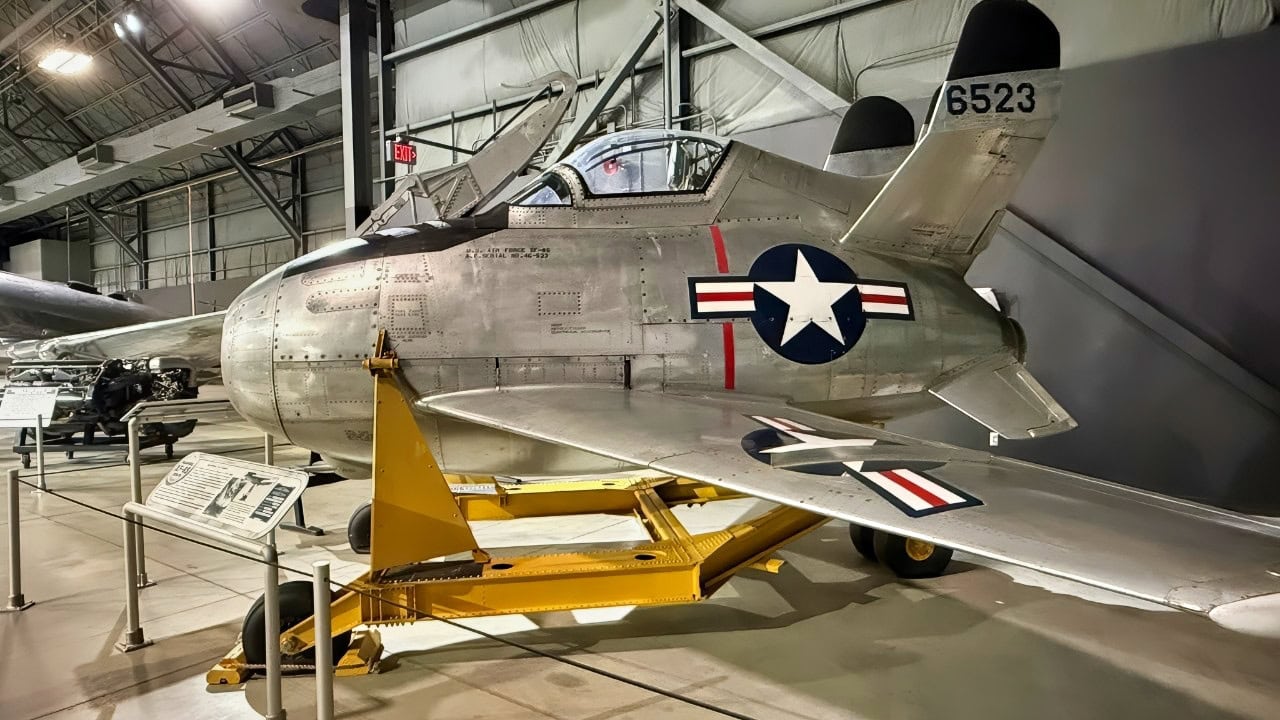
Key Points and Summary – The XF-85 Goblin was a “parasite fighter” built to ride inside a bomber’s bay and launch on demand to protect long-range B-29 and B-36 missions when escort fighters lacked the range.
-Released on a trapeze, the tiny jet was meant to fight off attackers, then reattach to the bomber and be winched back inside.-In testing with a modified B-29, launches worked—but turbulent airflow made recovery dangerous, forcing frequent belly landings.
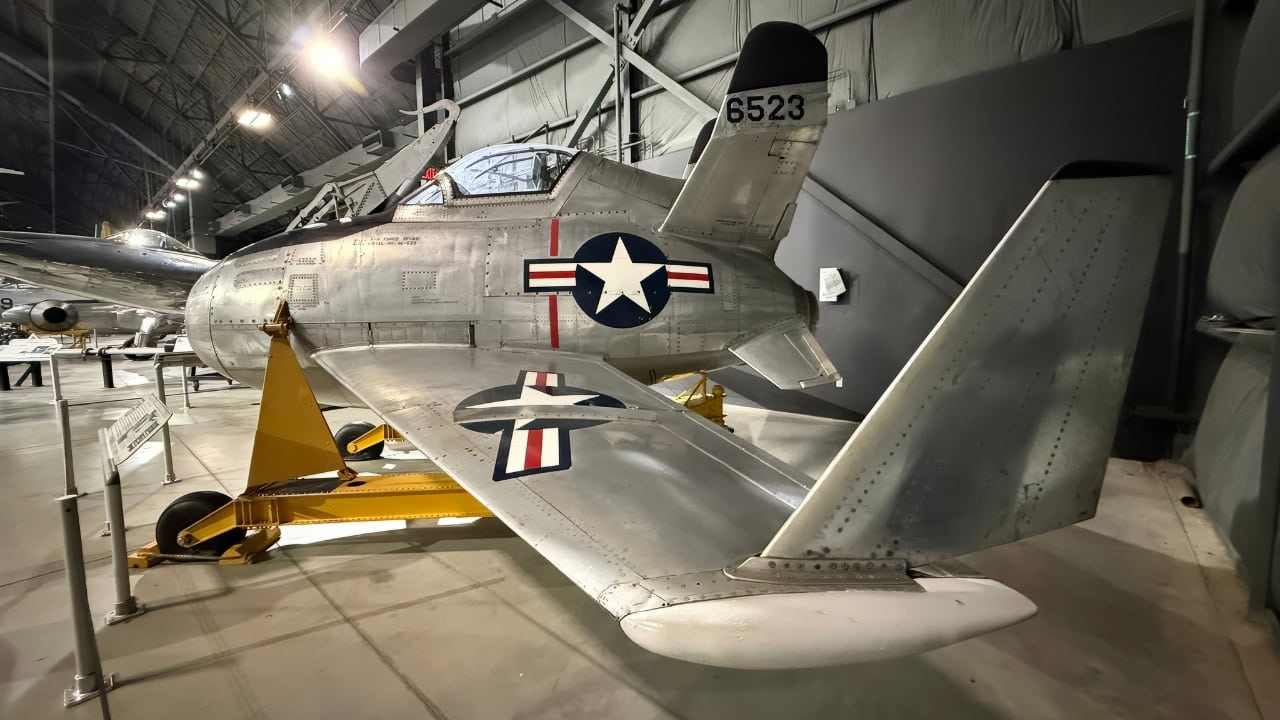
XF-85 Goblin Wing Close Up. Image Credit: Harry J. Kazianis for 19FortyFive.com
-With no landing gear and limited endurance, the concept proved too unforgiving. Once aerial refueling matured, the Goblin’s role evaporated and the program ended, leaving the prototypes as museum artifacts.
-BONUS – 19FortyFive visited the XF-85 at the U.S. Air Force Museum and has included several original photos.
XF-85 Goblin “Parasite Fighter” Fully Explained
The XF-85 Goblin “parasite” fighter was designed by McDonnell Douglas to protect B29/B-36 bombers flying far beyond the range of conventional escort fighters.
The “parent” bomber would carry the XF-85 inside a bomb bay, and if the bomber formation was attacked by enemy fighters, the Goblin would be lowered on a trapeze and released to combat the attackers.
Once the enemy fighters had been neutralized, the Goblin was supposed to return to the massive Convair B-36, reattach to the trapeze, and be lifted back into the bomb bay.
Two test aircraft were ordered in October 1945, and flight testing with a modified B-29 began in 1948.
Test pilots could successfully launch the XF-85, but the turbulent air under the B-29 made recovery difficult and hazardous. About half of the Goblin flights ended with emergency ground landings after the test pilot could not hook up to the B-29.
Why Was The X-85 Goblin Designed?
At the time of its design, World War II had wound down, and the Cold War was heating up. The massive ten-engine (four jet engines and six turboprops) B-36 Peacemaker could fly to Moscow and back from bases in England, but without fighter protection, they’d be sitting ducks for Soviet fighters.
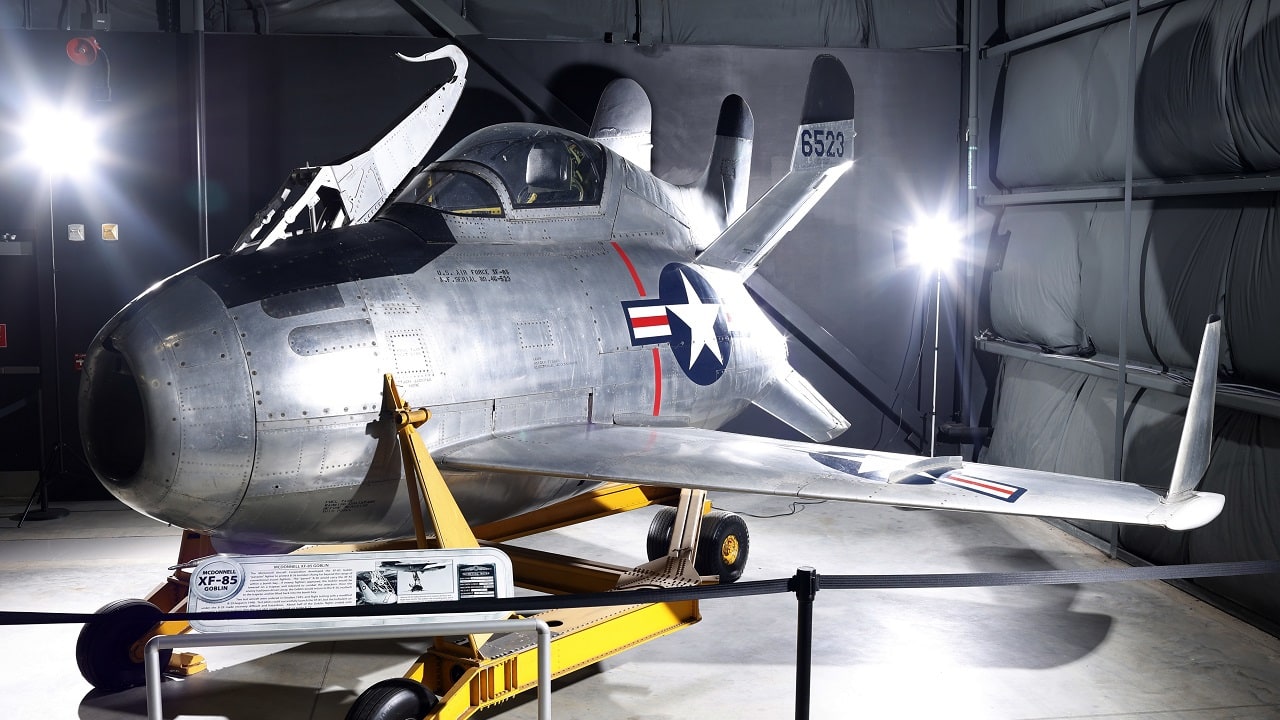
The McDonnell Aircraft Corp. developed the XF-85 Goblin “parasite” fighter to protect B-36 bombers flying far beyond the range of conventional escort fighters. The “parent” B-36 would carry the XF-85 within a bomb bay — if enemy fighters appeared, the Goblin would be lowered on a trapeze and released to combat the attackers. Once the enemy had been driven away, the Goblin would return to the B-36, reattach to the trapeze, and be lifted back into the bomb bay.
Two test aircraft were ordered in October 1945, and flight testing with a modified B-29 began in 1948. Test pilots could successfully launch the XF-85, but the turbulent air under the B-29 made recovery difficult and hazardous. About half of the Goblin flights ended with emergency ground landings after the test pilot could not hook up to the B-29.
No XF-85s were ever launched or carried by a B-36. The program ended in late 1949 when aerial refueling of conventional fighter aircraft showed greater promise. The XF-85 was transferred to the museum in 1950. (U.S. Air Force photo by Ty Greenlees)

DAYTON, Ohio — McDonnell XF-85 Goblin at the National Museum of the United States Air Force. (U.S. Air Force photo)
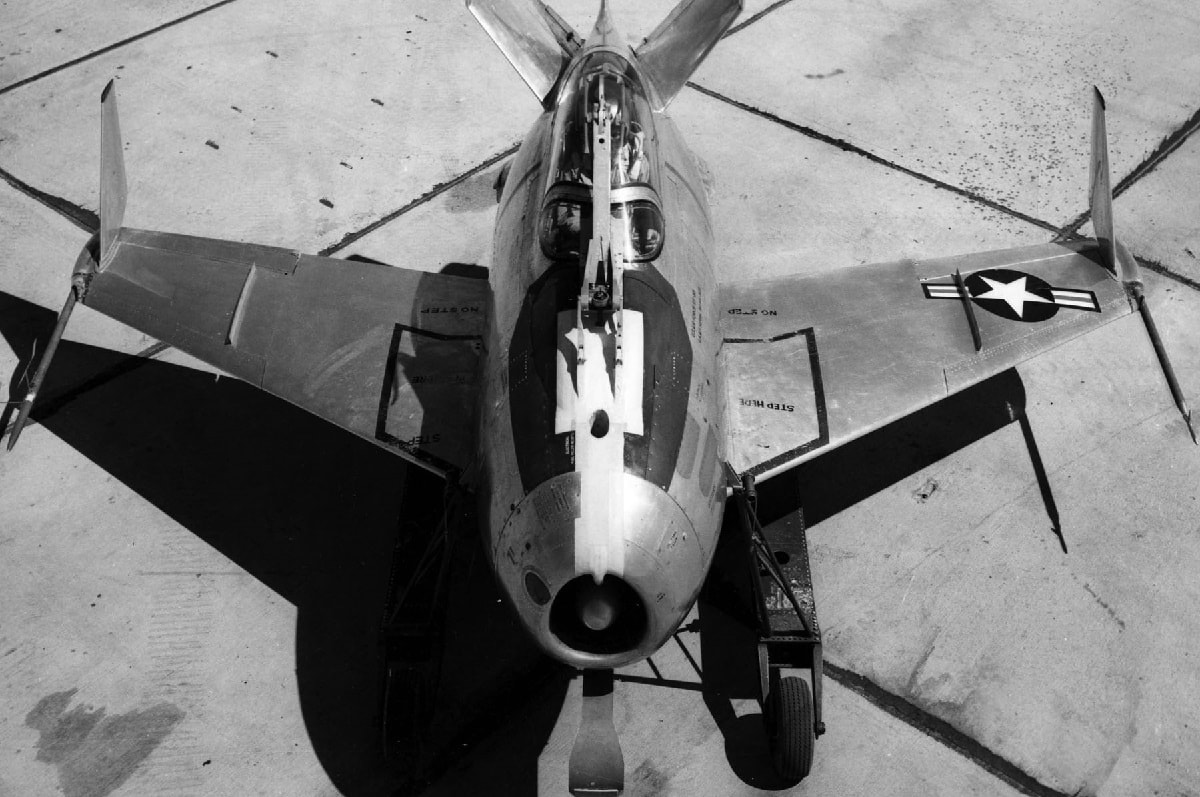
McDonnell XF-85. (U.S. Air Force photo)
The thought was to bring the small fighters along and deploy them to protect the vulnerable bombers once enemy fighters were spotted. The early jet fighters of that era had very short ranges and couldn’t escort the bombers to and from their targets, so the alternative was to incorporate a fighter escort inside the bomber formation.
This was the Air Force’s way of building an aircraft carrier of its own.
Meet The Air Force’s Tiniest Fighter Ever:
The XF-85 Goblin was just two inches short of 15 feet long, with a 21-foot wingspan. The stubby, little wings were designed to fold upright to fit into the B-36’s bomb bay. The Goblin weighed just 4,000 pounds.
The stumpy Goblin had a short range and a flight endurance of just an hour and twenty minutes. But powered by the Westinghouse XJ-34 turbojet with 3,000 pounds of thrust, it had a top speed of 650 mph, with a ceiling of 48,000 feet. The Goblin had a cruising speed of 225 mph.
The Goblin was armed with four .50 caliber M2 machine guns.
Despite its small stature, the Goblin had an ejection seat for the pilots in case of an emergency or it being shot down. The tail surface looked like rabbit ears and had a five-surface configuration.
The XF-85 Goblin Was Not Designed To Ever Land On A Runway:
However, the aircraft didn’t have any landing gear; the only way for the pilot to return safely was to reattach himself to the parent bomber via the trapeze.
The aircraft had a hook in the front of the fuselage, and it was (theoretically) supposed to hook the trapeze beneath the bomber, reattach itself, and then be pulled back into the bomber.
Half of the test flights ended with the pilots unable to reattach to the trapeze due to the turbulence below the B-29 bombers and forced to belly-land the test aircraft in the desert, now Edwards Air Force Base in California.
No XF-85s were ever launched or carried by a B-36. The program ended in late 1949 when the Air Force developed aerial refueling of conventional fighter aircraft, which showed greater promise.
The XF-85 project was canceled. The two surviving Goblin prototypes are now displayed as museum pieces at the National Museum of the United States Air Force at Wright-Patterson Air Force Base near Dayton, Ohio, and the Strategic Air and Space Museum in Ashland, Nebraska.
And, in fact, two of the pictures above 19FortyFive took at the U.S. Air Force Museum back in July of last year.
About the Author: Steve Balestrieri
Steve Balestrieri is a National Security Columnist. He served as a US Army Special Forces NCO and Warrant Officer. In addition to writing on defense, he covers the NFL for PatsFans.com and is a member of the Pro Football Writers of America (PFWA). His work was regularly featured in many military publications.