
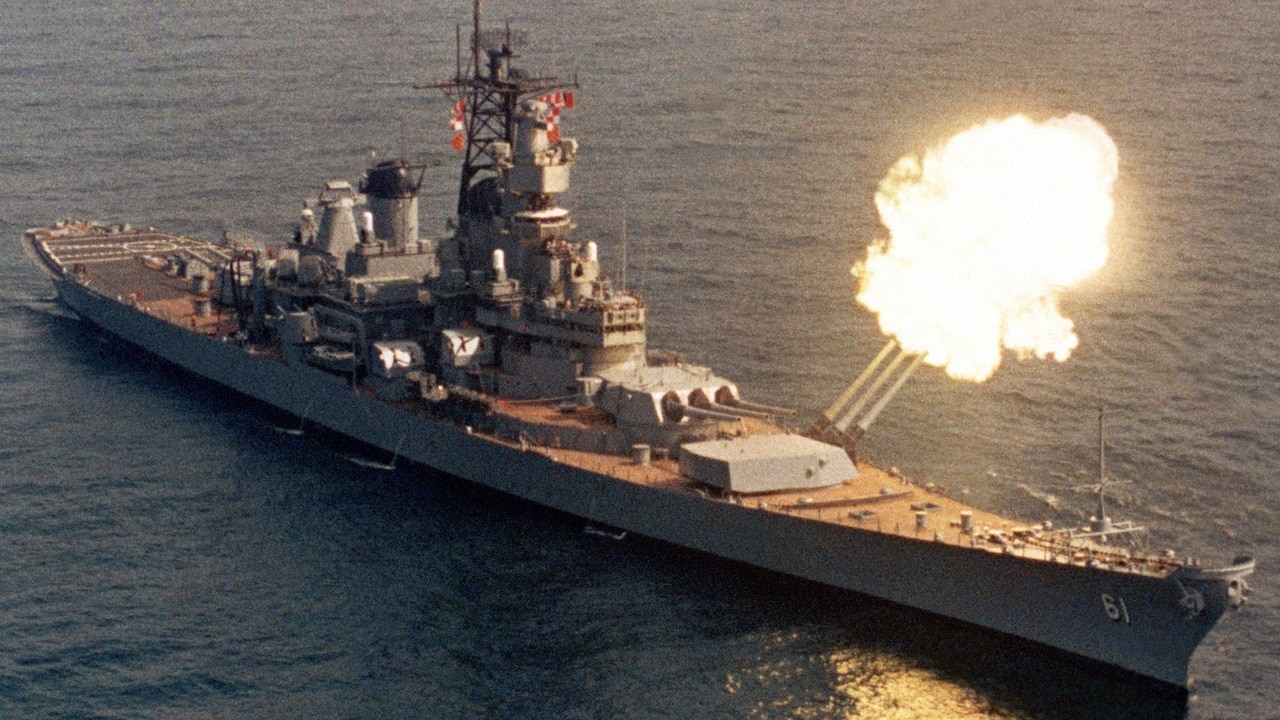
Synopsis: USS Wisconsin (BB-64)—the Iowa-class “Big Whisky”—entered service in April 1944 and surged into the Pacific Ocean, escorting fast carriers and delivering shore bombardment at Iwo Jima and Okinawa.
-Reactivated for 1950s fighting off the Korean Peninsula, it absorbed a direct 152 mm hit with minimal damage, then pinpointed and demolished the gun position with all nine 16-inch guns.
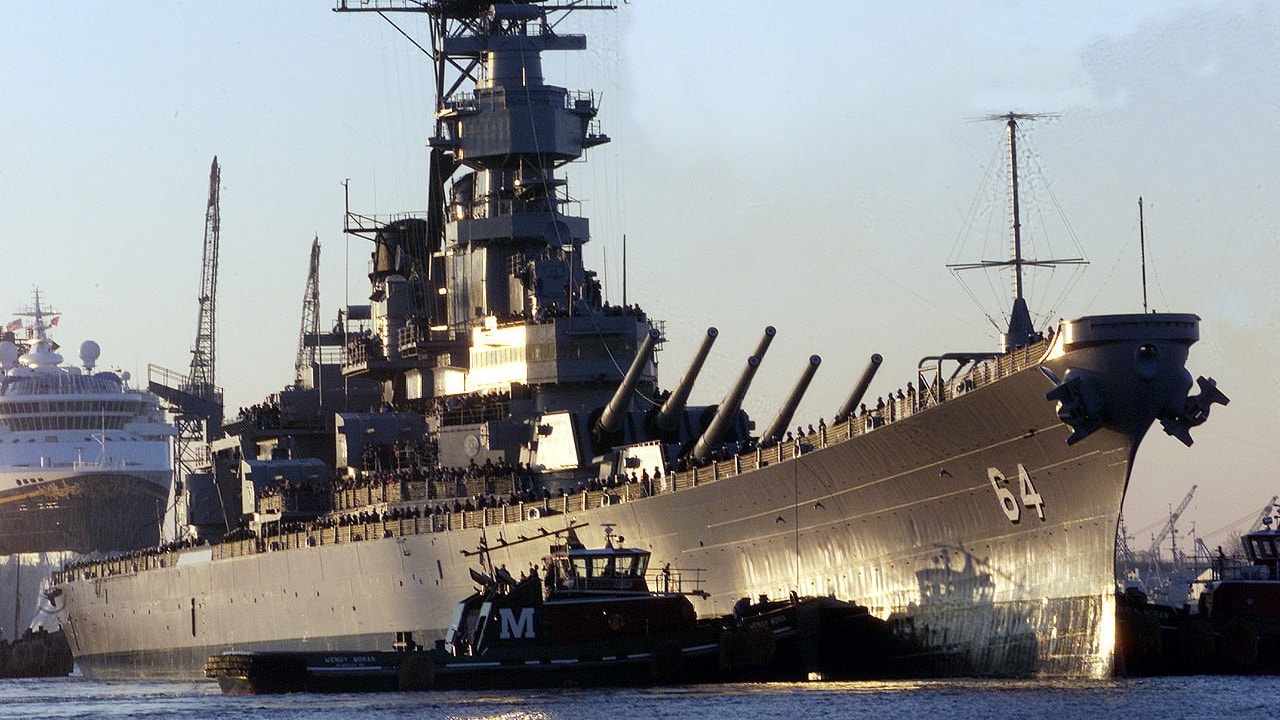
A tug boat nudges the bow of the battleship USS Wisconsin (BB 64) as the ship is pushed from the Norfolk Naval Shipyard to the Nauticus Museum in Norfolk, Va., on Dec. 7, 2000. The Wisconsin will be the centerpiece of a four-part exhibit on the battleship’s role in Naval history.
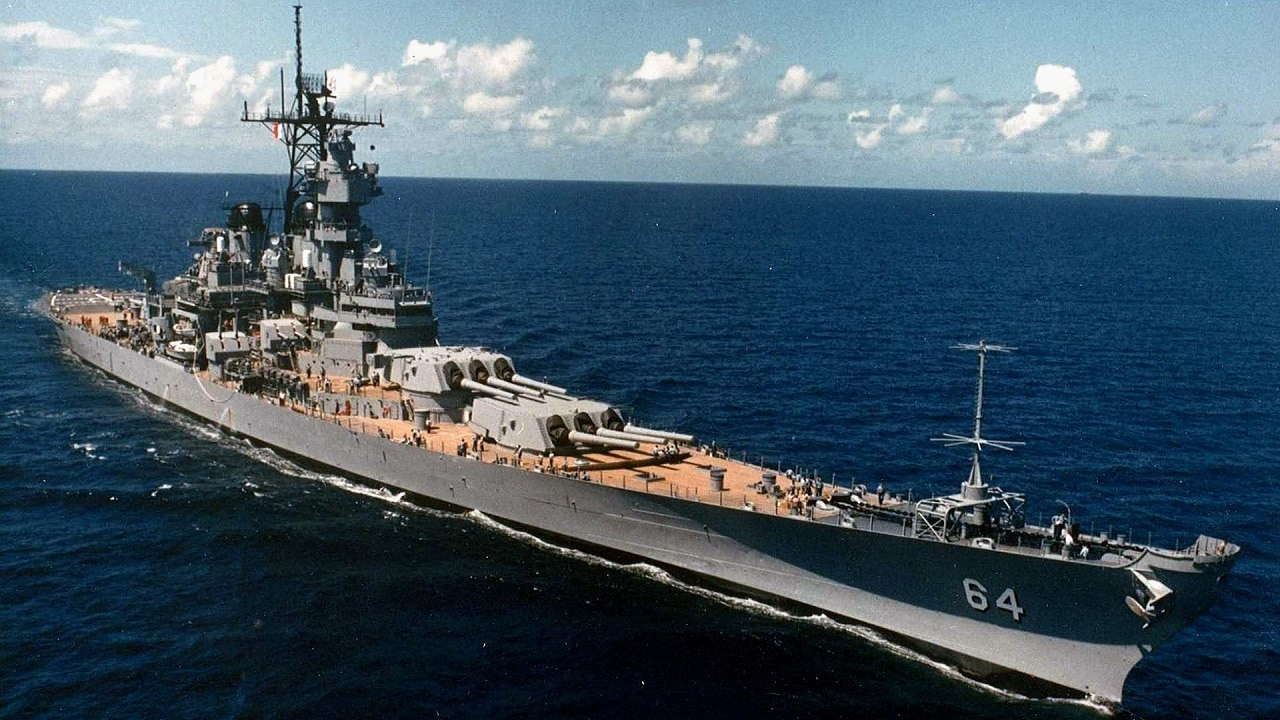
USS Wisconsin. Image Credit: Creative Commons.
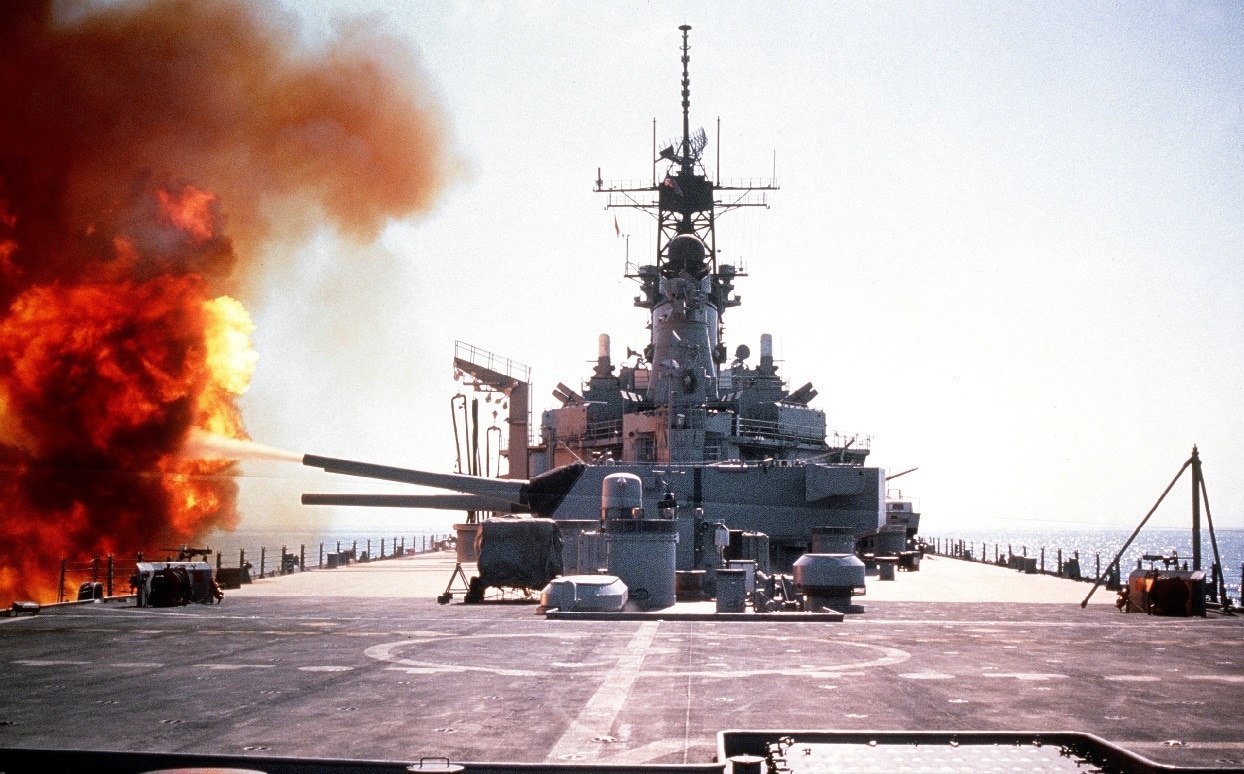
Image: Creative Commons.
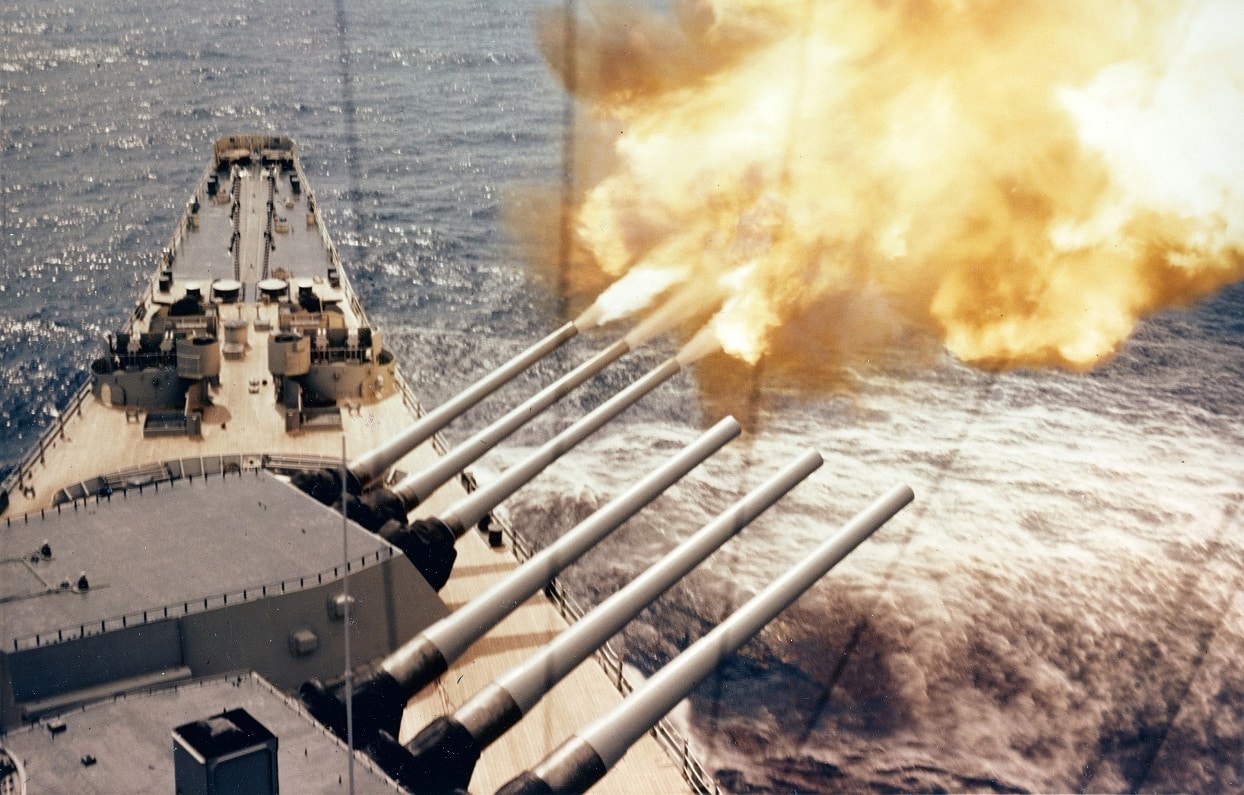
USS Wisconsin (BB-64) Fires a three-gun salvo from her forward 16/50 gun turret, during bombardment duty off Korea. Photograph is dated 30 January 1952. Official U.S. Navy Photograph, now in the collections of the National Archives.
-Modernized in the 1980s with cruise and anti-ship missiles, and equipped with close-in defenses, it returned to combat in the Persian Gulf in 1991—firing some of the last salvos from a battleship and even prompting a surrender to its drone scout.
USS Wisconsin, “The Big Wisky” Iowa-Class Battleship
The USS Wisconsin (BB-64) is an Iowa-class battleship built for the United States Navy (USN) during World War II.
Completed in 1944, the ship was assigned to the Pacific Theater during World War II, where she participated in the Philippines campaign and the Battles of Iwo Jima and Okinawa. The battleship shelled the Japanese home islands shortly before the end of the war in September 1945.
During the Korean War, Wisconsin shelled North Korean and Chinese targets in support of United Nations and South Korean ground operations, after which she was decommissioned. She was reactivated in 1986 during the Reagan administration’s Navy buildup; after a modernization program, she participated in Operation Desert Storm in January – February 1991.
Retired again in 1991, the Wisconsin still serves as a museum ship in Norfolk, VA.
The Iowa-class battleships were the biggest ever built by the US.
USS Wisconsin (BB-64) Fires a three-gun salvo from her forward 16/50 gun turret, during bombardment duty off Korea. Photograph is dated 30 January 1952. Official U.S. Navy Photograph, now in the collections of the National Archives.
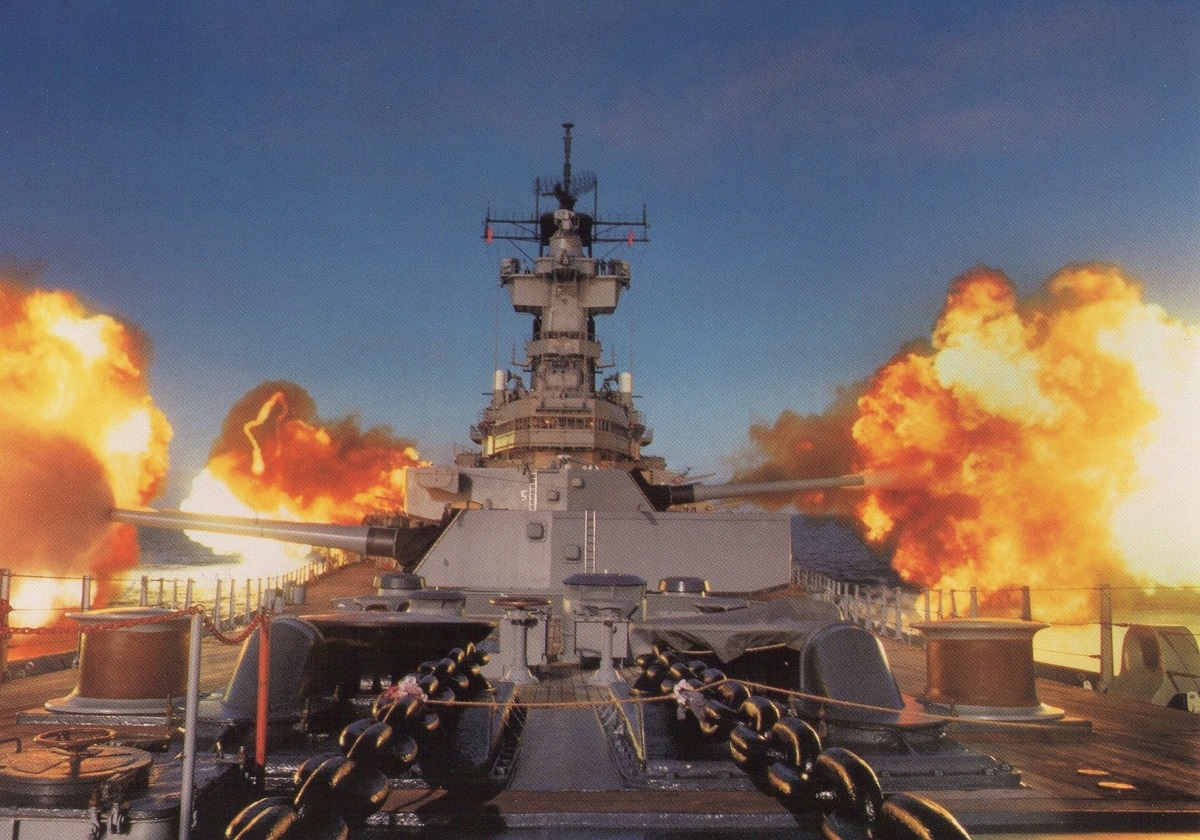
USS Wisconsin. Image: Creative Commons.
The big battlewagons of the Iowa class were the last and biggest battleships built by the United States. The Navy had initially planned to build six of the big battleships, but only four were built. As World War II showed, the aircraft carrier was the wave of the future.
However, during the war, the big battleships more than proved their worth, especially during amphibious landings. Their 16-inch (406 mm) guns could pound coastal defenses and surface ships, and the battleships could launch 2,700-pound projectiles more than 20 miles inland.
After the war, the big battleships were an afterthought, and the ships were relegated to the ‘mothball fleet‘. However, when North Korea invaded the South in 1950, the battleships would be called upon once again.
Meet The USS Wisconsin (BB-64)
The USS Wisconsin (BB-64) was the second battleship named after the state. Her keel was laid down on January 25, 1941, at the Philadelphia Navy Yard; launched exactly two years to the day after Pearl Harbor, on December 7, 1943; and commissioned on April 16, 1944, with Capt. Earl E. Stone in command.
After shakedown cruises in the Caribbean, she, along with a Navy task force consisting of the light cruiser Pasadena (CL-65), the destroyer escort Moore (DE-240), and the destroyers Collett (DD-730), Haynsworth (DD-700), Waldron (DD-699), and Charles S. Sperry (DD-697), transited the Panama Canal.
In mid-December 1944, she joined Admiral Halsey’s fleet off the coast of the Philippines. The Wisconsin performed escort duty for Task Force 38’s fast carriers during air strikes against Formosa, Luzon, and the Nansei Shoto, to neutralize Japanese forces there and to cover the unfolding Lingayen Gulf operations.
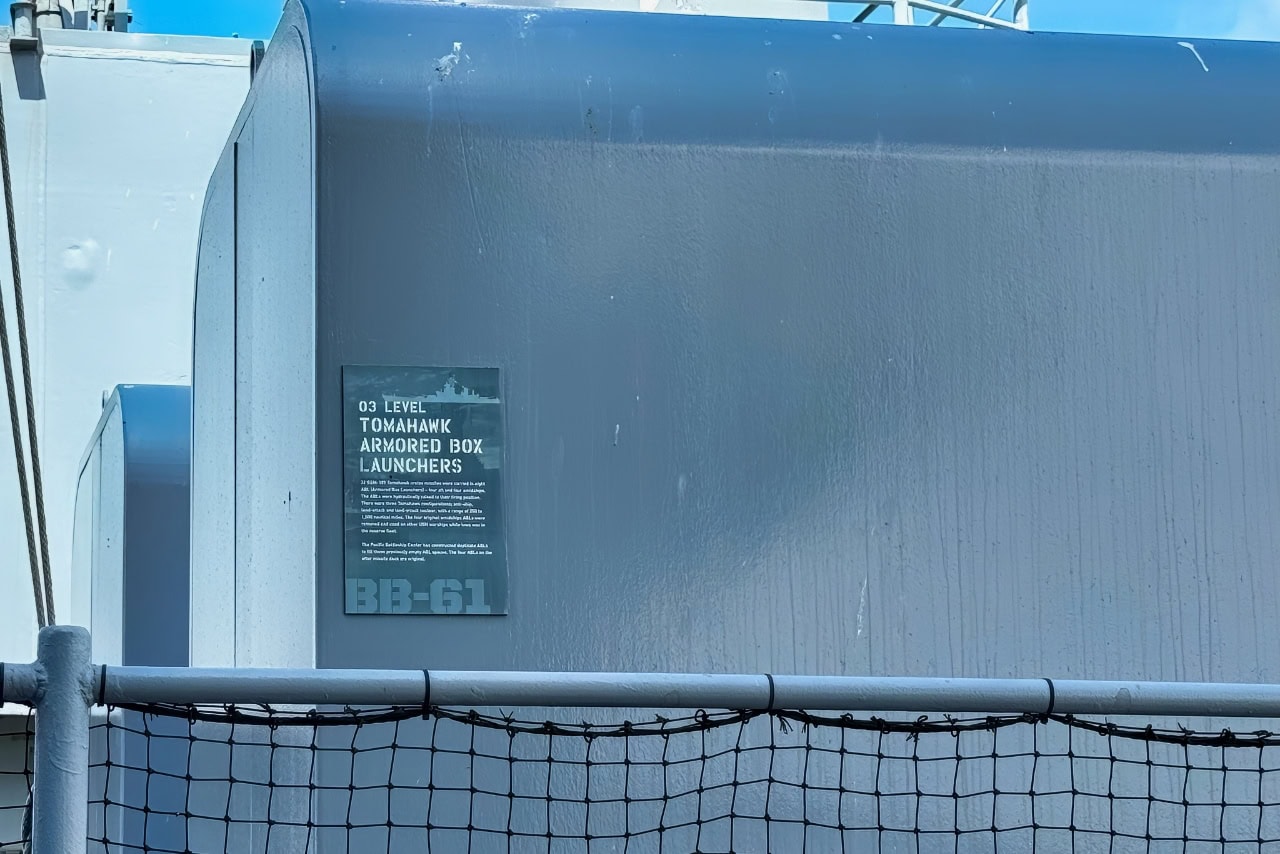
USS Iowa 19FortyFive image of Tomahawk Missiles on USS Iowa.
Those strikes, lasting from January 3 through 22, 1945, included a foray into the South China Sea, in the hope of drawing major units of the Japanese Navy into battle.
In mid-February, the Wisconsin approached the Japanese coast while carrier aircraft conducted airstrikes against the Japanese homeland. From there, she joined the invasion task force off the coast of Iwo Jima.
In March, the USS Wisconsin, Missouri, and New Jersey bombarded Okinawa in the prelude to the invasion of the island. Throughout the spring and into the summer, the big battleship remained off the coast of Japan and bombarded the Japan Steel Works.
After the Japanese surrender on August 15, she was part of the fleet sailing into Tokyo Harbor for the official surrender in September. After shuttling home troops during “Operation Magic Carpet,” the Wisconsin sailed back to the East Coast of the US and served as a training ship for cadets. On July 1, 1948, she was placed on inactive status and assigned to the Atlantic Reserve Fleet.
The USS Wisconsin’s Service in the Korean War
The Korean War began in June 1950, as Korean and US troops were pushed south. The Navy reactivated the battleships Iowa, New Jersey, Missouri, and Wisconsin from reserve status and prepared them to go to Korea.
The battleships were 887.3 feet long at the waterline and displaced roughly 55,000 tons. They were armed with nine 16-inch 50-caliber Mark 7 naval guns capable of firing high-explosive and armor-piercing shells. Secondary armaments consisted of six 5-inch/38-caliber Mark 12 guns, which could be used for bombardment or in anti-aircraft mode.
The United States and South Korean forces were pushed to the southern peninsula in June 1950 by huge numbers of North Koreans. But General Douglas MacArthur executed a brilliant amphibious operation at Inchon. The combined UN forces quickly pushed the North Koreans back to near the border with China.
Then, the Chinese entered the fray with the release of more than a quarter million troops, which shocked the Americans and later resulted in a stalemate that continued until the end of the conflict.
The battleship Missouri was the first battlewagon in action and fired volleys of 16-inch projectiles to cover the retreat of US soldiers from the Chinese border along the coastline.
Soon after, the USS Iowa, USS New Jersey, and USS Wisconsin joined the war. The “battleships used both their sixteen-inch main armament and their five-inch secondary armament to pound Chinese and North Korean positions along the coast. These positions included cave systems, concealed artillery, and command posts. As with the end of the Second World War, the battleships also hit strategic and operational targets, including railways, industrial parks, and transport centers.”
Wisconsin Hit, But Undamaged, Wreaked Havoc
The USS Wisconsin, nicknamed the “Big Wisky,” was off the coast of Songin in March 1952 and was bombarding entrenched North Korean positions ahead of an amphibious landing by the U.S. Marines. Her gunfire collapsed a tunnel through which a North Korean supply train was running.
The major tunnel collapse cut off the resupply and reinforcements of the North Koreans.
The North Koreans tried to fire counterbattery with a single 152mm artillery piece. They directly hit the USS Wisconsin, but due to the massive armor of the big battlewagon, the ship was undamaged, and no fatalities were suffered, although three sailors were wounded.
The ships offshore accompanying the USS Wisconsin were aware of the battleship’s legendary reputation as an aggressive warship. They sent signals to the ship: “Temper, temper.”
The USS Wisconsin ignored those messages and turned all nine of her 16-inch guns to bear on the pinpointed North Korean artillery position. The nine shells obliterated the North Korean position
The moral of the story is don’t mess with ‘Big Whisky.’
The battleship was returned to the “mothball fleet,” but she would be called upon again and again to defend the United States against its adversaries. The big Iowa-class battleships had more than proved their worth.
Big Wisky Returns In the 1980s In Time For Desert Storm
On October 22, 1988, the Wisconsin was recommissioned following nearly two years of refits. Among the upgrades were four Mk-141 quad cell launchers for 16 AGM-84 Harpoon anti-ship missiles, eight armored box launcher (ABL) mounts for 32 BGM-109 Tomahawk missiles, and a quartet of the navy’s Phalanx close-in weapon system (CIWS) 20-mm Gatling guns for defence against enemy anti-ship missiles and enemy aircraft.
The USS Wisconsin also received eight remotely controlled RQ-2 Pioneer unmanned aerial vehicles (UAVs), used to spot for its 16-inch guns.
On February 6, 1991, Wisconsin’s 16-inch guns destroyed an Iraqi artillery battery in Kuwait. The big battlewagon would continue to bombard additional targets in Kuwait.
In an extraordinary event, an event that occurred on February 23, a platoon of Iraqi troops surrendered to the Wisconsin’s UAV as it scouted a line of fortifications on Kuwait’s Faylaka Island.
It’s believed to be the first time in history that an aerial drone has captured enemy personnel. Big Wisky’s final shots were fired on February 28 would be the last salvos in history ever delivered in combat by a battleship.
The fast, powerful, and heavily armed battleships first envisioned for the upcoming war with Japan fired their guns in anger through Desert Storm, more than fifty years later, and were a testament to how great these ships were.
About the Author: Steve Balestrieri
Steve Balestrieri is a National Security Columnist. He served as a US Army Special Forces NCO and Warrant Officer. In addition to writing on defense, he covers the NFL for PatsFans.com and is a member of the Pro Football Writers of America (PFWA). His work was regularly featured in many military publications.