
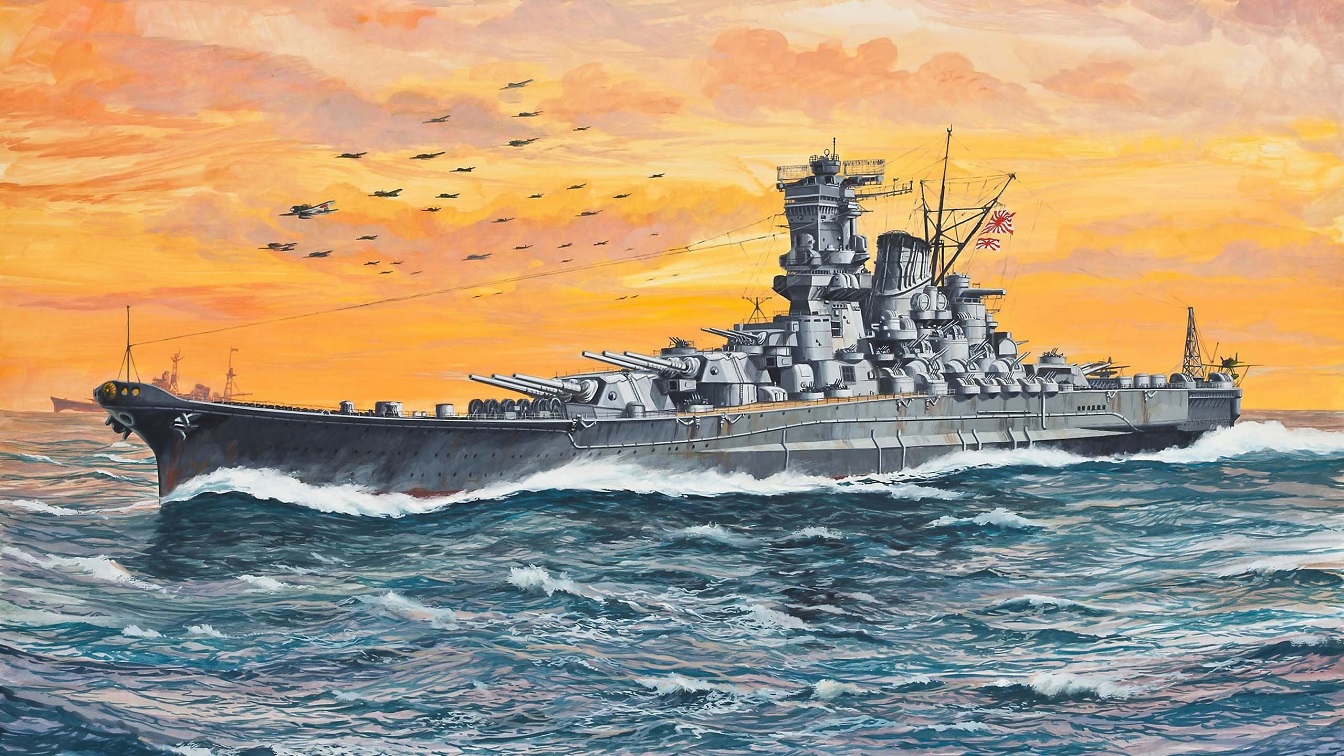
Synopsis: The Imperial Japanese Navy battleship Musashi—sister ship to Yamato—was among the largest warships ever built, displacing about 73,000 tons and mounting 18.1-inch guns that hurled massive armor-piercing shells out to roughly 26 miles.
-Yet Musashi’s story is ultimately about airpower eclipsing surface firepower. During the 1944 Battle of Leyte Gulf, U.S. carrier aircraft hammered Musashi with repeated strikes; the ship famously absorbed extraordinary punishment before finally going under, taking much of its crew with it.
-In 2015, Paul Allen’s expedition located and photographed the wreck in the Sibuyan Sea.
Japan’s Forgotten 73,000-Ton Giant: The Japanese Navy’s Musashi Battleship
Battleships are majestic machines. They have awesome size and devastating firepower. The ships bristle with guns and powerful armaments—sometimes even Tomahawk missiles.
We often write about the Iowa-class of battleships that served from World War Two through Operation Desert Storm. We have also published many stories about the mighty Japanese battleship Yamato. But Japan had another powerful dreadnought during World War Two that does not get enough attention from naval historians and media: The Musashi was huge. It displaced 73,000 tons—far outweighing the Iowa-class, which measured between 45–48,000 tons.
More About the Musashi
The Musashi is the sister ship to the Yamato, which displaced a few thousand fewer tons. The Musashi was even more heavily armed. It carried awesome 18.1-inch guns that fired up to two 3,220-pound armor-piercing shells every 60 seconds, with a maximum range of 26 miles.
Despite its power, however, the Musashi had some tough luck. It sank during the Battle of Leyte Gulf in 1944. Before going to the bottom, the Musashi proved it could take a pounding and still stay afloat. It endured hits from 19 torpedoes and 17 bombs. The Americans were astounded at how long it took for the Musashi to sink. Brave dive bombers and torpedo bombers expertly avoided the ship’s anti-aircraft guns, and when the Musashi went down at last, nearly half of her 2,399 sailors drowned.
But It Was Found By an American Exploration Effort Decades Later
The Musashi history ends with an inspiring chapter. In 2015, after years of effort, a salvage team run by Microsoft co-founder Paul Allen was able to locate and photograph the Musashi in the Philippines’ Sibuyan Sea at nearly 3,280 feet of depth.
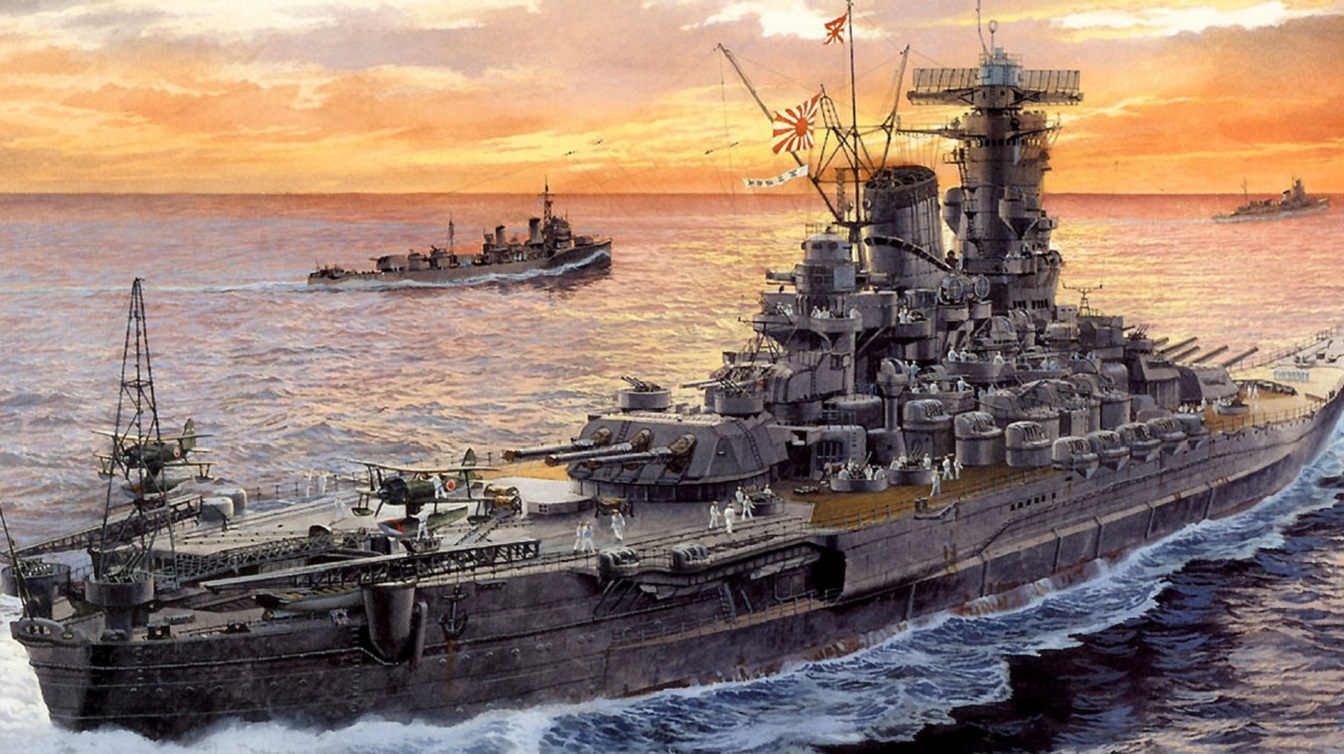
Battleship Yamato. Image Credit: Creative Commons.
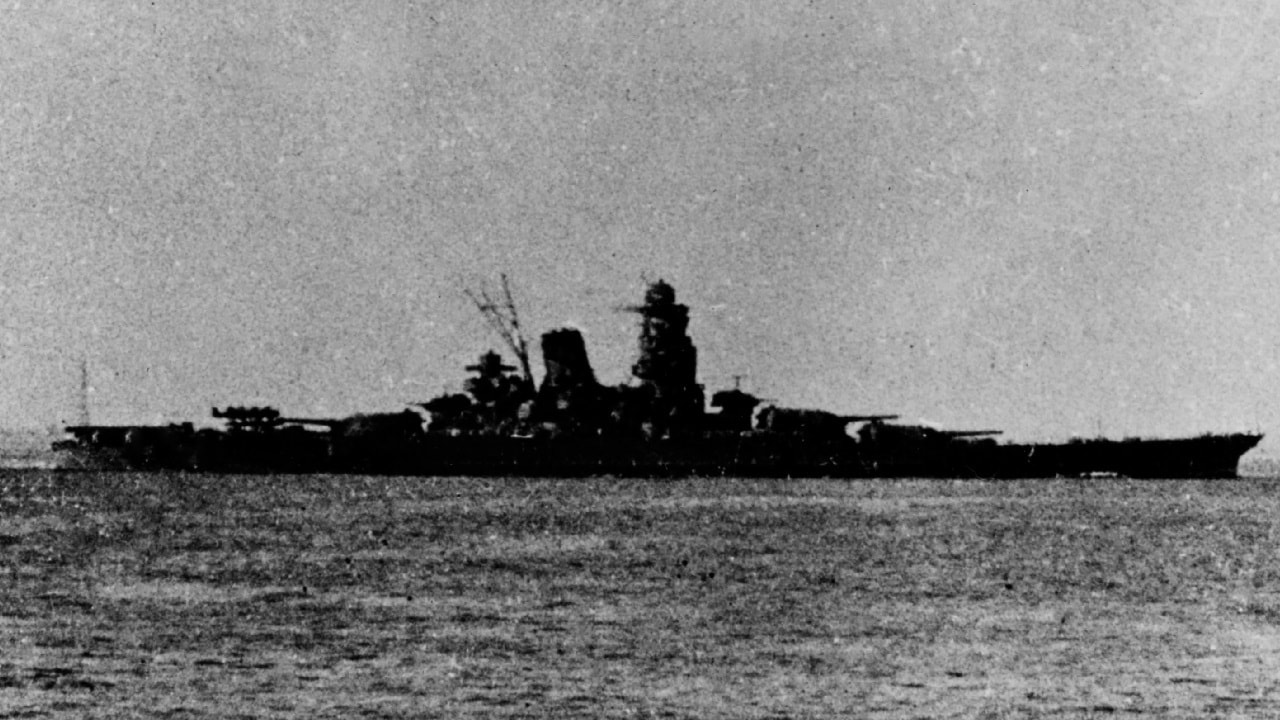
Yamato-class battleship Yamato. Image Credit: Creative Commons
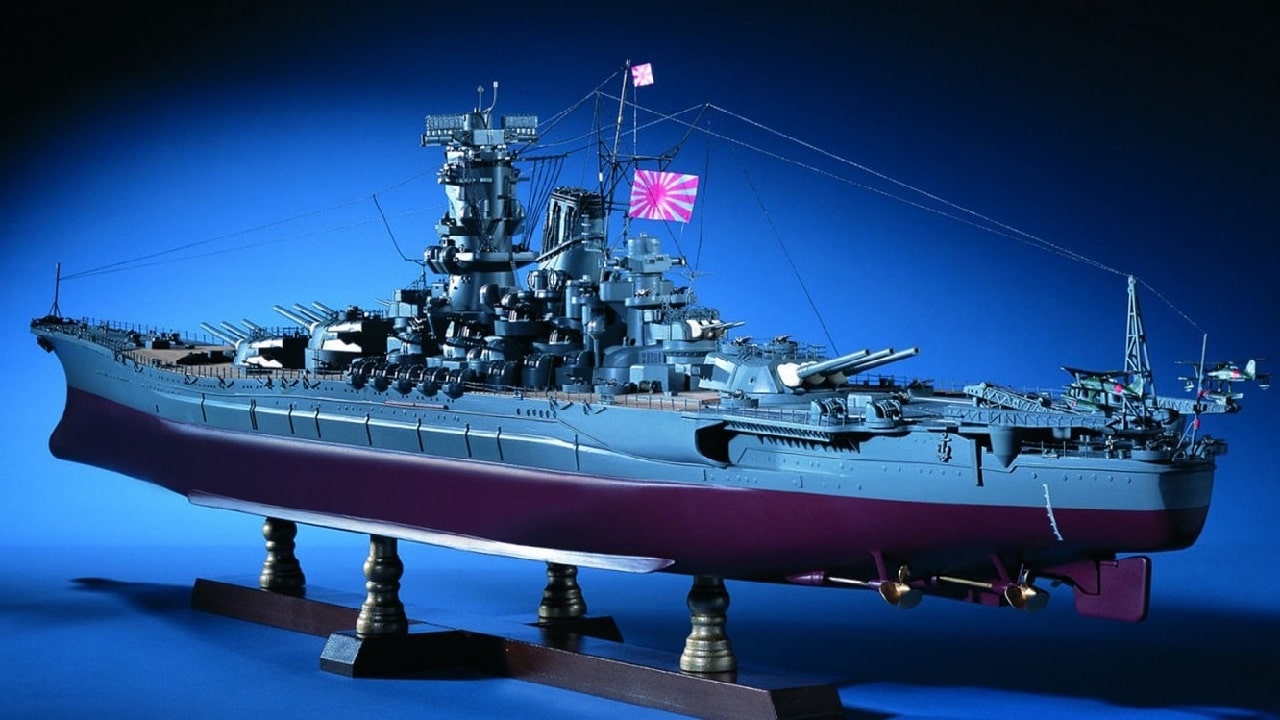
Yamato-class battleship model. Image Credit: Creative Commons.
Allen’s team spent years surveying the ocean floor and conducting deep-sea analysis to discover the wreck of the Musashi. Allen’s search yacht, the M.Y. Octopus, never gave up.
The ship lay deep in an inhospitable part of the Indo-Pacific. Other discovery crews had spent 11 years searching for the Musashi, but they all came up empty. They knew approximately where the ship lay, but it was difficult and expensive to assemble and sustain a large team for a lengthy search. The billionaire Allen, though, had almost unlimited resources and a keen interest in naval history.
Heavily Armed Battlewagon
The Musashi itself was a marvel when it was constructed in the late 1930s. It was heavily armored, and those 18.1-inch rifled guns were bigger than the 16-inch guns on the Iowa-class.
However, the Musashi was always something of a tough-luck vessel. By 1942, during its commissioning, the Japanese Navy was already running out of the airplanes necessary to keep U.S. pilots from flying close to the battleship. This lack of air cover would spell doom for the Musashi during that violent battle in which it was sunk.
In 1943, it was mainly used as a transfer ship to ferry troops and supplies to islands around the Pacific. Before the deadly Leyte Gulf battle in early 1944, it was hit by a torpedo from an American submarine. The Japanese Navy had a difficult choice to make. The admirals wanted the Musashi’s firepower and its men and cargo, but the ship needed better armor. Repairs were made, and it also received better anti-aircraft guns.
The Musashi patrolled near the area where the Battle of Philippine Sea took place in June 1944 but did not participate in the combat. It was thus spared, but its run would end later that year at Leyte Gulf.
The American Pilots Had Never Seen Such Destruction
U.S. pilots attacking the Musashi were impressed. After every hit, huge geysers sprang up—the explosions created huge shock waves that endangered the American dive bombers—but the ship absorbed the blows.
“The sinking of Musashi was the final answer to the challenge that Billy Mitchell made to the utility of warships in the early 1920s,” The Diplomat wrote, as noted by the National Interest. The publication added that “no air force in the world was capable of inflicting such damage on a moving, well-defended target before mid-1944, when the U.S. Navy was able to accumulate a fleet of pilots, attack aircraft and the carriers of size and lethality that hadn’t even been envisioned in 1942, much less 1921.”
Significant Historical Milestone
When Allen’s team found the Musashi, it was encrusted with coral and rusted almost beyond recognition. As the Guardian wrote, “Allen, who has devoted a small part of his estimated $17.5 billion fortune to deep-sea and space exploration, said on his website that the discovery of the wreck, at a depth of more than half a mile, marked ‘an important milestone in the annals of World War II naval history.’”
The wreck showed just how violent World War Two was. It also signified the vulnerability of battleships to marauding airplanes.
The sinking of the Musashi presaged the end of the Japanese Navy’s fight. Maybe in a different war, the Musashi could have dominated, but the defense industrial base of the United States simply produced more airplanes than the Japanese Navy could handle—the Musashi could not survive the aerial onslaught.
About the Author: Brent M. Eastwood
Author of now over 3,000 articles on defense issues, Brent M. Eastwood, PhD is the author of Don’t Turn Your Back On the World: a Conservative Foreign Policy and Humans, Machines, and Data: Future Trends in Warfare plus two other books. Brent was the founder and CEO of a tech firm that predicted world events using artificial intelligence. He served as a legislative fellow for US Senator Tim Scott and advised the senator on defense and foreign policy issues. He has taught at American University, George Washington University, and George Mason University. Brent is a former US Army Infantry officer. He can be followed on X @BMEastwood.