
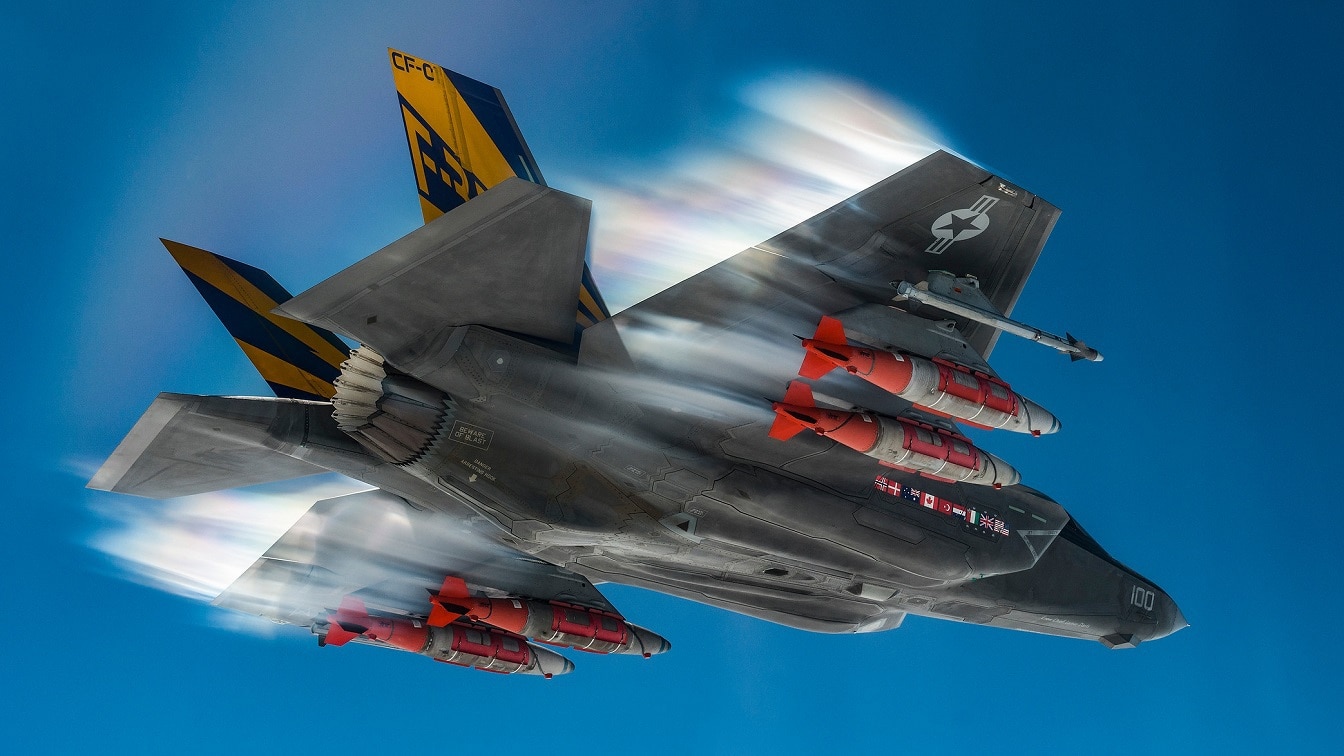
Synopsis: Canada is sending a practical signal on fighter procurement: paying for long-lead F-35 components while publicly insisting the purchase is still under review.
-That upstream spending locks in schedule, workshare, and industrial participation, narrowing the odds of a late pivot.
-The argument is strategic, not aesthetic—continental defense through NORAD and coalition relevance now depend on survivable sensors and real-time data integration.
-A split fleet may look economical, but it multiplies training, maintenance, basing, and mission-planning friction in a force already short on depth. Time, not slogans, is the hidden cost.
Canada’s F-35 “Review” Is Over in Everything but Name
Canada is paying for parts of an aircraft it still claims to be “reviewing.” That is not a bureaucratic curiosity. It is a tell. Ottawa does not allocate scarce funds to long-lead fighter components unless the runway ahead is already being cleared. The practical signal is plain: Canada is moving toward a larger F-35 buy, and it should.
The Quiet Signal On the F-35
The payments matter because they sit upstream from the public decision point. Advanced fighters do not work like pickup trucks on a dealer lot. Production queues are real, suppliers sequence work years out, and a country that waits for a neat cabinet moment often finds its delivery window sliding right as its legacy fleet ages out.
Long-lead funding also creates facts on the ground. It anchors Canadian firms in the production stream, protects workshare already earned, and keeps Canada’s place in line. That is not the same as signing for the full fleet. It is still a form of commitment, because it narrows the set of plausible alternatives as time passes and money accumulates.
A government that truly intended to walk away would slow this down, not accelerate it. It would avoid small decisions that lock in larger ones later. Ottawa has chosen the opposite direction.
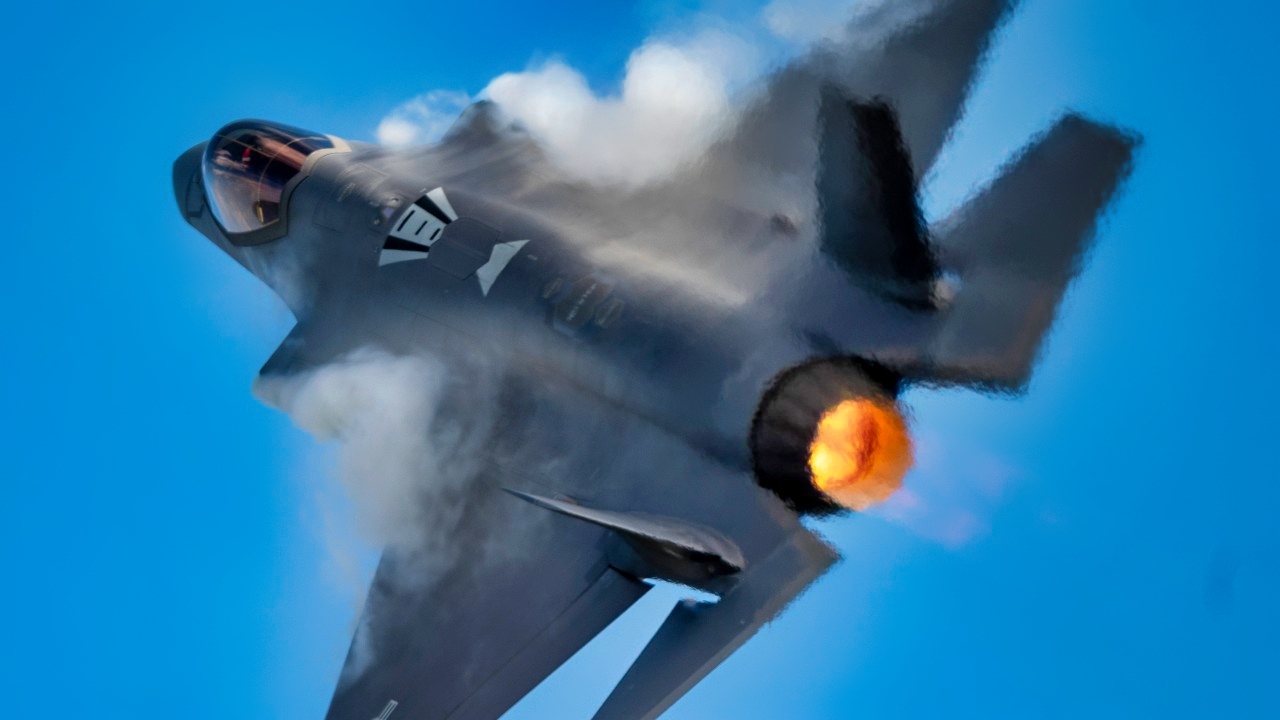
U.S. Air Force Maj. Melanie “Mach” Kluesner, the pilot for the F-35A Demonstration Team, performs aerial maneuvers in a USAF F-35A Lightning II during the practice day before the airshow at Jacksonville Naval Air Station, Florida, on 18 October, 2024. The practice day ensures that the team is able to safely and properly display the power, agility, and lethality of America’s 5th generation fighter jet. (U.S. Air Force photo by Senior Airman Nicholas Rupiper)
The Aircraft Canada Actually Needs
Canada’s airpower problem is not a boutique debate about stealth for its own sake. The job is continental warning and response, carried out in lockstep with the United States through NORAD, and reinforced through expeditionary commitments with allies who now fight inside dense air defenses. That environment rewards aircraft that can survive, sense, and share in real time. The F-35 was built for that world.
The point is not that other aircraft cannot fly sovereignty patrols. They can. The point is that sovereignty patrols no longer sit apart from a larger sensor and command system. Modern continental defense is becoming a data contest as much as a platform contest. Canada needs an aircraft that can plug into that system without workarounds that look acceptable on briefing slides but turn brittle under pressure.
Ottawa’s review has often been framed as a choice between autonomy and dependence. That framing misleads. Canada’s operational reality is integration. It has been integrated for decades and will remain so because geography and alliance structure leave little room for romantic independence.
The Mixed Fighter Fleet Trap
The alternative that keeps resurfacing is a split buy. Deploy a small number of F-35s for high-end warfare, then fill out the force with a lower-cost fourth-generation platform like the Gripen for routine tasks. On paper, that appears balanced. In practice, it creates friction that compounds.
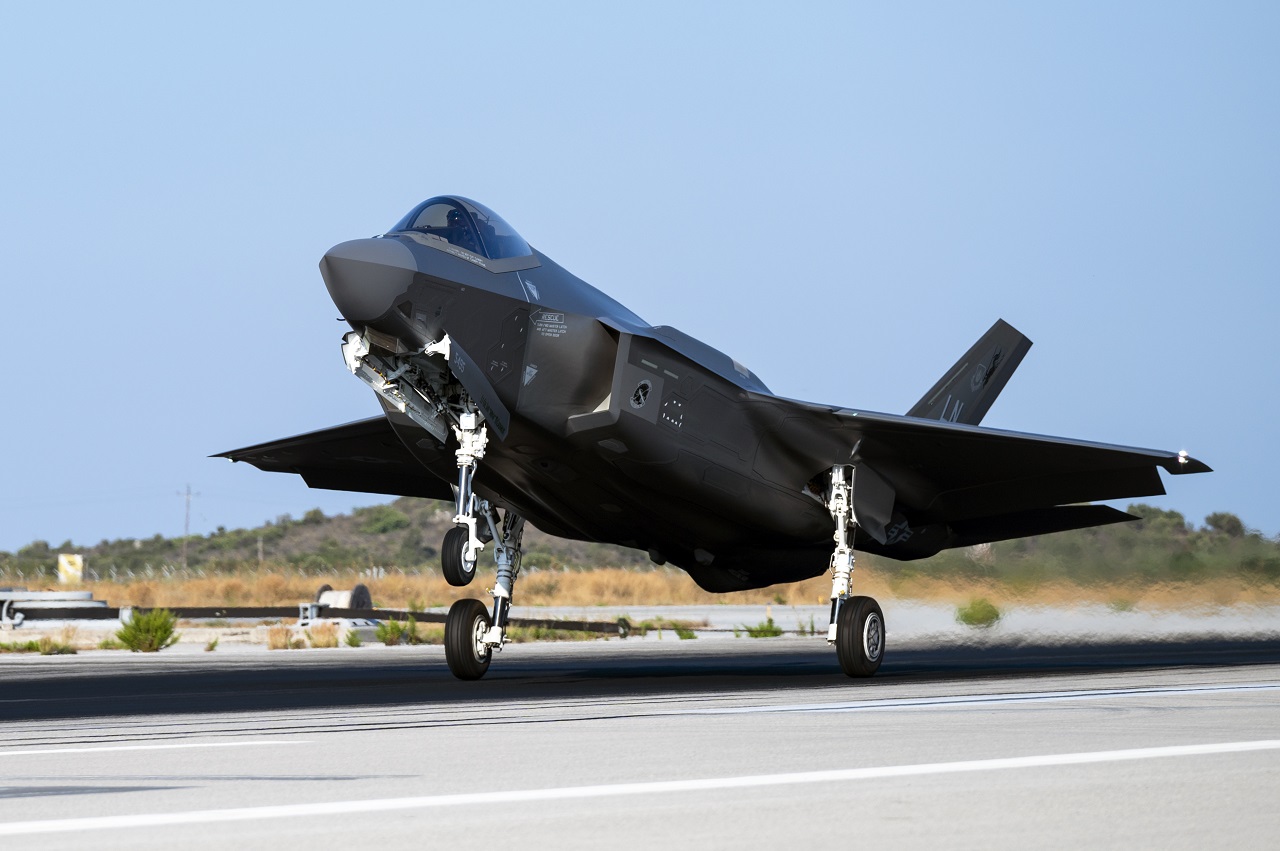
A U.S. Air Force F-35A Lightning II, assigned to the 495th Fighter Squadron from Royal Air Force Lakenheath, England, lands for the first time at Souda Air Base, Greece, July 7, 2022. The fifth-generation aircraft will be participating in exercise Poseidon’s Rage, in an effort to bolster U.S.-Hellenic readiness and interoperability. (U.S. Air Force Photo By Tech. Sgt. Rachel Maxwell)
A mixed fleet duplicates training pipelines. It divides maintainers by airframe. It complicates basing and spares. It also pushes mission planning into constant compromises, as commanders may be tempted to allocate the “good” jets to the hard problems while leaving the remainder to handle what appears easy until it suddenly is not.
Canada already struggles with personnel depth. It already faces infrastructure demands at Cold Lake and Bagotville as the CF-18 approaches the end of its service life. A split fleet is not a clever hedge under those conditions. It is a tax paid every day, in every squadron, for the privilege of saying the country kept its options open.
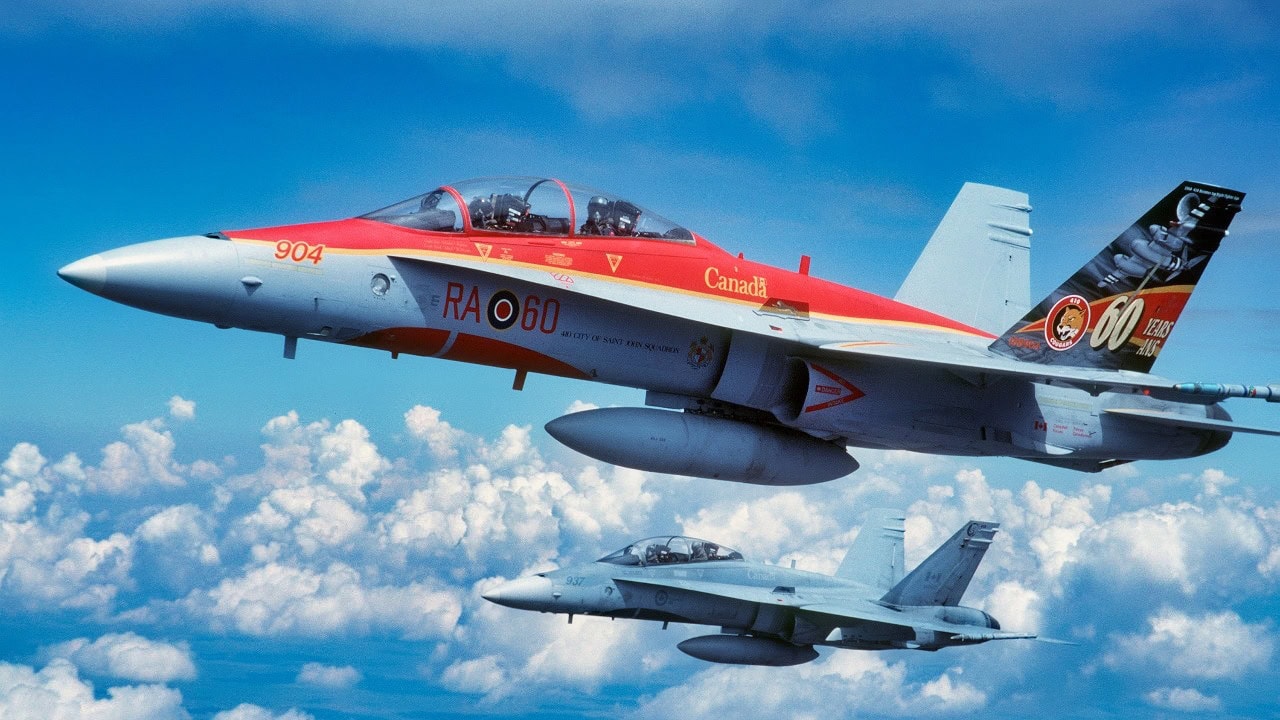
Two Canadian Forces, 410 Squadron CF-188B Multi-Role Fighters, one painted in special anniversary colors, flying over the Utah Test and Training Range (UTTR) for planned engagements during the Tiger Meet of the Americas. The Inaugural Tiger Meet of the Americas brought together flying units from throughout North America that have a Tiger or large cat as their unit symbol. The Tiger Meet of the Americas closely mirrors the North Atlantic Treaty Organization (NATO)/Europe Tiger Meet in its goal of fostering camaraderie, teamwork and tactics familiarization.
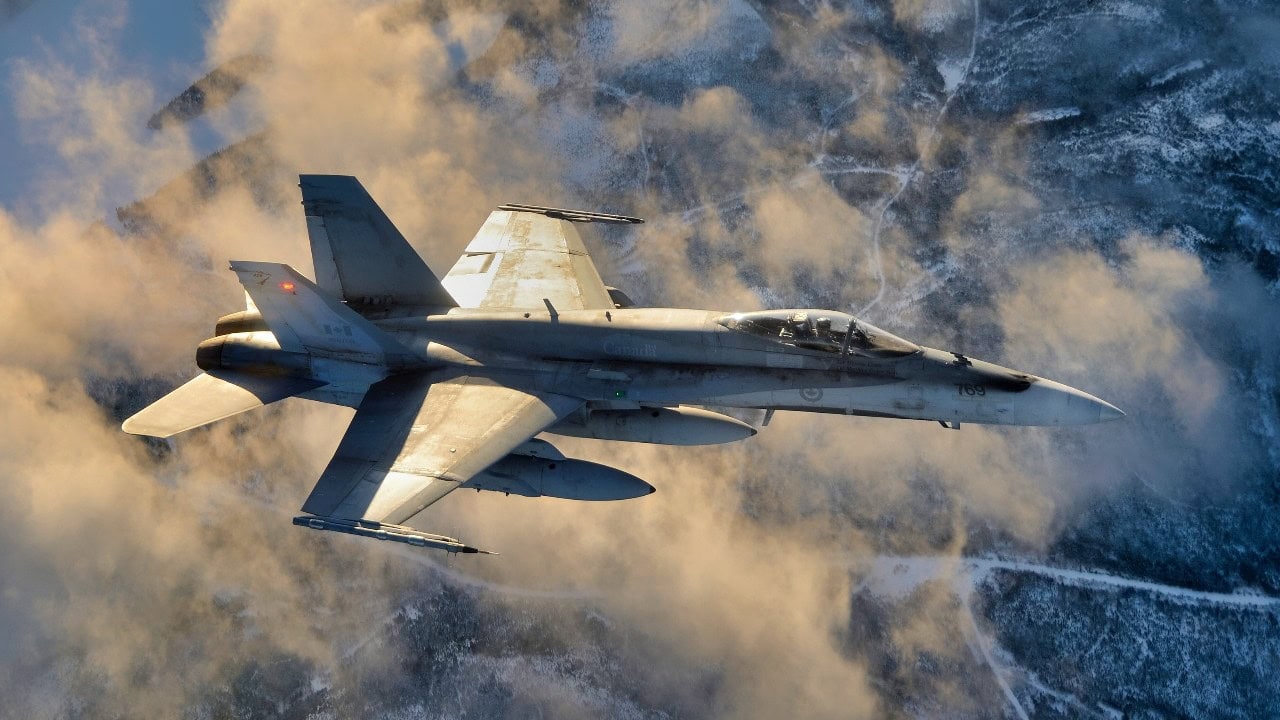
Canada Air Force CF-18. Image Credit: Creative Commons.
The long-lead payments point in the other direction. They suggest Ottawa has begun to internalize the real cost of indecision.
Industrial Leverage Without Illusions
There is also a domestic economic angle that matters, and it runs counter to the comforting myth that Canada can walk away without consequences. The Canadian industry is already embedded in the F-35 program. Components made in Canada are stored on aircraft delivered worldwide. That is not a future promise. It is an existing supply relationship with real jobs and real firms, depending on stable participation.
Ottawa can press for better terms. It can demand clearer sustainment arrangements. It can push for deeper in-country maintenance capacity. Those are legitimate objectives, and they fit Canada’s broader need to strengthen its defense industrial base. What Ottawa cannot do is pretend that a late pivot to another aircraft will be costless. Industrial policy does not work on slogans. It works on contracts, facilities, and predictable demand.
Long-lead funding is the language those systems speak. It tells partners and suppliers that Canada is not merely browsing.
The Real Cost Question On the Stealth Fighter Call
Any serious F-35 argument must acknowledge cost pressures. Independent oversight has warned that the program’s overall bill is rising, driven by inflation and infrastructure costs. That matters. It should sharpen scrutiny, not trigger panic.
The relevant comparison is not sticker price in isolation. It is cost-relative to function. A cheaper aircraft that requires extensive integration fixes, extra command-and-control work, and sustained mitigation to operate alongside U.S. forces can become expensive in a different way. It can also become strategically costly when it reduces the quality of Canada’s contribution in the moments that matter most.
There is another cost that often receives insufficient attention. Time. Canada’s CF-18 fleet has been extended repeatedly. That buys months, not decades. Each year of delay increases the risk that Canada will be forced into a rushed decision later, on worse terms, with fewer options, and with a readiness gap that is harder to hide.
Sorry, JAS 39 Gripen: The Decision Ottawa Is Already Making
Ottawa’s public posture still leans on the language of review. The spending behavior points elsewhere. Purchasing long-lead components tied to additional aircraft was decided in advance of the press conference. It reflects a government that understands how procurement momentum works and is quietly deciding to live with it.
That is the right move. Canada’s defense posture rests on NORAD credibility and coalition relevance. The air domain is where both are tested first, and where failure is hardest to explain away after the fact. The F-35 is not perfect and will require discipline in sustainment and force generation. Yet it remains the aircraft that best fits Canada’s operational ecosystem, because that ecosystem has already evolved around fifth-generation integration.
Canada can keep pretending it is still at the start of the decision tree. The purchase of long-lead parts suggests it knows better. The only serious question now is when Ottawa will match its public language to the reality it is already funding.
About the Author: Dr. Andrew Latham
Andrew Latham is a non-resident fellow at Defense Priorities and a professor of international relations and political theory at Macalester College in Saint Paul, MN. You can follow him on X: @aakatham. Dr. Latham writes a daily column for 19FortyFive.com.