
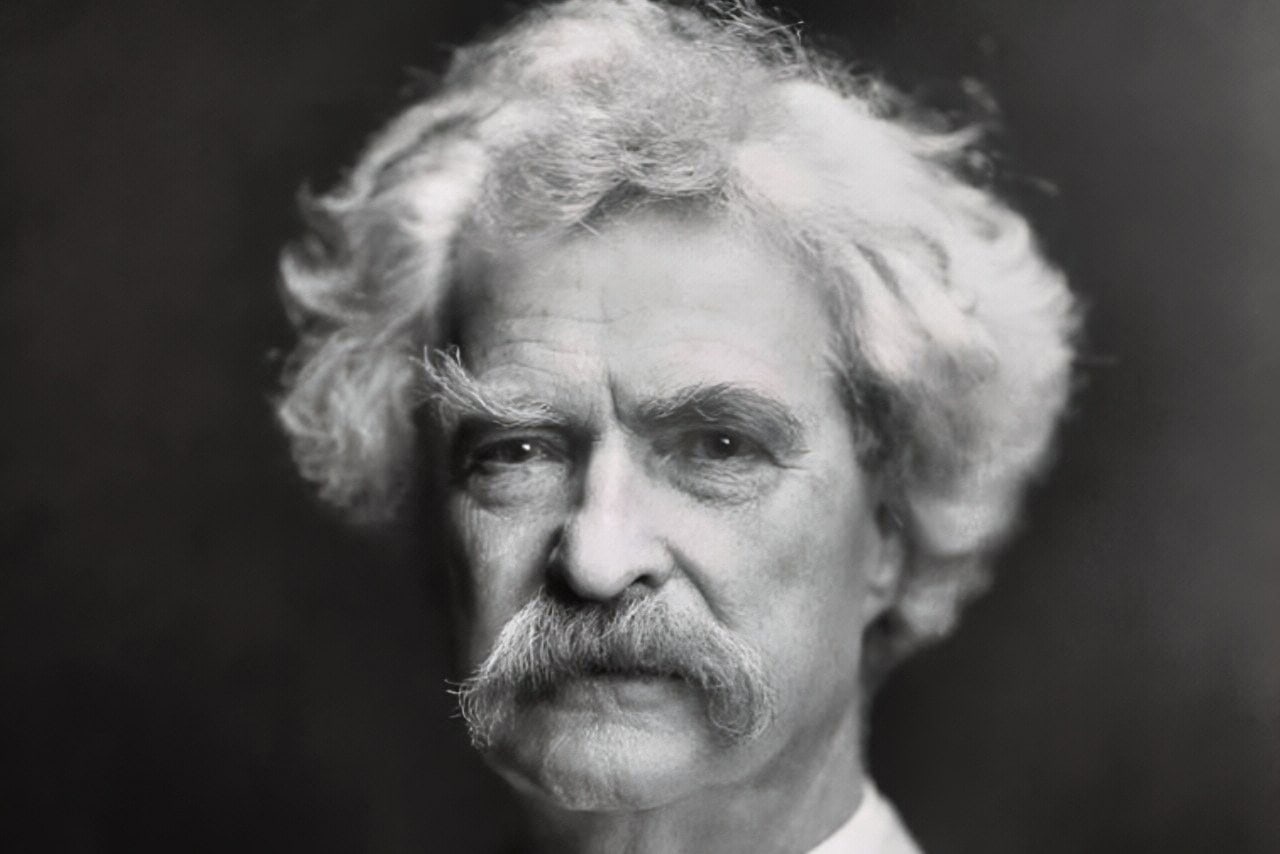
Synopsis: Mark Twain, born Samuel Clemens, remains America’s most iconic wit, famously entering and exiting the world alongside the appearance of Halley’s Comet.
-His Missouri roots in Hannibal shaped the legends of Tom Sawyer, but his real-life adventures were equally cinematic.
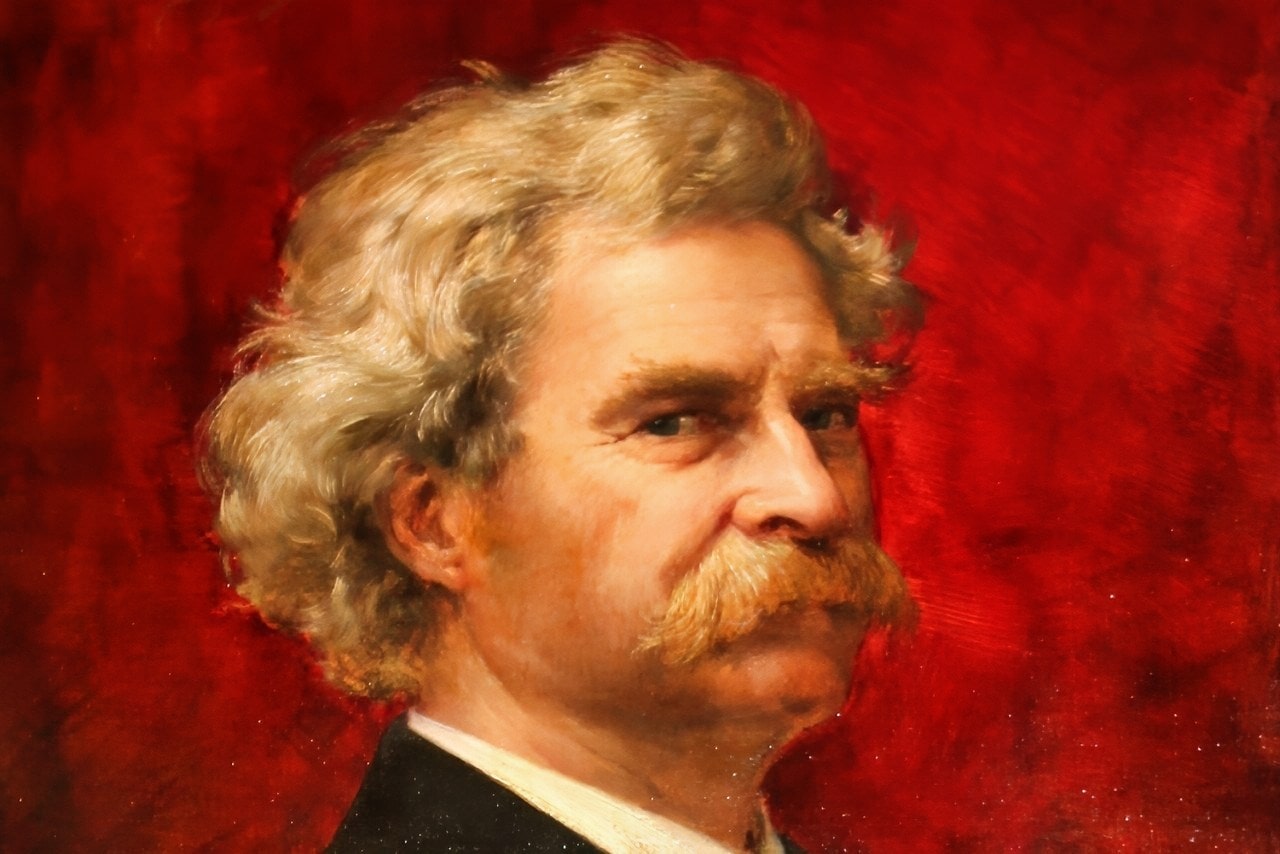
Mark Twain Portrait. Image Credit: Creative Commons.
-From a short-lived, two-week stint as a Confederate militia officer to his transformative years as a Mississippi riverboat pilot—where he earned the pseudonym “Mark Twain” (signaling 12 feet of safe water)—Clemens’ life was a series of fortuitous retreats and cosmic coincidences.
-Explore the eerie predictions and tragic upbringing of the man who founded all modern American literature.
QUOTE OF THE DAY – “I am an old man and have known a great many troubles, but most of them never happened.” – Mark Twain
The above quote is often attributed to the late great Samuel Langhorne Clemens. Though it may be apocryphal, the author known to the world as Mark Twain certainly was a master of wit.
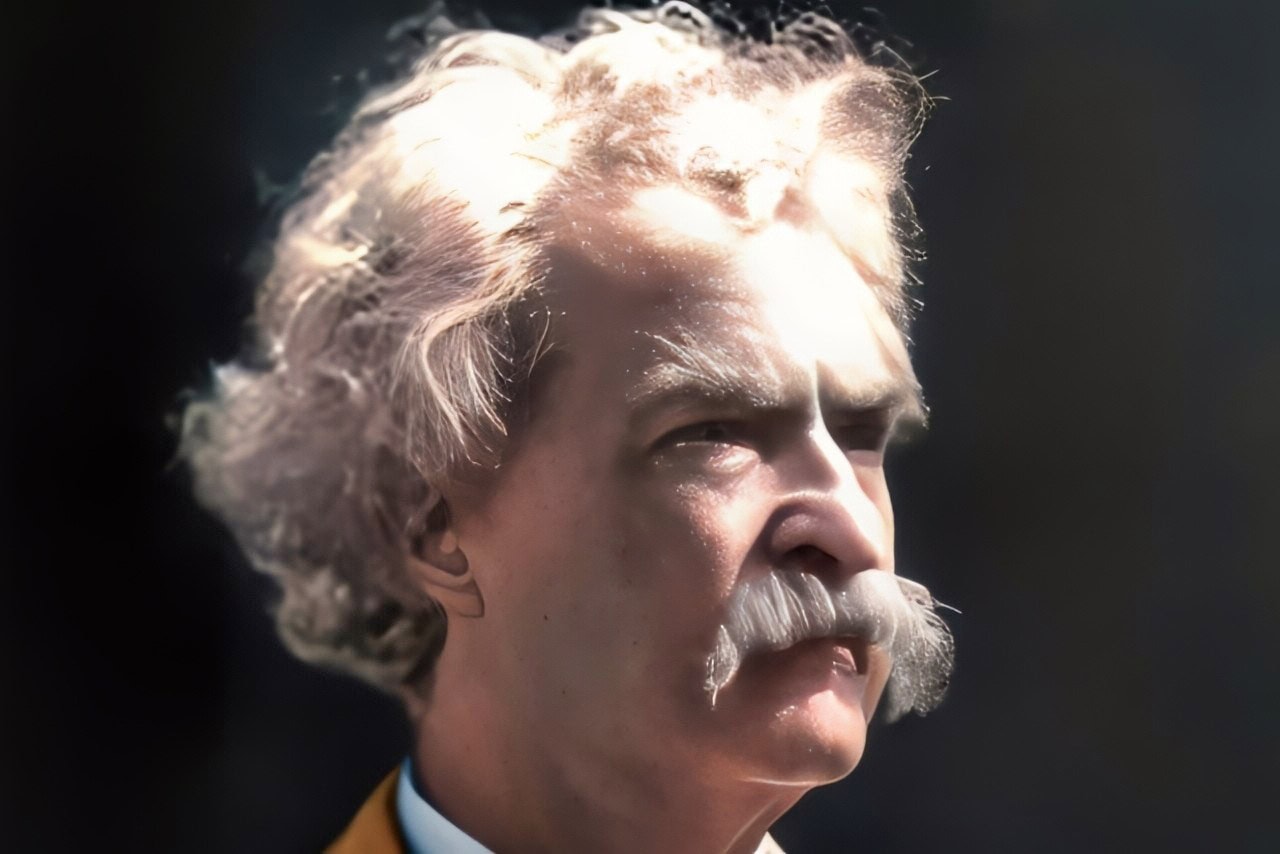
Mark Twain. Creative Commons Image.
His Birth: Cometary Cosmic Clemens?
Samuel Langhorne Clemens was born on November 30, 1835, in Florida, Missouri, and grew up in the small town of Hannibal, Missouri
There is a certain crazy cosmic coincidence to Clemens’s birth and death that astronomers and astrologers will find fascinating: a nexus with Halley’s Comet. He was born two weeks after the world’s most famous comet made its closest approach to the Earth.
In Twain’s own words (written the year before his passing): “I came in with Halley’s Comet in 1835; it’s coming again next year, and I expect to go out with it. It would be a great disappointment in my life if I don’t. The Almighty has said, no doubt: ‘Now here are these two unaccountable freaks; they came in together, they must go out together.'”
Indeed, his words proved eerily prescient, as his fatal heart attack transpired on April 21, 1910 (he was 74 years old at the time), the day after Halley’s Comet made its closest and most visible approach to the Sun.
Presbyterian Parentage
Some might find his reference to “The Almighty” a tad curious, given the rather dim views of organized religion that Twain espoused in his later years.
That said, true to his partial Scots-Irish ancestry (he was also of partial English descent), Samuel Clemens was raised as a Presbyterian, and his funeral would indeed take place in a Presbyterian church.
Alas, young Sam lost half of that parentage at an early age: His father, John Marshall Clemens, died when the boy was only 11 years old, compelling Sam to drop out of school and go to work as an apprentice for a printer to earn money and support his widowed mother and his six siblings.
The silver lining behind the cloud of this tragedy was that this job with the printer planted the seed of writing in his brain.
“Rollin’ On A River…”
“But I never saw the good side of the city/Till I hitched a ride on a riverboat queen/Big wheel keep on turnin’/Proud Mary keep on burnin’/Rollin’, rollin’, rollin’ on the river”—“Proud Mary” by Creedence Clearwater Revival (CCR).
Granted, that song came out over a century after Twain’s riverboat career, but eh, what the heck, I still consider it thematic.
Hannibal was located on the Mississippi River and set the stage for young Sam’s fascination with riverboats.
Around the age of 21, he decided to turn that childhood fascination into a career pursuit, training as a pilot on a steamboat and finally earning his pilot’s license after two years of intensive study. The decision proved to be fortuitous in more ways than one. The career would provide his famous nom de plume: “Mark Twain” comes from a term used on steamboats to signal that the water was 12 feet deep.
A Brief and Inauspicious Military Career
What is almost forgotten by all but the most hardcore history buffs is that Twain did in fact serve ever-so-briefly in the American Civil War (which broke out when he was 26 years of age).
As Claire Barrett writes for HistoryNet, “In the summer of 1861, the former riverboat pilot went to war, according to the St. Louis Magazine, on a small yellow mule carrying a valise, a carpetbag, two gray blankets, a homemade quilt, a squirrel rifle, 20 yards of rope, a frying pan and, perhaps most importantly of all, an umbrella.
“The 25-year-old Missourian, alongside 14 other idealistic young men, answered Gov. Claiborne Fox Jackson’s call of 50,000 militia to defend their home state. The few, the band of brothers, called themselves the Marion Rangers, with Twain entering their ranks as a second lieutenant.”
However, Lt. Clemens abruptly quit that militia officer’s billet after a measly two weeks. In his own words (penned in 1885 in the satirical short story The Private History of a Campaign That Failed), “The first hour was all fun, all idle nonsense and laughter. But that could not be kept up. . . . I knew more about retreating than the man that invented retreating,”
A Writing Career Is Born
However, that act of de facto desertion proved to be every bit as fortuitous as Twain’s riverboat pilot work.
His brother, Orion Clemens, offered him an opportunity to go west that summer to Nevada, an offer that Samuel readily accepted.
It was upon his westward migration that his writing career began in earnest.
He started with short stories, and the first of the batch to gain true popularity and critical acclaim was The Celebrated Jumping Frog of Calaveras County, published in 1865.
The rest is history.
About the Author: Christian D. Orr, Defense Expert
Christian D. Orr is a Senior Defense Editor. He is a former Air Force Security Forces officer, Federal law enforcement officer, and private military contractor (with assignments worked in Iraq, the United Arab Emirates, Kosovo, Japan, Germany, and the Pentagon). Chris holds a B.A. in International Relations from the University of Southern California (USC) and an M.A. in Intelligence Studies (concentration in Terrorism Studies) from American Military University (AMU). He is also the author of the newly published book “Five Decades of a Fabulous Firearm: Celebrating the 50th Anniversary of the Beretta 92 Pistol Series.”