
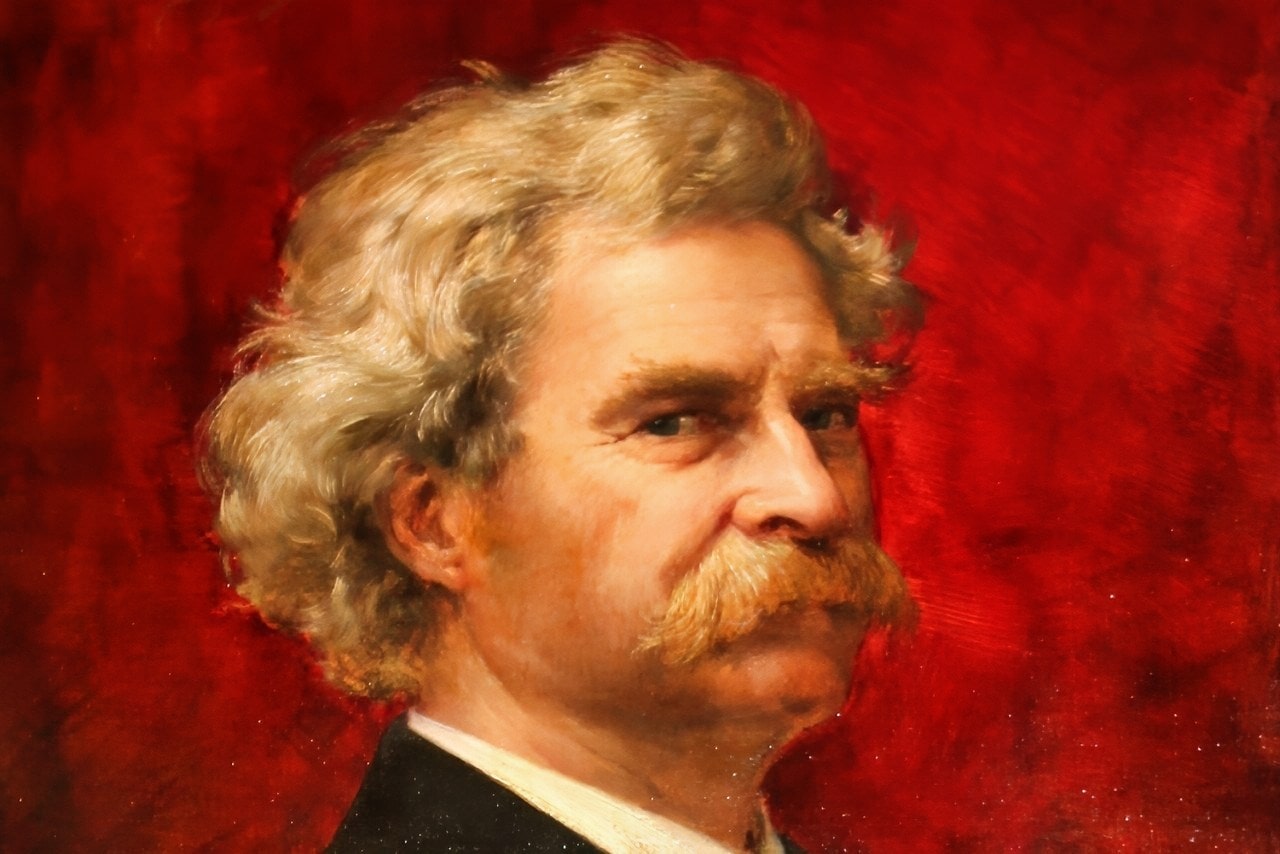
Summary and Key Points: Mark Twain—born Samuel Langhorne Clemens in 1835—rose from a modest Missouri upbringing into one of America’s defining writers and satirists.
-After his father died, Clemens left school early and apprenticed as a printer, then pursued a dream on the Mississippi as a steamboat pilot, a world that later inspired his pen name “Mark Twain.”
-He broke out with short fiction before producing enduring classics like Tom Sawyer and Huckleberry Finn, and later skewered power and hypocrisy in A Connecticut Yankee in King Arthur’s Court. Twain died in 1910, but his work and persona remain deeply woven into popular culture.
Mark Twain’s 1 Quote That Explains a Life: “The Day You Find Out Why”
“The two most important days in your life are the day you are born and the day you find out why.” – Mark Twain
That quote belongs to Mark Twain, one of the most renowned American writers, political commentators, and humorists of the late 19th and early 20th centuries.
More has been written about (and by) Mark Twain than you can shake a stick at. But it’s always a good time to take a look at Twain’s life and career.
Early Life
Samuel Langhorne Clemens was born on November 30, 1835, in Florida, Missouri, and grew up in the small town of Hannibal, Missouri, which was located on the Mississippi River and set the stage for young Samuel’s fascination with riverboats. Samuel was the sixth of seven children of Jane (née Lampton), a Kentuckian, and John Marshall Clemens, a Virginian. Twain was of English and Scots-Irish descent.
Sadly, John Clemens died when his son was only 11 years old. Out of economic necessity, Samuel dropped out of school and went to work as an apprentice for a printer to earn money and support his widowed mother. It was here that the seed of writing was planted in his brain.
Steamboat Captain Career: The Inspiration for His Pen Name
As noted by Twain’s Ducksters mini-bio, “Around the age of 21, Samuel decided to pursue his dream. He trained as a pilot on a steamboat. He had to learn all the potential dangers and snags along the lower Mississippi river. It took him two years of hard work and study, but he eventually earned his pilot’s license. …When he started writing, Samuel took on the pen name Mark Twain. The name comes from a term used on steamboats to signal that the water was 12 feet deep.”
Famous Works
Twain’s writing career began when he moved out west during the American Civil War—he started with short stories.
The first of the batch to gain true popularity and critical acclaim was The Celebrated Jumping Frog of Calaveras County. As he gained popularity, proficiency, and confidence, he moved to full-length novels, with The Adventures of Tom Sawyer and Adventures of Huckleberry Finn becoming his most popular.
For the sake of brevity, I shall limit my analysis to A Connecticut Yankee in King Arthur’s Court, published in 1889. Unlike so many other works on the legend of King Arthur and the Knights of the Round Table—works such as Sir Thomas Malory’s Le Morte d’Arthur, which was eventually adapted into the 1981 John Boorman film Excalibur—the knights and nobles in this novel are not depicted in a flattering light by the first-person narrator.
As noted in the Project Gutenberg summary, “When Hank Morgan, a Connecticut engineer, receives a blow to the head, he awakens in medieval England during King Arthur’s reign. Using his modern knowledge, he poses as a powerful magician and becomes the king’s chief adviser. Hank attempts to modernize the past and implement democratic reforms, but faces opposition from Merlin, the nobility, and the Church in this satirical tale about progress, power, and conflicting eras.”
It’s been decades since I read this book, but I do recall Morgan (Twain) being especially damning about the pious hypocrisy of the nobles, who fall decidedly short of Christian charity toward serfs.
Twain’s last published work was The Autobiography of Mark Twain, which is a bit of a misnomer, as it is a collection of anecdotes and ruminations rather than a conventional autobiography. It was dictated during the last few years of his life and left in typescript and manuscript at his death. It was finally published in complete three-volume form by the Mark Twain Project between 2010 and 2015.
Marriage to Olivia
In February 1870, then-35-year-old Clemens married then 24-year-old Olvia Langdon, who bore him four children (Langdon, Susy, Clara, and Jean) and ended up preceding her husband in death by six years.

Mark Twain Black and White. Image Credit: Creative Commons.
Death of Mark Twain
Mark Twain died of a heart attack on April 21, 1910, at the age of 74, in Redding, Connecticut. His funeral took place at the Brick Presbyterian Church on Fifth Avenue, New York, and he was laid to rest at Olivia’s family plot at Woodlawn Cemetery in Elmira, New York.
Immortalization in Pop Culture
Mark Twain’s works have been adapted into multiple films. One of the more creative filmic adaptations of A Connecticut Yankee in King Arthur’s Court was made for TV in 1989. The protagonist is not the adult white male Hank Morgan, but rather a African-American girl named Karen Jones, played by then-10-year-old Keshia Knight Pulliam (best known as Rudy Huxtable on NBC-TV’s “The Cosby Show”).
Mr. Clemens himself has been portrayed in more than his fair share of TV shows and movies. Fellow fans of late 1970s and early 1980s TV series will remember Fantasy Island starring Ricardo Mantalban and Hervé Villechaize. In one episode, titled “The Angel’s Triangle/Natchez Bound,” Las Vegas card dealer Jenny Ryan (Jenilee Harrison), indulges her fantasy of plying her craft on a 19th-century Mississippi riverboat, and ends up meeting a younger, clean-shaven Mark Twain (Stephen Shortridge). The character initially introduces himself to Jenny by his real name, as he hasn’t become a famous writer yet.
About the Author: Christian D. Orr, Defense Expert
Christian D. Orr is a Senior Editor. He is a former Air Force Security Forces officer, Federal law enforcement officer, and private military contractor (with assignments worked in Iraq, the United Arab Emirates, Kosovo, Japan, Germany, and the Pentagon). Chris holds a B.A. in International Relations from the University of Southern California (USC) and an M.A. in Intelligence Studies (concentration in Terrorism Studies) from American Military University (AMU). He is also the author of the newly published book “Five Decades of a Fabulous Firearm: Celebrating the 50th Anniversary of the Beretta 92 Pistol Series.”