
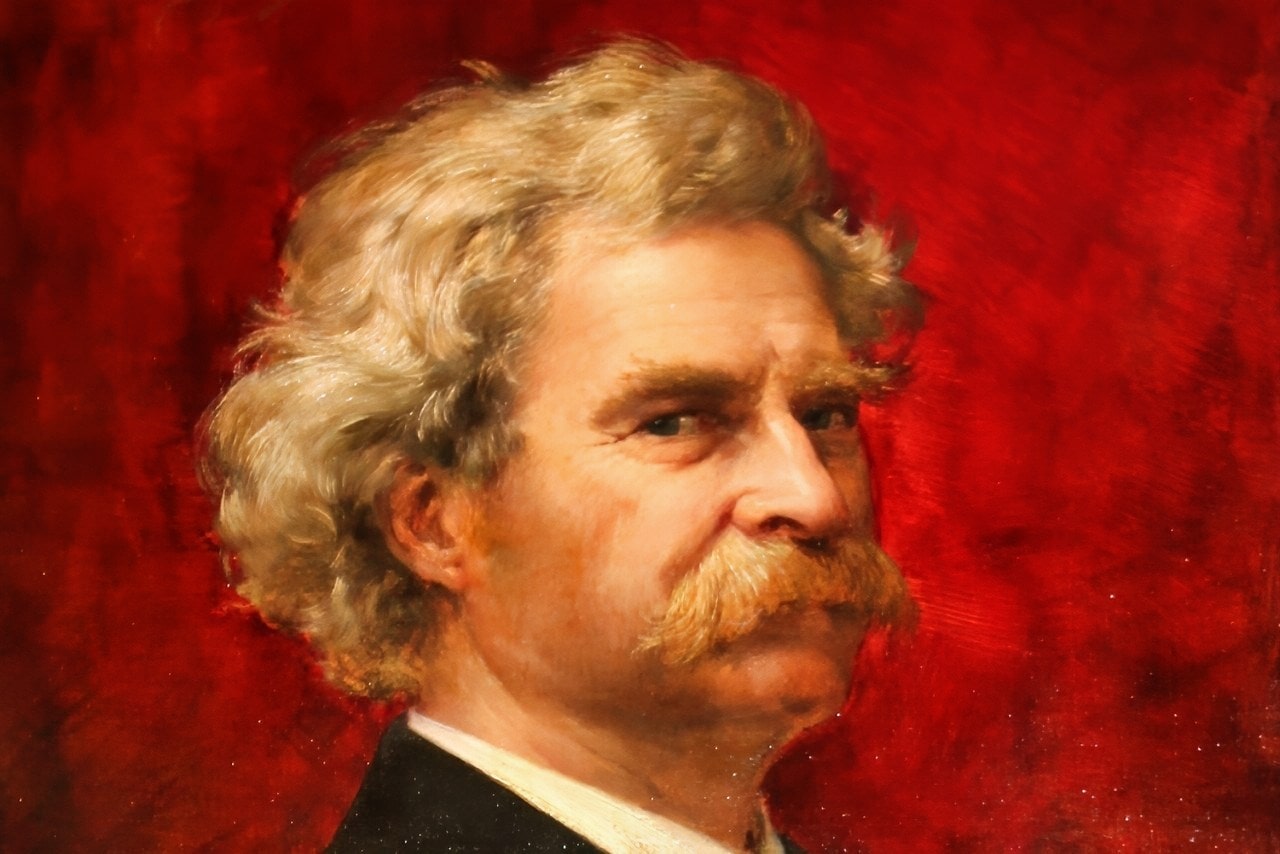
Summary and Key Points: Mark Twain’s final years were marked by profound personal loss and radical political shifts.
-Following the 1904 death of his wife and editor, Olivia “Livy” Langdon, a devastated Twain channeled his grief into sharp social satire and activism.
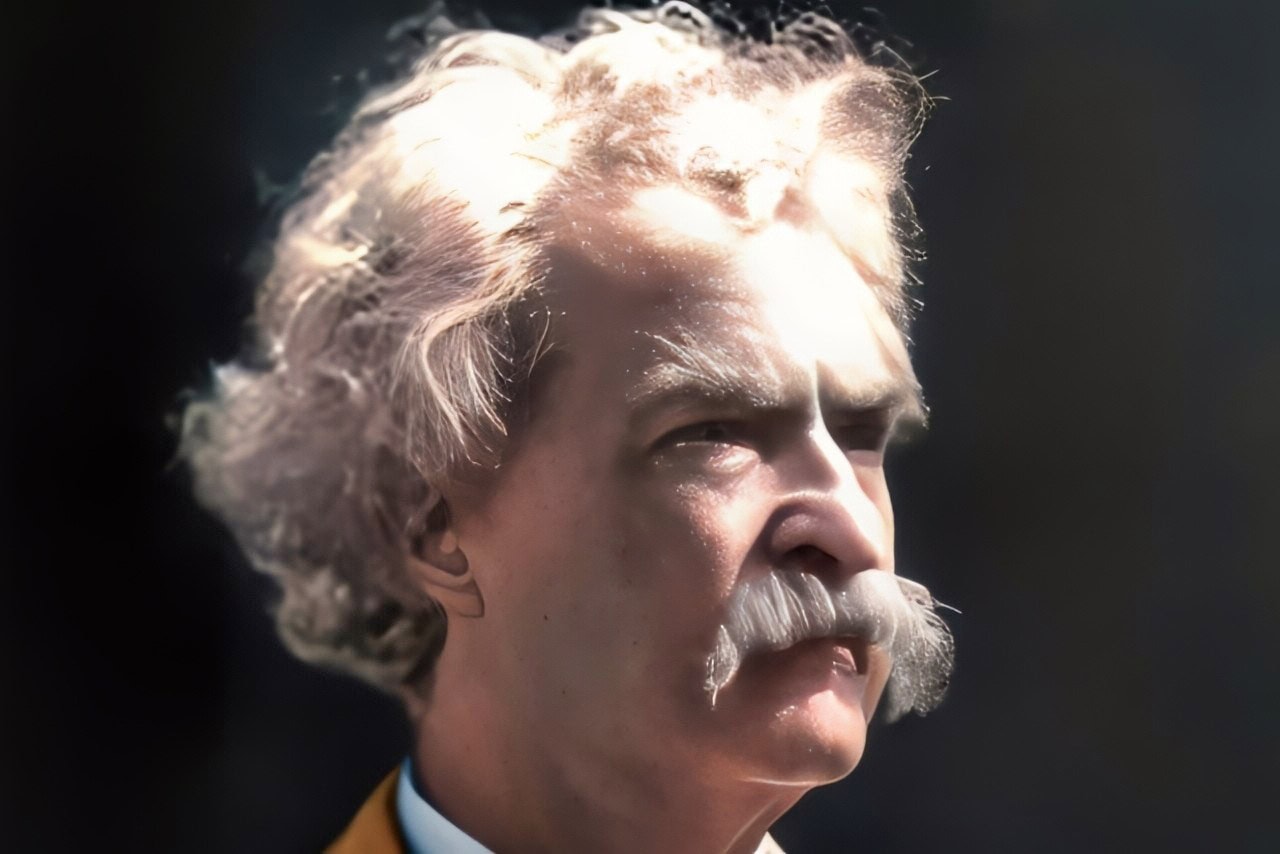
Mark Twain. Creative Commons Image.
-Serving as Vice President of the American Anti-Imperialist League, he used his platform to condemn atrocities in the Congo and the Philippine-American War.
-True to his own 1909 prediction, Twain “went out” with Halley’s Comet, dying of a heart attack in 1910. His final masterpiece, an autobiography suppressed for a century by his own request, became a global bestseller in 2010.
“Eden” Legacy: Why Mark Twain’s Most Personal Quote Summed Up in 2 Words
“A person who won’t read has no advantage over one who can’t read.” – Mark Twain
The above quote is often attributed to Samuel Langhorne Clemens, better known as Mark Twain. However, while Twain said many memorable things, this particular attribution may be apocryphal.
Be that as it may, Twain is rightfully remembered for many profound musings.
Having previously done a general overview of his early life and career, a focus on his twilight years is in order.
Mark Twain the Widower
In February 1870, a 35-year-old Clemens married 24-year-old Olvia Langdon, who was lovingly nicknamed “Livy” and bore him four children (Langdon, Susy, Clara, and Jean). Theirs was an unlikely pairing.

Mark Twain Black and White. Image Credit: Creative Commons.
Consider the contrasts:
-Livy was a thoroughly proper easterner, while Sam was a rugged man of the West.
-She came from a family that was rich and well-educated, while Sam had grown up in poverty and dropped out of school at age 12.
-She was thoroughly pious and holier-than-thou, while he had a knack for drinking, smoking, and cussing.
Nevertheless, the couple made it work for 34 years, until Livy’s death did them part. Going back to the quote at the top of this article, Livy did not have the non-reader’s malady. Indeed, she became the proofreader and editor of all Twain’s manuscripts. As a testament to Livy’s proofreading skills, Twain opined that if it were not for her, his most important works, such as Adventures of Huckleberry Finn, would never have been written.
Livy ended up preceding her beloved husband in death by six years—due to heart failure—and it absolutely devastated him. As noted in a February 12, 2018 article for The Conversation “After Livy’s death, Sam found it difficult to live. One of the chroniclers of their lifelong love affair finds perhaps his most poignant testimony in 1905’s ‘Eve’s Diary,’ in which the character of Adam says at Eve’s graveside,‘Wheresoever she was, there was Eden.’”
Later Honors and Activism
As a fascinating bit of gee-whiz historical trivia, Twain was among the first celebrities to be photographed in color, posing for a photo taken via the Autochrome Lumiere process (the world’s first practical process of color photography, named in honor of the Lumière brothers, Auguste and Louis) in 1908.
Earlier in his life, Twain had been a supporter of American imperialism, but he did a 180-degree turnaround during the last decade of his life.
He served as vice president of the American Anti-Imperialist League from 1901 until his death in 1910, coming out strongly against the Philippine–American War and American colonialism. Among the last of his works published while he was still alive was a satirical pamphlet, “King Leopold’s Soliloquy.” The work, published in 1905, discussed Belgian atrocities in the Congo Free State (the present-day Democratic Republic of the Congo).
Death and Posthumous Publication
Mark Twain/Samuel Langhorne Clemens passed away in Redding, Connecticut, after a heart attack, on April 21, 1910. He was 74 years of age. His funeral took place at the Brick Presbyterian Church on Fifth Avenue, New York City, and he was laid to rest at his beloved Livy’s family plot at Woodlawn Cemetery in Elmira, New York.
Twain remained a big-time cigar smoker—a habit he reportedly acquired at the age of eight—for his entire adult life, smoking anywhere from 22 to 40 stogies per day. (“I smoke in moderation,” he said. “Only one cigar at a time.”)
There is a strange coincidence between Clemens’ birth, his death, and the passing of Halley’s Comet. In Twain’s own words, written the year before his passing: “I came in with Halley’s Comet in 1835; it’s coming again next year, and I expect to go out with it. It would be a great disappointment in my life if I don’t. The Almighty has said, no doubt: ‘Now here are these two unaccountable freaks; they came in together, they must go out together.'”
Indeed, his fatal heart attack came the day after Halley’s Comet made its closest and most visible approach to the Sun.
Mark Twain goes down in history as one of the very few people to become a bestselling author in the 19th, 20th, and 21st centuries, thanks to his posthumous work, The Autobiography of Mark Twain. As noted in a December 13, 2010 Voice of America (VOA) news article, “‘It was deliberately unpublished,’ says Robert Hirst, curator of the Mark Twain Papers at the University of California Berkeley, where Twain’s biography has been held since 1949. ‘He specifically says he doesn’t want it published in its entirety, complete, until 100 years after his death.’”
About the Author: Christian D. Orr, Defense Expert
Christian D. Orr is a Senior Defense Editor. He is a former Air Force Security Forces officer, Federal law enforcement officer, and private military contractor (with assignments worked in Iraq, the United Arab Emirates, Kosovo, Japan, Germany, and the Pentagon). Chris holds a B.A. in International Relations from the University of Southern California (USC) and an M.A. in Intelligence Studies (concentration in Terrorism Studies) from American Military University (AMU). He is also the author of the newly published book “Five Decades of a Fabulous Firearm: Celebrating the 50th Anniversary of the Beretta 92 Pistol Series.”