
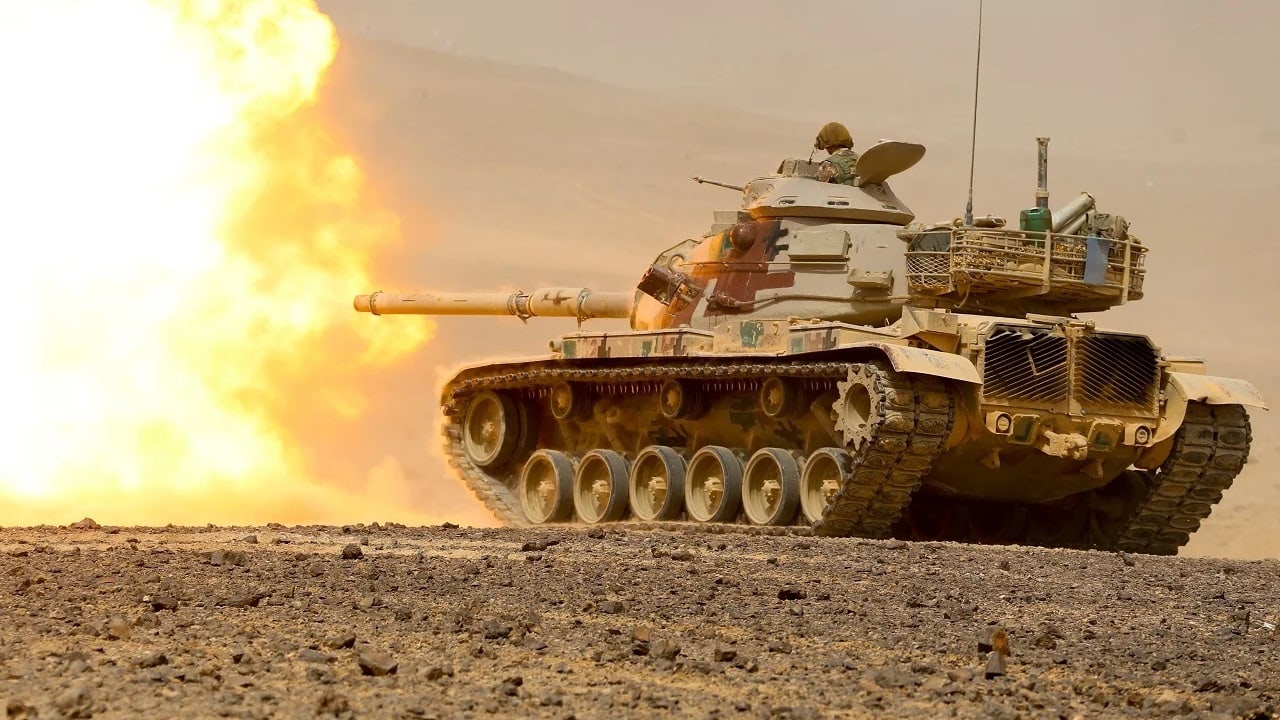
Summary and Key Points: The M60 main battle tank, often misidentified as a “Patton,” served as the U.S. Army’s primary armored workhorse from 1959 to 1991. While the proposed M60A4 variant aimed to bridge the capability gap between legacy armor and the M1 Abrams, the project was ultimately canceled in favor of the revolutionary turbine-powered Abrams.
-The M60A4 would have featured enhanced passive armor, a refined 105mm M68 gun with 70% move-and-hit probability, and advanced thermal sights.
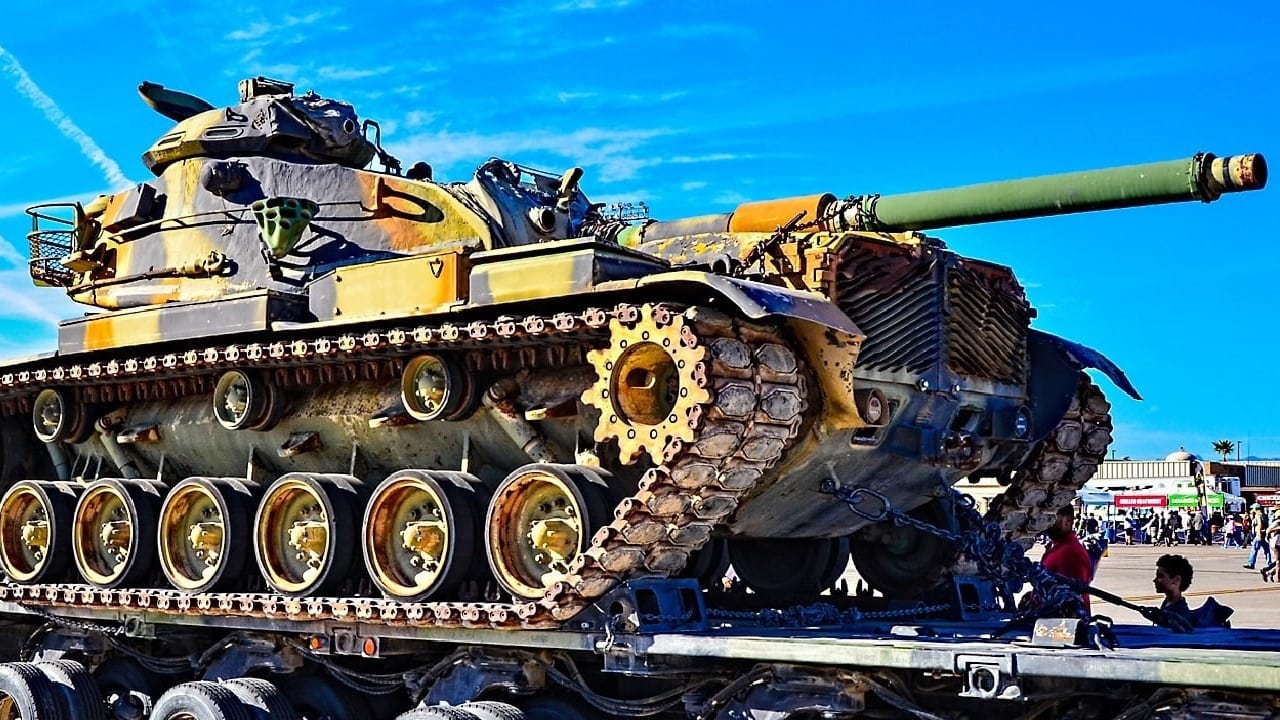
M60 Tank. Image Credit: Creative Commons.
-Instead, the Army focused on the RISE (Reliability Improved Selected Equipment) program, ensuring the M60A1 and A3 models remained effective against Soviet threats until their final retirement in 1997.
“Super Patton”: The M60A4 Main Battle Tank Summed Up in 2 Words
The M60 main battle tank was a second-generation direct descendant of the M48 Patton tank. In fact, many of the components are interchangeable. While many characterize the M60 family of tanks as a “Patton” tank, it was not. The official designation from the Army was “Tank, Combat, Full Tracked: 105-mm Gun, M60.”
The Army, however, called the M60 a “product-improved descendant” of the Patton tank’s design. If it sounds confusing, it probably was at the time. Because the M60 was just an enhanced version of the M48. The tank was issued in 1959, but didn’t begin arriving at European bases until late 1960.
The US produced over 15,000 M60s during its period of service, which ran from 1959 to 1991 after the Desert Storm war with Iraq. However, National Guard units used the M60 until 1997.
The proposed M60A4 tank, envisioned as a further upgrade to the M60 series, would likely have been a highly potent, rugged, and reliable, though ultimately conventional, late-Cold War battle tank.
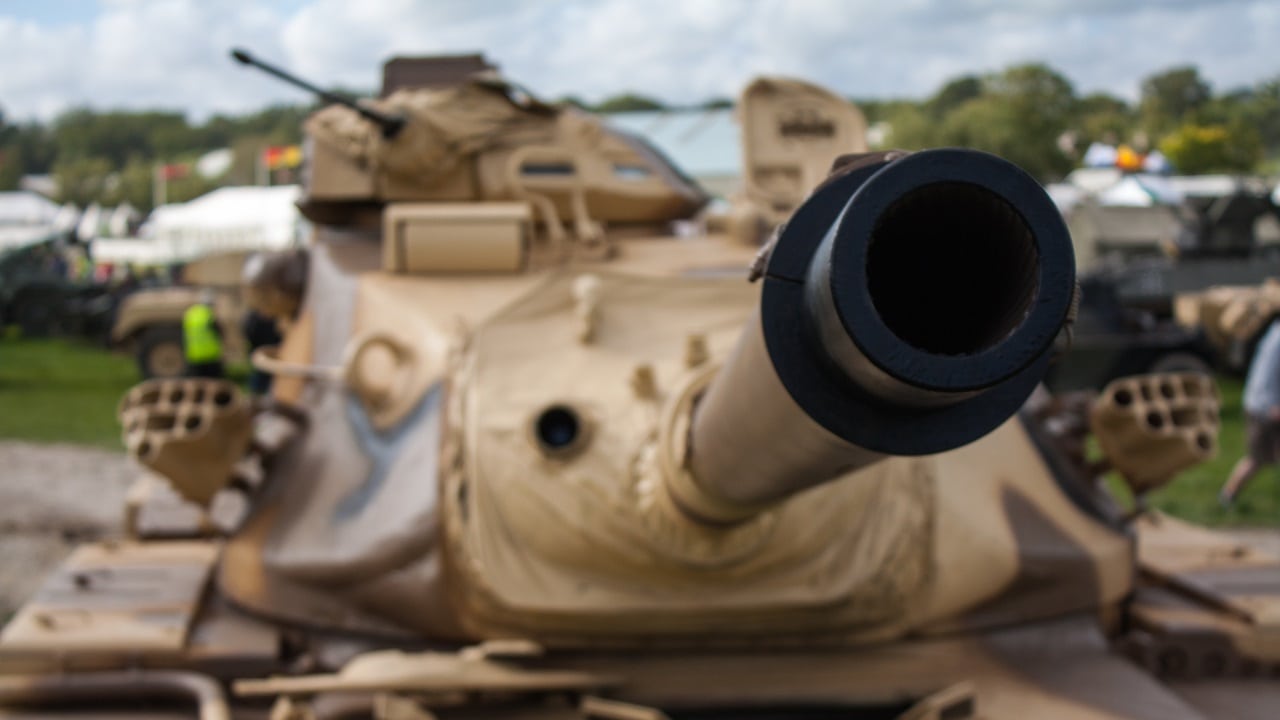
M60 Tank. Image Credit: Creative Commons.
It would have featured enhanced armor (likely for added protection against shaped-charge munitions), an improved engine/transmission, and refined fire-control systems, effectively bridging the capability gap before the M1 Abrams.
The additional improvements recommended for the M60A4 were the tank thermal sight, a muzzle reference system, a Halon fire extinguisher system, and hardware to permit the installation of devices such as a chemical alarm
What Features Would Have Been Developed For The Potential M60A4:
The M60A4 would have retained the reliable 105mm M68 gun, which remained effective against most threats of its era.
The main gun of the M60A1 was the M68E1 105mm. It was an upgrade of the 90mm used in the M48.
There were many different types of ammunition used in the M60, including APDS-Tracer (APDS-T) (M392 and M728), Armor-Piercing Fin-Stabilized Discarding Sabot-Tracer (APFSDS-T) (M735 and M774), APFSDS Depleted Uranium (DU) (APFSDS-DU) (M833), HEAT-FS (M456), APDS dummy and target practice rounds, High Explosive Plastic (HEP)/ High-Explosive Squash Head (HESH) (M393), white phosphorus, and canister rounds.
The Add-On Stabilization (AOS) was introduced in late 1972. This kit was made to fit the existing hydraulic gun control system with minimum modifications. It allows the gunner to aim and track targets and improves the gunner’s surveillance of the battlefield terrain while the tank is moving.
It increased the hit probability from zero to 70 percent while the tank was on the move.
Increased Armor Protection:
Focus on increased protection, likely incorporating advanced passive armor or early explosive reactive armor (ERA) to counter the shaped charges of improved Anti-Tank Guided Missiles (ATGM) and Soviet tank ammunition.
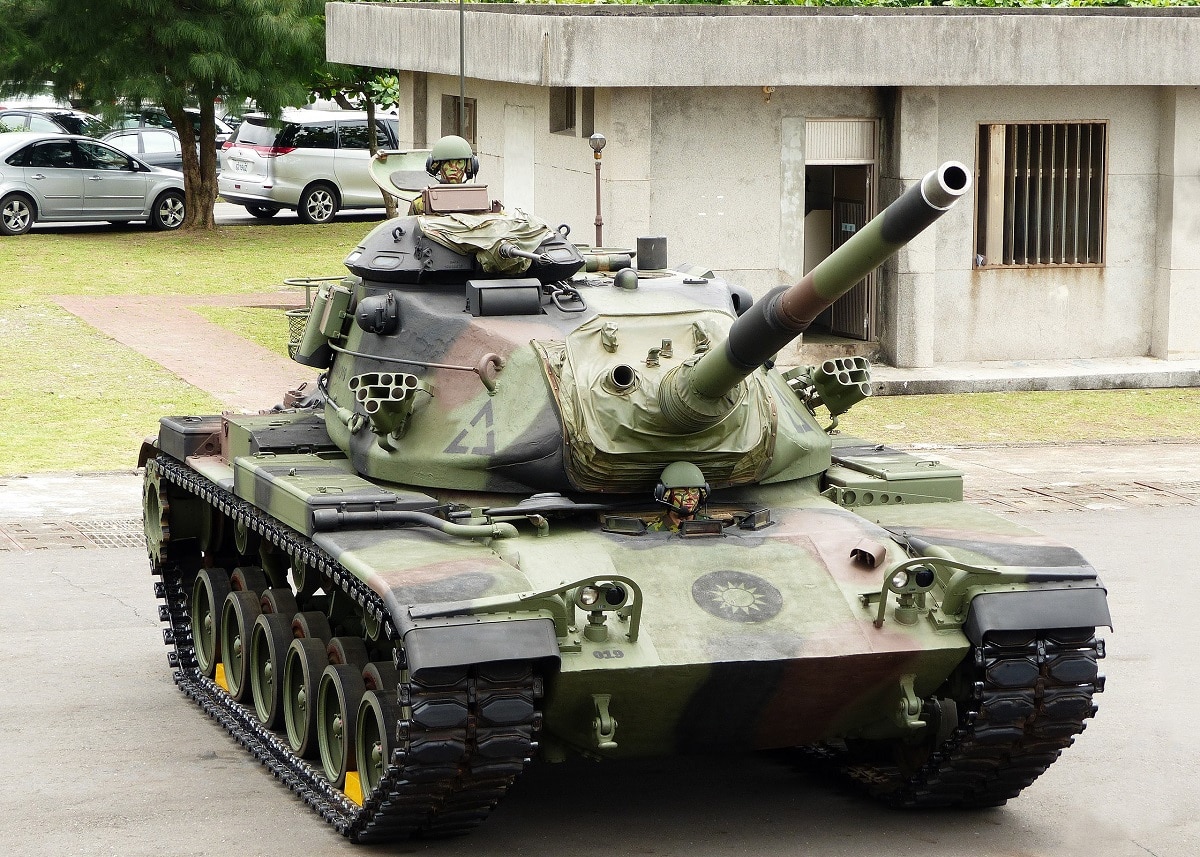
ROC M60 tank. Image: Creative Commons.
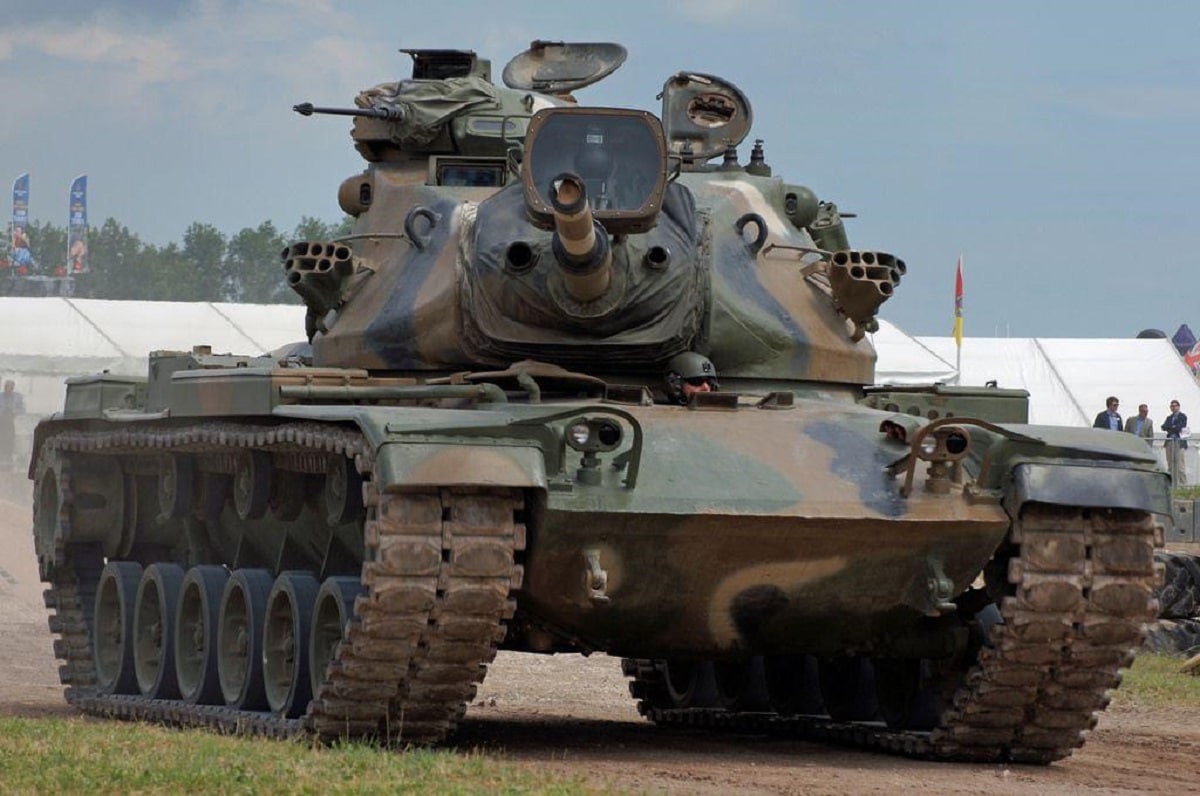
M60 Patton Tank. Image: Creative Commons.

An M60A3 main battle tank from the 1st Platoon, 48th Brigade, 108th Armored Division, Georgia National Guard, moves through a recently cleared roadblock during the training exercise Company Team Defense. (1983)
The upgrade would have likely addressed the earlier M60 reliability issues with improved engines (like the AVCR-1790-1B) and suspensions (potentially hydropneumatic) to handle the increased weight.
It would have been a “product-improved” tank rather than a revolutionary one, designed to maximize the life and effectiveness of the existing, proven Patton platform.
While not as advanced as the M1 Abrams, an M60A4 would have likely been a formidable, cost-effective, and highly reliable combat vehicle in the 1970s and 1980s.
Why Wasn’t The M60A4 Ever Developed?
The M60A4 was never developed because the U.S. Army shifted focus entirely to the advanced M1 Abrams main battle tank, rendering further substantial upgrades to the aging M60 Patton platform obsolete.
By the late 1970s, the M60 series had reached its growth potential, and improvements focused on enhancing existing M60A1/A3 models via the RISE program rather than developing a new variant.
The Army made the correct decision to transition to the M1 Abrams. The Army considered the M60’s armor and mobility inadequate against modern threats and chose to replace it entirely by 1997.
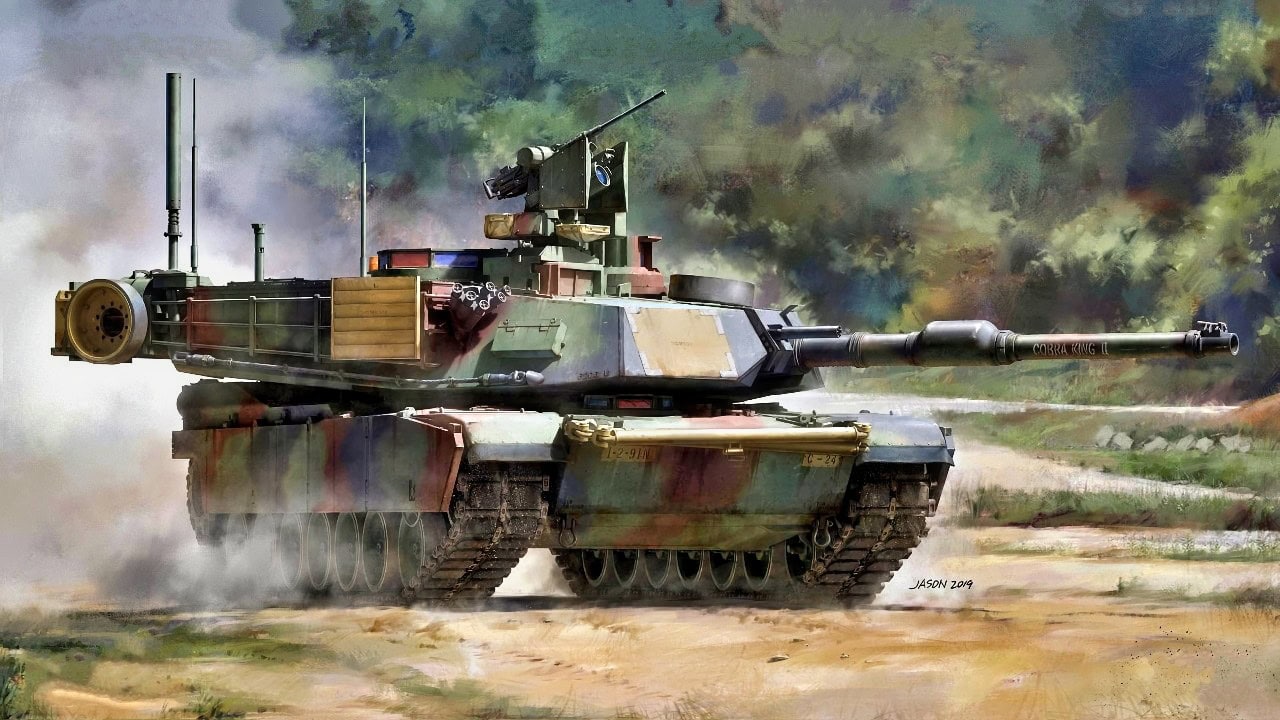
M1 Abrams Tank. Image Credit: Creative Commons.
Diminishing returns made further variants unnecessary. The M60 series was already deemed heavily upgraded, with the RISE program addressing major reliability issues in earlier models.
The tank platform was considered too heavy and, despite upgrades, still had outdated armor protection against Soviet threats.
Focus on Cost-Effective Upgrades: Resources were invested in improving the M60A3 (using thermal sights and improved fire control) rather than developing a new A4 version.
The RISE Program
The M60A1 RISE (Reliability Improved Selected Equipment) program, initiated in 1974, upgraded U.S. M60A1 tanks with improved engines, suspension, and electrical systems. The subsequent RISE Passive variant added Explosive Reactive Armor (ERA) to counter HEAT threats, notably used by the USMC during Desert Storm.
The package featured an upgraded AVDS-1790-2C engine, enhanced suspension, a top-loading air cleaner, and a 650-amp alternator.
The “Passive” upgrade (starting roughly 1978) introduced passive night-vision systems (eliminating the need for an infrared searchlight) and Blazer ERA blocks for the turret and hull.
The M60A1 underwent further changes over the years, but by the time the Soviets released the T-72, it was showing its age. The Soviet tank had better armor, firepower, and speed, but the M60A1 had better fire control systems, thermal imaging, and laser rangefinding.
It was time for the M1 Abrams.
About the Author: Steve Balestrieri
Steve Balestrieri is a National Security Columnist. He served as a US Army Special Forces NCO and Warrant Officer. In addition to writing on defense, he covers the NFL for PatsFans.com and is a member of the Pro Football Writers of America (PFWA). His work was regularly featured in many military publications.