
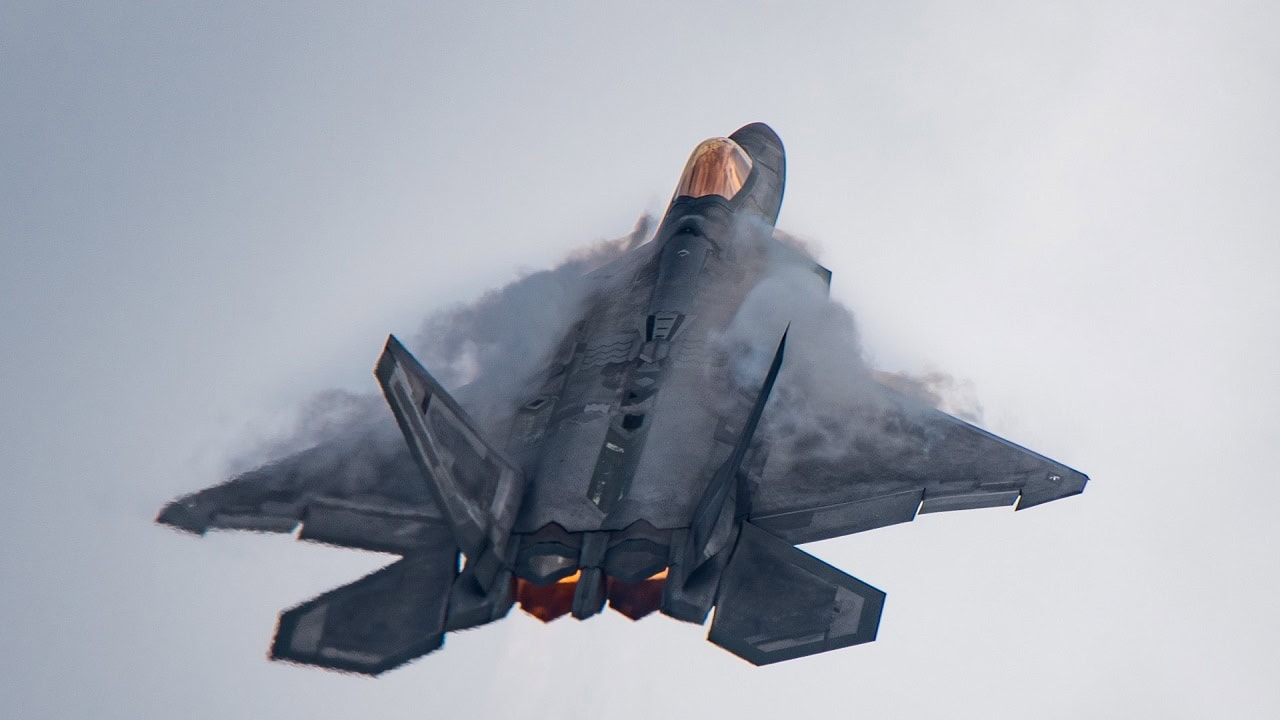
Summary and Key Points: U.S. airpower in the Western Pacific depends on a small set of forward bases that are visible, targetable, and vulnerable to repeated missile salvos. In a conflict with China, the decisive early damage is likely to occur on the ground—runways, taxiways, fuel systems, and weapons infrastructure—where sortie generation can be throttled even if aircraft survive.
-China’s strike complex is built for recurring disruption, exploiting missile-defense inventory limits and using surveillance to retarget repairs in near-real time.
-Dispersal concepts complicate targeting but introduce their own friction. The central question becomes operational tempo: how quickly bases can repair and relaunch under sustained suppression.
America’s Pacific Airpower Has a Message for China: Bases Are the Bullseye
American airpower in the Western Pacific operates from a network of forward bases that can be mapped, surveilled, and targeted long before a conflict begins.
Much of the force that underpins U.S. deterrence in the region — fighters, tankers, surveillance aircraft — is concentrated at a small number of fixed airfields whose locations are known and whose operating patterns are closely monitored. In peacetime, that concentration enables speed. Aircraft can be armed, fueled, and launched in compressed cycles that project power across vast distances with little warning.
The same concentration results in exposure once missiles begin flying. In a war with China, the first meaningful damage to U.S. airpower is unlikely to occur in the skies over contested waters. It would begin on the ground, under salvos aimed at runways, aircraft parking areas, fuel storage, and the infrastructure that sustains sortie generation. Aircraft destroyed before takeoff never enter the fight, and aircraft grounded by damaged bases remain operationally absent even when they survive intact.
This dynamic shifts the opening balance of the air campaign. The contest begins not as a duel between opposing aircraft but as an exchange between expendable precision munitions and high-value platforms operating from fixed infrastructure. Under those conditions, the question is less whether American airpower can fight and more how much of it can generate sustained sorties once forward bases begin absorbing repeated strikes.
The Strike Complex Built for Base Suppression
China’s missile forces have been designed for this mission.
Over time, the People’s Liberation Army Rocket Force has fielded an inventory calibrated for fixed-target suppression across the first island chain and beyond. Improvements in guidance have increased reliability, while expanding launcher capacity has deepened strike density. The operational effect lies in the ability to impose recurring disruption rather than isolated damage.

An Italian air force F-35A Lightning II assigned to the 32nd Wing, Amendola Air Base, Italy, taxis while participating in Astral Knight 2021 (AK21) at Aviano Air Base, Italy, May 21, 2021. The aircraft that participated in AK21 include the U.S. Air Force F-15E Strike Eagle, HH-60 Pave Hawk and C-130J Super Hercules aircraft, Italian air force F-35 Lightning II aircraft, Hellenic air force F-16 and Emb-145 Erieye aircraft, and Croatian air force MiG-21 BisD/UMD aircraft. (U.S. Air Force photo by Airman 1st Class Brooke Moeder)
Runway surfaces would face immediate pressure. Cratering does not need to be permanent to achieve an effect. Even limited structural damage can halt launch cycles while engineering teams move to assess repairability. Those teams would be working under the assumption that additional salvos could arrive before restoration is complete.
Aircraft that survive intact would not necessarily remain usable. Hardened shelters reduce blast exposure, but they do not guarantee access to functional taxiways. Broken pavement can immobilize airframes even when they remain technically flyable. Survivability at the platform level does not ensure sortie production.
Fuel systems introduce a different vulnerability vector. Aviation fuel must be stored in volume to sustain high-tempo operations. That concentration creates targeting opportunities despite protective measures. A successful strike on storage or distribution nodes can generate fires that burn long enough to interrupt scheduling cycles well after the initial impact.
Munitions storage introduces operational friction. Precision targeting does not require total destruction of weapons inventories. It only needs to create uncertainty about what remains safe to handle. Under degraded safety conditions, loading crews slow their pace. That reduction alone constrains sortie flow.
This is where the operational danger consolidates. Platform losses matter, but they are not the sole determinant of combat power. The interruption of launch rhythm at scale carries consequences that accumulate over time. Air campaigns derive strength from repetition. Break the cycle and aggregate pressure declines even if aircraft numbers remain stable.
Missile Defense and the Limits of Protection
Missile defense provides only partial insulation. Interceptor systems can blunt inbound salvos, but they operate within finite inventory limits. Reload timelines matter. Saturation tactics are structured to exploit those limits, not to defeat defenses outright but to erode them through volume.
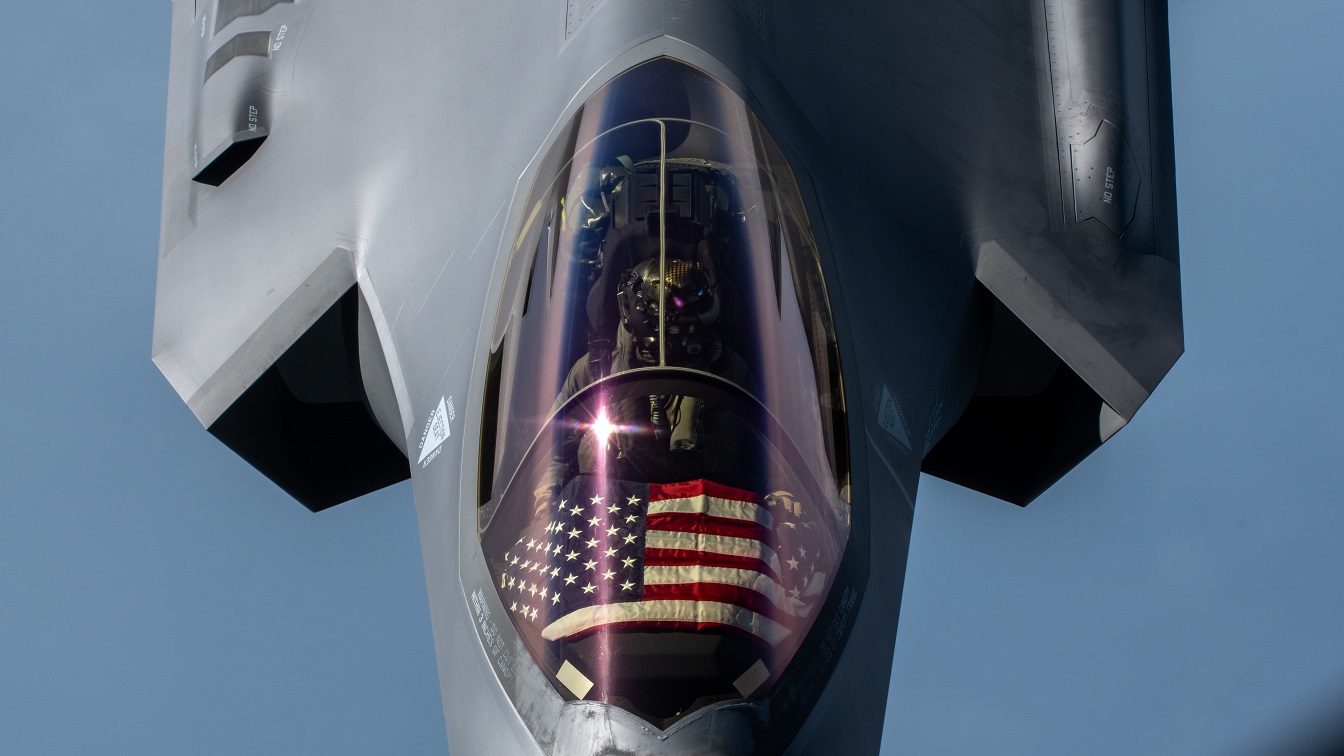
An F-35A Lightning II from the 354th Fighter Wing, Eielson Air Force Base, Alaska, flies behind a KC-135 Stratotanker assigned to the 117th Air Refueling Squadron, Forbes Field Air National Guard Base, Kansas, over the Indo-Pacific, March 10, 2022. Aircrews routinely fly missions aimed at sharpening the necessary skills needed to respond to emerging situations at a moment’s notice. (U.S. Air Force photo by Airman 1st Class Yosselin Perla)
Hardening efforts mitigate exposure without eliminating it. Shelters protect airframes from fragmentation and overpressure. They do far less for the surrounding infrastructure required to arm and service those aircraft. Protection without operational access produces only temporary resilience.
Dispersal strategies like Agile Combat Operations (ACE) complicate targeting geometry but introduce friction of their own. Operating from austere locations reduces the risk of concentration. It also strains maintenance capacity and delays weapon preparation. Mobility under persistent surveillance becomes increasingly difficult to sustain once conflict begins.
Repair capacity therefore becomes central to operational survival. Rapid runway repair teams, prepositioned materials, and redundant engineering units determine how quickly sortie generation can resume. The tempo of restoration begins to matter as much as the scale of damage. Recovery time becomes a strategic variable.
All of this unfolds beneath continuous reconnaissance. Chinese surveillance systems are designed to monitor base activity in near-real-time. Damage assessment feeds directly back into strike planning. Follow-on salvos would likely focus on assets already under repair rather than untouched infrastructure.
The operational picture that emerges is one of sustained suppression. U.S. installations would not disappear in the opening hours. They would face recurring degradation that complicates sortie generation day after day. The cumulative effect would stem from repetition rather than singular devastation.
Airpower Decided on the Ground
This dynamic forces a recalibration of how air superiority is measured in such a theater. Control of the air cannot be assessed solely through aerial engagements once basing systems become the primary target set. The ability to generate, recover, and relaunch aircraft at scale becomes the underlying determinant of staying power.
Logistics, therefore, moves from an enabling function to a central function. Stockpiles must expand, repair assets must be distributed more widely, and fuel redundancy shifts from contingency planning to structural requirement. Under sustained missile pressure, resilience begins to displace efficiency as the organizing logic of forward air operations.
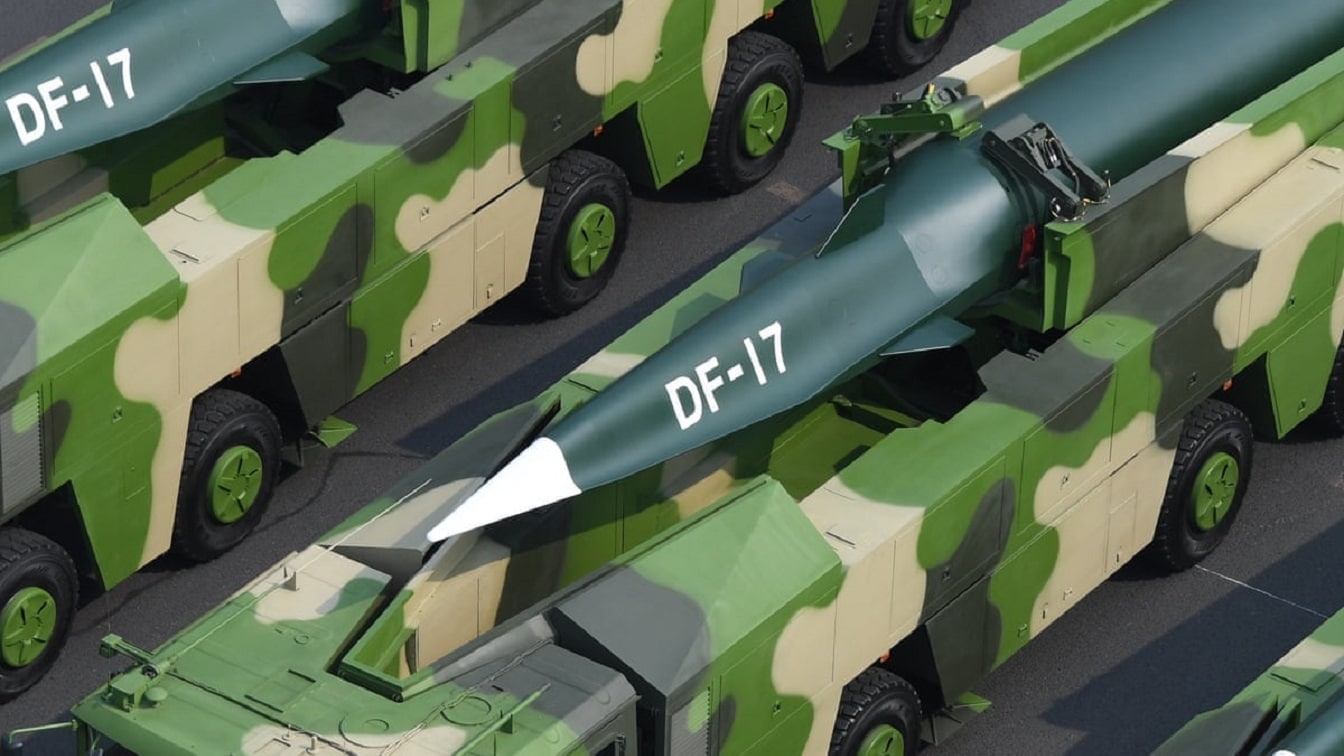
DF-17 Chinese Missile. Image Credit: Creative Commons.
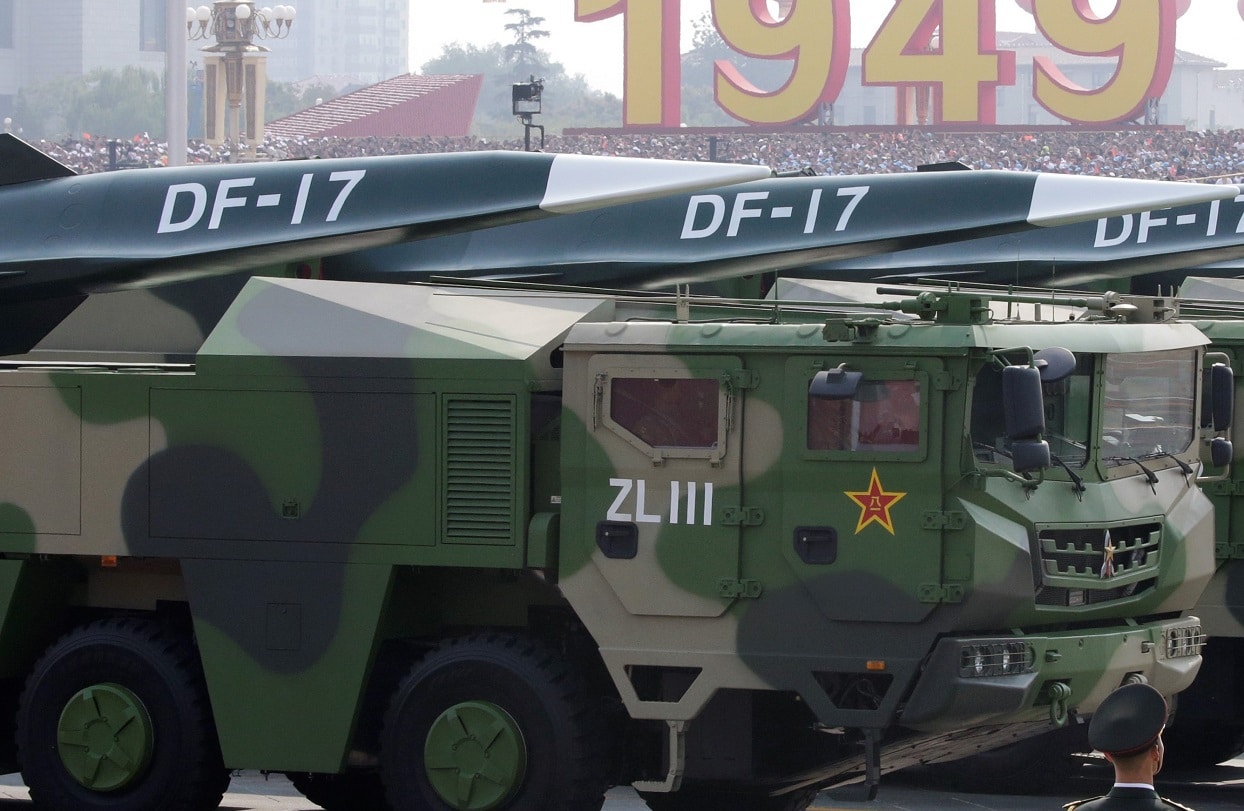
Image of DF-17 missile. Image: Creative Commons.
None of this suggests that U.S. airpower would vanish in the opening hours of a Pacific war. Aircraft would survive. Some bases would remain operational. Long-range aviation would still project power from outside immediate missile envelopes, and carrier aviation would impose its own targeting dilemmas on Chinese planners.
The question is not whether American airpower could fight. It is the question of where, how quickly, and at what tempo it can sustain operations once forward infrastructure begins to absorb repeated strikes. Aircraft that must operate from a greater distance arrive later, remain on station for shorter periods, and generate fewer cycles over time. The cumulative effect is measured more by the thinning of operational presence across the theater than by dramatic losses.
Forward basing has always been treated as a mechanism for compressing time and distance in crisis response. Missile saturation stretches both back out again. Sortie generation slows. Recovery cycles lengthen. The margin for rapid reinforcement narrows just as escalation pressure rises. Under those conditions, the early phase of conflict becomes a contest over whether forward airpower can remain operationally relevant rather than merely technically intact.
That distinction carries strategic weight. Deterrence rests not only on the existence of advanced aircraft but on the visible ability to use them at scale under fire. If forward bases can be suppressed faster than they can restore tempo, the operational burden shifts outward — onto carriers, long-range bombers, and rotational deployments operating at greater remove from the fight. Those forces remain potent, but they alter response timelines in ways adversaries can factor into escalation planning.
Which is why the opening missile exchange would matter so disproportionately. It would not decide the war, but it would shape the geometry of airpower for everything that follows — how quickly it arrives, how persistently it operates, and how much pressure it can sustain once the sky over the Western Pacific becomes contested in earnest.
About the Author: Dr. Andrew Latham
Andrew Latham is a non-resident fellow at Defense Priorities and a professor of international relations and political theory at Macalester College in Saint Paul, MN. You can follow him on X: @aakatham. Dr. Latham writes a daily column for 19FortyFive.com.