
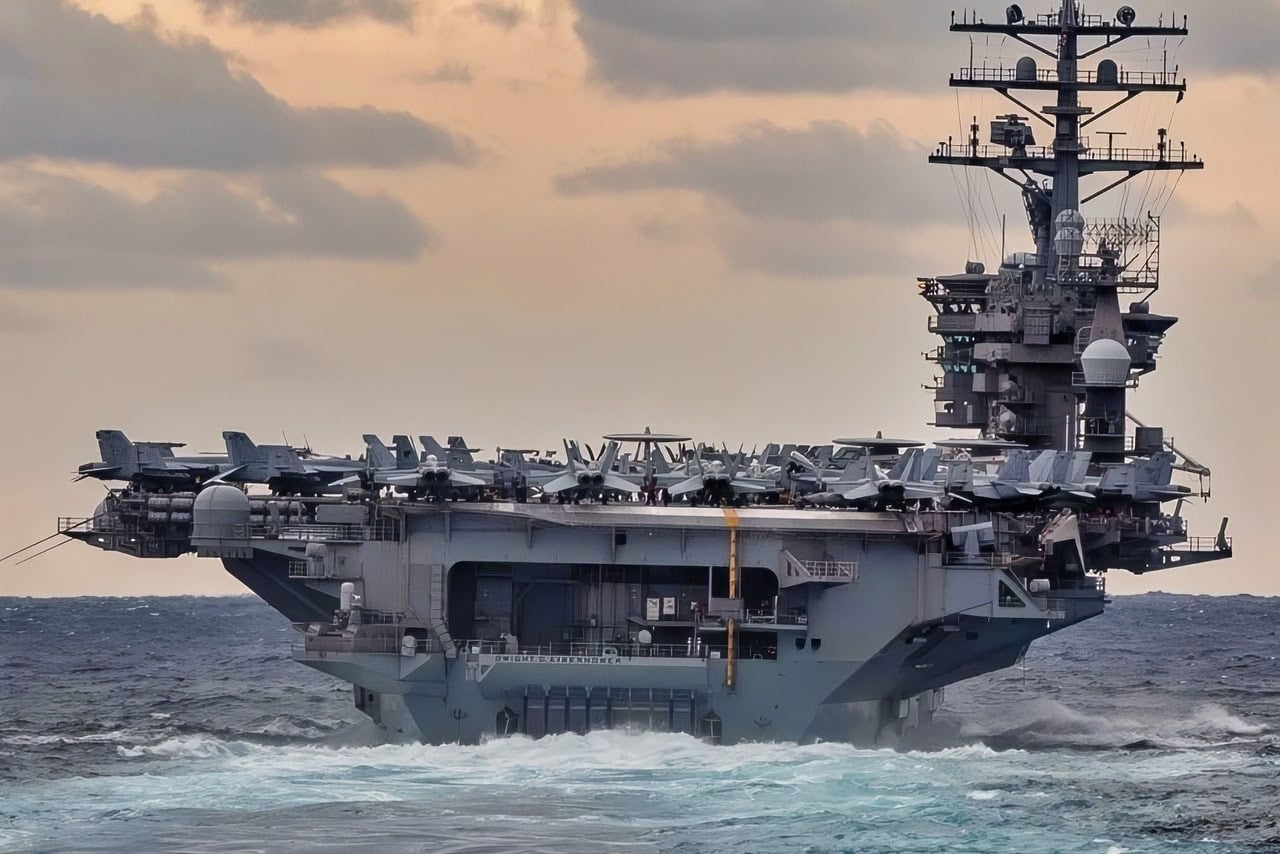
Supercarrier Era Over for the U.S. Navy? Summary and Key Points
-Chief of Naval Operations Admiral Daryl Caudle unveiled his “U.S. Navy Fighting Instructions” in San Diego, signaling a major shift toward a “Hedge Strategy.” Moving away from a reliance on massive aircraft carrier strike groups for every mission, Caudle advocates for a leaner, more distributed force utilizing smaller warships, unmanned drones, and scalable mission packages.
-This approach aims to counter near-parity adversaries like China and Russia through adaptability and speed rather than raw mass dominance.
-By prioritizing modularity, the Navy intends to maintain a presence in regions such as the Caribbean with Littoral Combat Ships while preserving high-end assets for high-consequence conflicts.
Aircraft Carriers: The U.S. Navy Finally Admits A Hard Truth
The Navy’s Chief of Naval Operations (CNO), Admiral Daryl Caudle, laid out his “U.S. Navy Fighting Instructions” to more than 1,000 service members, defense industry executives, and strategic analysts on Tuesday during a conference at the San Diego Convention Center.
Caudle’s vision is for commanders to use the Navy’s newer, smaller warships instead of relying on supercarrier strike groups for every contingency. He told the AP in an interview that his strategy would make the Navy’s presence, especially in regions like the Caribbean, leaner and better tailored to meet actual threats.
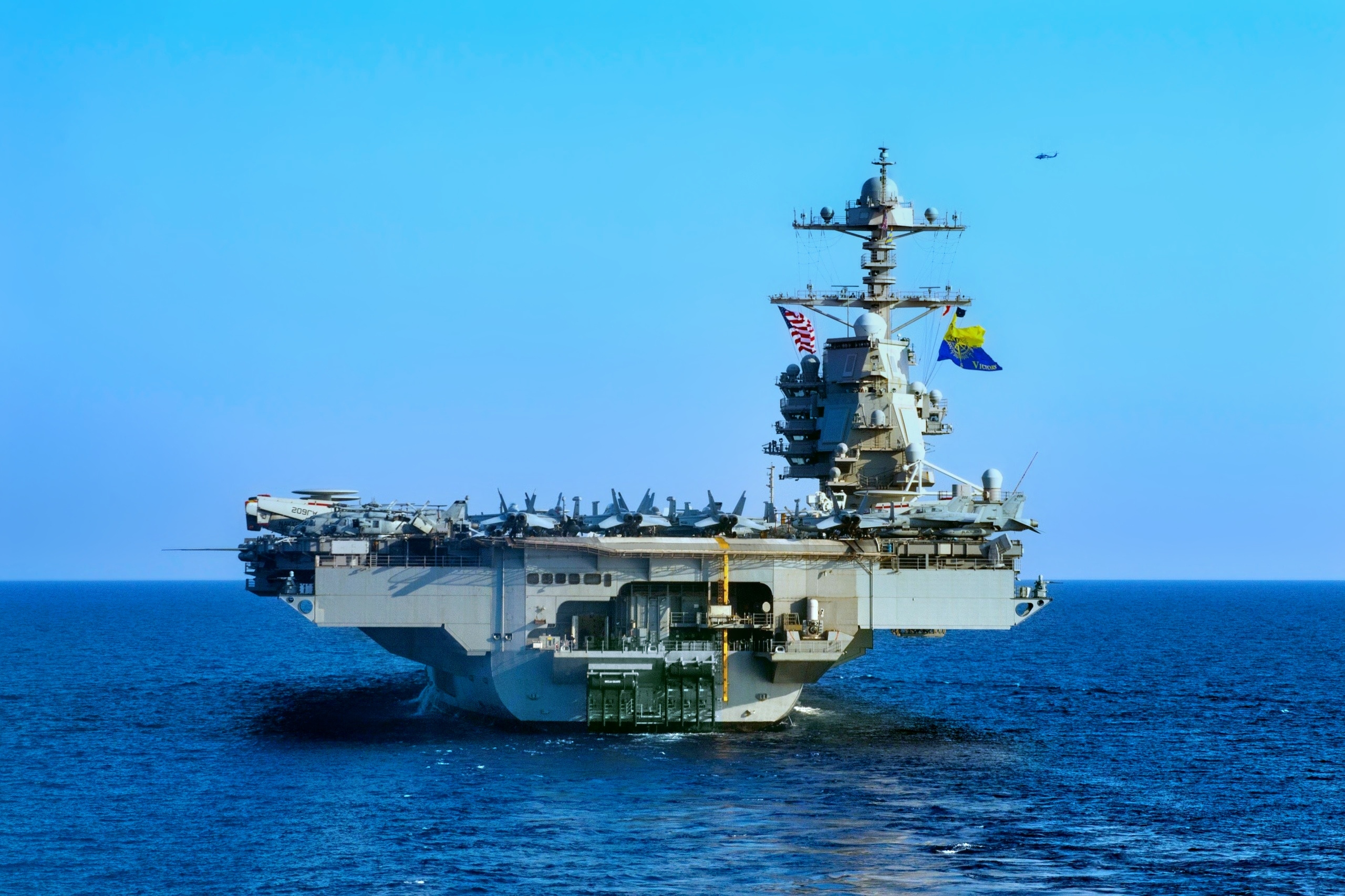
Ford-Class Aircraft Carrier. Image Credit: Creative Commons.
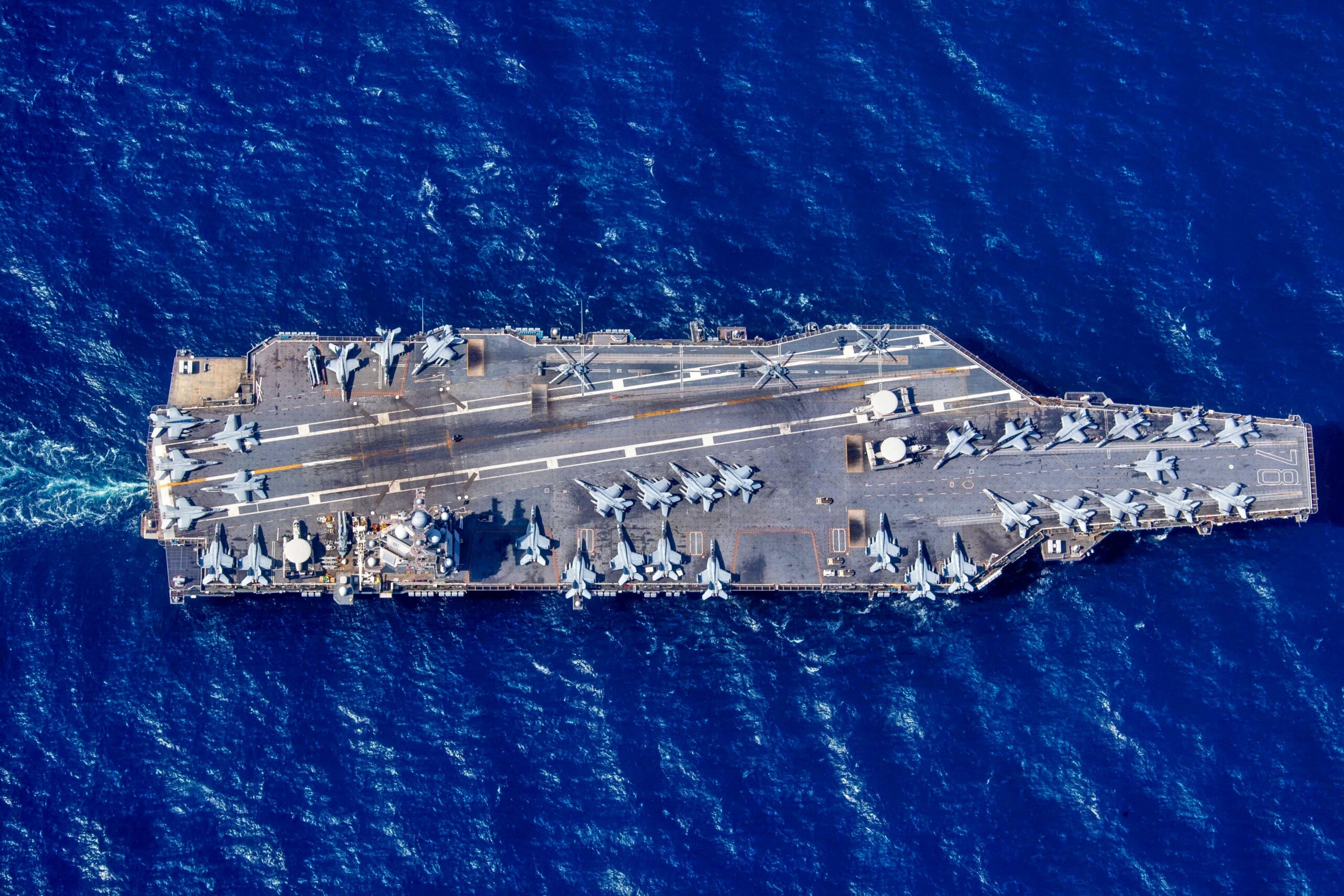
Ford-Class. Image Credit: Creative Commons.
“Our Navy’s approach to combat can no longer be based on capability overmatch and winning by mass dominance alone,” CNO Caudle said.
A Smaller, Leaner Force In America’s Back Yard
Caudle said he had already conveyed his strategy to the commander of Southern Command, “and we’re in negotiation on what his problem set is—I want to be able to convey that I can meet that with a tailored package there.”
The U.S. military has seized multiple suspicious and falsely flagged tankers connected with Venezuela that were part of a global shadow fleet of merchant vessels that help governments such as Venezuela, Russia, and Iran evade economic sanctions.
“That doesn’t really require a carrier strike group to do that,” Caudle said, adding that he believes the mission could be done with some smaller littoral combat ships, Navy helicopters, and close coordination with the Coast Guard.
“I don’t want a lot of destroyers there driving around just to actually operate the radar to get awareness on motor vessels and other tankers coming out of port,” Caudle added. “It’s really not a well-suited match for that mission.”
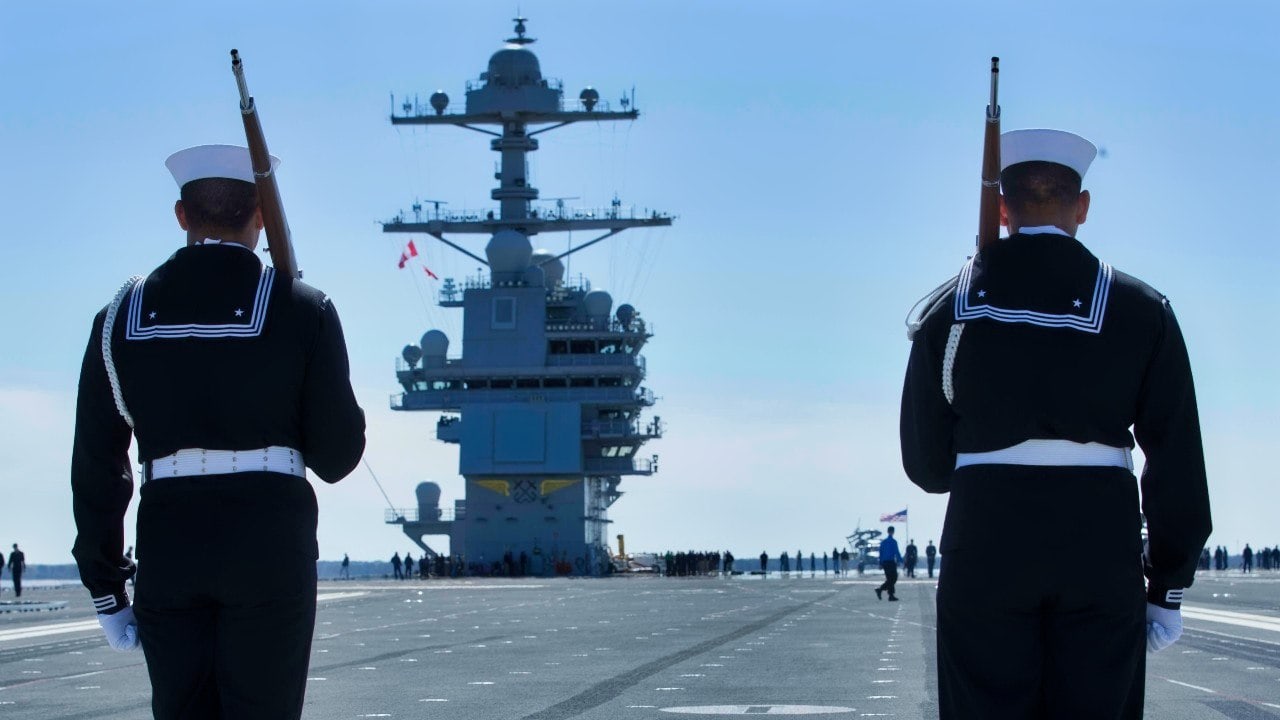
(April 8, 2017) — Logistics Specialist 3rd Class Miguel Monduy, from Miami, Florida, and Aviation Ordnanceman Airman Michael Valdez, from Pheonix, Arizona, assigned to Pre-Commissioning Unit Gerald R. Ford (CVN 78), stand on the flight deck for shifting colors. The future USS Gerald R. Ford (CVN 78) is underway on its own power for the first time. The first-of-class ship — the first new U.S. aircraft carrier design in 40 years — will spend several days conducting builder’s sea trials, a comprehensive test of many of the ship’s key systems and technologies. (U.S. Navy photo by Mass Communication Specialist Seaman Gitte Schirrmacher)
Caudle’s Hedge Strategy
The U.S. Navy Fighting Instructions provide a comprehensive framework to transition the force toward a “hedge strategy” emphasizing adaptability, speed, and risk-sharing in contested environments.
The strategy focuses on using smaller, scalable, and unmanned systems to complement, rather than rely solely on, traditional large, mass-dominant combatants.
The Hedge Strategy for the U.S. Navy
“How do we ensure we can fight and win across the spectrum of conflict, under conditions we cannot entirely predict, against adversaries who are increasingly capable, innovative, and aggressive—at near parity levels—simultaneously in key areas of vital national interest around the world?” Caudle asked an audience at the U.S. Naval War College.
His strategy is designed to make the fleet more flexible and better able to execute specific, unpredictable missions.
“Our Navy’s approach to combat can no longer be based on capability overmatch and winning by mass dominance alone,” Caudle said. “The Nation needs a Navy that can hedge lethal effects aggressively, innovate continuously, fight distributivity, and command with clarity across a global network of battlespaces.”
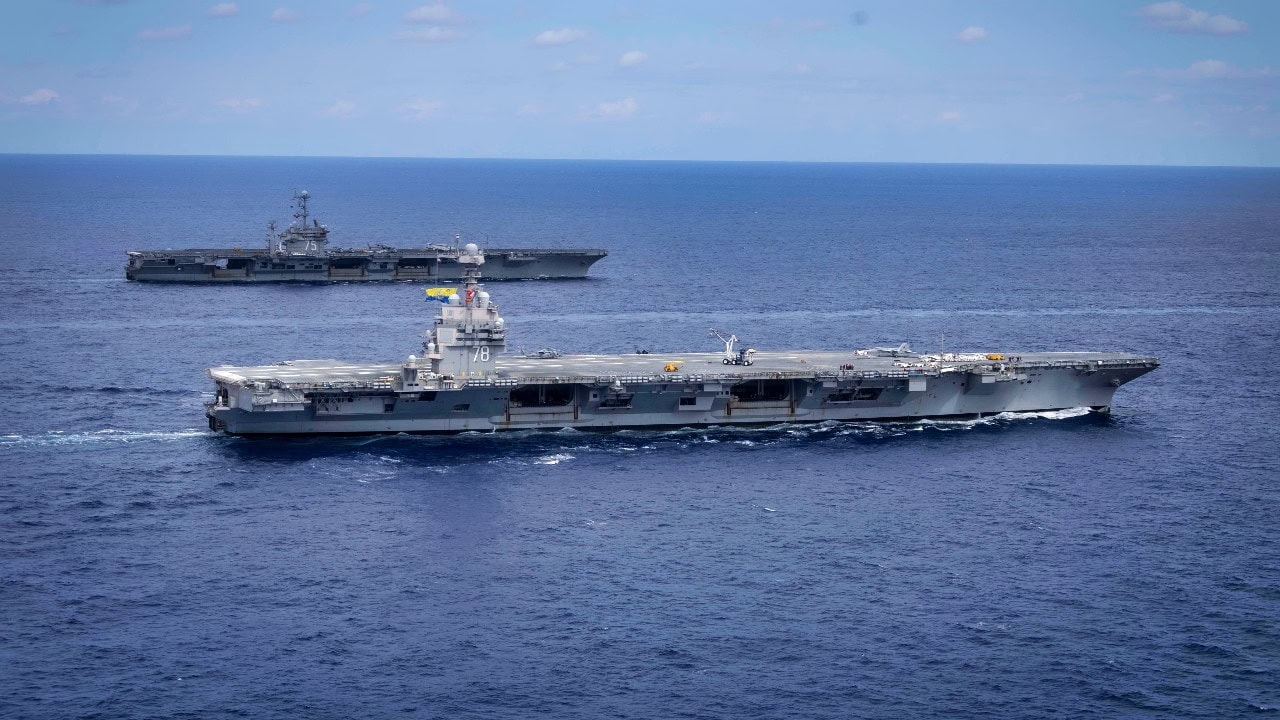
ATLANTIC OCEAN. (Aug. 24, 2024) The Nimitz-class aircraft carriers USS Harry S. Truman (CVN 75), back, and the world’s largest aircraft carrier, USS Gerald R. Ford (CVN 78), sail in formation in the Atlantic Ocean, Aug. 24, 2024. USS Gerald R. Ford is the flagship of the Gerald R. Ford Carrier Strike Group. The aircraft carrier is underway in the Atlantic Ocean to further develop core unit capabilities and skills such as fuels certification and ammunition on-load during its basic phase of the optimized fleet response plan. (U.S. Navy photo by Mass Communication Specialist 2nd Class Maxwell Orlosky).
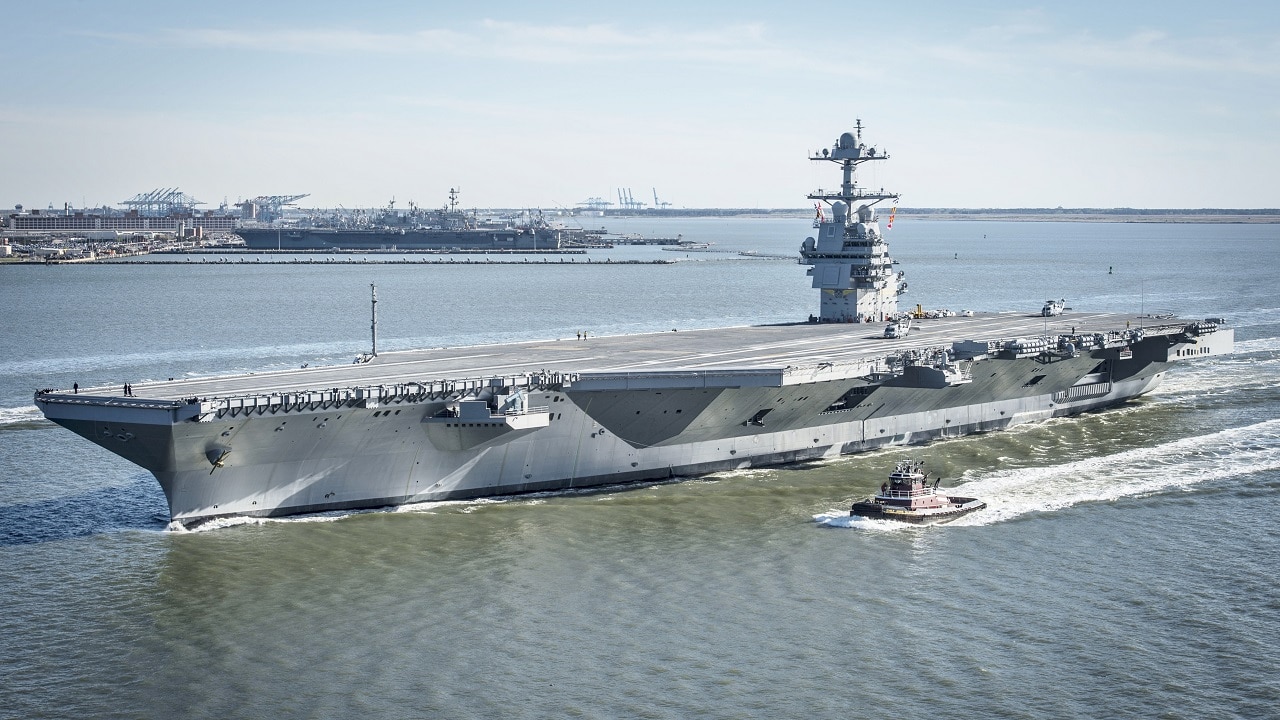
The U.S. Navy aircraft carrier USS Gerald R. Ford (CVN-78) underway under her own power for the first time while leaving Newport News Shipbuilding, Newport News, Virginia (USA), on 8 April 2017. The first-of-class ship – the first new U.S. aircraft carrier design in 40 years – spent several days conducting builder’s sea trials, a comprehensive test of many of the ship’s key systems and technologies. USS George Washington (CVN-73) and the amphibious assault ship USS Kearsarge (LHD-3) are visible in the background.
The strategy is built on three pillars—foundry (industry/supply chain), fleet (readiness), and fight (operational capability)—to ensure the Navy can handle unpredictable, high-stakes conflicts.
Instead of building a massive but brittle fleet designed for a single type of war, the focus is on creating adaptable, modular force packages that can be customized for specific missions, such as deterring aggression in the Indo-Pacific.
Caudle’s warfighting strategy balances high-end warfighting capability with scalable, cost-effective forces capable of responding across a wide range of crises and conflicts.
A significant factor in this is to create tailored forces involving scalable, mission-focused combinations of platforms, systems, and capabilities designed to address high-consequence scenarios without constraining overall fleet design.
Integrating unmanned systems to accomplish many missions. Incorporating unmanned surface, undersea, and air drone systems to augment the primary battle force.
Speed and risk management are expressly acknowledged. Caudle says that in an era of great power competition, decision speed is critical, and risk should be actively managed and shifted rather than eliminated.
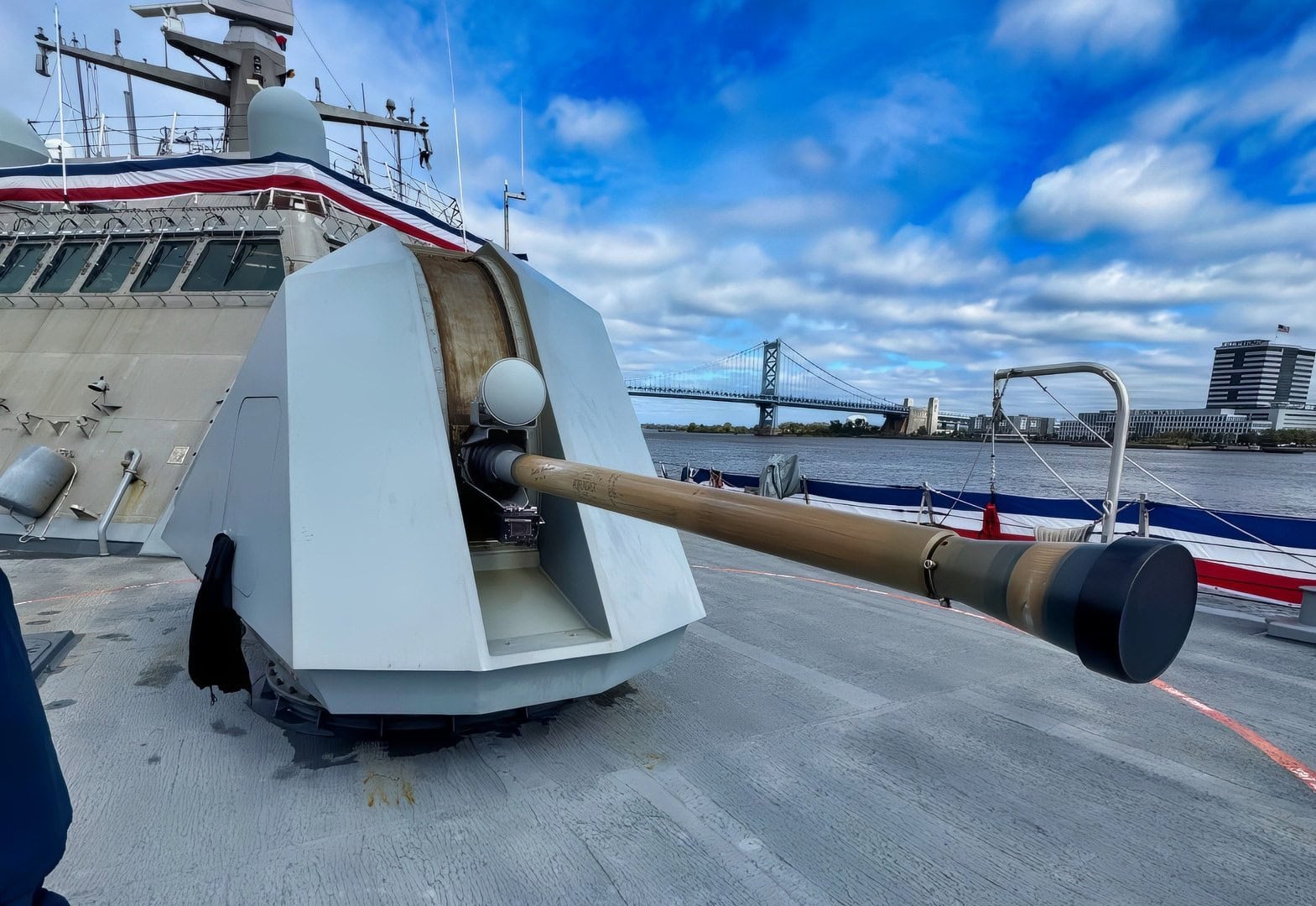
Littoral Combat Ship Deck Gun U.S. Navy. Image Credit: 19FortyFive.com
Caudle’s guidance aims to move away from, or at least supplement, exclusive reliance on high-end, mass-dominant platforms such as aircraft carriers, in favor of more distributed, lethal effects.
The instructions explicitly address the need to solve “unmanned dilemmas” by fixing doctrinal and process gaps regarding strategic laydown and global force management.
The central theme of his Fighting Instructions is the reliance on U.S. sailors.
“At the center of this vision will always be the United States Navy Sailor,” he said. “They are our most enduring strategic advantage, our primary weapon system, and the heartbeat of our world-class Navy.”
His strategy, he believes, ensures the U.S. Navy is prepared for what lies ahead.
“It will ensure we are ready. Not for the last war, but for the one that is coming,” he said.
About the Author: Military Expert Steve Balestrieri
Steve Balestrieri is a National Security Columnist. He served as a US Army Special Forces NCO and Warrant Officer. In addition to writing on defense, he covers the NFL for PatsFans.com and is a member of the Pro Football Writers of America (PFWA). His work was regularly featured in many military publications.