
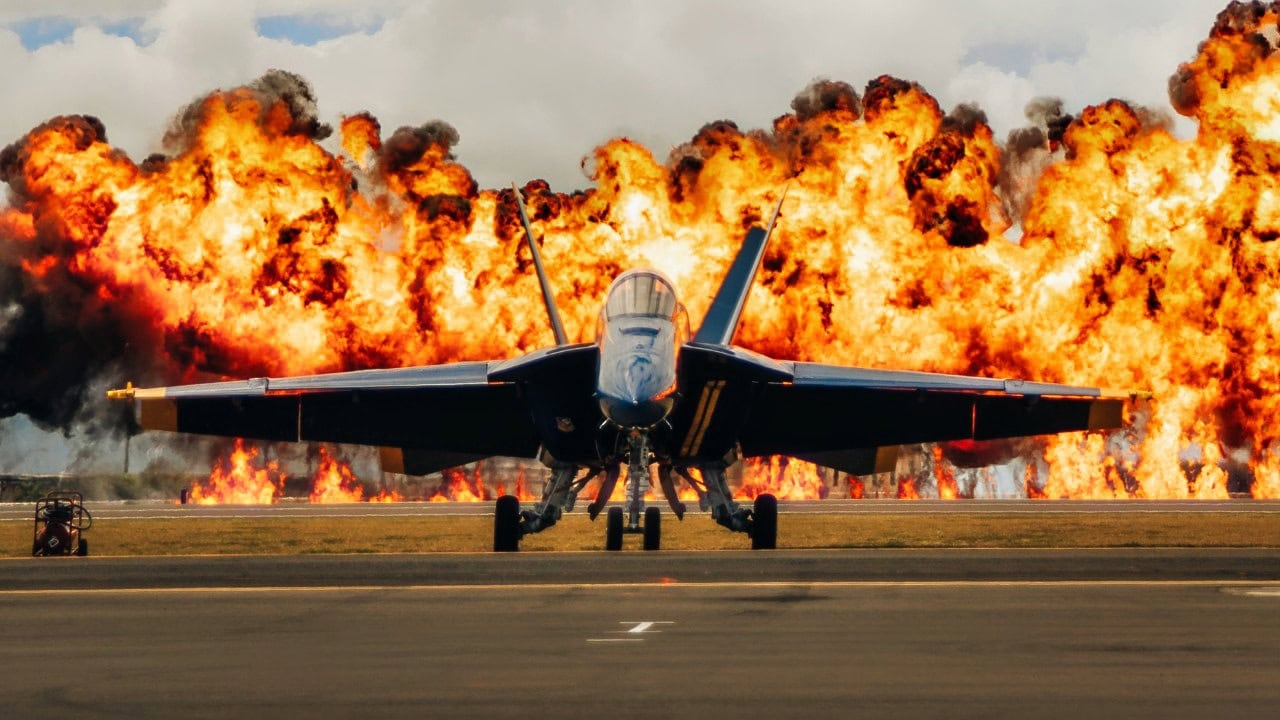
Summary and Key Points: The F/A-18E/F Super Hornet remains the U.S. Navy’s indispensable workhorse by leaning into its strengths: reliability, mass, and payload flexibility.
-Rather than competing directly with fifth-generation stealth, the F/A-18 utilizes Block III upgrades—including advanced networking and the APG-79 AESA radar—to function as a lethal node in a carrier-wide data web.
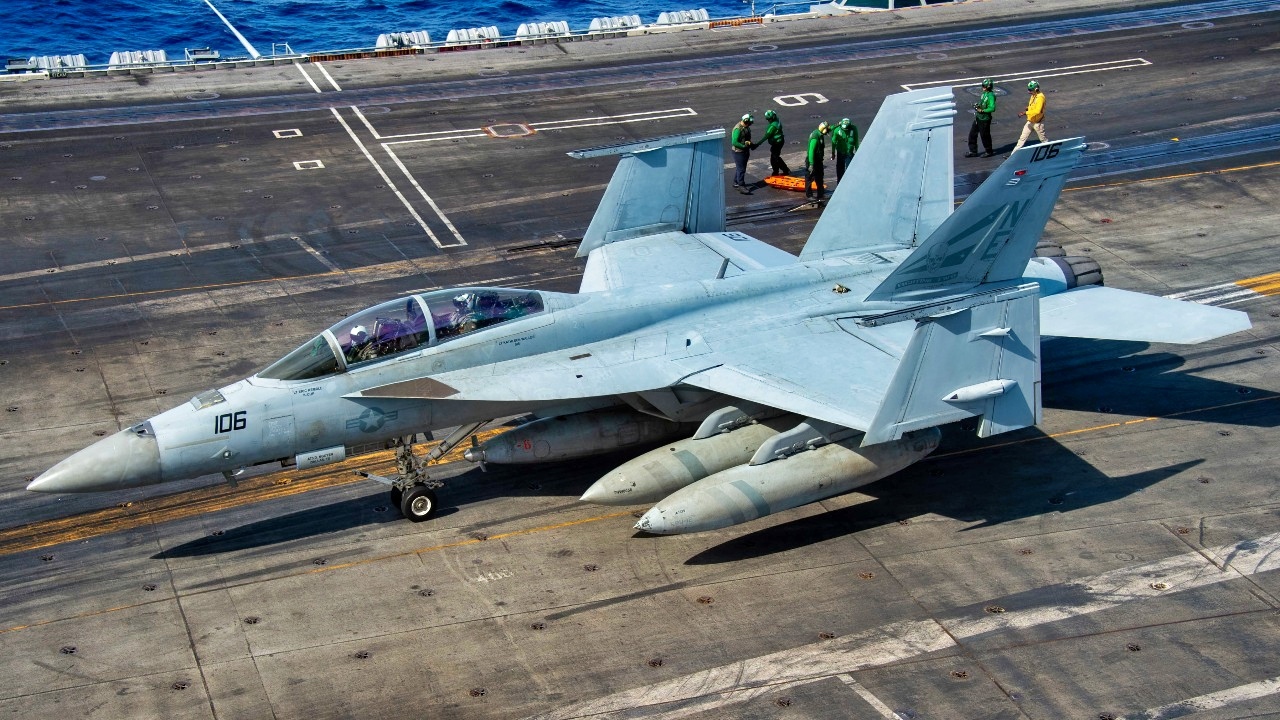
(Dec. 30, 2021) An F/A-18F Super Hornet, assigned to the “Bounty Hunters” of Strike Fighter Squadron (VFA) 2, taxis on the flight deck of Nimitz-class aircraft carrier USS Carl Vinson (CVN 70), Dec. 30, 2021. Carl Vinson Carrier Strike Group is on a scheduled deployment in the U.S. 7th Fleet area of operations to enhance interoperability through alliances and partnerships while serving as a ready-response force in support of a free and open Indo-Pacific region. (U.S. Navy photo by Mass Communication Specialist 3rd Class Jeff D. Kempton)
-When paired with the EA-18G Growler’s electronic jamming and the F-35’s stealthy reconnaissance, the Super Hornet provides the volume of fire necessary to overwhelm peer adversaries. It’s not the future of air combat, but it is the “muscle” that keeps the present-day carrier wing viable.
Beyond Stealth: How the F/A-18 Super Hornet Counter-Attacks the J-20 and F-35
The F/A-18E/F Super Hornet first entered service in the early 2000s, a fourth-generation fighter at a time when fifth-generation fighters were emerging. Yet, the F/A-18 has remained central to US Navy carrier air wings, even with the arrival of the F-35 or the J-20 abroad. So how does a non-stealth, fourth-generation fighter remain viable against fifth-generation threats?
The Design Philosophy
The Super Hornet was designed as a carrier-centric multirole workhorse—not a boutique air-dominance fighter. The platform priorities are reliability, maintainability at sea, and payload and range flexibility.
Built to replace multiple legacy fighters, such as the A-6, F-14, and older Hornets, the F/A-18 Super Hornet is a workhorse whose success is measured by sortie generation and availability, not stealth alone.
But fifth-generation platforms do present a problem; with low observability, sensor fusion, and networked targeting, these advantages threaten traditional fourth-generation tactics. Yet, the Super Hornet survives, not by changing how it fights, but by not pretending to be a cutting-edge stealth fighter.
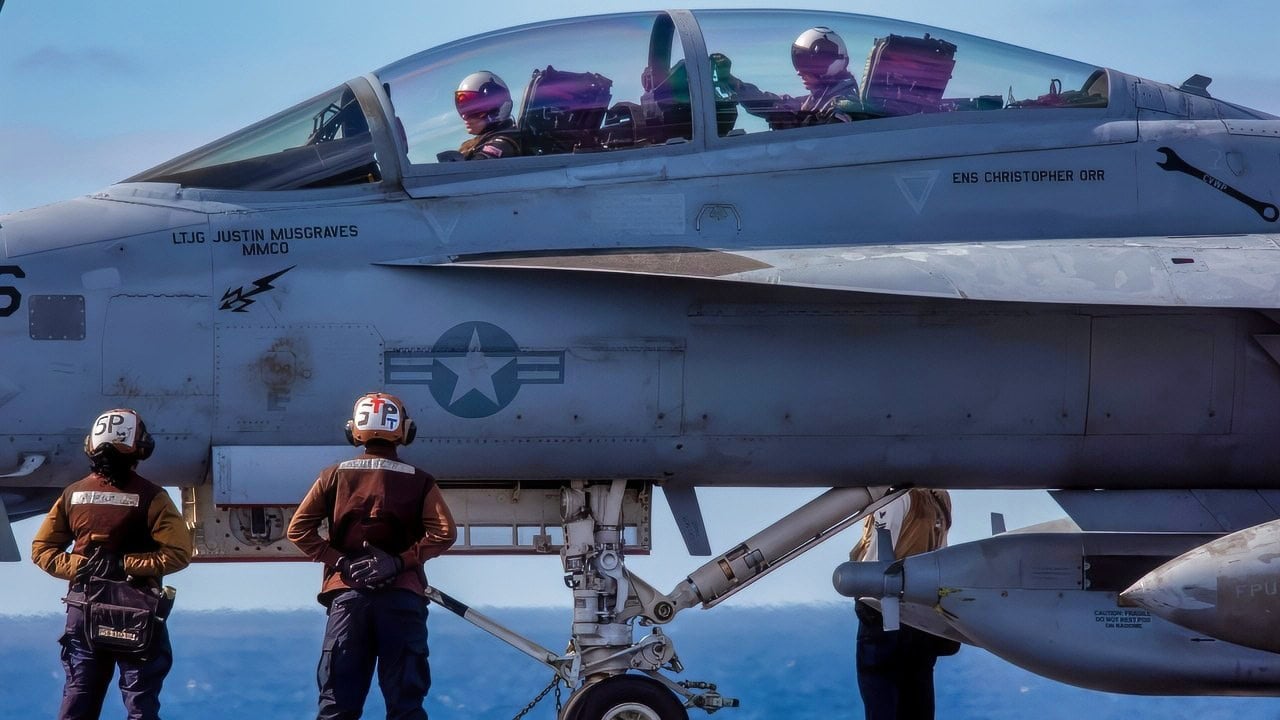
U.S. Navy Sailors prepare to taxi an EA-18G Growler, attached to Electronic Attack Squadron (VAQ) 133, on the flight deck of Nimitz-class aircraft carrier USS Abraham Lincoln (CVN 72) on Nov. 24, 2025. USS Abraham Lincoln (CVN 72), flagship of the Abraham Lincoln Carrier Strike Group, is underway conducting routine operations in the U.S. 3rd Fleet area of operations, demonstrating the U.S. Navy’s long-term commitment to a free and open Indo-Pacific. (U.S. Navy photo by Mass Communication Specialist Seaman Daniel Kimmelman)
Key Upgrades
Multiple upgrades have kept the Super Hornet relevant. First, the introduction of AESA radar, the APG-79, fundamentally changed the aircraft. It provided longer detection ranges, multi-target tracking, and electronic attack support. This improved sensor performance narrows the awareness gap with fifth-generation fighters.
Second, the F/A-18 increasingly fights as part of a network, rather than an isolated platform. Through integration with the E-2D, F-35, and Aegis-equipped surface combatants, the Super Hornet can act as a missile truck, relay node, and cooperative shooter. This integration offsets stealth disadvantages by leveraging shared battle space awareness.
Third, the EA-18G Growler variant serves as a major force multiplier, providing stand-off jamming, radar suppression, and degradation of enemy sensors. Electronic attack reshapes the engagement space, enabling Super Hornets to survive and fight more effectively.
Weapon Improvements
Modern air combat is increasingly decided by missile performance, targeting quality, and cooperative engagement rather than raw kinematics. And the Super Hornet is properly equipped with modern weaponry.
Specifically, the Super Hornet carries advanced air-to-air missiles and long-range stand-off weapons. Payload flexibility remains a core strength of the platform, the ability to mix and match ordnance to meet a wide variety of mission profiles.
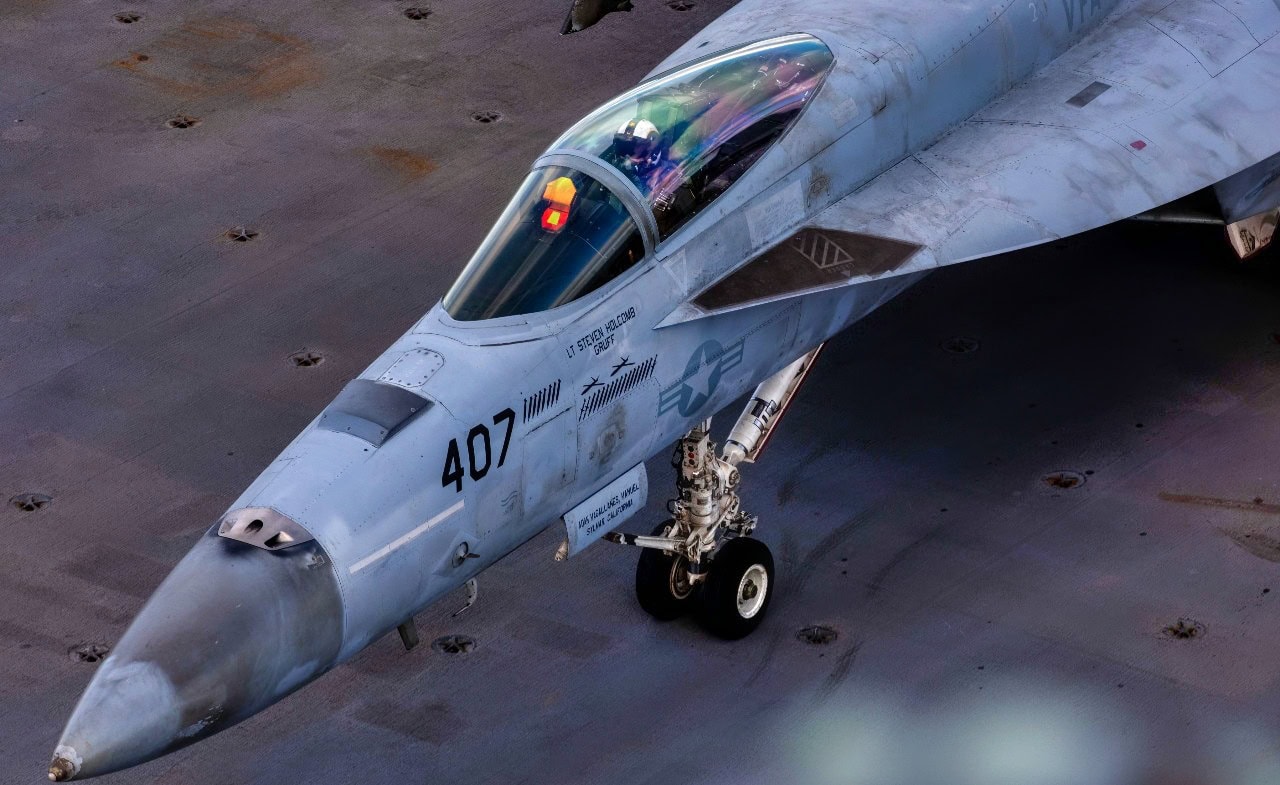
(Dec. 7, 2024) LT Steven Holcomb, attached to the Gunslingers of Strike Fighter Squadron (VFA) 105, operates a F/A-18E Super Hornet on the flight deck during flight operations, Dec. 7, 2024. USS George H.W. Bush is in the basic phase of the Optimized Fleet Response Plan conducting flight deck certification.(U.S. Navy photo by Mass Communication Specialist Seaman Jayden Brown)
And of course, while stealth is desirable, it’s not everything—especially in the naval environment. Carrier aviation imposes constraints on stealth saltwater corrosion, tight deck cycles, high sortie demand, and so on. The Super Hornet adds value through rapid turnaround, deck handling, and high availability. Fifth-generation fighters are valuable—but expensive and maintenance-intensive.
Tactical Employment
Super Hornets would rarely be charged with fighting against fifth-generation opponents alone.
Typically, the Super Hornet would support US stealth assets, providing volume of fire and defending the carrier strike group.
This works best in layered air defense, not solo penetration.
So, the Super Hornet is prevented from engaging head-on with fifth-generation fighters, as that would put it at a distinct disadvantage. As a supplement, however, the Super Hornet is still an asset.
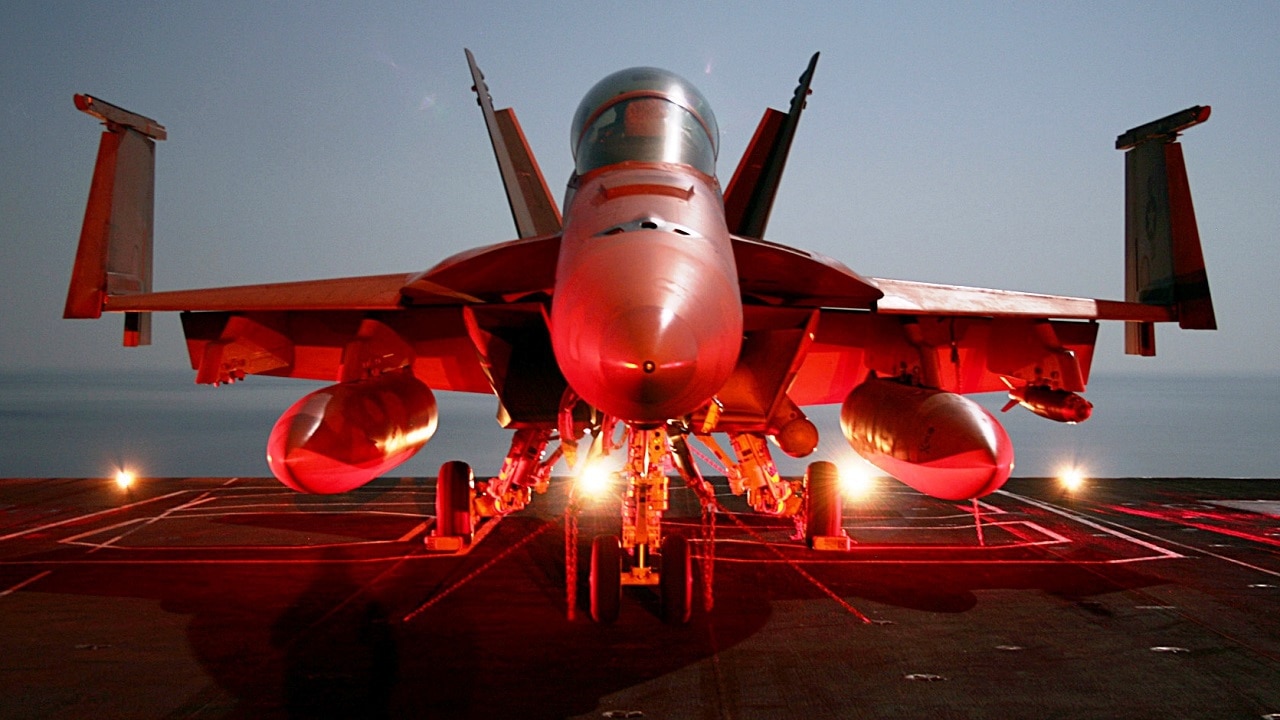
An F/A-18F Super Hornet Strike Fighter Squadron 103 is parked on the flight deck of the aircraft carrier USS Dwight D. Eisenhower (CVN 69) as the ship operates in the Arabian Sea on Dec. 5, 2006. The Eisenhower is in the Arabian Sea in support of maritime security operations.
Understanding the Super Hornet’s limitations is part of why the platform remains successful.
The jet cannot match stealth aircraft in first-look survivability or penetrate dense A2/AD networks on its own. Its relevance depends on support systems, EW, and numbers and availability.
Longevity and Resilience
The Super Hornet is still in the game because it evolves incrementally, it fills roles that stealth aircraft don’t want, and it’s already paid for and understood. The aircraft fits a role; the Navy needs both high-end stealth and reliable mass.
The Hornet provides the mass. As a complement to fifth-generation fighters, the Super Hornet is still effective.
And by staying in that lane, by avoiding head-to-head engagement with fifth-generation fighters, the Super Hornet can remain valuable, proof that modern air power is about integrated systems, not single platforms dogfighting one another.
The Super Hornet is very clearly not the future of air combat. But it remains essential to the present moment.
Upgrades in sensors, networking, and electronic warfare keep the platform credible. And for the foreseeable future—while carriers need large, flexible air wings—the Super Hornet will remain in the fight, even as fifth-generation and unmanned platforms become more central to naval aviation.
About the Author: Harrison Kass
Harrison Kass is an attorney and journalist covering national security, technology, and politics. Previously, he was a political staffer and candidate, and a US Air Force pilot selectee. He holds a JD from the University of Oregon and a master’s in global journalism and international relations from NYU.