
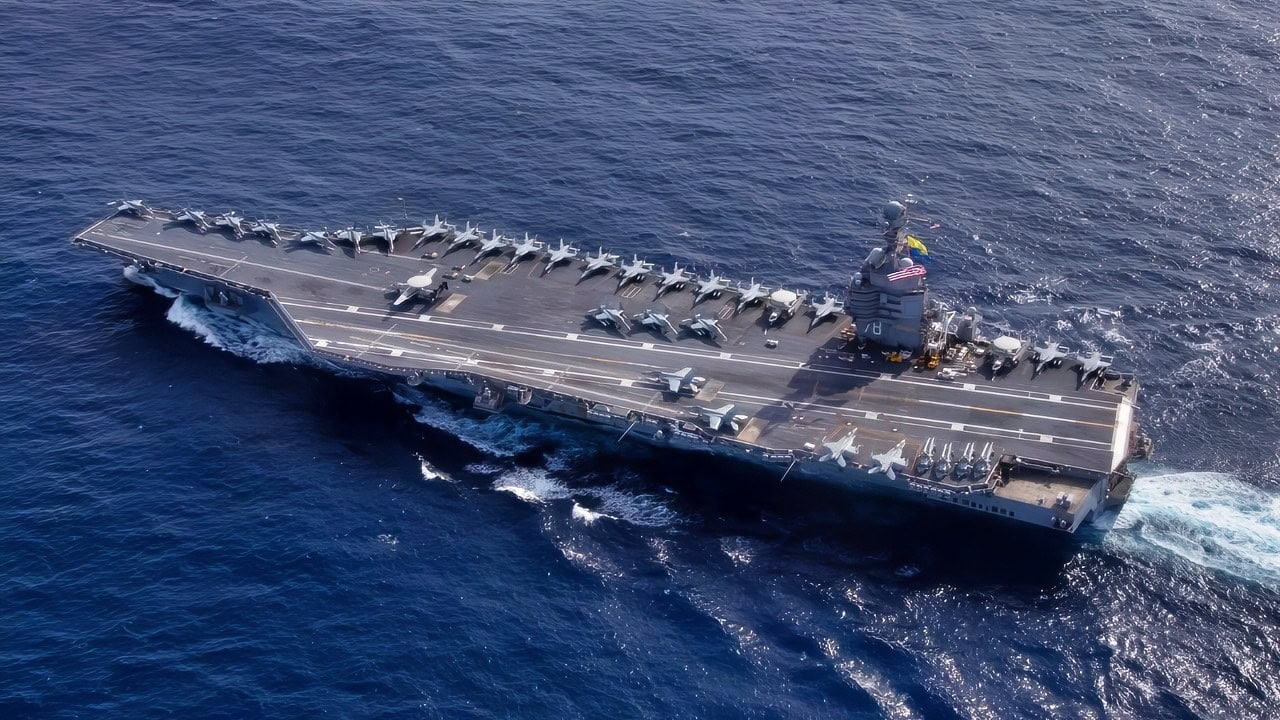
Summary and Key Points: USS John F. Kennedy’s sea trials mark progress for the Navy’s Ford-class—but also spotlight how long new carriers take to reach the water.
-CVN-79’s timeline stretches roughly 11 years from keel-laying to sea trials, slower than the lead ship USS Gerald R. Ford. With USS Enterprise projected for 2030 and USS Doris Miller for 2032—plus several more planned hulls still without clear schedules—the carrier replacement plan looks increasingly tight as Nimitz-class ships near retirement.
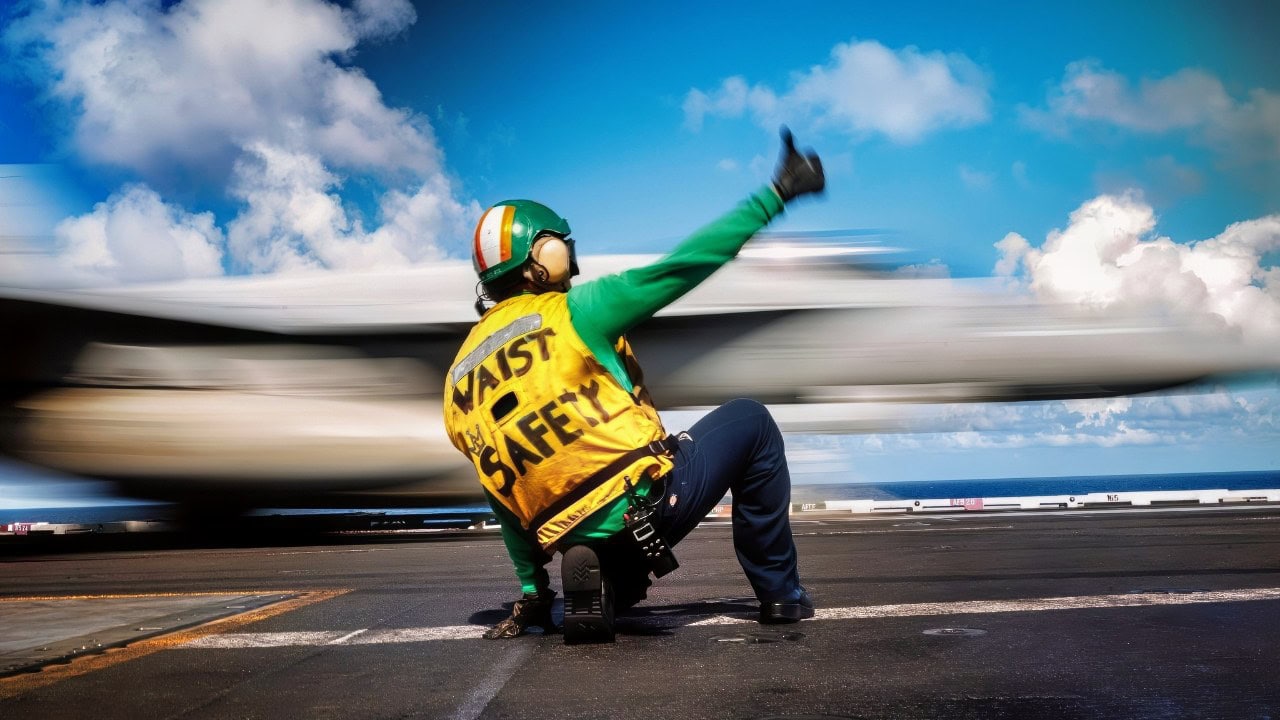
USS Gerald R. Ford Aircraft Carrier or Supercarrier

Oct. 9, 2022 – The first-in-class aircraft carrier USS Gerald R. Ford (CVN 78) steams the Atlantic Ocean during a simulated straits transit with the Gerald R. Ford Carrier Strike Group (GRFCSG) in the Atlantic Ocean, Oct. 9, 2022. The Gerald R. Ford Carrier Strike Group is deployed in the Atlantic Ocean, conducting training and operations alongside NATO Allies and partners to enhance integration for future operations and demonstrate the U.S. Navy’s commitment to a peaceful, stable and conflict-free Atlantic region. (U.S. Navy photo by Mass Communication Specialist 2nd Class Jackson Adkins)
-Meanwhile, China’s carrier force continues expanding, including work tied to a larger Type 004.
The Ford-Class Supercarrier Race Is Now a Numbers Fight
As we recently reported, the U.S. Navy’s Gerald R. Ford-class carrier USS John F. Kennedy (CVN-79) has embarked on her sea trials, making her the second Ford-class carrier to set sail.
While CVN-79’s sailors and builders should be proud of the achievement, it also raises a scary question: can the JFK’s remaining Ford-class sister ships be built quickly enough to keep up with China and Russia?
Slow-Going Fords…
The Kennedy was laid down on July 20, 2015, and launched on October 29, 2019. It was christened on December 7 of that year by Jack Kennedy’s daughter Caroline. In all, there was about an 11-year gap between the JFK’s keel-laying and the start of sea trials.
For comparison, the lead ship of the class, the USS Gerald R. Ford (CVN-78) was laid down on November 14, 2009, christened on November 9, 2013, and began sea trials in 2017, equating to a mere eight-year gap between keel-laying and sea trials. (CVN-78’s commissioning took place on July 22, 2017).
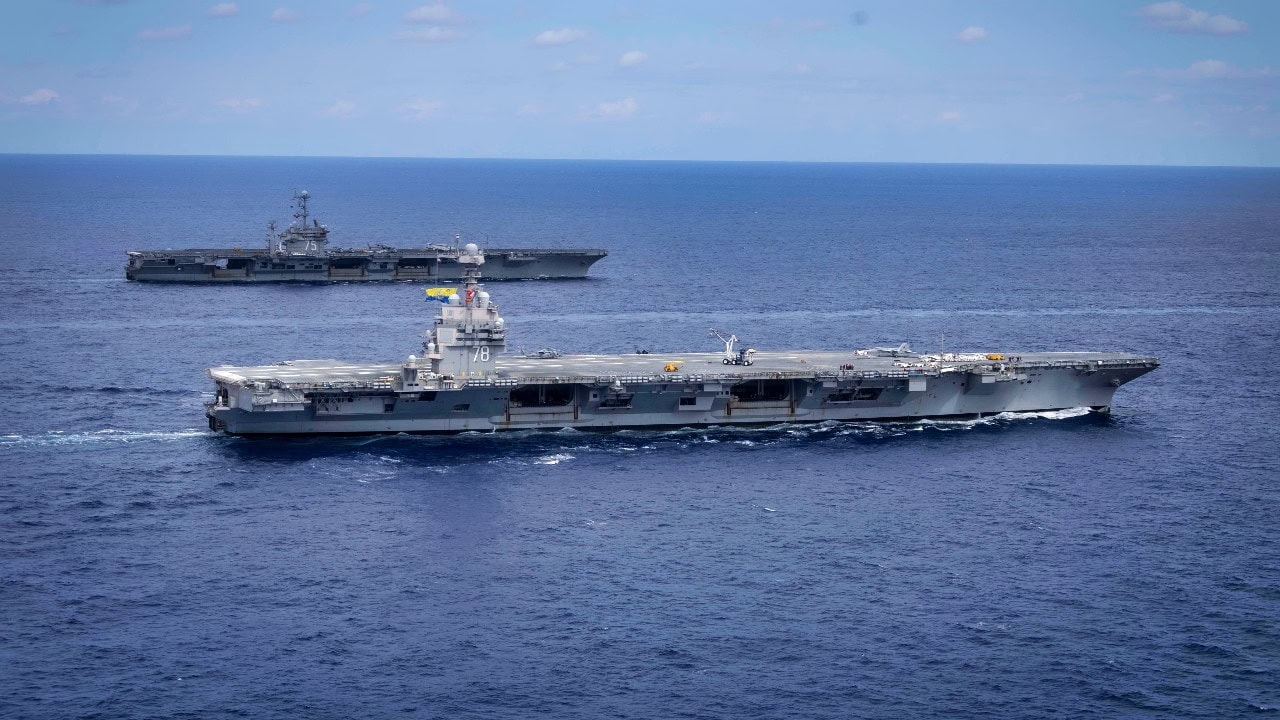
ATLANTIC OCEAN. (Aug. 24, 2024) The Nimitz-class aircraft carriers USS Harry S. Truman (CVN 75), back, and the world’s largest aircraft carrier, USS Gerald R. Ford (CVN 78), sail in formation in the Atlantic Ocean, Aug. 24, 2024. USS Gerald R. Ford is the flagship of the Gerald R. Ford Carrier Strike Group. The aircraft carrier is underway in the Atlantic Ocean to further develop core unit capabilities and skills such as fuels certification and ammunition on-load during its basic phase of the optimized fleet response plan. (U.S. Navy photo by Mass Communication Specialist 2nd Class Maxwell Orlosky).
Meanwhile, the next ship of the class, the future USS Enterprise (CVN-80), was laid down on August 27, 2022, and is expected to be commissioned sometime in 2030.
Seven more Ford-class carriers are planned after that: the future USS Doris Miller (CVN-81), which now has a projected delivery date of 2032; USS William J. Clinton (CVN-82); and USS George W. Bush (CVN-83), as well as four more carriers that haven’t been named yet. Keel-laying dates for these “Magnificent Seven” are very much yet to be determined—let alone sea trials.
…And Fast-Going Nimitz-Class
Meanwhile, Nimitz-class vessels are fast approaching their retirements.
The time-honored and battle-tested Nimitz-class supercarriers are getting long in the tooth, and though in theory the remaining Fords are supposed to replace them on a one-for-one basis (CVN-78 replaced the earlier iteration of the USS Enterprise, that being CVN-65, which is now awaiting the scrapyard), there are some concerns about whether that’s working out as well in practice as it was supposed to in theory.
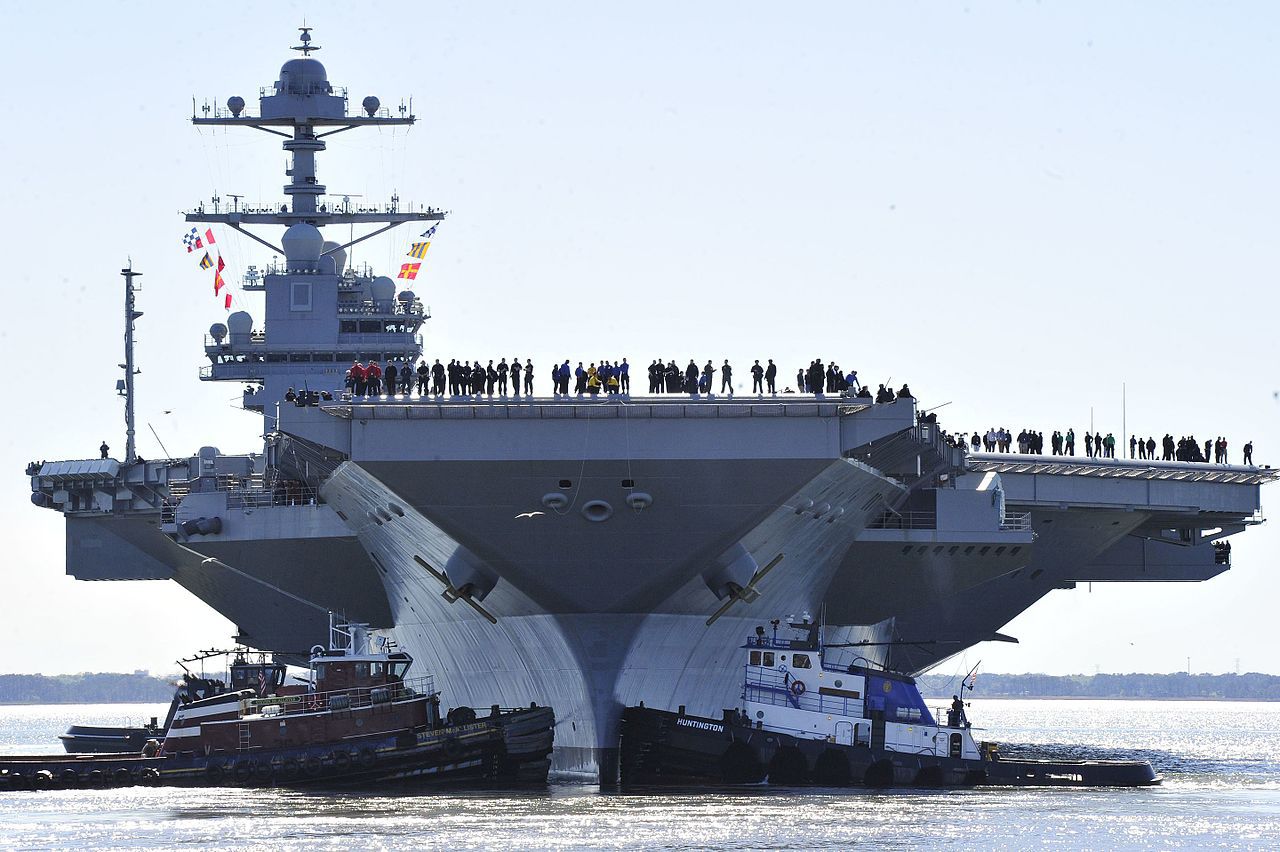
NEWPORT NEWS, Va. (April 8, 2017) – Pre-Commissioning Unit Gerald R. Ford (CVN 78) Sailors man the rails as the ship departs Huntington Ingalls Industries Newport News Shipbuilding for builder’s sea trials off the coast. The first- of-class ship—the first new U.S. aircraft carrier design in 40 years—will spend several days conducting builder’s sea trials, a comprehensive test of many of the ship’s key systems and technologies. (U.S. Navy photo by Chief Mass Communication Specialist Christopher Delano).
The USS John F. Kennedy is supposed to replace the USS Nimitz (CVN-68), while the Enterprise (CVN-80, that is) is expected to replace the USS Dwight D. Eisenhower (CVN-69).
CVN-68’s retirement phase is expected to be completed next month, so it appears that the CVN-79 is on track to meet the first goal.
Meanwhile, CVN-69 was originally planned for retirement in 2027, but now the Navy is considering extending her. This might not be a bad idea, in case CVN-80’s commissioning date of 2030 runs into delays and cost overruns. .
Meanwhile, Over in China…
As noted in U.S. President Donald Trump’s Executive Order “Restoring American’s Maritime Dominance,” “Recent data shows that the United States constructs less than one percent of commercial ships globally, while the People’s Republic of China (PRC) is responsible for producing approximately half.”
China’s shipbuilding prowess includes that nation’s first nuclear-powered aircraft carrier, the Type 004, which recently began construction at Dalian shipyard and is projected to displace 110–120,000 tons and carry more than 90 aircraft, including J-15T and J-35 fighters.
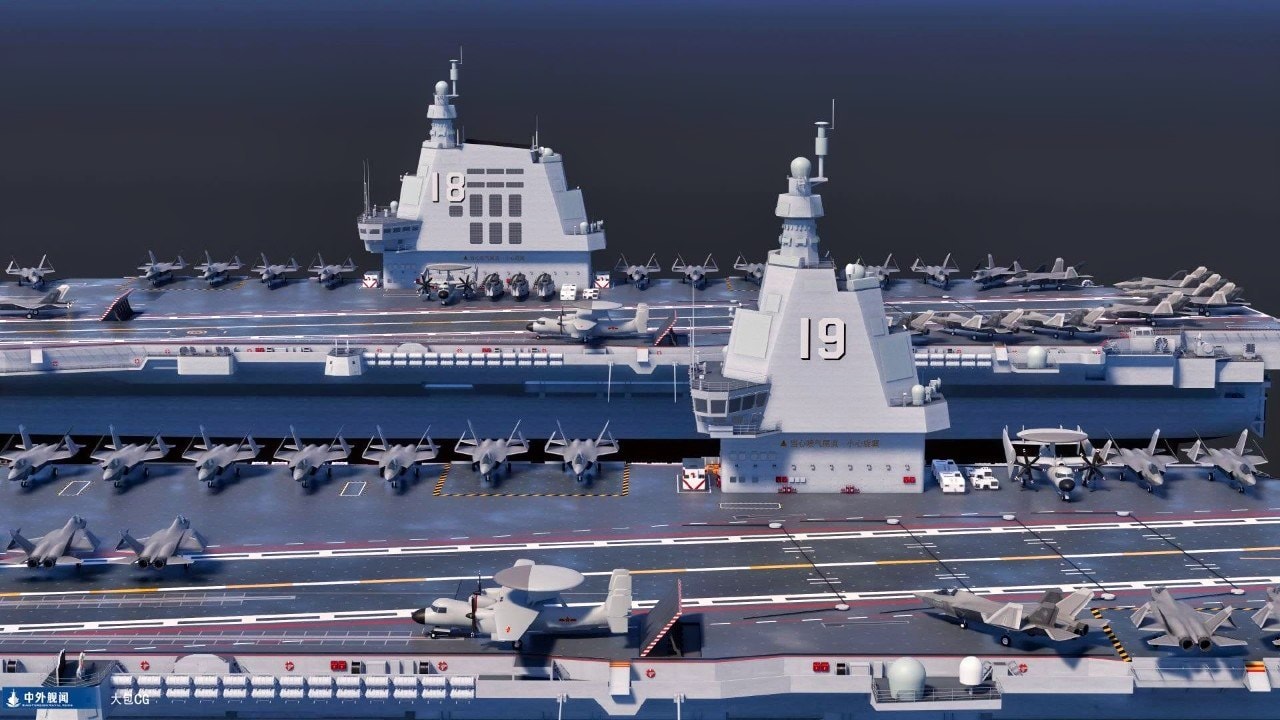
China Aircraft Carrier Models. Image Credit: Creative Commons.
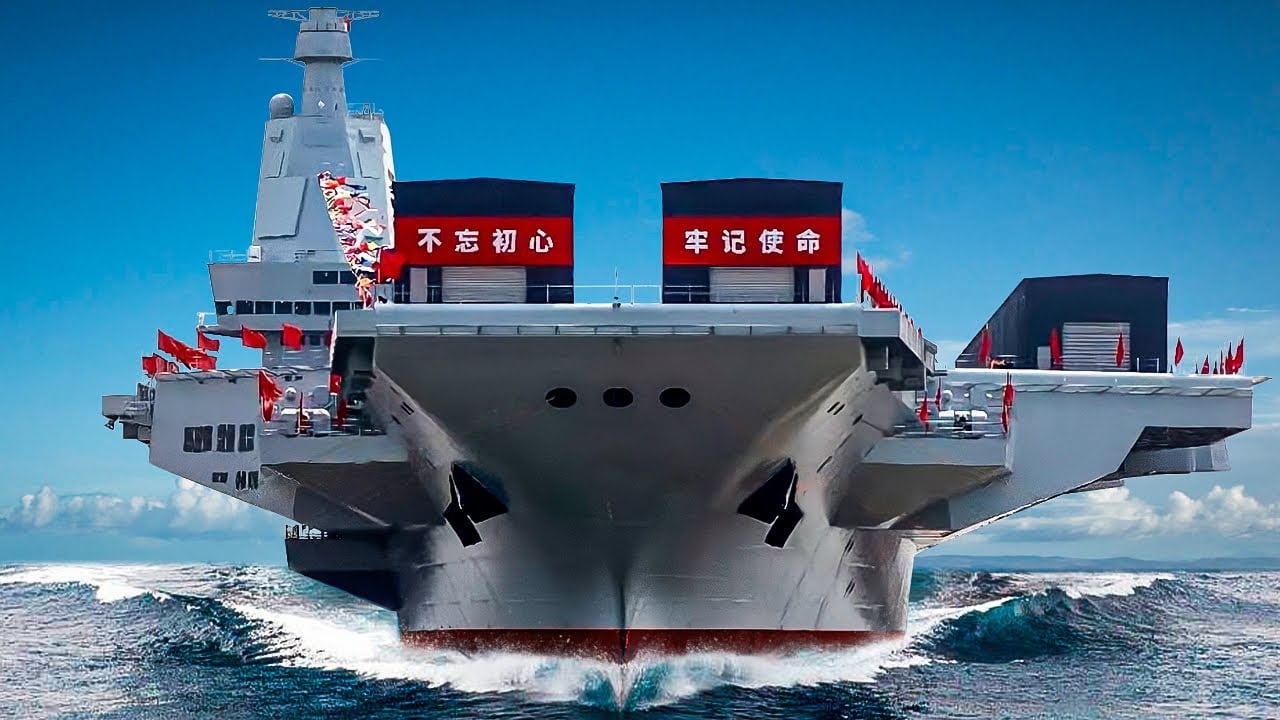
China Aircraft Carrier. Image Credit: YouTube Screenshot.
It would be the largest warship ever built in Asia if and when it is completed.
The People’s Liberation Army Navy (PLAN) currently has three operational carriers: the Type 001 carrier Liaoning, the Type 002 carrier Shandong, and the Fujian-class Type 003 carrier Fujian.
These were commissioned in 2012, 2019, and 2025, and displace 60,900, 70,000, and 80,000+ tons, respectively.
In short, the U.S. Navy is in a race against time numbers in its Great Power competition against Beijing and the PLAN.
About the Author: Christian D. Orr, Defense Expert
Christian D. Orr is a Senior Defense Editor. He is a former Air Force Security Forces officer, Federal law enforcement officer, and private military contractor (with assignments worked in Iraq, the United Arab Emirates, Kosovo, Japan, Germany, and the Pentagon). Chris holds a B.A. in International Relations from the University of Southern California (USC) and an M.A. in Intelligence Studies (concentration in Terrorism Studies) from American Military University (AMU). He is also the author of the newly published book “Five Decades of a Fabulous Firearm: Celebrating the 50th Anniversary of the Beretta 92 Pistol Series.”