
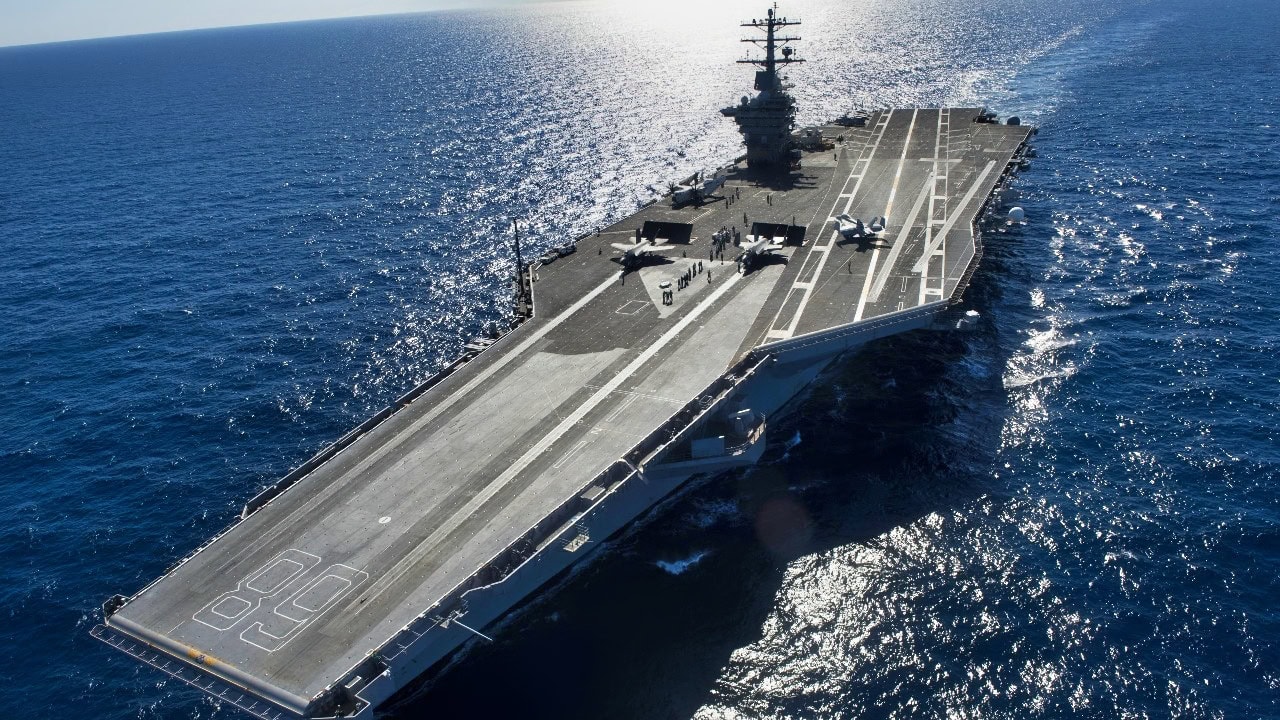
Synopsis: USS John F. Kennedy (CVN-79), the second Gerald R. Ford-class supercarrier, has begun manufacturer sea trials—an early step toward delivery and eventual fleet service.
-The milestone matters because carrier availability is tight: under the Navy’s “rule of thirds,” only a small fraction of the force is typically deployed at once, while the rest trains up or sits in deep maintenance.
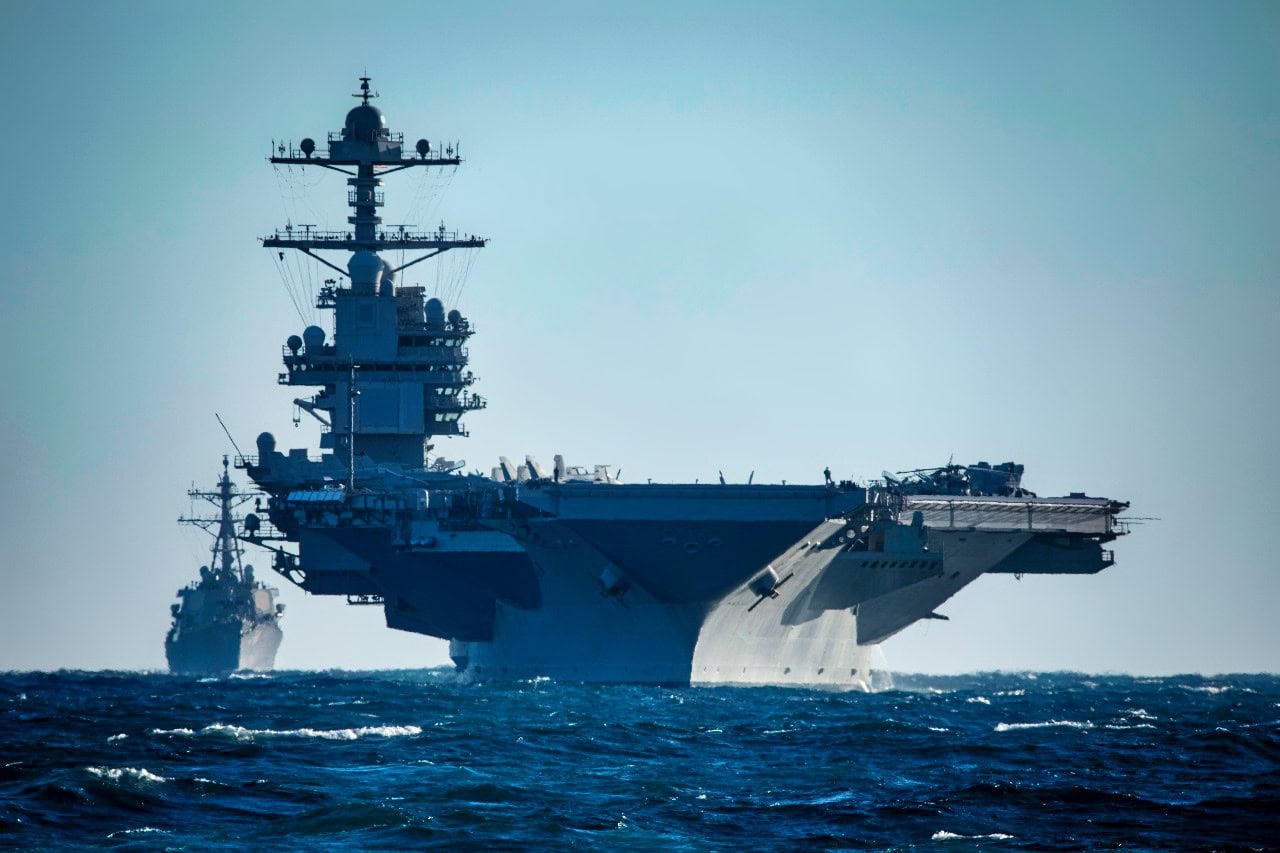
A view from the Ticonderoga-class guided missile cruiser USS Normandy (CG 60) of the first-in-class aircraft carrier USS Gerald R. Ford (CVN 78) and the Arleigh Burke-class guided missile destroyers USS Thomas Hudner (DDG 116), USS Ramage (DDG 61) and USS McFaul (DDG 74) as the ships steam in formation during a drill while underway as part of the Gerald R. Ford Carrier Strike Group March 5, 2023. Ford Carrier Strike Group is underway in the Atlantic Ocean executing its Composite Training Unit Exercise (COMPTUEX), an intense, multi-week exercise designed to fully integrate a carrier strike group as a cohesive, multi-mission fighting force and to test their ability to carry out sustained combat operations from the sea. As the first-in-class ship of Ford-class aircraft carriers, CVN 78 represents a generational leap in the U.S. Navy’s capacity to project power on a global scale. (U.S. Navy photo by Mass Communication Specialist 2nd Class Malachi Lakey)
-Refueling and complex overhauls can sideline a nuclear carrier for years, compounding operational strain when accidents and repairs intervene. CVN-79’s progress brings another 100,000-ton, nuclear-powered supercarrier closer to relieving overstretched deployments—while highlighting how far carrier design has advanced since the conventionally powered JFK (CV-67).
USS John F. Kennedy Heads to Sea: The Navy’s Next Ford-Class Carrier Begins Trials
As befits a Commander-in-Chief who served in the U.S. Navy, John F. Kennedy has had not just one, but two aircraft supercarriers named in his honor. The second just embarked on her sea trials.
Bottom Line Up Front (BLUF): A New Supercarrier Is Born
The Aviationist shares the details:
“The next Gerald R. Ford-class supercarrier, to be known as the USS John F. Kennedy (CVN 79), set sail under its own power from Newport News for the first time on Jan. 28, 2026 to begin manufacturer sea trials. …
“Ahead of scheduled delivery to the U.S. Navy in March 2027, which will come with its own set of sea trials, these initial tests will certify the 100,000 ton behemoth’s major systems and components under close watch from specialist Huntington Ingalls Industries (HII) personnel. …
“The Kennedy was laid down at the HII facility in Newport News, birthplace of all U.S. Navy nuclear aircraft carriers, in 2015. The subsequent eleven year gap until commencing sea trials is longer than the USS Gerald R. Ford experienced, the first-of-class having been laid down in 2009 and began sea trials in 2017.”
Why Is It a Big Deal?
CVN-79 is the second of the long-awaited Ford-class carriers to set sail. The John F. Kennedy will help alleviate a shortage of operational supercarriers in the Navy.
Navy logisticians apply a “rule of thirds” to work on carriers: At any given time, one-third of these warships are deployed, one-third are preparing for deployment, and one-third are undergoing maintenance. With 11 carriers in the fleet, this means that only three to four are typically out to sea.
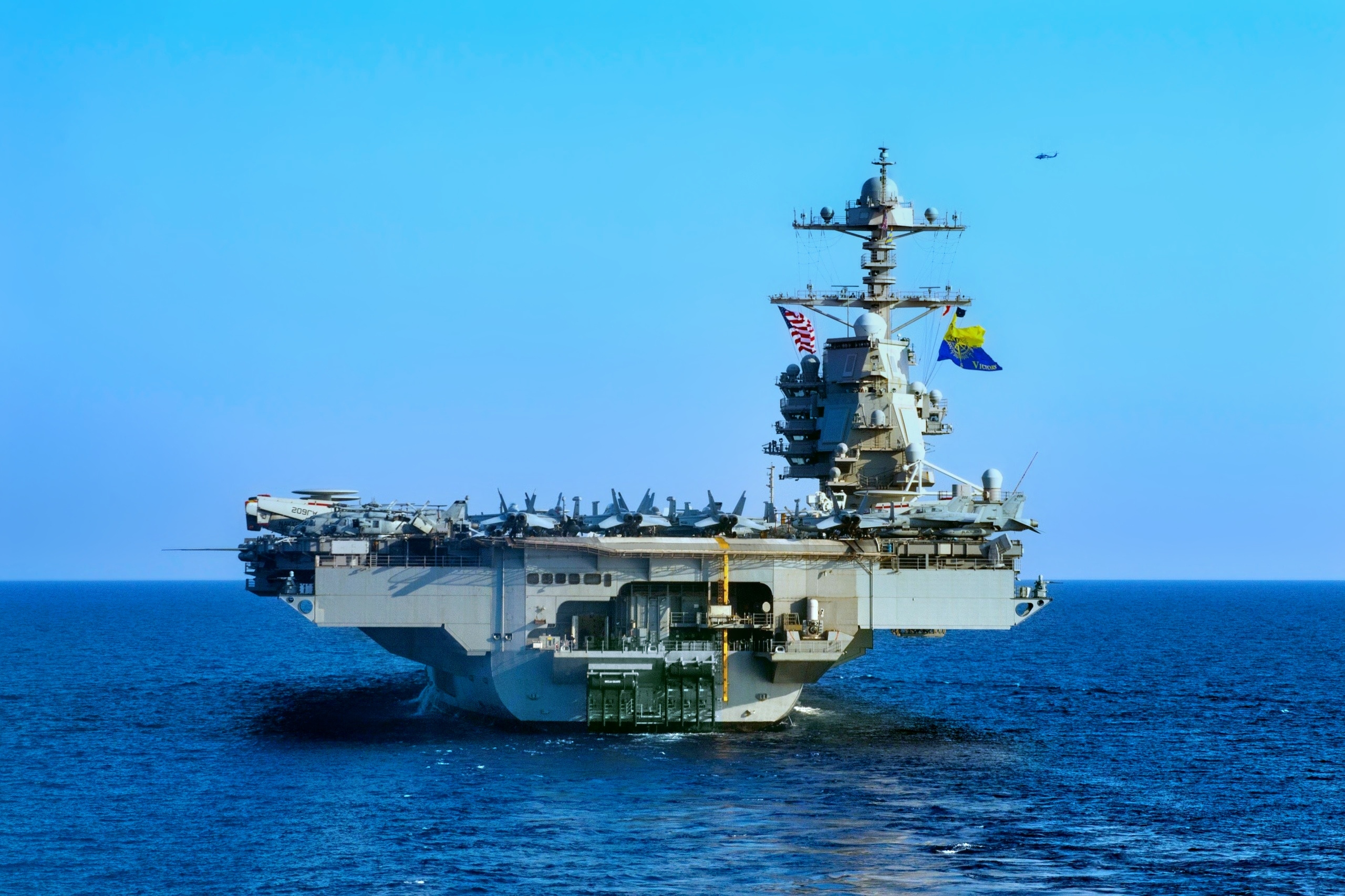
Ford-Class Aircraft Carrier. Image Credit: Creative Commons.
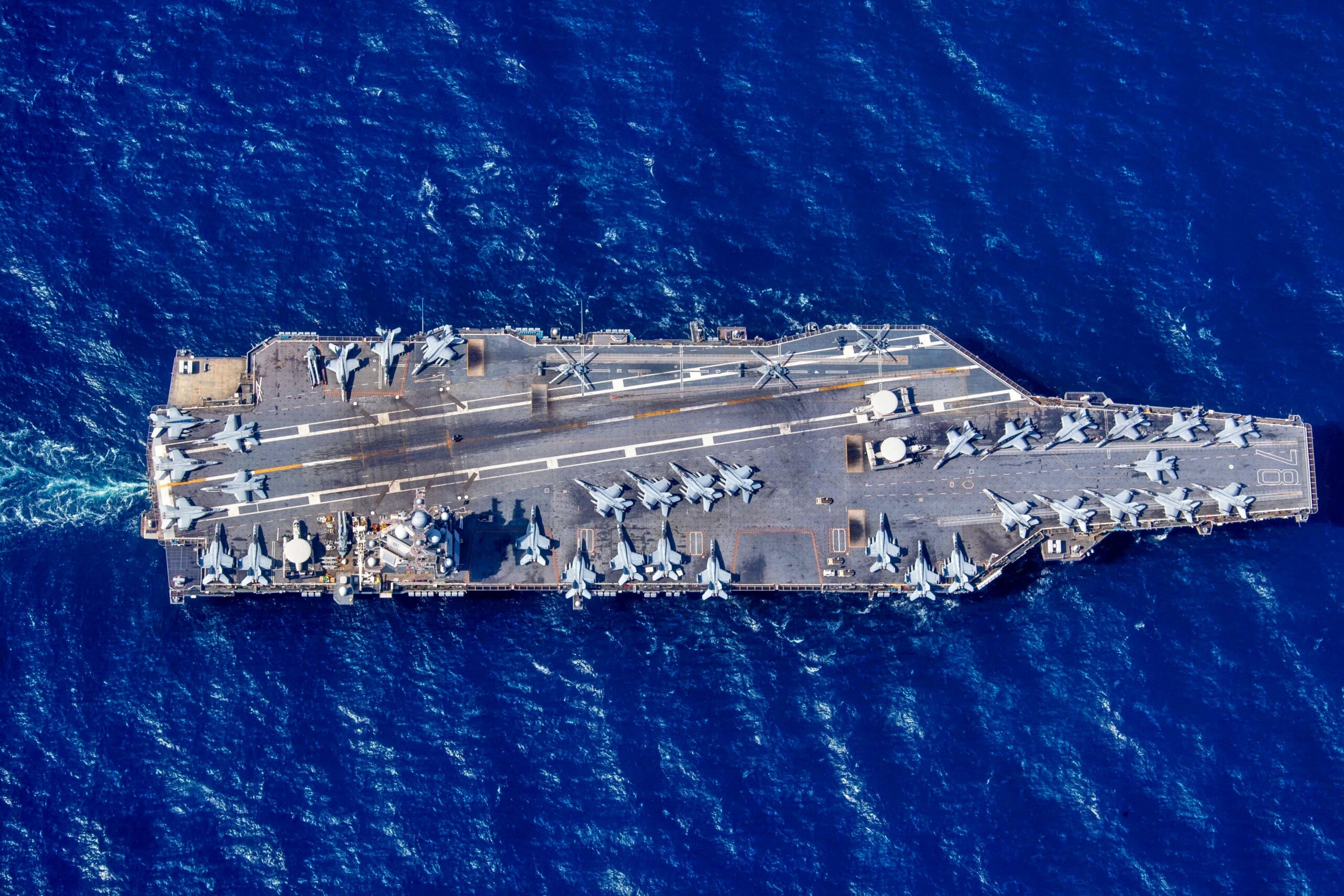
Ford-Class. Image Credit: Creative Commons.
Further complicating logistics, nuclear-powered supercarriers are required to undergo a refueling and complex overhaul (RCOH) every 25 years. This procedure entails cutting a massive hole into the hull and replacing everything from catapult systems to water purifiers.
As a prime example of just how arduous and time-consuming the RCOH process truly is, the Nimitz-class carrier USS George Washington (CVN-73) was out of action for whopping 2,100 days.
Her sister ship, the USS Harry S. Truman (CVN-75), was still operating eight months after a February 2025 collision with the Panamanian-flagged bulk carrier M/V Besiktas-M. It wasn’t until October that CVN-75 was finally scheduled for the completion of repair work. It will take place as part of her RCOH procedure at the Newport News Shipbuilding docks—reportedly, in the next 10 months.
The start of sea trials for the USS John F. Kennedy brings her that much closer to operational status, and equally closer to providing some relief for the hard-working crews onboard currently operational carriers.
Comparing the Old JFK and the New: CV-67 vs. CVN-79 Comparative Tech Specs and Vital Stats
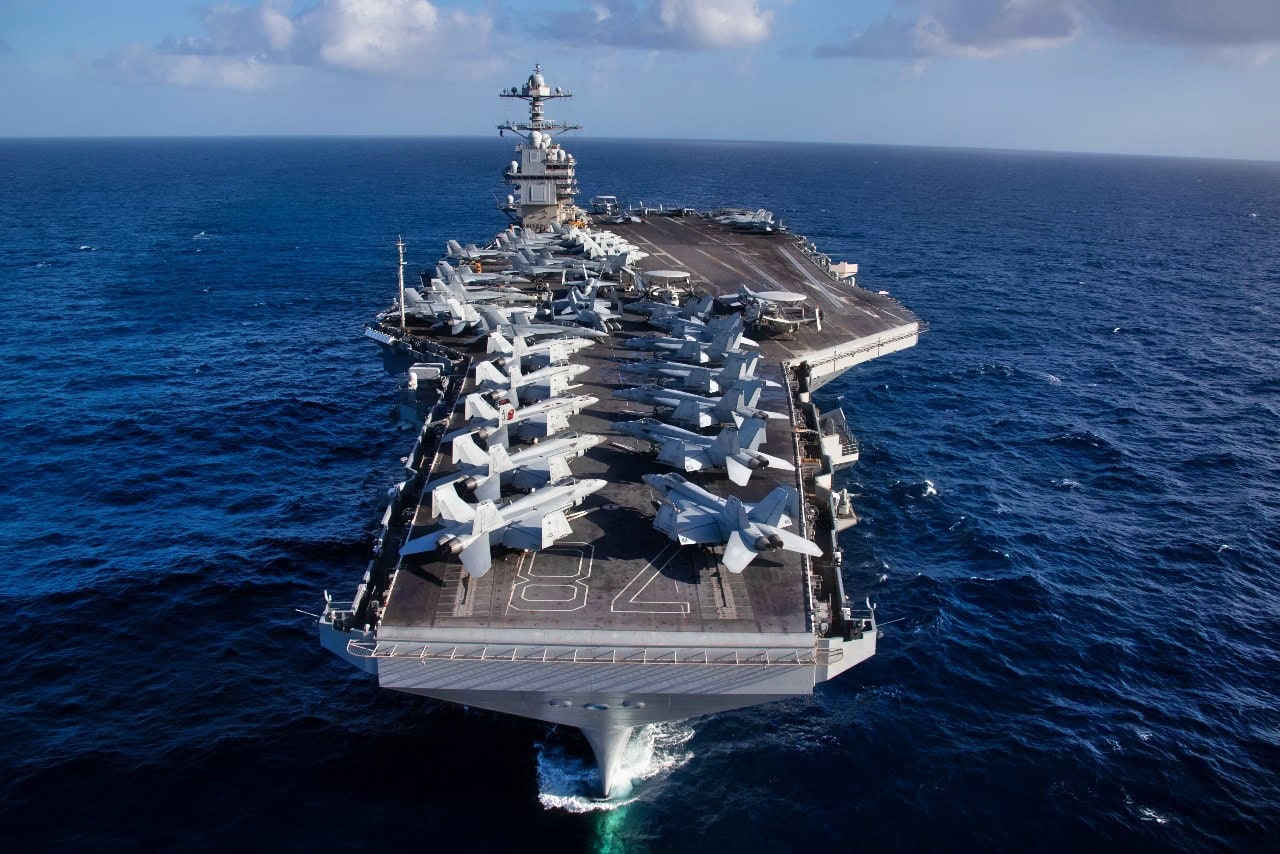
The world’s largest aircraft carrier USS Gerald R. Ford (CVN 78), steams in the Mediterranean Sea, Dec. 24, 2023. The Gerald R. Ford Carrier Strike Group is currently operating in the Mediterranean Sea. The U.S. maintains forward-deployed, ready, and postured forces to deter aggression and support security and stability around the world. (U.S. Navy photo by Mass Communication Specialist 2nd Class Jacob Mattingly)
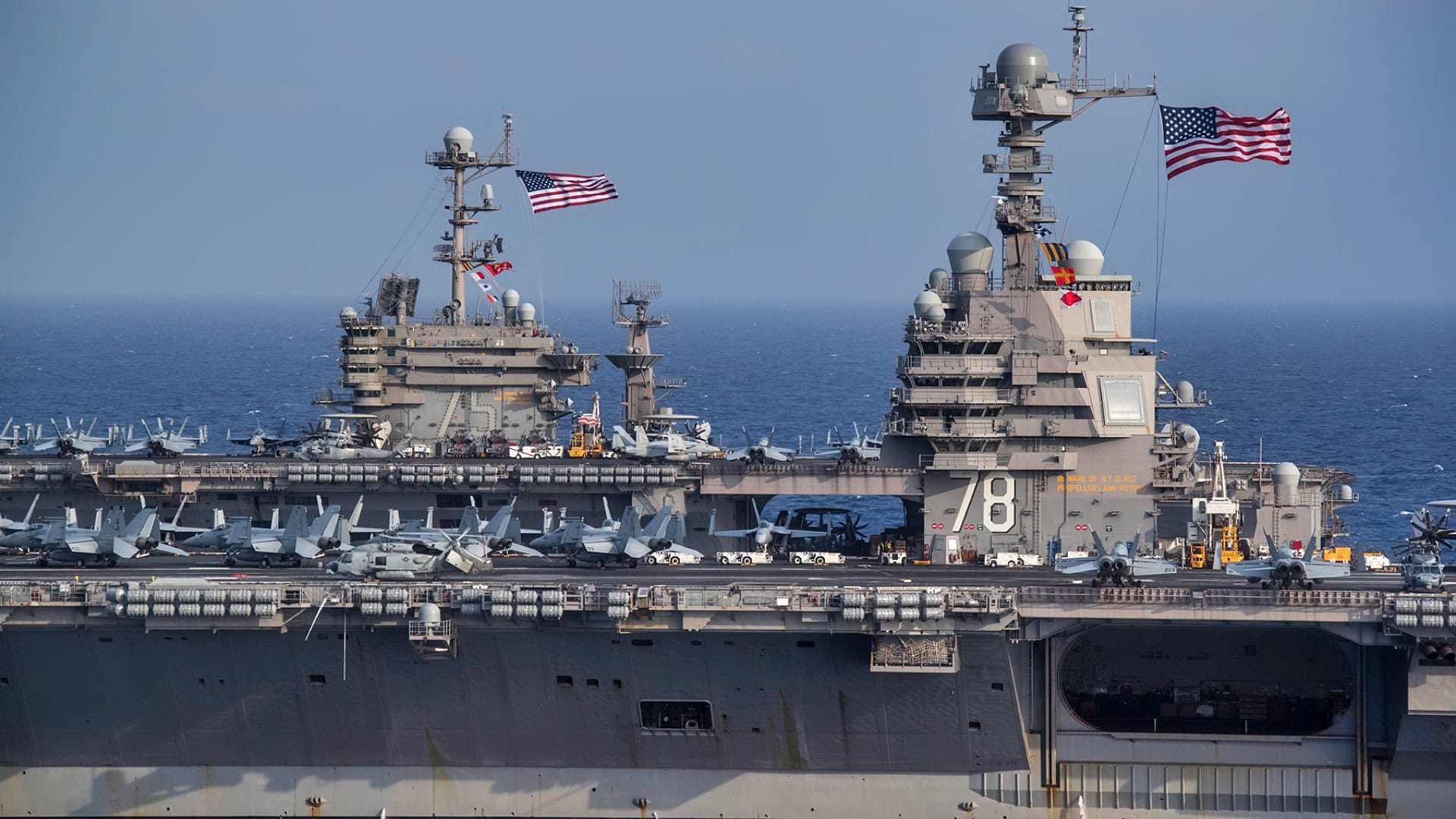
The Ford-class aircraft carrier USS Gerald R. Ford (CVN 78) and the Nimitz-class aircraft carrier USS Harry S. Truman (CVN 75) transit the Atlantic Ocean June 4, 2020, marking the first time a Ford-class and a Nimitz-class aircraft carrier have operated together underway. Ford is underway conducting integrated air wing operations, and the Harry S. Truman Carrier Strike Group remains at sea in the Atlantic as a certified carrier strike group force ready for tasking in order to protect the crew from the risks posed by COVID-19, following their successful deployment to the U.S. 5th and 6th Fleet areas of operation. (U.S. Navy photo by Mass Communication Specialist 2nd Class Ruben Reed)
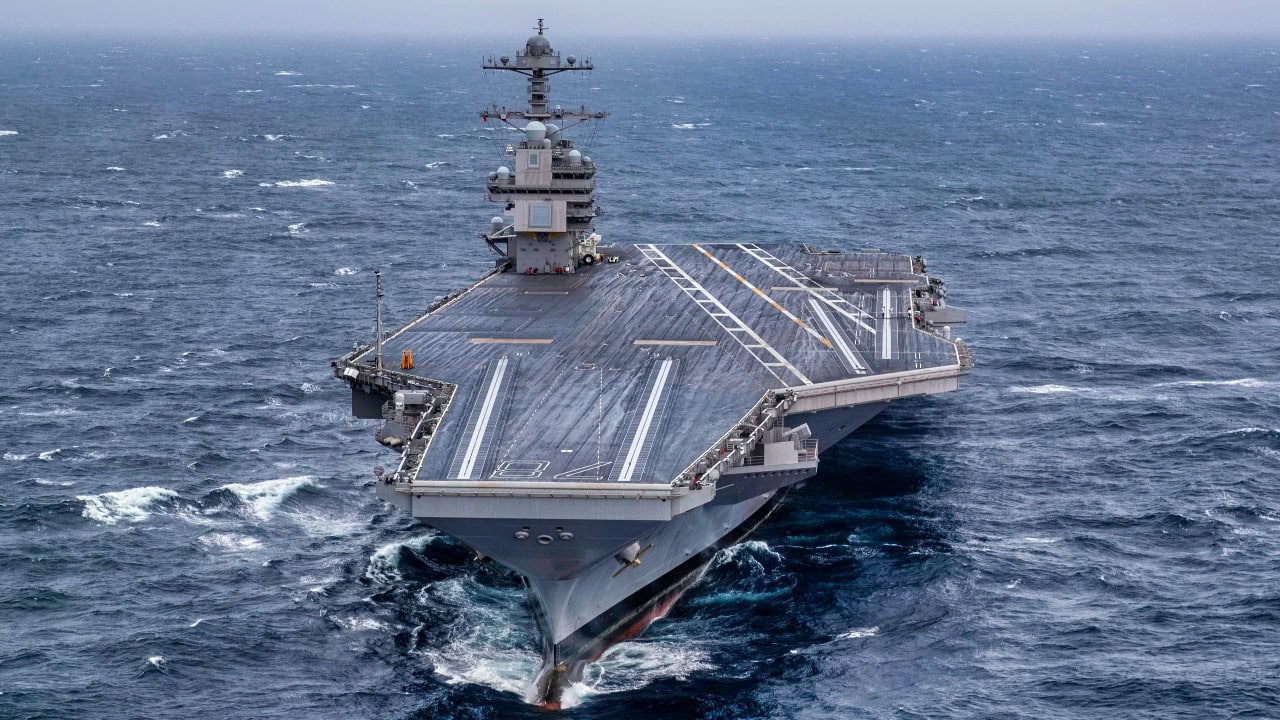
ATLANTIC OCEAN (Oct. 27, 2019) USS Gerald R. Ford (CVN 78) steams in the Atlantic Ocean for the first time since July 2018. Ford is conducting sea trials following its 15 month post-shakedown availability. (U.S. Navy photo by Mass Communication Specialist 3rd Class Connor Loessin)
Though still considered a supercarrier, the original USS John F. Kennedy (CV-67) was the last conventionally powered Navy aircraft carrier; every supercarrier since has been nuclear-powered. The following construction history and vital stats are courtesy of USCarriers.Net:
Keel Laid: October 22, 1964
Christened: May 27, 1967 (by John Kennedy’s daughter Caroline Kennedy, appropriately enough)
Commissioned: September 7, 1968
Decommissioned: August 1, 2007
Builder: Newport News Shipbuilding Co., Newport News, Va.
Propulsion system: eight 1200 psi (8.3 MPa) boilers,
four steam turbines, four shafts, 280,000 shp (210 MW)
Hull Length, overall: 1,052 feet (320.6 meters)
Beam Width: 130 feet (39.6 meters)
Draft: 36,7 feet (11.2 meters)
Displacement: approx. 82,655 tons fully laden
Speed: 30+ knots
Planes: approx. 80
Crew Complement: Ship: 3,117; Air Wing: 2,480
Armament:
– two Mk 29 NATO Sea Sparrow launchers
– two 20mm Phalanx CIWS (Close-In Weapon System) Mk 15
– two Rolling Airframe Missile (RAM) Systems
Meanwhile, courtesy of that same site, here are the facts and figures for CVN-79:
Keel Laid: August 22, 2015
Christened: December 7, 2019 (once again by daughter Caroline)
Commissioned: 2027
Builder: Huntington Ingalls Industries (HII), Newport News, Va.
Propulsion system: two A1B nuclear reactors, four shafts
Lengths, overall: 1.092 feet
Flight Deck Width: 252 feet
Beam: 134 feet
Draft: 39 feet
Displacement: approx. 100,000 tons full load
Speed: 30+ knots
Aircraft: 90 fixed-wing and helicopters, 4 EMALS Electromagnetic Catapults (F-35s will be used)
Crew: Officers: 508 Enlisted: 3789
Armament:
– Rolling Airframe Missile (RAM)
– Phalanx CIWS
Homeport: Norfolk, VA
About the Author: Christian D. Orr, Defense Expert
Christian D. Orr is a Senior Defense Editor. He is a former Air Force Security Forces officer, Federal law enforcement officer, and private military contractor (with assignments worked in Iraq, the United Arab Emirates, Kosovo, Japan, Germany, and the Pentagon). Chris holds a B.A. in International Relations from the University of Southern California (USC) and an M.A. in Intelligence Studies (concentration in Terrorism Studies) from American Military University (AMU). He is also the author of the newly published book “Five Decades of a Fabulous Firearm: Celebrating the 50th Anniversary of the Beretta 92 Pistol Series.”