
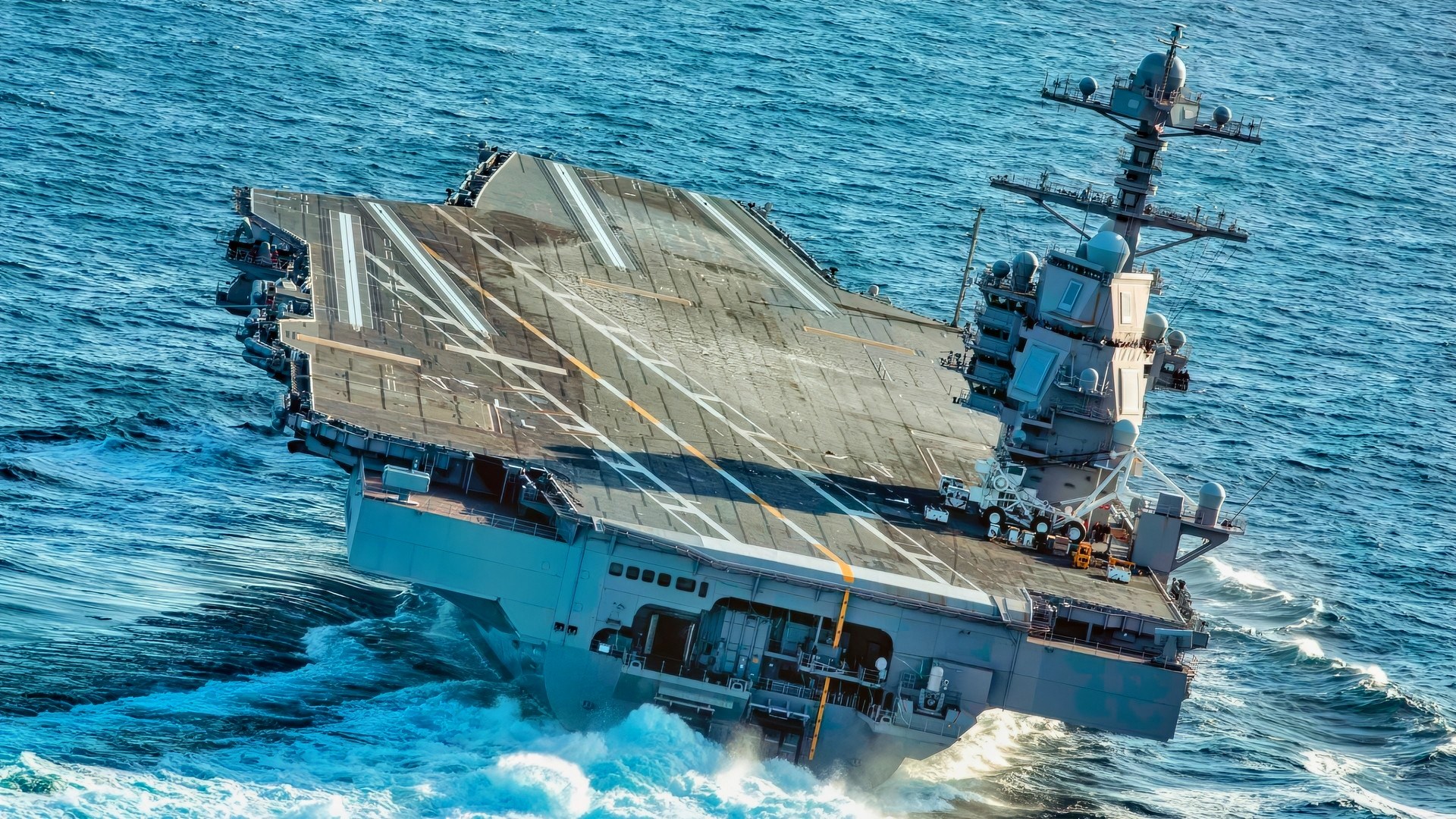
Key Points and Summary – The Department of Defense has accelerated the delivery of the USS John F. Kennedy (CVN-79) to March 2027, following a warning from Defense Secretary Pete Hegseth to Newport News Shipbuilding that further delays and cost overruns will not be tolerated.
-This decision follows the successful combat debut of the USS Gerald R. Ford in Operation Absolute Resolve off the coast of Venezuela, which validated the class’s advanced technologies like EMALS and increased power generation.
-Hegseth emphasized that shipyard leadership jobs are “on the line” as the Trump administration seeks to resolve industrial bottlenecks and modernize the fleet rapidly.
Ford-Class Vindication? Navy Rushes Second Aircraft Carrier After Successful Deployment Off Venezuela
The United States Department of Defense confirmed on January 6, 2026, that construction of the aircraft carrier USS John F. Kennedy will be accelerated, with delivery now expected sometime around March 2027.
The announcement came after a visit by Defense Secretary Pete Hegseth to Huntington Ingalls Industries’ Newport News Shipbuilding yard in Virginia, where he publicly warned shipyard leadership that cost overruns and delays would no longer be tolerated.
The decision comes as the Navy applies operational lessons from the first Ford-class carrier’s recent combat deployment in the Caribbean, suggesting the Trump White House is looking to rapidly address longstanding problems such as ballooning costs, reliability issues, and delays.
For almost a decade, the Ford-class program has been seen as a cautionary tale about overly ambitious naval procurement efforts – but now, Pentagon leadership sees it as an urgent requirement that must be delivered faster.
Troubled Development to Combat Necessity
The Ford-class is the first complete redesign of a U.S. nuclear-powered aircraft carrier since the Nimitz-class entered service in the 1970s.
While similar in size to its predecessor – around 100,000 tons full load and over 1,090 feet in length – the class introduced fundamentally new systems designed to increase sortie generation, reduce crew workload, and provide sufficient electrical power for future weapons and sensors. It was specifically designed to accommodate future technologies and remain relevant for decades.
Those changes, however, obviously come at a cost. The lead ship, USS Gerald R. Ford, entered service years late and roughly $2-3 billion over its original budget, with persistent problems in its electromagnetic aircraft launch system (EMALS), advanced arresting gear (AAG), and weapons elevators.
Those issues have drawn repeated criticism from Congress, the Government Accountability Office, and the Congressional Research Service, which warned that the Navy had accepted operational risk by deploying an unready platform.
Despite those concerns, the Navy has continued to argue that the Ford-class offered long-term advantages that could not be achieved through incremental upgrades to the Nimitz fleet – and with good reason.
EMALS allows aircraft to be launched with precisely controlled acceleration, thereby reducing stress on airframes and enabling the operation of lighter or unmanned aircraft that steam catapults cannot properly support.
The ship’s new nuclear reactors generate significantly more electrical power than earlier carriers, too – a requirement for high-energy modern sensors, electronic warfare systems, and directed-energy weapons expected to arrive in the future.
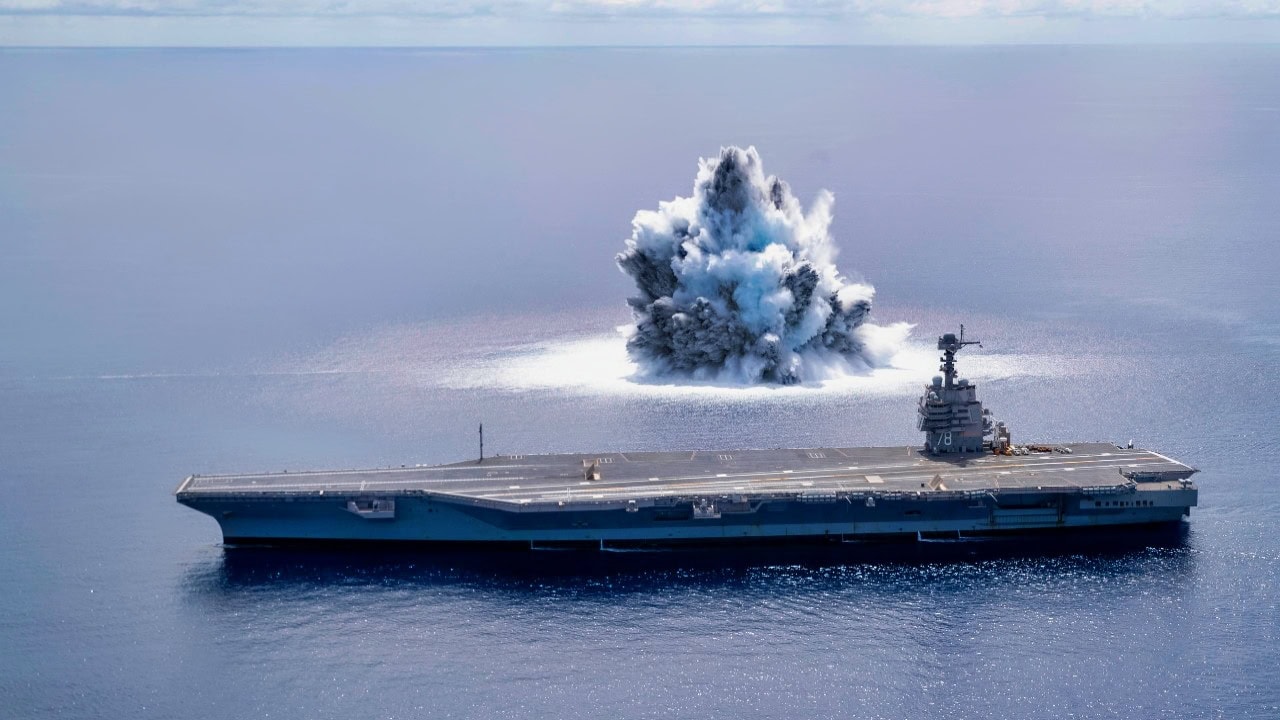
The aircraft carrier USS Gerald R. Ford (CVN 78) completes the first scheduled explosive event of Full Ship Shock Trials while underway in the Atlantic Ocean, June 18, 2021. The U.S. Navy conducts shock trials of new ship designs using live explosives to confirm that our warships can continue to meet demanding mission requirements under harsh conditions they might encounter in battle. (U.S. Navy photo by Mass Communication Specialist 3rd Class Riley B. McDowell)
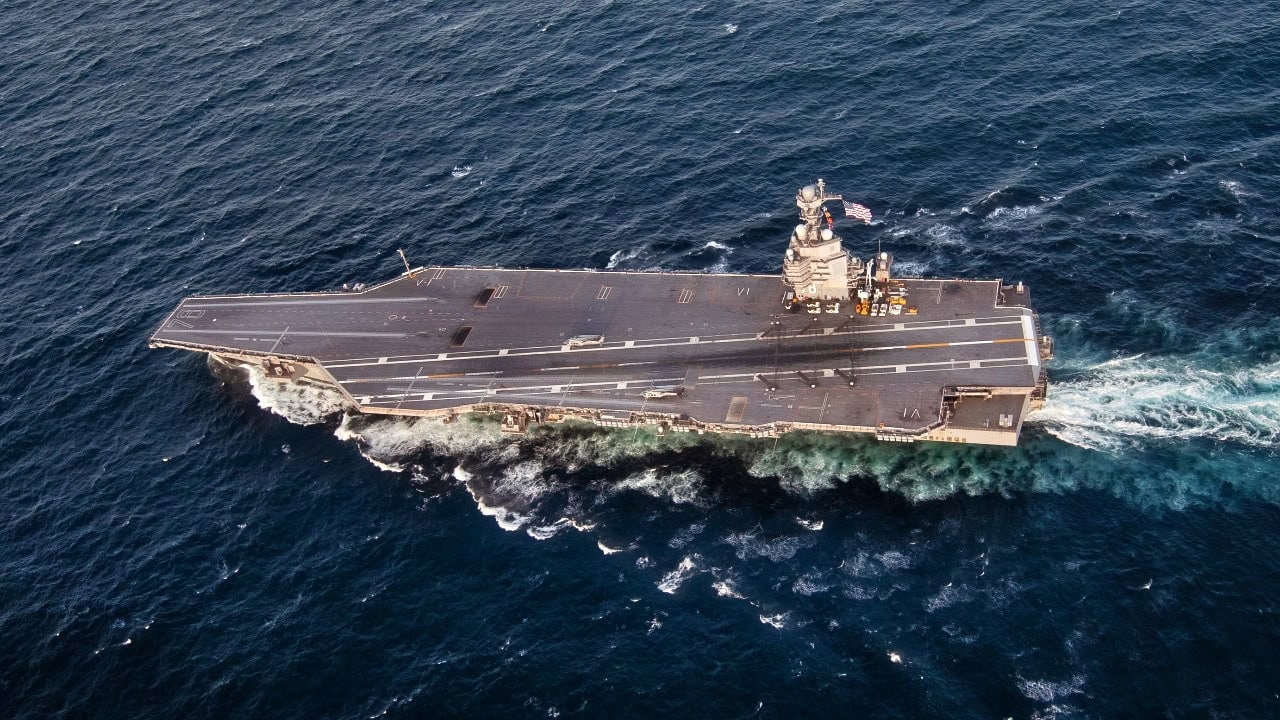
The Ford-class aircraft carrier USS Gerald R. Ford (CVN 78) and the Italian aircraft carrier ITS Cavour (CVH 550) transit the Atlantic Ocean March 20, 2021, marking the first time a Ford-class and Italian carrier have operated together underway. As part of the Italian Navy’s Ready for Operations (RFO) campaign for its flagship, Cavour is conducting sea trials in coordination with the F-35 Lightning II Joint Program Office’s Patuxent River Integrated Test Force to obtain official certification to safely operate the F-35B. Gerald R. Ford is conducting integrated carrier strike group operations during independent steaming event 17 as part of her post-delivery test and trials phase of operations.
That argument was proven correct in early January 2026, when U.S. officials confirmed that USS Gerald R. Ford had participated in real-world operations off the coast of Venezuela, providing intelligence, surveillance, reconnaissance, and electronic warfare support during Operation Absolute Resolve.
While the Pentagon released only limited operational details, the deployment marked the first time a Ford-class carrier had been used in an active combat environment and not just in demonstrations or exercises.
The Navy’s willingness to employ CVN-78 in an operational role appears to have demonstrated its capability and inspired the decision to fast-track construction of new ships in its class.
Pete Hegseth Announces New Aircraft Carrier Plans
During Secretary Hegseth’s January 6 visit to Newport News Shipbuilding, the only U.S. yard capable of building nuclear-powered aircraft carriers, it was made abundantly clear that delays and overruns would no longer be tolerated – and that jobs were “on the line” if production targets were not met.
“We’re holding your leadership accountable,” Hegseth told workers. “We’re holding your leadership’s feet to the fire. Their jobs are on the line to ensure that you can deliver what America needs, that your craftsmanship is unleashed, that you are taken care of, that you are paid properly, that your work is done safely, that we can move at speed and at scale.”
The message was directed not only at the Ford-class program but at the U.S. shipbuilding enterprise more broadly. Newport News and General Dynamics Electric Boat are already struggling to meet submarine production rates required for both the U.S. Navy needs and the AUKUS partnership with Australia and the United Kingdom.
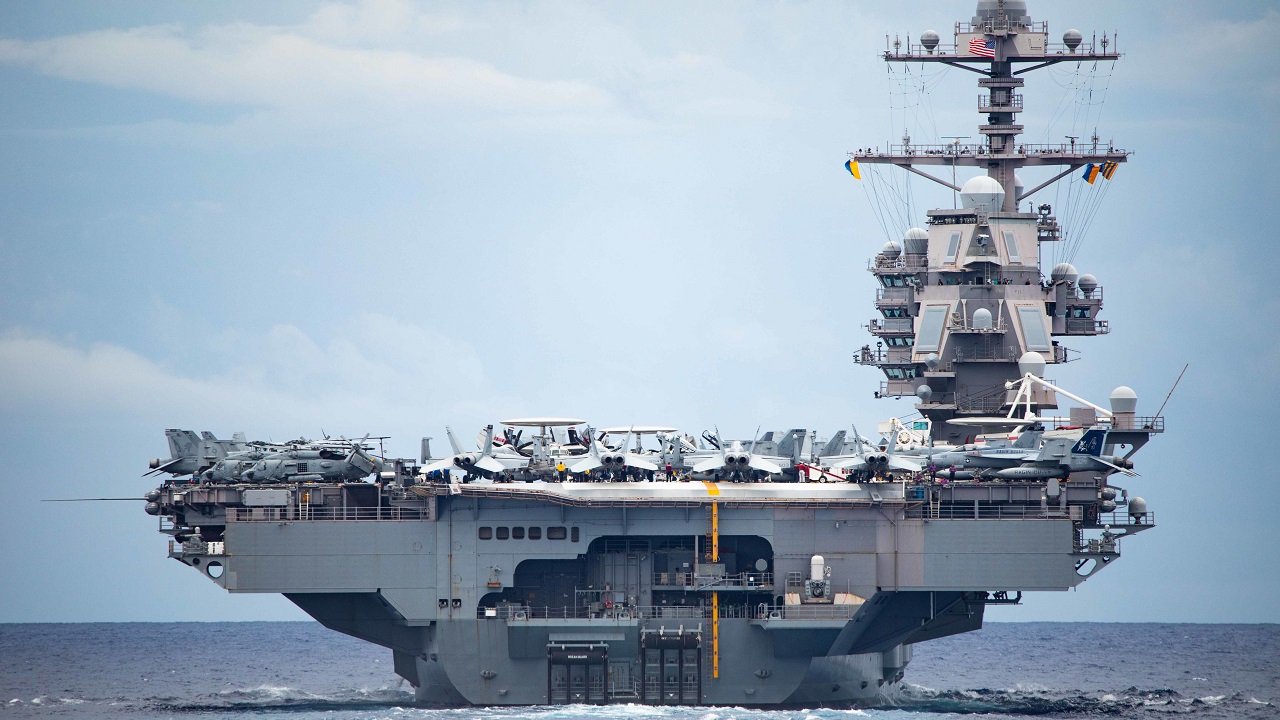
A view of the first-in-class aircraft carrier USS Gerald R. Ford (CVN 78) from aboard the Ticonderoga-class guided-missile cruiser USS Normandy (CG 60) as Normandy participates in a Tactical Force Exercise as part of the Gerald R. Ford Carrier Strike Group, Oct. 13, 2022. Ford is on its inaugural deployment conducting training and operations alongside NATO Allies and partners to enhance integration for future operations and demonstrate the U.S. Navy’s commitment to a peaceful, stable and conflict-free Atlantic region. (U.S. Navy photo by Mass Communication Specialist 2nd Class Malachi Lakey)
Industrial bottlenecks are currently a major threat to American military hardware development, alongside workforce shortages and aging infrastructure, all of which are making it difficult for the U.S. Navy to sustain its fleet size targets.
Huntington Ingalls Industries responded to Hegseth’s remarks by pointing to recent investments in workforce hiring, retention, and facility expansion – arguing that shipyard throughput has already improved measurably over the last 12 months.
The company also noted that two Virginia-class submarines were delivered in 2025, meeting the Navy’s baseline goal but still falling short of future demand.
The news also reflects President Donald Trump’s recent warning that defense contractors prioritising stock buybacks over productivity will face greater scrutiny.
Faster delivery of USS John F. Kennedy, therefore, should serve as a test of whether American industry can actually meet efficiency demands under new pressure – or whether more drastic action needs to be taken.
About the Author:
Jack Buckby is a British researcher and analyst specialising in defence and national security, based in New York. His work focuses on military capability, procurement, and strategic competition, producing and editing analysis for policy and defence audiences. He brings extensive editorial experience, with a career output spanning over 1,000 articles at 19FortyFive and National Security Journal, and has previously authored books and papers on extremism and deradicalisation.