Key Points and Summary – The USS Gerald R. Ford aircraft carrier was meant to usher in a new era of U.S. naval power, but embarrassing and costly problems have defined its early years.
-A mis-scaled airline-style sewage system requires $400,000 acid flushes, while undersized elevators can’t even take standard pallets, forcing sailors to manhandle supplies.
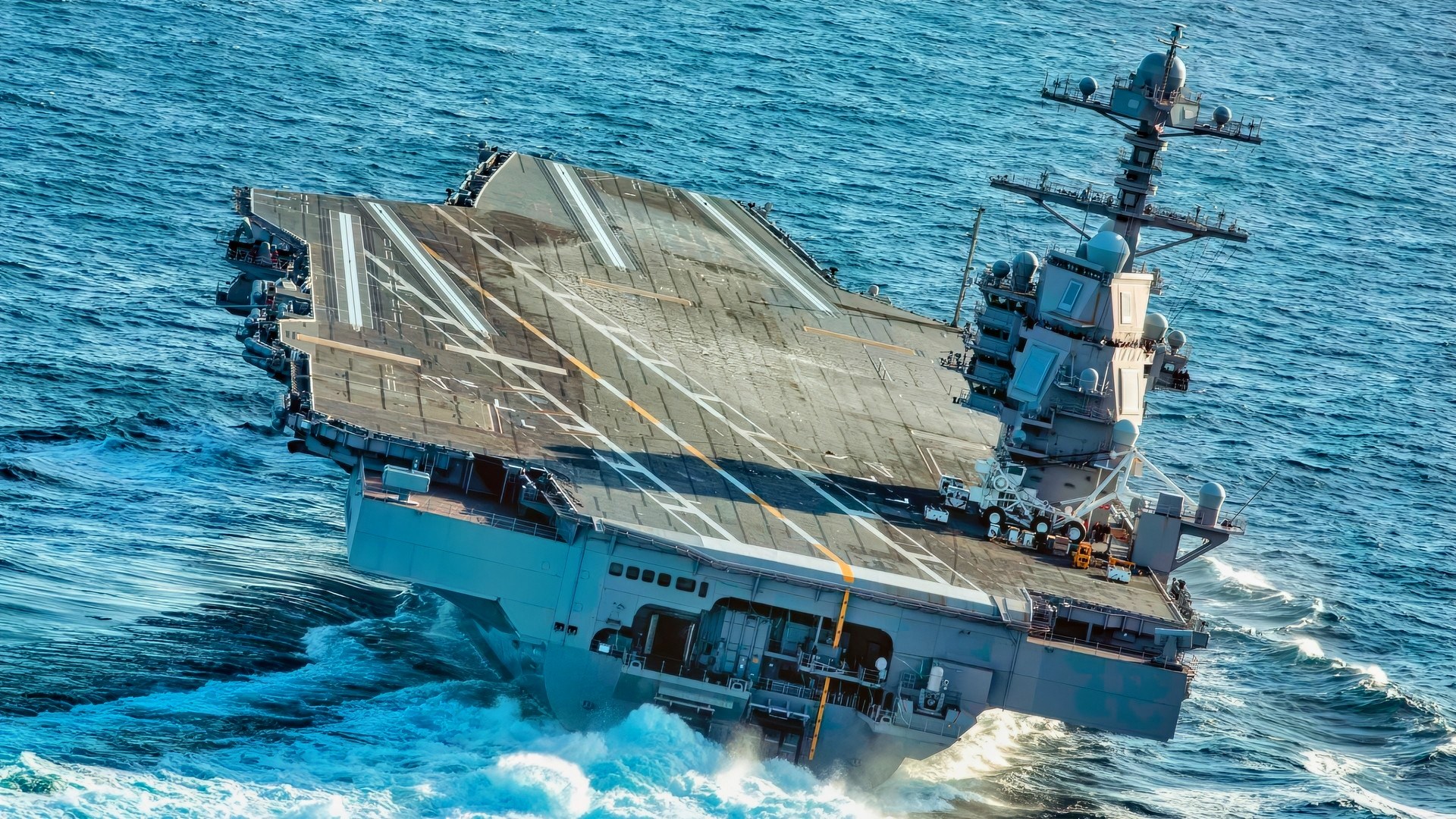
USS Gerald R. Ford (CVN 78) conducts high-speed turns in the Atlantic Ocean. Ford is at sea conducting sea trials following the in port portion of its 15 month post-shakedown availability. (U.S. Navy photo by Mass Communication Specialist 3rd Class Connor Loessin)
-At the high end, the Electromagnetic Aircraft Launch System, Advanced Arresting Gear, and propulsion turbines have all suffered reliability and integration issues, delaying full operations.
-Together, these flaws turn the Navy’s most advanced carrier into a cautionary tale about overreach, integration risk, and a strained shipbuilding base.
Clogged Toilets, Tiny Elevators: Inside the Ford-Class Aircraft Carrier Mess
The USS Gerald R. Ford (CVN-78), is in the news, thanks to its recent deployment to the Caribbean. First laid down in 2009 and commissioned in 2017, the warship made its first combat deployment six years later, in 2023.
The nuclear-powered Ford-class carriers are set to replace Nimitz-class carriers on a one-to-one basis. And while work on the second of the class, the USS John F. Kennedy, is ongoing, the class has been riddled with problems.
For starters, the Gerald R. Ford has experienced issues related to the ship’s sanitation system—specifically, its toilets. The issue was first publicly outlined in a report by the Government Accountability Office (GAO).
In a 2020 report that covered Navy shipbuilding practices, the GAO found that a sanitation system originally designed for airplanes presented the Navy with significant, staggeringly expensive issues.
“For example, the Navy used a brand new toilet and sewage system on the CVN 77 and 78, similar to what is on a commercial aircraft, but increased in scale for a crew of over 4,000 people,” the GAO wrote in their report. “To address unexpected and frequent clogging of the system, the Navy has determined that it needs to acid flush the CVN 77 and 78’s sewage system on a regular basis, which is an unplanned maintenance action for the entire service life of the ship. According to fleet maintenance officials, while each acid flush costs about $400,000, the Navy has yet to determine how often and for how many ships this action will need to be repeated, making the full cost impact difficult to quantify.”
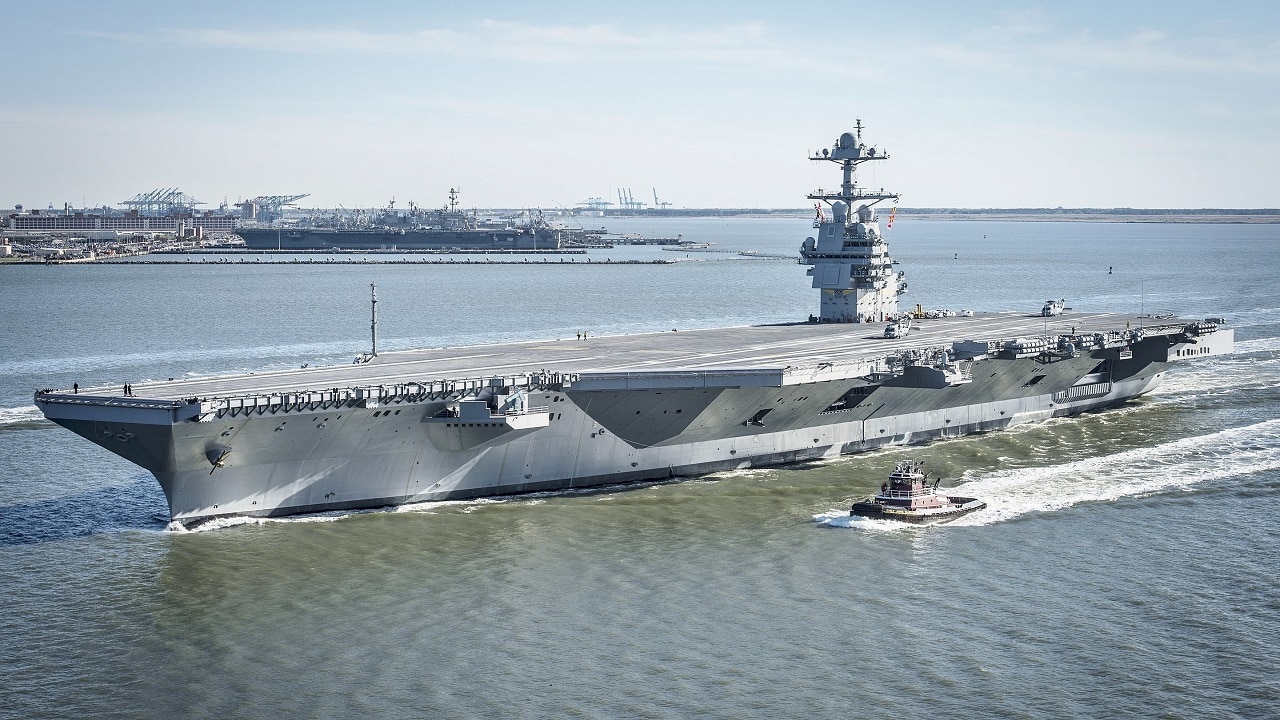
The U.S. Navy aircraft carrier USS Gerald R. Ford (CVN-78) underway under her own power for the first time while leaving Newport News Shipbuilding, Newport News, Virginia (USA), on 8 April 2017. The first-of-class ship – the first new U.S. aircraft carrier design in 40 years – spent several days conducting builder’s sea trials, a comprehensive test of many of the ship’s key systems and technologies. USS George Washington (CVN-73) and the amphibious assault ship USS Kearsarge (LHD-3) are visible in the background.
Bloomberg confirmed that the sanitation system’s piping, while sufficient for several hundred airline passengers, was not scaled up to serve thousands of sailors.
“The pipes are too narrow and when there are a bunch of sailors flushing the toilet at the same time, like in the morning, the suction doesn’t work,” said Shelby Oakley, a GAO director. “The Navy didn’t anticipate this problem.”
USS Gerald R. Ford: Starting Out Was Not Easy
Another high-profile issue affecting the Ford-class carriers concerns the ship’s elevators, which are used to ferry aircraft, ammunition, crew stores, and other sundries throughout the aircraft carrier.
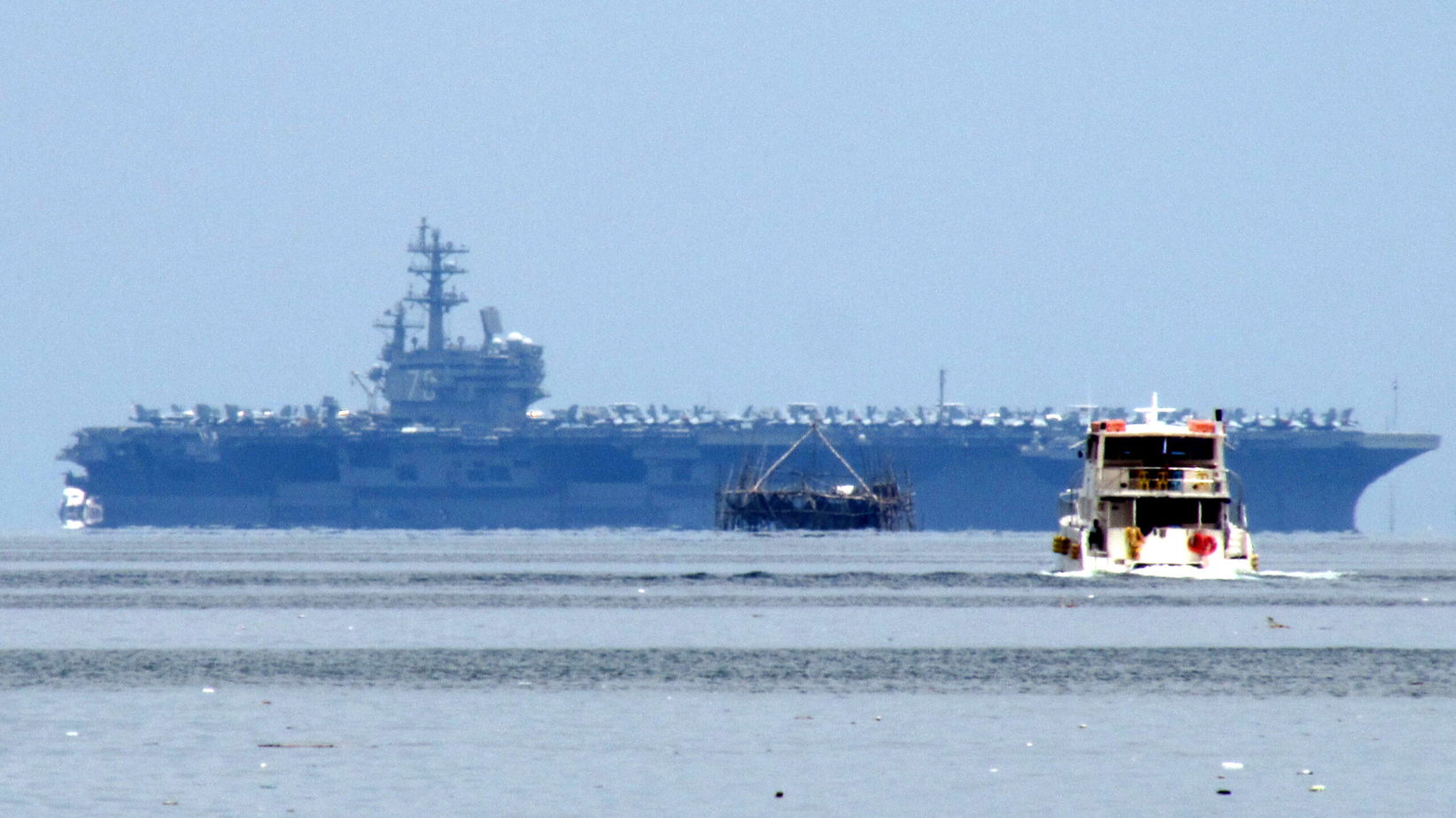
The USS Ronald Reagan (CVN-76), a Nimitz-class Aircraft Carrier of the United States Navy (USN) as seen from the SM by the Bay Amusement Park.
he issue? They’re tiny, the GAO report explained:
“The Navy used a new design for CVN 77’s stores elevators, which are used to move provisions between decks. However, among other issues, the elevators are too small to fit a standard sized pallet jack. Thus, provisions cannot be loaded or unloaded with a pallet jack or a forklift and must be manually unpacked and stacked by hand on to the elevator.
“Unloading is further complicated, according to the ship’s crew, because the elevator doors are so small that the average sailor cannot stand up as they enter and exit the elevator. The fleet has mitigated a few of these problems, but a redesign of the elevator would be necessary to fit standard pallets and fully resolve the other problems.”
The Ford-class’ teething issues are not limited to toilets and miniature elevators, however. They go much deeper and touch on its flashiest new system: the Electromagnetic Aircraft Launch System (EMALS), which replaces the steam-powered aircraft launching apparatus.
Like the EMALS system, the Ford-class’ Advanced Arresting Gear (AAG) is also electronically controlled. Overall, the carrier has a greater degree of control over how much force is transferred to the aircraft while taking off (in the case of the EMALS) and during recovery (AAG).
The ability to fine-tune launch and recovery by accounting for different aircraft types, weights, and payloads should increase sortie rates, as well as reducing the wear and tear aircraft experience during demanding operations at sea.
The teething problems experienced by the EMALS and AAG meant that, for a time, they could only be used with F/A-18E/F Super Hornets and EA-18G Growler electronic warfare jets—they were not compatible for operations with the F-35C, the carrier-capable variant of the fifth-generation stealth fighter.
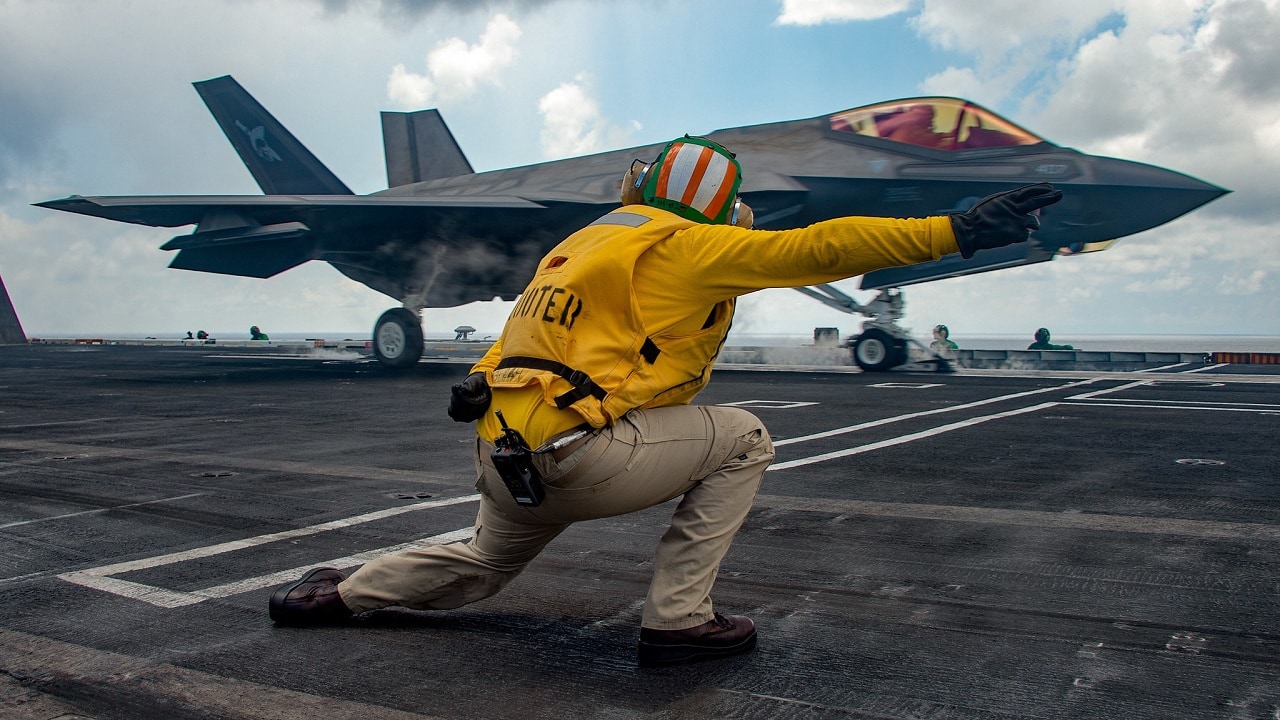
SOUTH CHINA SEA (Oct. 25, 2021) Lt. Nicholas Eppler, from Exeter, Calif., directs flight operations as an F-35C Lightning II assigned to the “Argonauts” of Strike Fighter Squadron (VFA) 147 launches from the Nimitz-class aircraft carrier USS Carl Vinson (CVN 70), Oct. 25, 2021. The Carl Vinson Carrier Strike Group is on a scheduled deployment in the U.S. 7th Fleet area of operations to enhance interoperability through alliances and partnerships while serving as a ready-response force in support of a free and open Indo-Pacific region. (U.S. Navy photo by Mass Communication Specialist Seaman Emily Claire Bennett) 211025-N-TY704-1241
U.S. President Donald Trump railed against the EMALS and AAG systems during his first term in office, threatening to return carrier launch and recovery to their steam-powered predecessor—though that threat proved to be an empty one.
Ford-Class Aircraft Carrier Problems are Real
Another problem during the Ford’s initial shakedown concerned its propulsion system, as first reported by USNI News. The issue lies not with the carrier’s pair of nuclear reactors, but with the turbines they are connected to. Though the issue was ultimately rectified, the fix required “extensive overhauls” before it continued sea trials.
About the Author: Caleb Larson
Caleb Larson is an American multiformat journalist based in Berlin, Germany. His work covers the intersection of conflict and society, focusing on American foreign policy and European security. He has reported from Germany, Russia, and the United States. Most recently, he covered the war in Ukraine, reporting extensively on the war’s shifting battle lines from Donbas and writing on the war’s civilian and humanitarian toll. Previously, he worked as a Defense Reporter for POLITICO Europe. You can follow his latest work on X.