
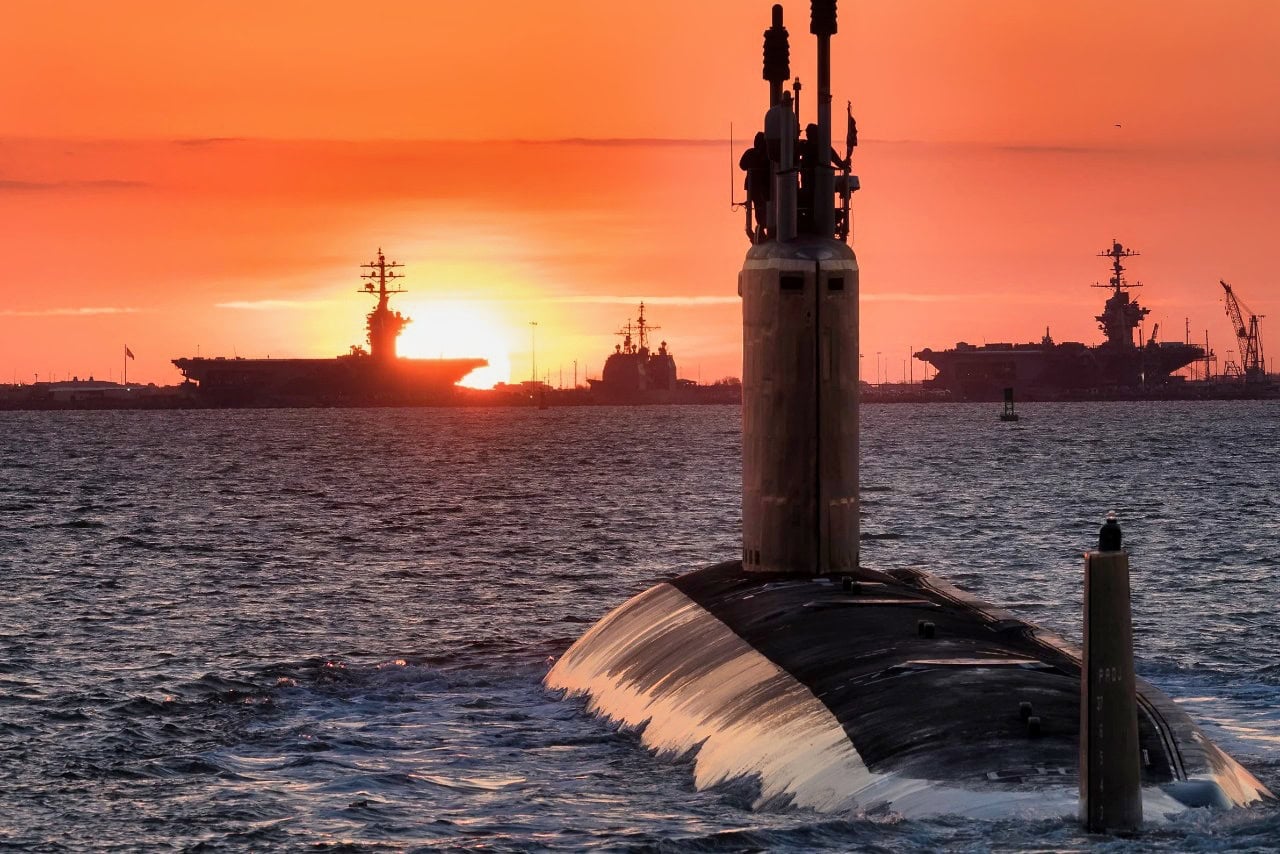
Summary and Key Points: The Virginia-class attack submarine has shifted from a Cold War replacement to a long-running, upgradeable undersea workhorse built in successive “blocks.”
-Early boats focused on quieting and versatility; Block III introduced bow and launch changes, Block IV improved availability, and Block V added the Virginia Payload Module—boosting Tomahawk capacity to as many as 40 missiles.
-With Block VI now in production, the platform continues to evolve with enhanced computing and payload flexibility, while planners eye future strike options, including conventionally armed hypersonic weapons.
-Sustained upgrades also align with shipyard realities at General Dynamics Electric Boat and Huntington Ingalls Newport News Shipbuilding.
Like an iPhone: How the Virginia-Class Submarine Keeps Getting Better and Better for the U.S. Navy
The U.S. Navy’s Virginia-class attack submarine program, which is now nearing a quarter-century of continuous production, is one of the most vital pillars of American underseapower.
So vital, it seems, that it keeps getting expanded and upgraded rather than retired and replaced.
What began as a program to replace Cold War boats with more modern vessels has become an almost modular, upgradeable fleet expected to extend well into the 2040s.
In late 2025, the program entered Block VI production with new long-lead procurement contracts and named hulls, demonstrating that this decades-old platform remains a critical asset for the U.S. Navy andis expected to continue providing service for decades to come.
In fact, the best feature of the Virginia-class is that it continues to improve through updates, much like an iPhone that can receive new features and capabilities while retaining its core design.
Meet the Virginia-Class
The Virginia class (SSN-774) is a nuclear-powered fast-attack submarine designed for a wide range of missions, including anti-submarine and anti-surface warfare, intelligence, surveillance, reconnaissance, and strike.
The class was first commissioned in 2004 and planned in successive “blocks,” each introducing new capabilities and refinements to the basic hull and systems.
Blocks I and II were the original boats, designed to replace aging Los Angeles-class submarines with a quieter, more versatile platform.
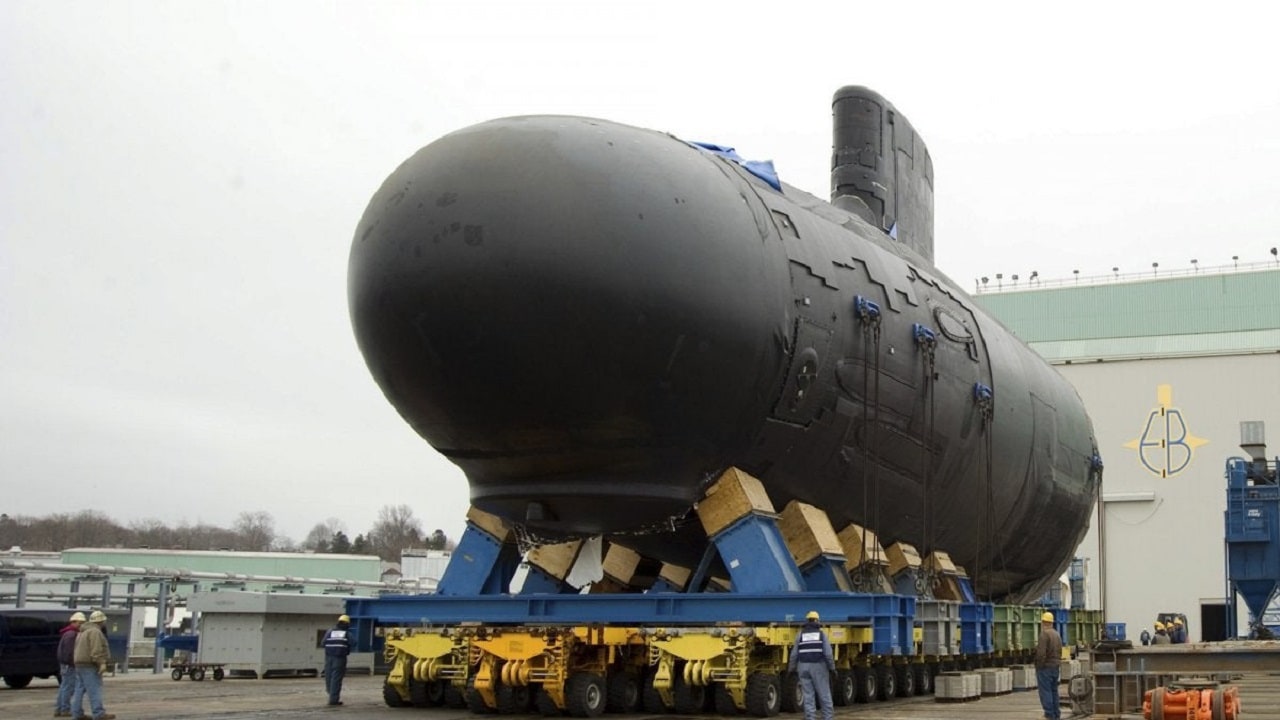
Image of Block III US Navy Virginia-class Submarine.
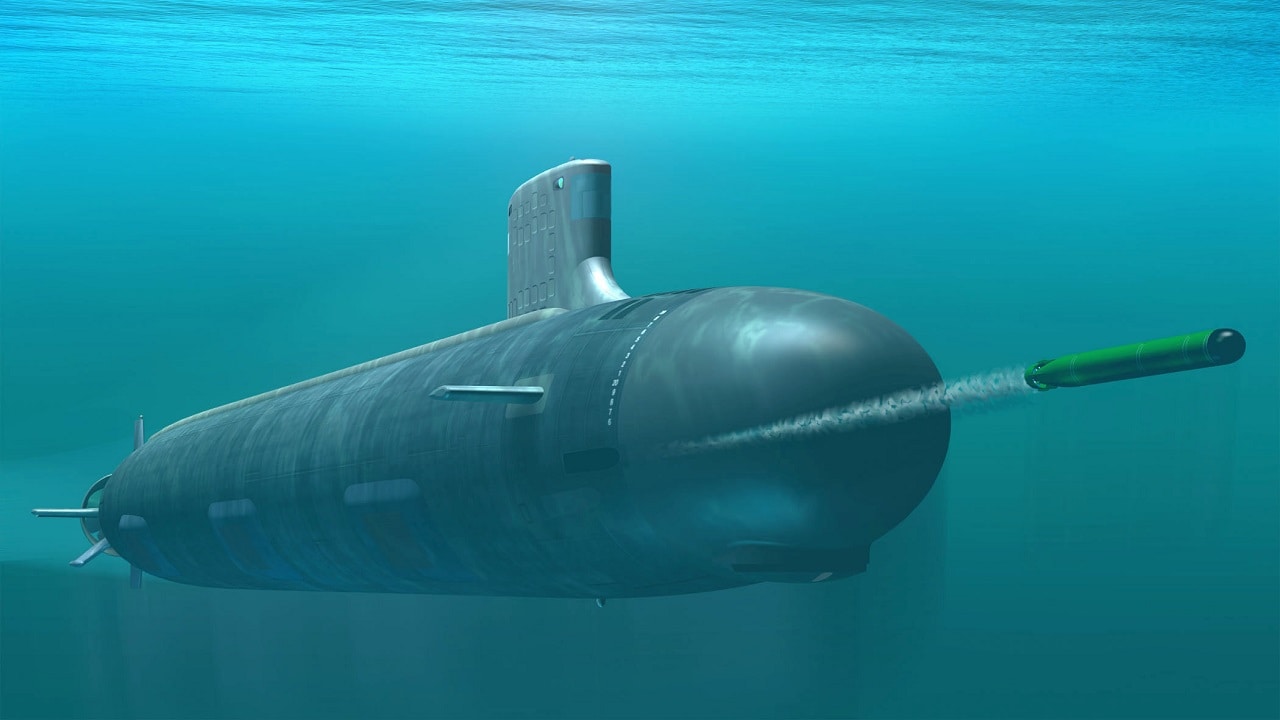
(May 21, 2003) — This conceptual drawing shows the new Virginia-class attack submarine now under construction at General Dynamics Electric Boat in Groton, Conn., and Northrop Grumman Newport News Shipbuilding in Newport News, Va. The first ship of this class, USS Virginia (SSN 774) is scheduled to be delivered to the U.S. Navy in 2004. U.S. D.O.D. graphic by Ron Stern. (RELEASED)
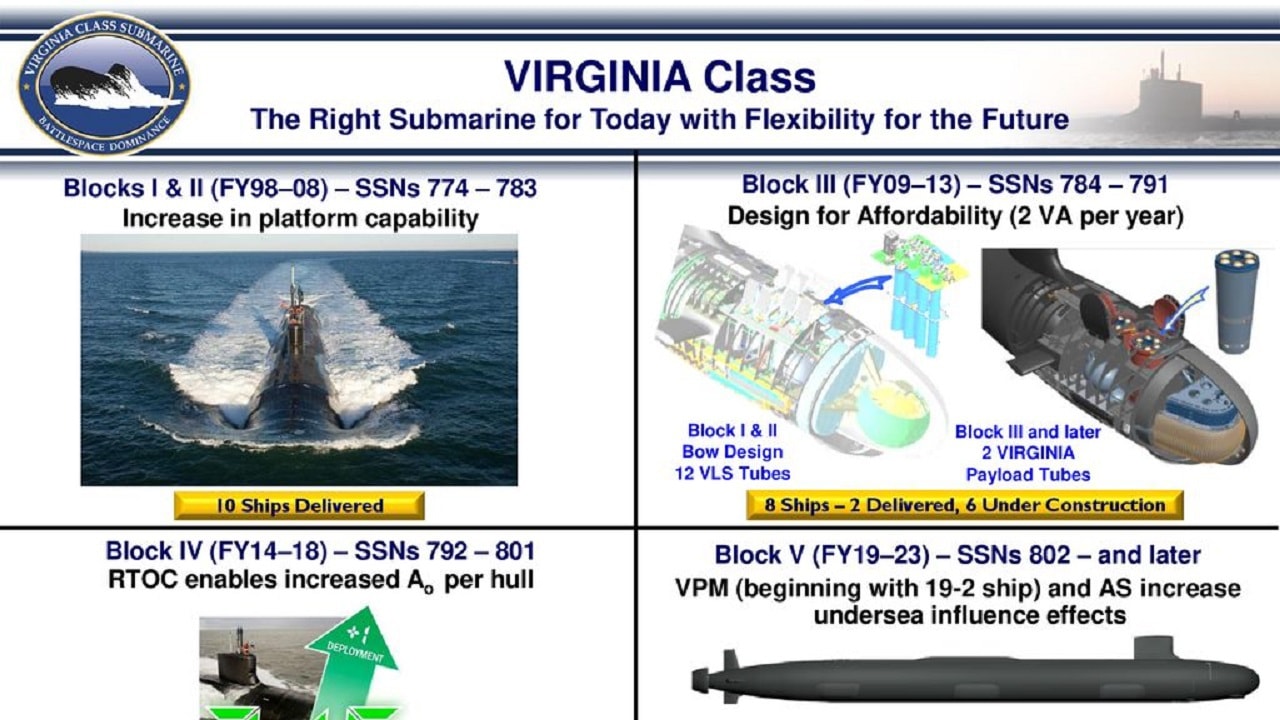
(FY98–08) – SSNs 774 – 783. Block III (FY09–13) – SSNs 784 – 791. Increase in platform capability. Design for Affordability (2 VA per year) Block I & II Bow Design. 12 VLS Tubes. Block III and later 2 VIRGINIA Payload Tubes. 10 Ships Delivered. 8 Ships – 2 Delivered, 6 Under Construction. Block IV (FY14–18) – SSNs 792 – 801. Block V (FY19–23) – SSNs 802 – and later. RTOC enables increased Ao per hull. VPM (beginning with 19-2 ship) and AS increase undersea influence effects. 10 Ships – 5 Under Construction, 5 Under Contract. In Design Phase, FY19 Construction Start. 16.
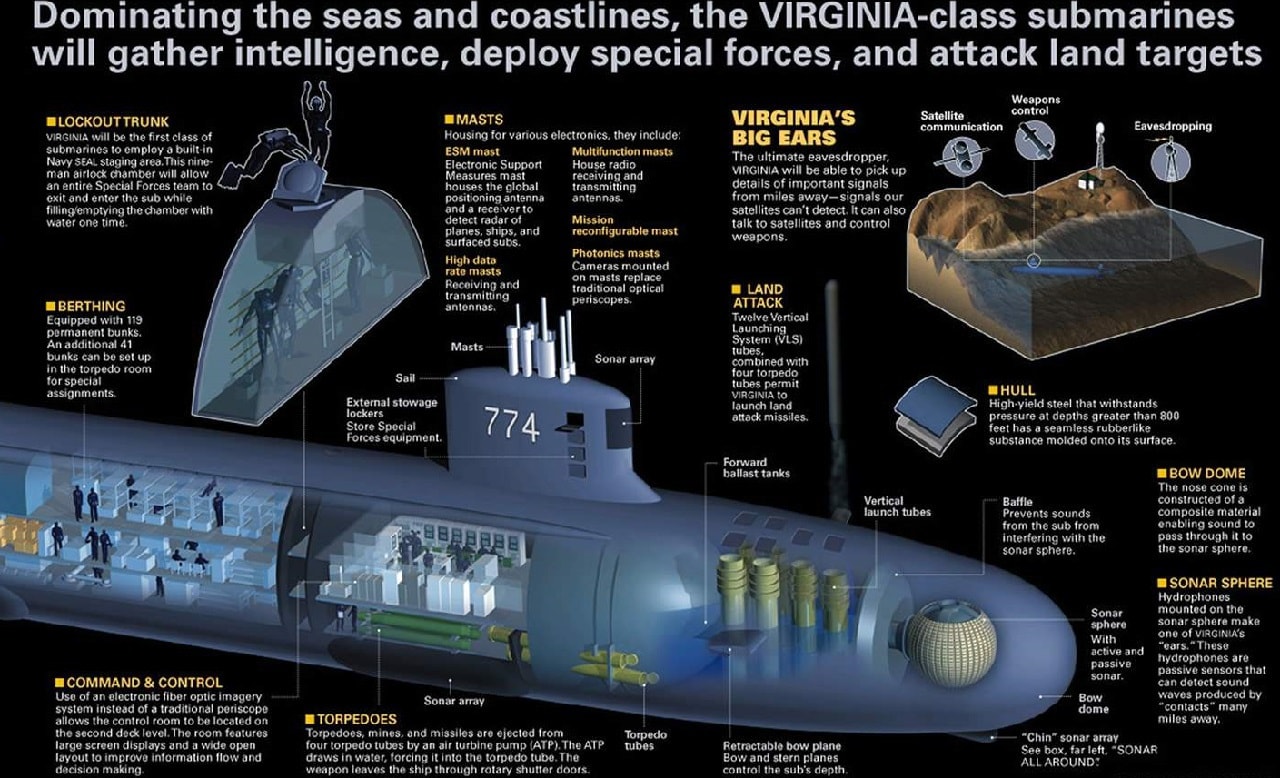
Image of Virginia-class Submarine features. Image Credit: Creative Commons.
Block III was introduced in 2014, featuring redesigned bow sections with improved sonar and two Virginia Payload Tubes replacing traditional vertical launchers.
Block IV built on those improvements, making it more reliable and both easier and faster to deploy, reducing the number of major maintenance periods and increasing its operational availability.
Block V was a major leap for the platform, adding the Virginia Payload Module (VPM) – an 84-foot hull insertion with additional large-diameter tubes. The new module dramatically increased the vessel’s Tomahawk cruise missile capacity to up to 40 missiles.
Block VI is now in production. It is the latest iteration of the platform, continuing to evolve with enhanced computer systems and greater payload flexibility.
Designers and planners are also looking closely at future strike capabilities, including conventionally armed hypersonic weapons.
Why the Virginia Class Keeps Getting Upgrades
Upgrading major naval platforms over time is now uncommon; modern warships and submarines are often designed for modularity so that sensors, weapons, and systems can be refreshed as technologies improve.
The scope and number of incremental upgrades for Virginia-class submarines is, however, somewhat unusual for a single class. And that‘s by design.
The first reason the Virginia class has seen so many upgrades is mission flexibility. Unlike ballistic missile submarines (SSBNs) or dedicated guided-missile submarines (SSGNs), the Virginia class is designed to adapt to a wide range of operational demands, from operating in silence to gather intelligence or to engage in long-range land attacks.
Modular payload and sensor upgrades, therefore, help the platform remain relevant without requiring an entirely new design.
And then there’s the industrial and strategic planning that makes it possible. Despite well-known problems and delays across the military industrial base, the U.S. submarine industrial base, comprising General Dynamics Electric Boat and Huntington Ingalls Newport News Shipbuilding, is optimized to build Virginia-class submarines.
As threats continue to evolve, and as strategic requirements under initiatives like AUKUS grow, extending the life of a proven platform is far more practical. Opting for a new class of ship rather than block upgrades would require time and money to establish a new construction pipeline and wouldn’t be as efficient for decades.
Why Virginia Is Different
Defense programs typically undergo one or two major design iterations before replacement, and few remain in active construction for decades. Historically, classes such as the Los Angeles submarines evolved through several variants before being replaced by a new generation of vessels. The Virginia program, now entering its sixth formal block with rumors of possible Block VII and Block VIII upgrades, comprises a class of ships that are all quite different from one another.
The Virginia-class system is the product of a strategic necessity: it maintains a common hull, thereby minimizing the impact on shipbuilding yards’ processes with each upgrade.
It’s also the result of maturing technology, which continues to make it easier to build ships. Designing, testing, and fielding an entirely new submarine class would take an enormous amount of time and cost huge sums of money, and while it’s still on the cards, a next-generation submarine program has not yet entered the construction phase.
That new class of vessels, SSN(X), is now projected to begin production in the early 2030s, likely delaying entry into service into the 2040s. Extending Virginia’s life, therefore, allows the U.S. Navy to maintain undersea dominance while the new class enters production – without very much compromise.
What Next?
The Navy plans to keep the Virginia-class submarines in service well into the latter half of the 21st century, with some boats expected to reach service lives of 30+ years.
Continued production will ensure the class can meet current threats by integrating cutting-edge weapons and sensors until the SSN(X) arrives.
About the Author:
Jack Buckby is a British researcher and analyst specialising in defence and national security, based in New York. His work focuses on military capability, procurement, and strategic competition, producing and editing analysis for policy and defence audiences. He brings extensive editorial experience, with a career output spanning over 1,000 articles at 19FortyFive and National Security Journal, and has previously authored books and papers on extremism and deradicalisation.