
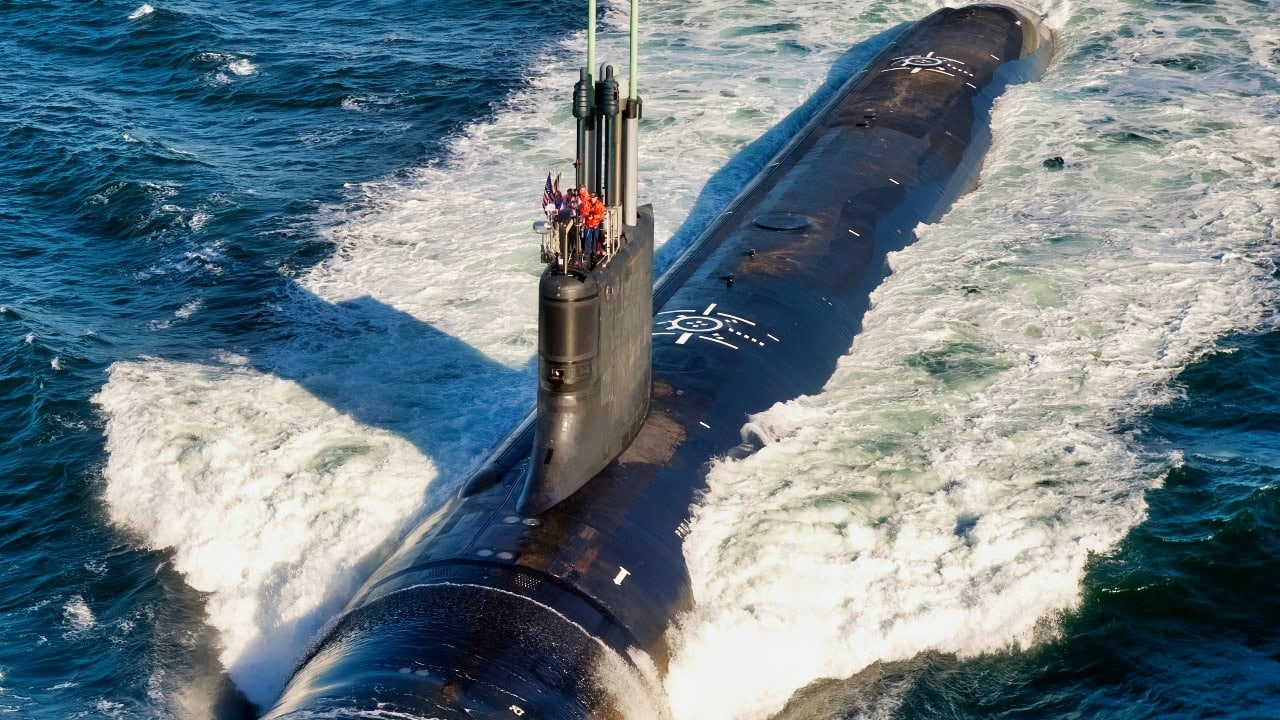
Summary and Key Points: The U.S. Navy’s Virginia-class Block V submarine represents a major leap in undersea warfare capabilities, primarily due to the new Virginia Payload Module (VPM).
-This mid-body section lengthens the hull and triples the missile capacity to 40 Tomahawks, allowing the Block V to assume the heavy strike role of retiring Ohio-class SSGNs.
-Designed for great power competition, particularly in the Indo-Pacific, the Block V integrates advanced stealth, sensors, and potential hypersonic weapons compatibility.
-With the first unit, the future USS Oklahoma, recently achieving “pressure hull complete” status, this variant ensures the U.S. retains superior power projection and deterrence capabilities for decades to come.
Virginia-Class Block V: The U.S. Navy’s New Underwater Beast
The Block V is the latest variant of the Virginia-class attack submarine. It is the first to receive the Virginia Payload Module, which gives these submarines the capability to launch large numbers of guided missiles, thus enabling them to stand in for Ohio-class SSGNs, which are soon to be retired.
The Virginia-class has long anchored the U.S. Navy’s attack submarine fleet.
The Block V was designed for great power competition—it is able to complete a wide range of missions, from intelligence-gathering and reconnaissance to high-intensity strikes.
Design and Development of the Virginia-Class
The origins of the Virginia-class trace back to the 1990s, when the Navy sought a more affordable alternative to the highly advanced but costly Seawolf-class submarines. The collapse of the Soviet Union had reshaped global naval priorities. Instead of focusing exclusively on deep-ocean submarine hunting, the Navy anticipated an operational environment that demanded versatility: littoral access, land attack, special operations support, and intelligence gathering.
The result was a submarine class optimized not only for stealth and lethality but also for modularity and cost control, aided by extensive use of computer-aided design tools and 3D visualization technologies. These design methods made the Virginia-class more economical to build and operate, significantly reducing costs compared to the Seawolf.
Over time, the Virginia program expanded through successive blocks, each incorporating new technologies and responding to lessons learned. Early blocks improved sensor systems, hull design, and construction processes—but none approached the scale of transformation found in the Block V.
The Navy recognized a need to carry over the exceptional strike capacity of the retiring Ohio-class. Those SSGNs are floating arsenals capable of launching massive volleys of Tomahawk cruise missiles. As their retirement loomed, the Navy faced a critical deficit in undersea strike volume and needed a solution. Block V became that solution.
The Virginia Payload Module: The Block V’s “Teeth”
The defining feature of the Virginia-class Block V submarine is the inclusion of the Virginia Payload Module (VPM). This new mid-body hull section significantly increases internal volume and expands payload capacity in unprecedented ways.
The VPM consists of four large-diameter payload tubes, and taken together, these tubes allow Block V submarines to carry up to forty Tomahawk cruise missiles which is more than triple the twelve missiles carried by older iterations. This increase meaningfully strengthens the Navy’s ability to conduct high-volume land-attack missions from beneath the ocean’s surface.
The VPM also lengthens the hulls of Block V submarines by approximately 84 feet compared to earlier blocks. The modularity also means these subs can carry more than just Tomahawk missiles.
Reports indicate the Navy is assessing plans to integrate hypersonic missiles aboard Block V and later Virginia-block submarines, though there is no official confirmation. Such upgrades would bolster deterrence against peer competitors by allowing submarines to deliver extremely fast, high-energy strikes from concealed positions across the globe.
The Role of the Block V
The Block V also benefits from upgraded sonar arrays and combat systems that improve detection capability and situational awareness.
Details are classified, but reporting confirms a significant upgrade in both the active and passive sonar performance of these submarines, making them highly adept at detecting, tracking, and engaging adversary submarines or surface ships in contested waters. The improvements also support missions such as Intelligence, Surveillance, and Reconnaissance.
Block V submarines could be especially important in the Indo-Pacific region, where tensions with China continue to escalate and nations compete for influence in surface and subsurface environments. The Block V’s enhanced payload, stealth, and endurance enable them to operate at extended ranges while remaining concealed.
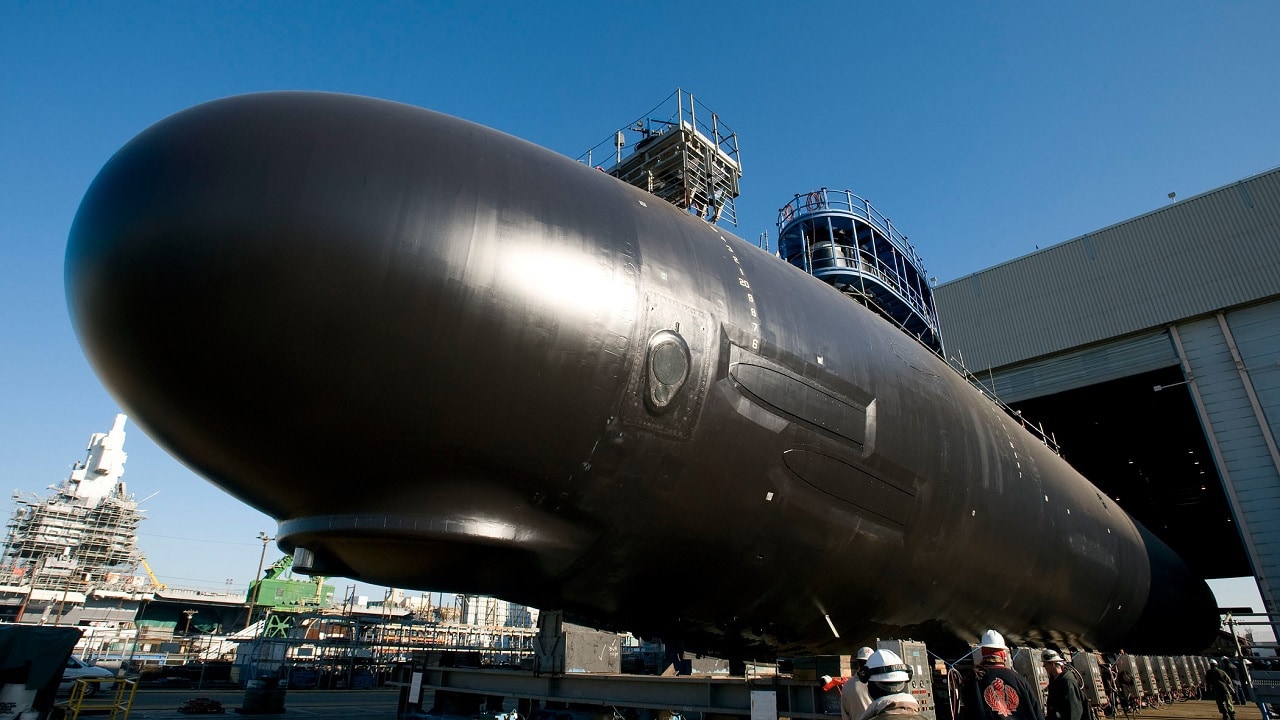
Virginia-Class. Image Credit: Creative Commons.
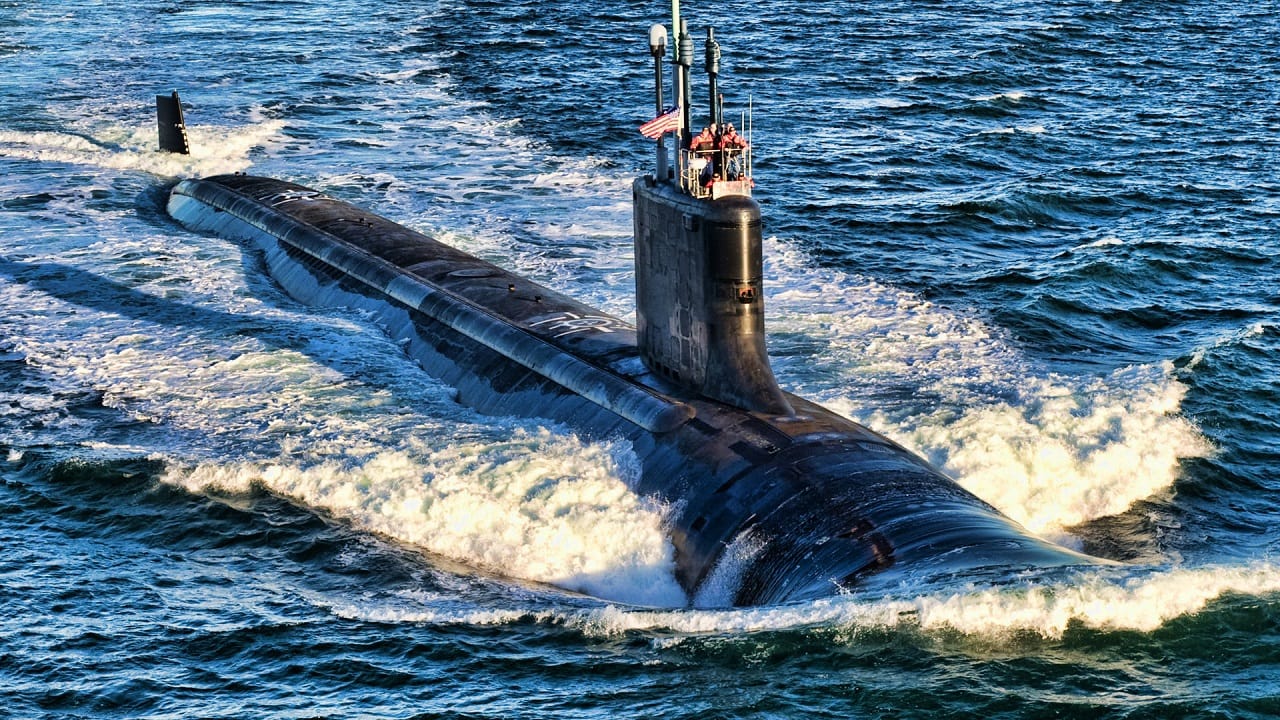
US Navy Attack Submarine. Image Credit: Creative Commons.
Some Virginia-class submarines may even be exported to Australia as part of the AUKUS trilateral security agreement. That would significantly enhance allied underwater power projection and bolster collective maritime security in the region.
Production Status
Block V submarines are constructed at Huntington Ingalls Industries’ Newport News Shipbuilding division and at General Dynamics Electric Boat. In December 2025, the Navy achieved a milestone when the future USS Oklahoma (SSN-802), the very first Block V submarine, reached pressure hull complete status.
This stage marks a critical moment in submarine construction, as the major hull sections are fully joined into a single watertight structure. The Oklahoma is the 29th Virginia-class submarine overall and the first built to the Block V design.
The Virginia-class Block V submarine is a transformative undersea platform. It dramatically expands strike capacity, restores critical capabilities lost through the retirement of earlier submarine classes, enhances detection and sensing systems, and incorporates modular payload options that ensure adaptability for decades to come.
As geopolitical competition intensifies and undersea warfare grows increasingly complex, Block V can be best understood as a necessary evolution, not just a simple upgrade. It is the centerpiece of a wider strategic initiative to guarantee that the United States and its allies retain the ability to project power, gather intelligence, and deter adversaries.
About the Author: Isaac Seitz
Isaac Seitz, a Defense Columnist, graduated from Patrick Henry College’s Strategic Intelligence and National Security program. He has also studied Russian at Middlebury Language Schools and has worked as an intelligence Analyst in the private sector.