
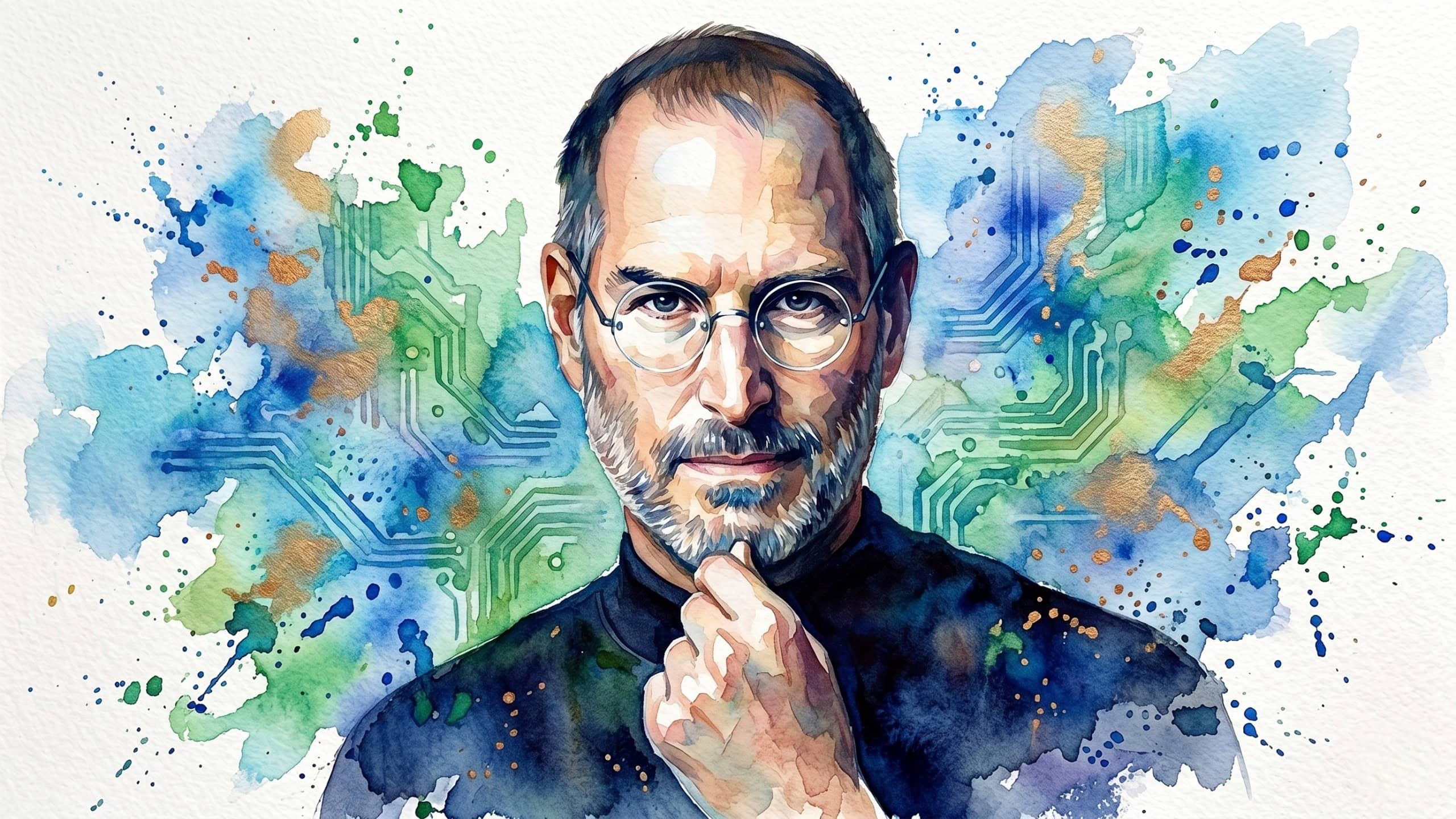
“Sometimes when you innovate, you make mistakes. It is best to admit them quickly and then focus on improving your other innovations.” – Steve Jobs
That quote belongs to the late great Steve Jobs, co-founder of Apple, Inc., and one of the truest tech geniuses and entrepreneurial success stories of all time.

Image Credit: Apple.
This particular quote from Mr. Jobs stands out because it shows that one of the hallmarks of a successful person is the ability to bounce back from failures time and time again and come out of those adversities better than ever.
Steve Jobs: The Quote That Defined Him
Accordingly, we shall now focus on his failures that, in turn, helped set him up for even greater successes.
College Dropout
Even before he entered the business world, young Steve Jobs experienced his first significant failure in the hallowed halls of academia.
In 1972, he graduated from Homestead High School and enrolled at Reed College, a pricey liberal arts college in Portland, Oregon.
His lower-middle-class adoptive parents, Paul (a U.S. Coast Guard veteran) and Clara Jobs (née Hagopian), could scarcely afford Reed’s expensive tuition; however, they had promised the lad’s unwed biological parents—Joanne Schieble and Abdulfattah Jandali, who had put their son up for adoption whilst he was still an infant—that he would receive a college education, so they bit the proverbial bullet and somehow managed to put up the funds.
Apple iPhone. Image: Creative Commons.
Well, that turned out to be much ado about relatively little, as Steve dropped out of Reed after one measly semester without bothering to tell his adoptive parents, his rationale & rationalization being he did not want to spend his cash-strapped parents’ hard-earned money on an education that seemed meaningless to him.
As stated by the All about Steve Jobs.com website, “he was more interested in eastern philosophy, fruitarian diets, and LSD than in the classes he took. He moved to a hippie commune in Oregon, where his main activity was cultivating apples.” Perhaps there was a bit of foreshadowing in those last two words?
A few months thereafter, Steve returned to the Golden State to look for a job.
He was hired at the then-young video game maker Atari and used his earnings to finance a trip to India with one of his college friends, Dan Kottke, in order to “seek enlightenment.”
But instead of attaining enlightenment, Jobs came back from the South Asian subcontinent a little disillusioned.
Steve’s dropping out of college didn’t mean the end of his education, however; he continued to attend Reed by auditing his classes, including a course on calligraphy that was taught by Fr. Robert Joseph Palladino (November 5, 1932 – February 26, 2016), a former Trappist monk and future archdiocesan priest whose calligraphy ended up influencing Apple’s designs.
As Mr. Jobs said during a 2005 commencement address at Stanford University, “If I had never dropped in on that single course in college, the Mac would have never had multiple typefaces or proportionally spaced fonts.”
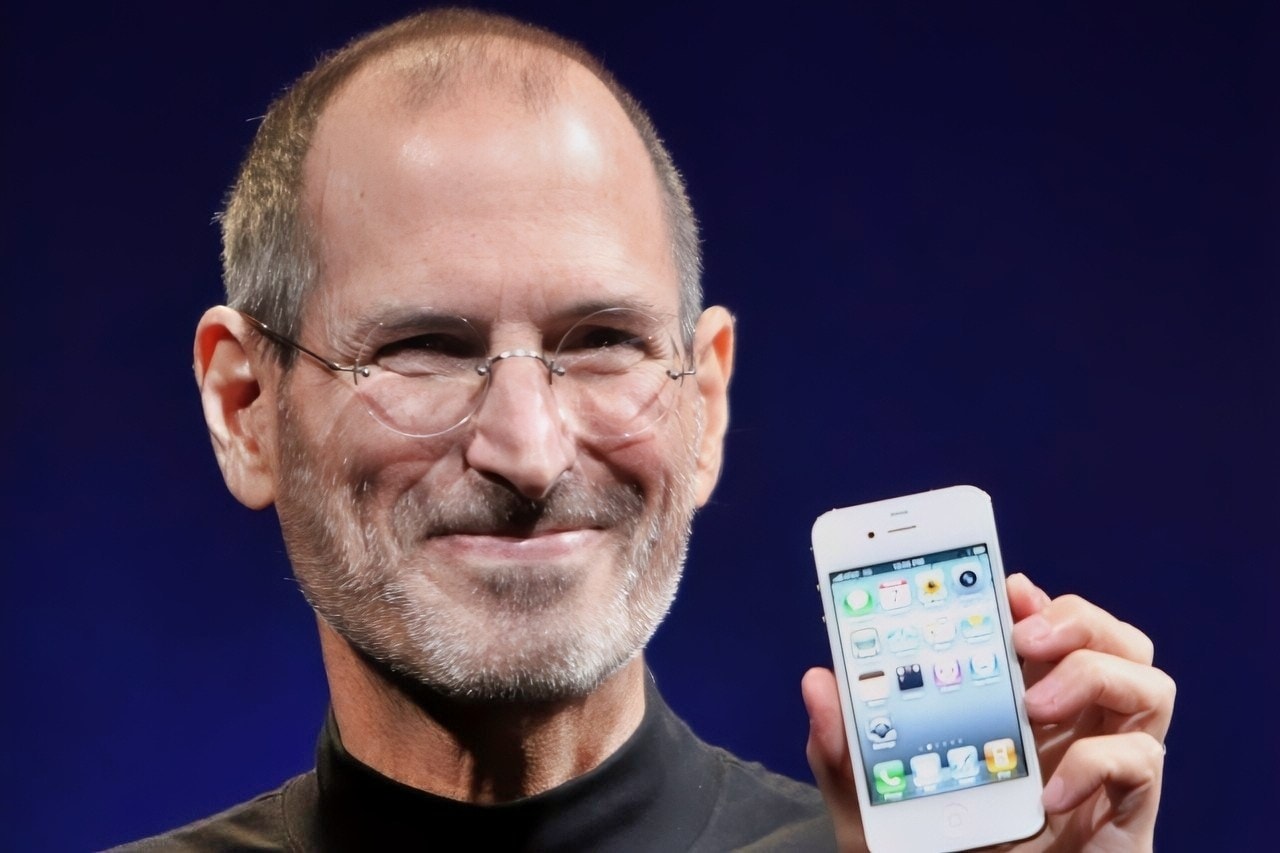
Steve Jobs from Apple. Image Credit: Creative Commons.
To scrape by during this period, he slept on the floor in friends’ dorm rooms, returned Coke bottles for food money, and got weekly free meals at the local Hare Krishna temple.
Jobs’s brief stint as a Reed College student would also prove to be fortuitous in more ways than one, as he befriended Robert Martin Friedland—then student body president—who went on to become a billionaire financier in the mining industry.
As a way of coping with the aforementioned disillusionment from his India pilgrimage, Jobs also rekindled his friendship with Steve “The Woz” Wozniak; the two had met when Jobs was 13, and Woz was 18.
By now, Wozniak was an active member of the Homebrew Computer Club, a group of early computer hobbyists. Drawing upon the knowledge gained as a member of Homebrew, “Woz” built his own computer board, simply because he wanted a personal computer for himself, with no grandiose ambitions in mind.
Knowing a good thing when he saw it, Jobs quickly understood that his friend’s brilliant invention could be sold to software hobbyists, who wanted to write software without the hassle of assembling a computer kit.

Image: Creative Commons.
The younger Steve convinced the older Steve to start a company for that purpose.
Thus, it came to pass that Apple Computer was born on April 1, 1976. This was no mere April Fool’s joke, and just as 1976 marked the bicentennial of America’s Declaration of Independence, the foundation of Apple would set the two Steves on the path to financial independence.
In December 1980, barely four years after its founding, Apple went public via IPO, boosting Steve Jobs’s net worth to over $200 million at the age of 25.
To put those things in perspective, $200 million would be $803.4 million in today’s dollars.
From the ashes of a college education gone off the rails rose the proverbial Phoenix of a tech giant.
Alas, glory proved to be fleeting.
Fast-forward five years to 1985, and there was already trouble in paradise. The Macintosh computer was losing out to the IBM PC, and Jobs got into a power struggle with Apple CEO John Sculley, who had been lured away from Pepsi-Cola just two years earlier.
Long story short, in May 1985, Steve Jobs was stripped of operational duties by the board of directors, though he still held the nominal title of chairman of the board, and he resigned from Apple and sold all but one of his Apple shares in disgust.
By this time, Woz had already left the company and sold most of his stock, as he felt the company he had co-founded with his childhood chum had “been going in the wrong direction for the last five years.”
The NeXT Big Failure
Yes, the wordplay here is fully intended.
Steve Jobs spent the initial part of those post-Apple “wilderness years” by forming a company called NeXT. However, his then-new company’s flagship product, the NeXT Cube, didn’t catch on because it was overpriced.
Not even the financial backing of Texan billionaire and eventual quixotic presidential candidate Ross Perot could keep NeXT on life support for very long.
Jobs was devastated by this failure. He started focusing less on work and took much-needed time to focus more on family, namely his wife Laurene, whom he married in 1991, and his newborn son, Reed.”
Fortunately, Steve still had millions of dollars left in his bank account—unlike so many geniuses who end up drunk and penniless—and he used a goodly chunk of that money to: (1) hire small group of computer scientists who needed a new employer when George Lucas sold the computer graphics division of his Lucasfilm empire; and (2) incorporate a new company called Pixar, which had been founded by Ed Catmull and Alvy Ray Smith back in the late 1970s.
Suffice it to say that Pixar proved much more successful than NeXT.
From the ashes of NeXt rose the Phoenix of Pixar.
What Goes Around, Comes Around
By 1997, Apple was foundering, and the board of directors approached Jobs, hat in hand, to help resurrect the company he had given life to in the first place.
In the ultimate comeback story—and a magnanimous display of the willingness and ability to let bygones be bygones—on September 16, 1997, Steve accepted the offer to become Apple’s interim CEO, and for good measure, he brought with him his executive team from NeXT and installed them in key positions.
Long story short, the plan worked. Apple was saved by its founder. The Phoenix had risen from the ashes one more time.
Losing His Final Battle
Sadly, Jobs died at his home in Palo Alto, California, on October 5, 2011, at the way too young age of 56, due to complications from a relapse of his previously treated islet-cell pancreatic neuroendocrine tumor.
His wife, children, and sisters were at his side.
His final words were “Oh wow. Oh wow. Oh wow.”
A private funeral was held two days later, and at his request, Steven Paul Jobs was buried in an unmarked grave at Alta Mesa Memorial Park, the only nonsectarian cemetery in Palo Alto, California.
Christian D. Orr, Defense Expert
Christian D. Orr is a Senior Defense Editor. He is a former Air Force Security Forces officer, Federal law enforcement officer, and private military contractor (with assignments worked in Iraq, the United Arab Emirates, Kosovo, Japan, Germany, and the Pentagon). Chris holds a B.A. in International Relations from the University of Southern California (USC) and an M.A. in Intelligence Studies (with a concentration in Terrorism Studies) from American Military University (AMU). He is also the author of the book “Five Decades of a Fabulous Firearm: Celebrating the 50th Anniversary of the Beretta 92 Pistol Series,” the second edition of which was recently published.