
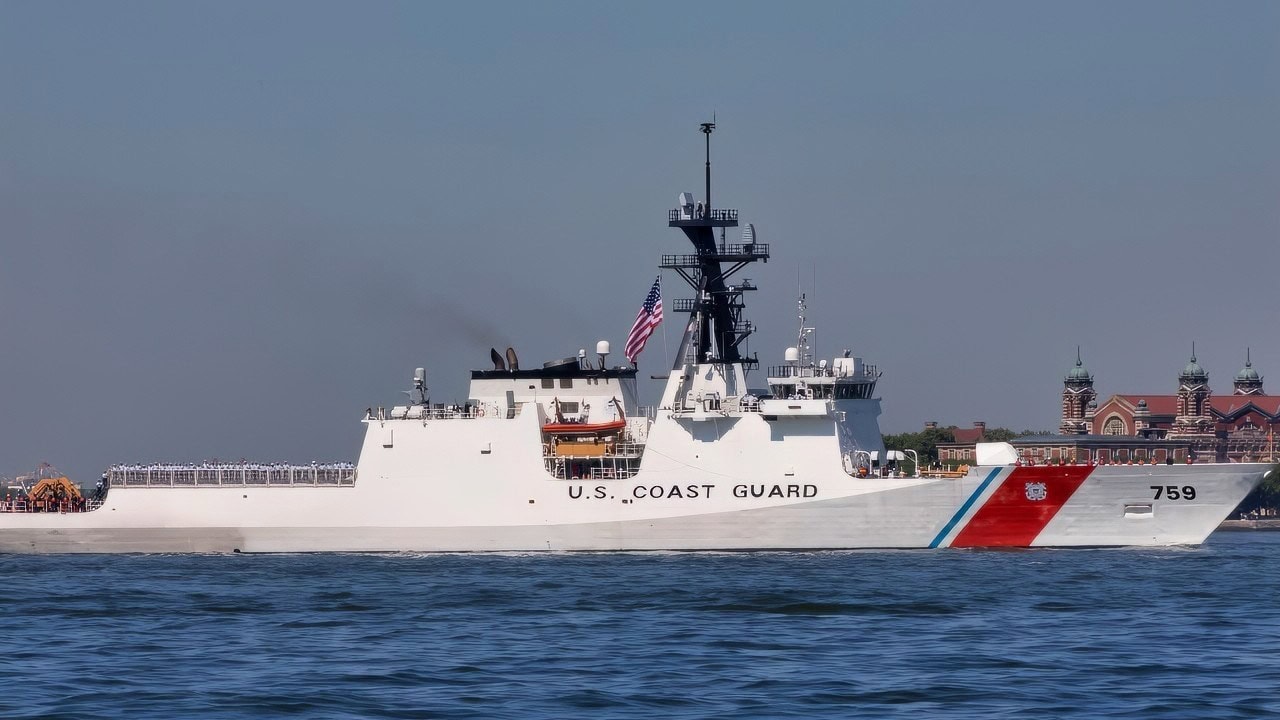
Summary and Key Points: U.S.–China tensions spiked after U.S. Coast Guard forces boarded an oil tanker, Skipper, in international waters near Venezuela, detaining roughly 30 sailors and seizing the ship as it headed for China. China condemned the move as unlawful “bullying,” challenging both the interdiction and the sanctions basis behind it.
-The argument offered in response is that Skipper misused a Guyanese flag and was not actually registered, stripping it of flag-state protections and rendering it effectively stateless—allowing boarding and inspection on the high seas.
China’s Xi Jinping. Image Credit: Creative Commons.
1 Tanker, 30 Sailors: Why the U.S. Says the Skipper Seizure Was Legal
Tensions between the U.S. and China flared in the early hours of December 10, when U.S. Coast Guard forces abruptly stormed the decks of an oil tanker headed for China. The Guyana-flagged vessel, operating miles off the coast of Venezuela, drew the attention of maritime patrol after appearing to misreport its geolocation data.
Authorities later discovered that the tanker, called Skipper, was a U.S.-sanctioned ship that had previously delivered oil to China. China’s Foreign Ministry quickly condemned the move, calling U.S. actions to seize the vessel “grossly violated international law” and “acts of bullying.”
In the aftermath of the overnight raid that captured Venezuelan President Nicholas Maduro, leaders from countries across the world, including within the U.S., have called for Washington to legally justify its military operations.
While the White House has yet to provide a complete legal rationale for the Maduro raid, the seizure of the Guyana-flagged tanker rests on firmer legal grounds. The U.S. military conducted the interdiction pursuant to the principles outlined in both the UN Charter and the UN Convention on the Law of the Sea (UNCLOS), two treaties to which China is a party.
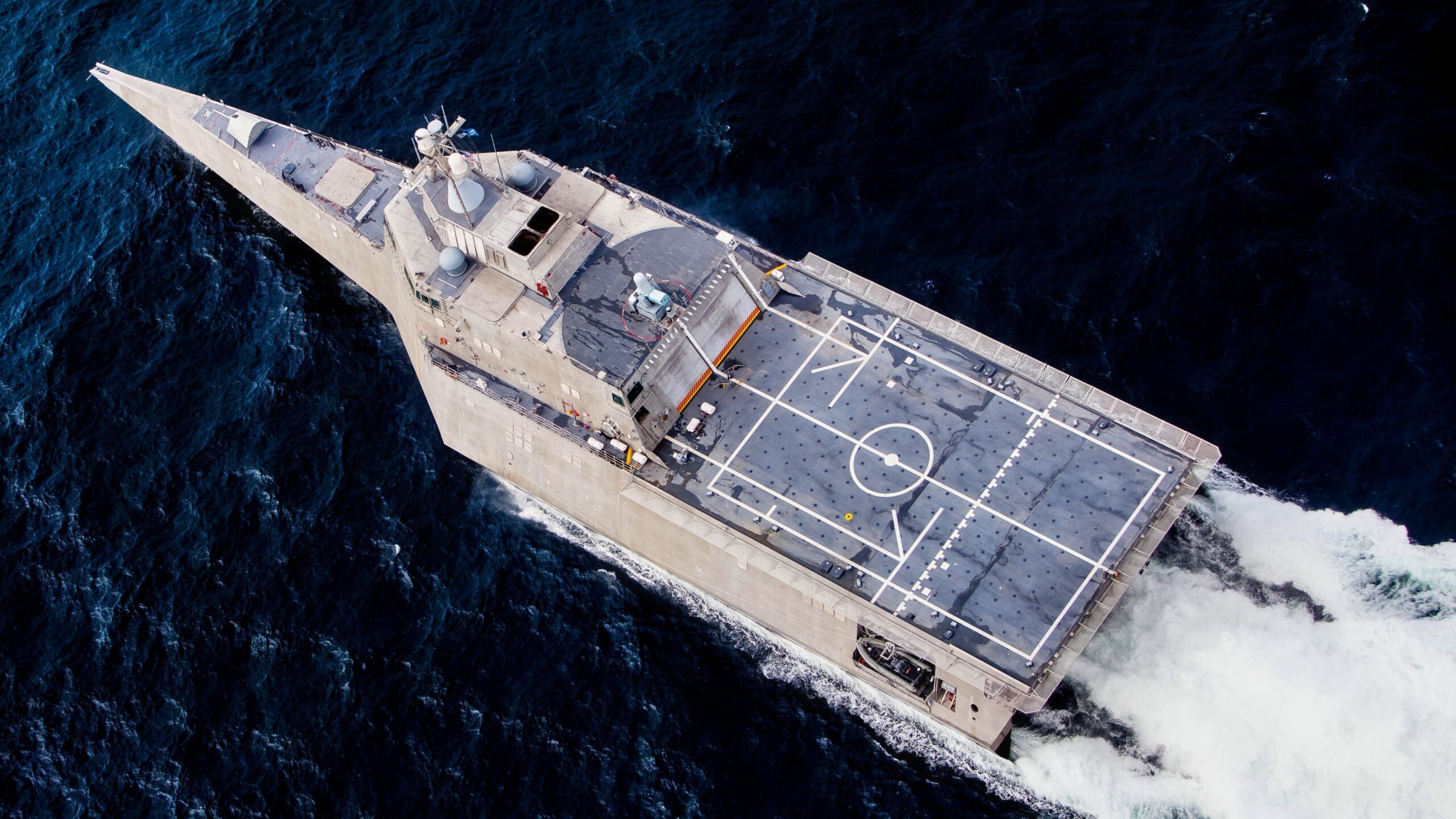
US Navy Littoral Combat Ship. Image Credit: Creative Commons.
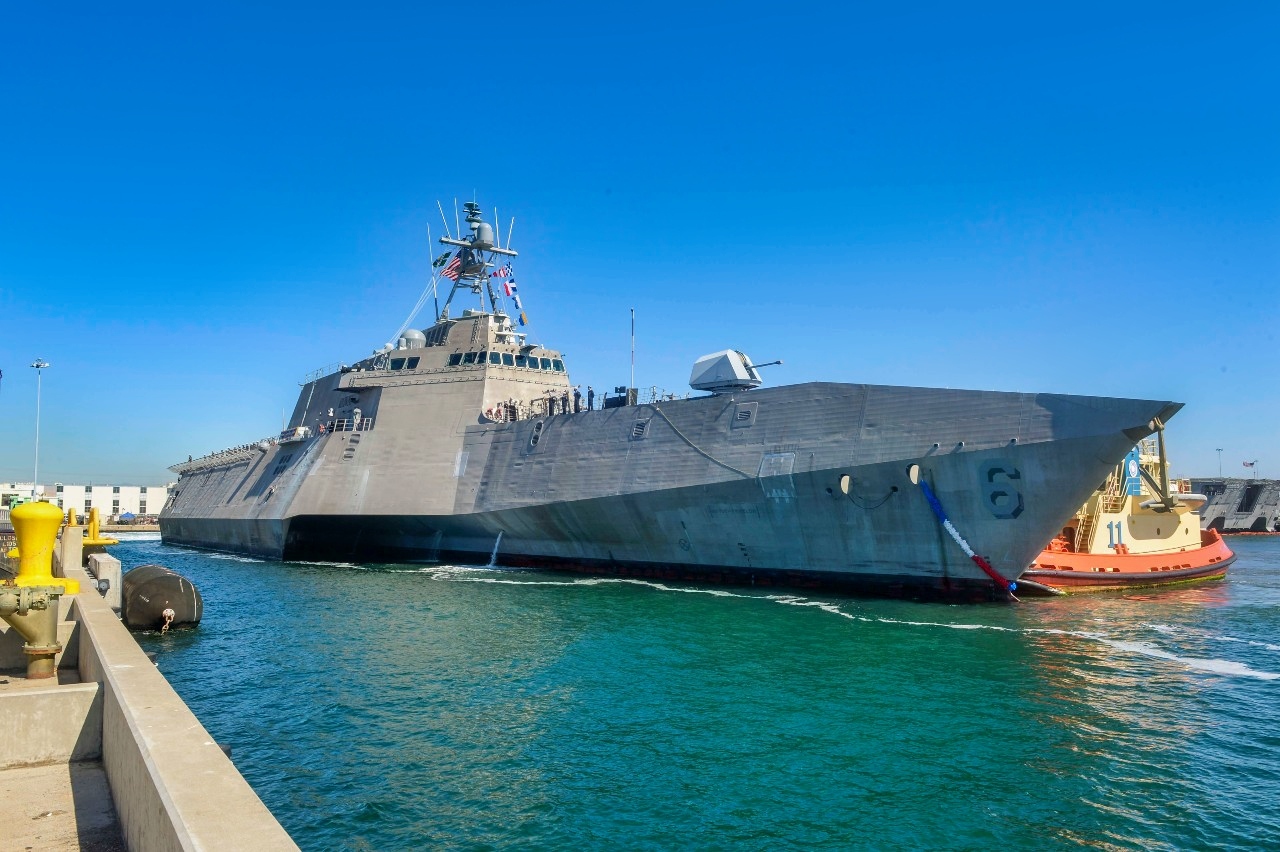
NAVAL BASE SAN DIEGO — The Independence-variant littoral combat ship USS Jackson (LCS 6) returns to its San Diego homeport, Oct. 6, 2023. Littoral Combat Ships are fast, optimally-manned, mission-tailored surface combatants that operate in near-shore and open-ocean environments, winning against 21st-century coastal threats. (U.S. Navy photo by Mass Communication Specialist 1st Class Vance Hand)
In a press statement, China’s Foreign Ministry alleged that the “arbitrary detention [of the tanker] severely violated” international law and that “unilateral sanctions lack a basis in international law.” These are two distinct claims: one concerns the legality of the interdiction itself, and the other challenges the legal basis asserted for the seizure. Each merits careful scrutiny.
Legal Maritime Operations and “Arbitrary Detention”
U.S. Coast Guard forces interdicted Skipper as it sailed into international waters between Grenada and Trinidad. Law enforcement agents, decked out in camouflaged gear, rappelled from a helicopter and promptly took control of the vessel. The crew offered no resistance, and the operation concluded without casualties.
The interdiction occurred on the high seas, an area beyond the exclusive territorial jurisdiction of any single state. Under Article 94 of UNCLOS, ships operating in international waters fall under the jurisdiction of their flag state in “administrative, technical, and social matters.” Skipper was flying a Guyanese flag, a designation that, at face value, would have limited boarding authority to Guyanese officials alone.
That would be the logical conclusion if Skipper were legally flying a Guyanese flag. In public statements, Guyana’s Maritime Administration Department clarified that the tanker had no “authorized use of the Guyana flag … [and was] not registered in Guyana.”
Skipper, therefore, forfeited the protections of Article 94 by falsely flagging, rendering it effectively stateless under international law.
In such circumstances, much like vessels suspected of piracy or illicit trafficking, any state may lawfully board and inspect the ship. The U.S. Coast Guard officers acted well within their legal authority.
Regarding arbitrary detention, China’s charge implies there were severe deprivations of human rights and liberties. Arbitrary detention is not defined in the UN Charter. Still, the Office of the United Nations High Commissioner for Human Rights has characterized arbitrary detention as involving unnecessary or disproportionate force, or detention carried out in the absence of due process.
Neither standard was violated here. After securing the vessel, U.S. authorities moved quickly to detain the roughly 30 sailors without incident. The absence of resistance or casualties strongly suggests that, if used at all, force was neither excessive nor unnecessary.
As for due process, the crew is now being prosecuted by the U.S. Attorney for the District of Columbia. A DOJ press release noted that a magistrate judge issued a seizure warrant more than two weeks before the interdiction.
Unilateral Sanctions
Foreign sanctions are coercive instruments of statecraft, imposed to constrain an actor’s behavior in pursuit of foreign policy objectives. In 2022, the U.S. Treasury Department sanctioned Skipper for its alleged involvement in transporting Iranian oil. Any sanctioned entity, according to a Treasury advisory opinion, must not “engage in conduct that evades sanction,” and violations of sanctions could result in “civil enforcement actions or criminal penalties.” The opinion concluded by reaffirming “commitment to aggressively enforcing sanctions.”
Once Skipper was designated as a sanctioned entity, the U.S., acting under domestic law, possessed the legal authority to compel compliance. The interdiction occurred in the high seas, and Skipper was unlawfully flying another nation’s flag. Together, those conditions stripped the vessel of sovereign protection and enabled any state to initiate legal enforcement operations.
China has nonetheless denounced unilateral sanctions as an illegitimate tool of statecraft, claiming they interfere with the domestic affairs of other nations and lack a foundation in international law. Neither claim withstands scrutiny. Here, the location of interdiction plays the decisive role; the high seas are a jurisdictionally neutral domain in which no state maintains exclusive authority, permitting the United States to lawfully carry out enforcement operations.
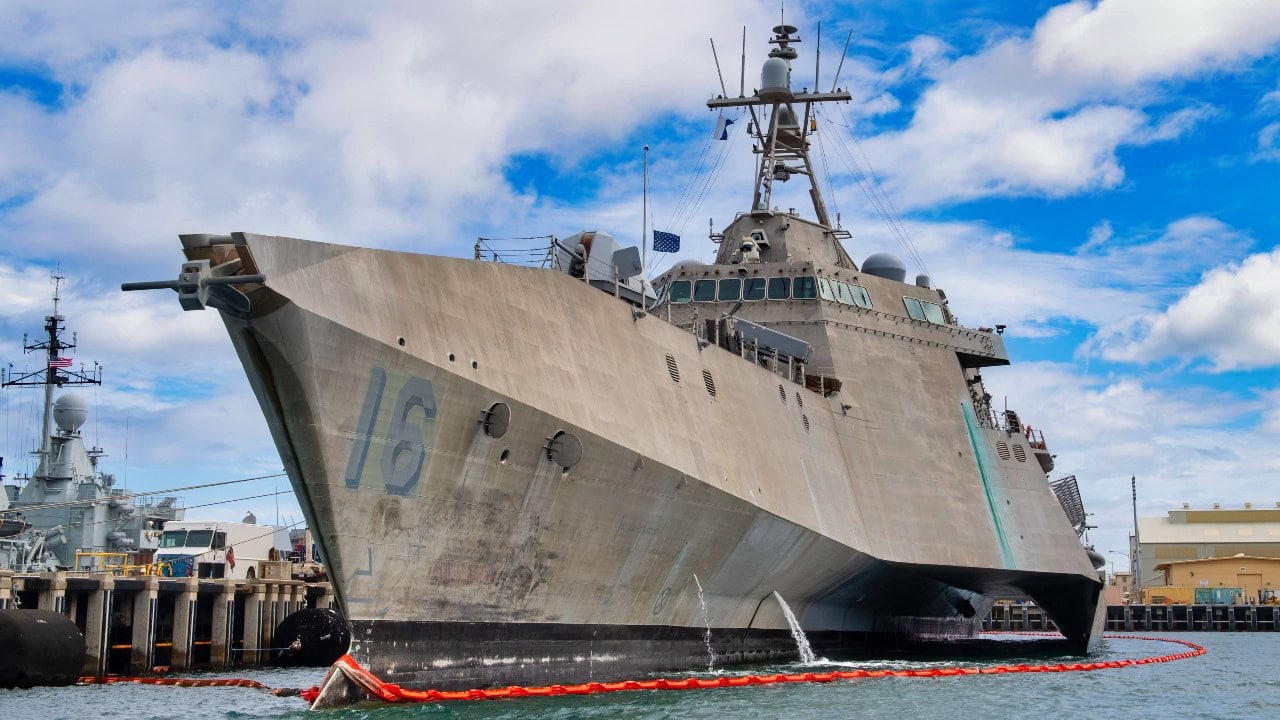
(July 7, 2022) – Independence-variant littoral combat ship USS Tulsa (LCS 16) moored at Joint Base Pearl Harbor-Hickam during Rim of the Pacific (RIMPAC) 2022. Twenty-six nations, 38 ships, four submarines, more than 170 aircraft and 25,000 personnel are participating in RIMPAC from June 29 to Aug. 4 in and around the Hawaiian Islands and Southern California. The world’s largest international maritime exercise, RIMPAC provides a unique training opportunity while fostering and sustaining cooperative relationships among participants critical to ensuring the safety of sea lanes and security on the world’s oceans. RIMPAC 2022 is the 28th exercise in the series that began in 1971. (U.S. Navy photo by Mass Communication Specialist 3rd Class Demitrius J. Williams)
More fundamentally, unilateral sanctions are an expression of domestic policy. States remain free to engage or disengage economically with other states and private actors. That’s a proposition that is neither novel nor controversial, and is, ironically, even reflected in China’s own practices. China’s Ministry of Commerce (MOFCOM) maintains an Unreliable Entity List that tracks foreign entities unaligned with the central government and has publicly pledged to “hold these foreign entities accountable for their unlawful actions.”
Sanctions enforcement has long been an established practice of statecraft, yet increasingly, its legitimacy is becoming obscured by political expediency. The danger in the shift to characterize undesirable actions as injustice, which extends beyond sanctions, is that it risks polarizing legitimate government conduct and further strains an international order already clouded by mistrust.
About the Author: Allen Zhang
Allen Zhang is a research assistant in the Heritage Foundation’s Asian Studies Center.