Can The Trump Strategy on Venezuela Work?
Key Points and Summary – Trump is escalating pressure on Nicolás Maduro with an oil-tanker blockade backed by a U.S. Navy carrier strike group. Analysts told 19FortyFive that coercion alone is unlikely to trigger regime change because Cuban security and Venezuelan counterintelligence are built to detect and crush elite defections early.
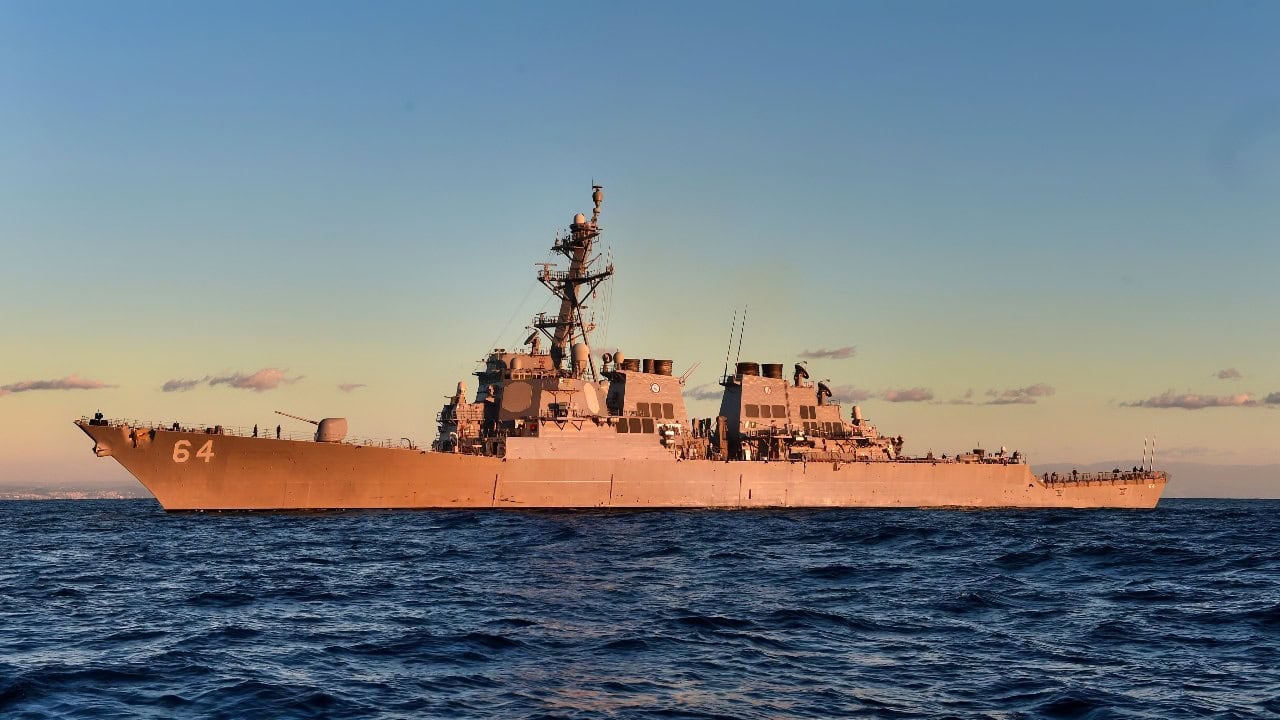
(Dec. 6, 2015). USS Carney (DDG 64) awaits the return of its small boat crew during a passenger transfer Dec. 6, 2015. Carney, an Arleigh Burke-class guided missile destroyer, forward deployed to Rota, Spain, is conducting a routine patrol in the U. S. 6th Fleet area of operations in support of U.S. national security interests in Europe. (U.S. Navy photo by Mass Communication Specialist 1st Class Theron J. Godbold/Released)
-Several sources also say the new team lacks continuity and appears to pivot tactics week to week, weakening leverage.
-Even a tight blockade may not fully choke cash flows, as narcotics routes, remittance seizures, and other channels persist. Naval pressure raises costs, but Maduro may endure. For Washington, patience and clarity matter.
A Carrier Strike Group Off Venezuela: Deterrent or Empty Threat?
Fort Lauderdale, Florida – In several discussions with Latin American specialists—some from the academic world, others from within the United States Government’s foreign policy, intelligence, and military affairs apparatus—19FortyFive gained insight into President Donald Trump’s Venezuela strategy.
We also spoke with US and European defense industrial and oil industry executives who are familiar with the situation in the region.
We asked them what they could see developing with the current standoff between the US President Donald Trump Administration and the dictatorial regime of Venezuela’s Nicolás Maduro Moros. The main issue is whether the military might of the US Navy carrier strike group assembled off the coast near the capital, Caracas, is enough to trigger regime change.
Washington has turned up the heat in recent days with the declaration of what is being called a blockade of any sanctioned oil tankers from either entering or departing a Venezuelan port. Some of these sanctioned vessels are already diverting away from Venezuela to avoid the US Navy flotilla, according to an AP report on Thursday.

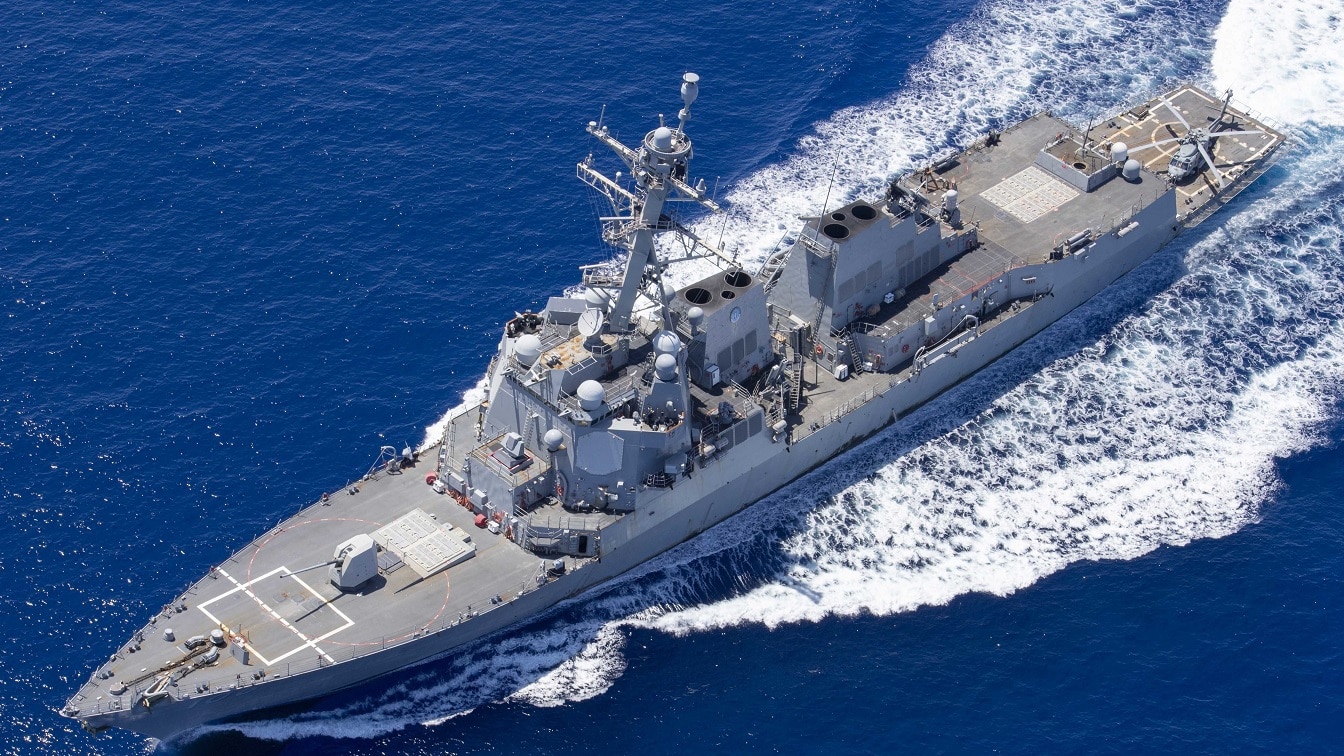
SOUTH CHINA SEA (Oct. 19, 2021) The Arleigh Burke-class guided-missile destroyer USS Milius (DDG 69), rear, and the Japan Maritime Self-Defense Force (JMSDF) Akizuki-class destroyer JS Akizuki (DD 115) transit the South China Sea in formation. Milius is assigned to Commander, Task Force (CTF) 71/Destroyer Squadron (DESRON) 15, the Navy’s largest forward-deployed DESRON and the U.S. 7th Fleet’s principal surface force. (U.S. Navy photo by Mass Communication Specialist 3rd Class Christine Montgomery) 211019-N-TC847-1020

PACIFIC OCEAN (May 7, 2018) The Arleigh Burke-class guided-missile destroyer USS Stockdale (DDG 106) maneuvers following a replenishment-at-sea with the aircraft carrier USS John C. Stennis (CVN 74). Stockdale is underway with the ships and squadrons of Carrier Strike Group (CSG) 3 conducting group sail training in preparation for its next scheduled deployment. (U.S. Navy photo by Mass Communication Specialist 2nd Class David A. Brandenburg/Released) 180507-N-UD522-0157
“Venezuela is surrounded by the largest Armada ever assembled in the History of South America,” Trump wrote on his Truth Social platform. “It will only get bigger, and the shock to them will be like nothing they have ever seen before—Until they return to the United States of America all of the Oil, Land, and other Assets that they previously stole from us.”
Trump’s statement refers to the days when US oil companies were the dominant players in Venezuela’s petroleum industry. That is, until Caracas nationalized those firms’ assets – the first time being in the 1970s and then again in the 21st century under Maduro and during the 1999-2013 rule of his late predecessor, Hugo Rafael Chávez Frías.
The compensation eventually proposed by Venezuela was considered too low by US firms, so in 2014, ExxonMobil won a $1.6 billion judgment from an international arbitration panel.
Protecting Maduro and Wielding Power in Venezuela
Communist-type dictatorships are nothing if not recalcitrant, especially when in a confrontation with Washington.
In Venezuela, what hardens that stance is the level of Cuban influence in Caracas and, as a former anti-Castro opposition figure in Miami told 19FortyFive, Havana’s “lives for the opportunity to poke Uncle Sam in the eye.” Encouraging Maduro to hold the line against the US “is one of the most visible ways for them to do so.”
The Cuban hand is active in several ways, not the least of which is that “the innermost circle of Maduro’s security detail that keeps him and those around him safe are all Cuban,” said another well-known expert, Dr. Sebastian Arcos, who is the Associate Director of the Cuban Research Institute at Florida International University.
Cuba will take no small measures to keep Maduro in power, Arcos explained. Not the least of which is because “Havana understands that Venezuela is the weak link” in the axis that also includes Caracas’s other partners – Russia and the PRC.
Havana does not want the link severed either, as in the future the Cuban regime may also have to depend increasingly on Venezuela for manpower for its labour force. Due to waves of emigration and economic trends that have depressed the birthrate, “at present Cuba is a demographic catastrophe,” said Arcos. “Its population is today the oldest in all of Latin America.”
Can US Pressure Remove Maduro From Power
Another analyst who is a US Government specialist on the region explained to 19FortyFive that the Cubans’ intelligence operatives and Venezuela’s own military counterintelligence services are “always spring-loaded to come down on anyone in the upper elites in Venezuela who might appear to be willing to take Maduro’s place at the behest of the US. This is the flaw in the theory that ‘if we apply enough pressure, someone would take Maduro out’ in a coup.”
The Cubans will know about it before it progresses very far and shut it down, was the conclusion of more than one Latin American analyst. There are also some other difficulties with the current US plan to remove Maduro, said more than one of the specialists who spoke to 19FortyFive.
One is that the team working on this issue in the current Trump 47 Administration is “basically all new,” said one analyst who was familiar with both the Biden and Trump 45 teams’ efforts in Latin America. “None of the people who were under Pompeo under the first Trump presidency are involved,” and there are some fundamental gaps when it comes to corporate knowledge.
A second is that there is no consistent approach to the problem, he said. “You see people saying ‘let’s try this as a solution,’ but then the following week it’s ‘well, that does not seem to be working, so let’s try something else.’ So instead of looking like a steady course of action by the administration on removing Maduro, what it appears to the outside observer is a good deal of flailing around.”
Finally, even if the blockade on oil trade and the other economic barriers are used to maximum effect, it will still not be enough to totally demonetize the elites around Maduro or cut off the money flow to pay the Cuban security forces that protect him. There are other channels of sending narcotics other than just speed boats, such as shipping containers, and other revenue flows like confiscations of remittances. These can sustain the regime longer than many people realize.”
About the Author: Reuben F. Johnson
Reuben F. Johnson has thirty-six years of experience analyzing and reporting on foreign weapons systems, defense technologies, and international arms export policy. Johnson is the Director of Research at the Casimir Pulaski Foundation. He is also a survivor of the Russian invasion of Ukraine in February 2022. He worked for years in the American defense industry as a foreign technology analyst and later as a consultant for the U.S. Department of Defense, the Departments of the Navy and Air Force, and the governments of the United Kingdom and Australia. In 2022-2023, he won two awards in a row for his defense reporting. He holds a bachelor’s degree from DePauw University and a master’s degree from Miami University in Ohio, specializing in Soviet and Russian studies. He lives in Warsaw.