
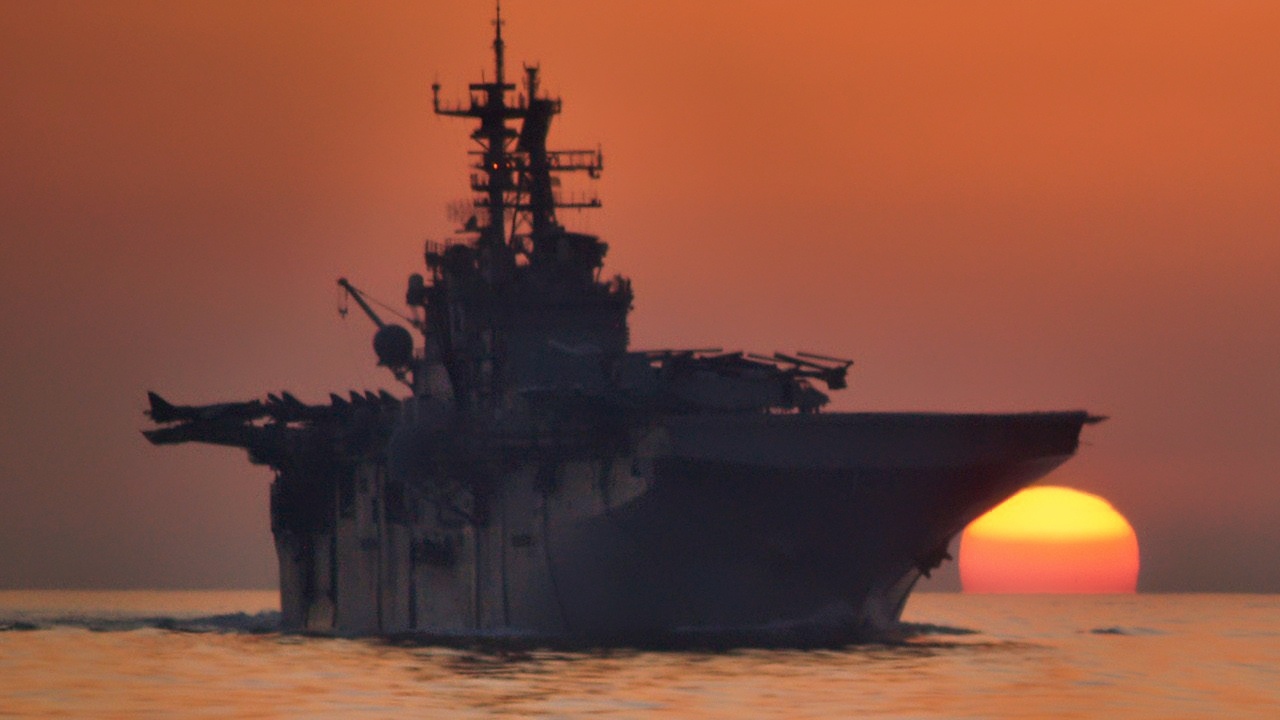
Key Points and Summary – If Washington shifts from counternarcotics to kinetic strikes on Venezuela, the Navy would be the tip of the spear.
-A Gerald R. Ford carrier strike group, backed by destroyers, cruisers, and attack submarines, could launch F-35Cs, Super Hornets, Growlers, and Tomahawk barrages from well offshore to blind and dismantle Maduro’s air defenses and command nodes.
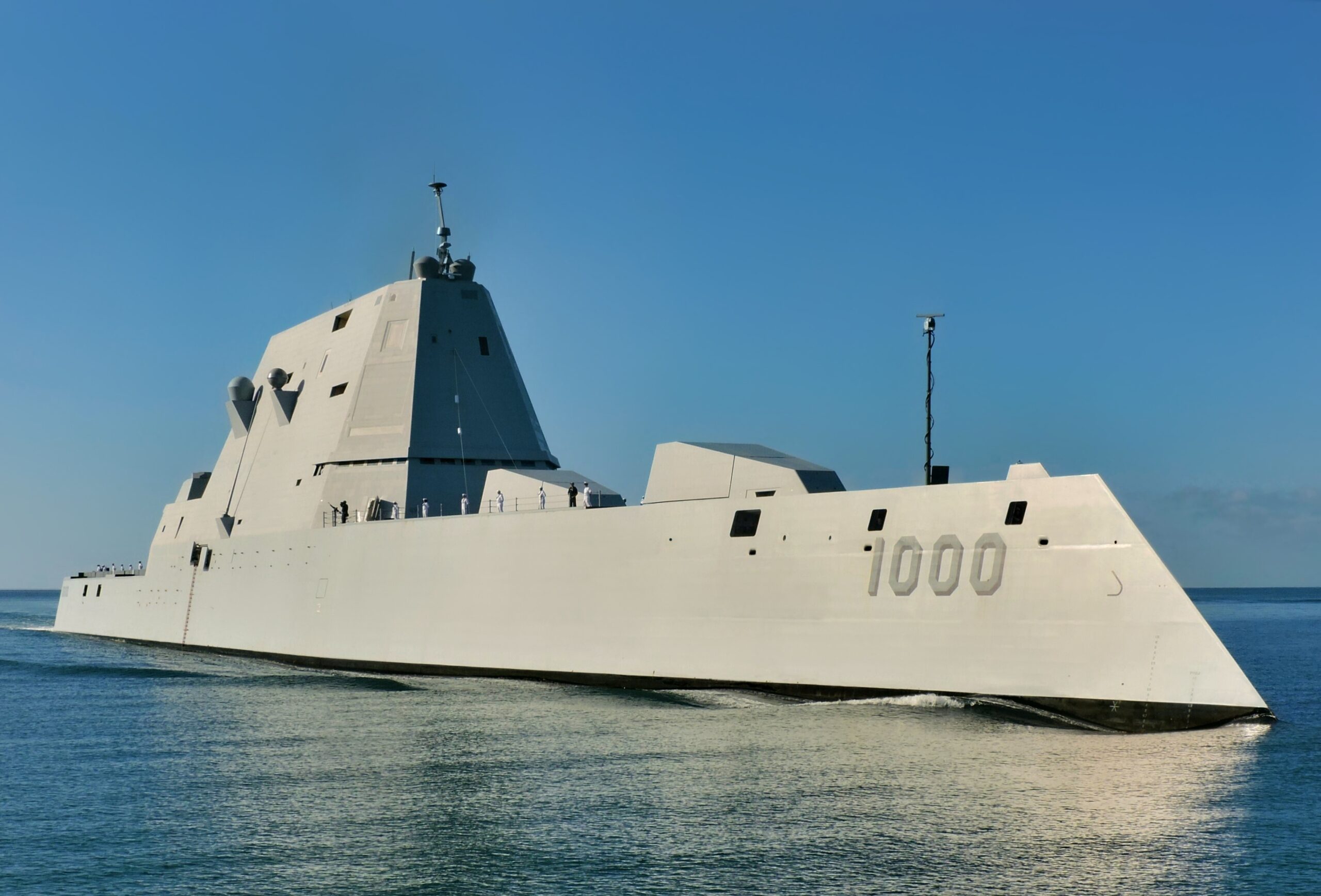
Zumwalt-Class Destroyer U.S. Navy. Image Credit: Creative Commons.
-An Iwo Jima–class amphibious group with a Marine Expeditionary Unit adds options for coastal raids or special operations support.
-Publicly framed as anti-drug operations, this posture also signals regime-change pressure and intersects unavoidably with Venezuela’s oil, sanctions evasion, and regional politics.
What U.S. Navy Assets Would Be Used In Strikes Against Venezuela?
If the United States decided to shift from a power-projection stance to conducting airstrikes against the Maduro regime in Venezuela, it would rely heavily on the Navy to overcome Venezuelan defenses.
Elizabeth Dickinson, the International Crisis Group’s senior analyst for the Andes region, said, “This is the anchor of what it means to have U.S. military power once again in Latin America.
“And it has raised a lot of anxieties in Venezuela, but also throughout the region. I think everyone is watching this with sort of bated breath to see just how willing the U.S. is to really use military force.”
While the U.S. insists Navy ships are there to stop the flow of illicit drugs into the U.S. and beyond, many believe that the carrier strike group is there strictly for the purpose of regime change.
“There’s nothing that an aircraft carrier brings that is useful for combating the drug trade,” Dickinson said. “I think it’s clearly a message that is much more geared toward pressuring Caracas.”
How Would The Navy Be Used Against Venezuela?
The Navy would deploy a massive, multi-layered force for operations near Venezuela. That force would be centered around the Gerald R. Ford Carrier Strike Group. The carrier itself (CVN-78) is supported by destroyers such as the USS Churchill (DDG-81), USS Bainbridge (DDG-96), and USS Mahan (DDG-72) for air defense and land attack, as well as cruisers for added firepower.
An Amphibious Ready Group such as the Iwo Jima group deployed with LHD-7, would bring Marines, helicopters such as Ospreys and Super Stallions, and landing craft for coastal operations. It would be supported by nuclear submarines, surveillance planes such as the P-8 Poseidons, carrier-based aircraft, and B-2 and B-52 bombers from regional bases.
Key Naval Assets In The Region
These assets would attack Venezuela by launching precision missile and air strikes from international waters, targeting military infrastructure, air defenses, and command centers, while keeping U.S. personnel out of range of most Venezuelan defenses.
The carrier’s air wing, which includes F-35C and F/A-18E/F Super Hornet fighter jets, could conduct numerous sorties to strike a range of targets. Attacks could target airfields, command nodes, radar systems, and facilities linked to alleged illicit activities like drug trafficking.
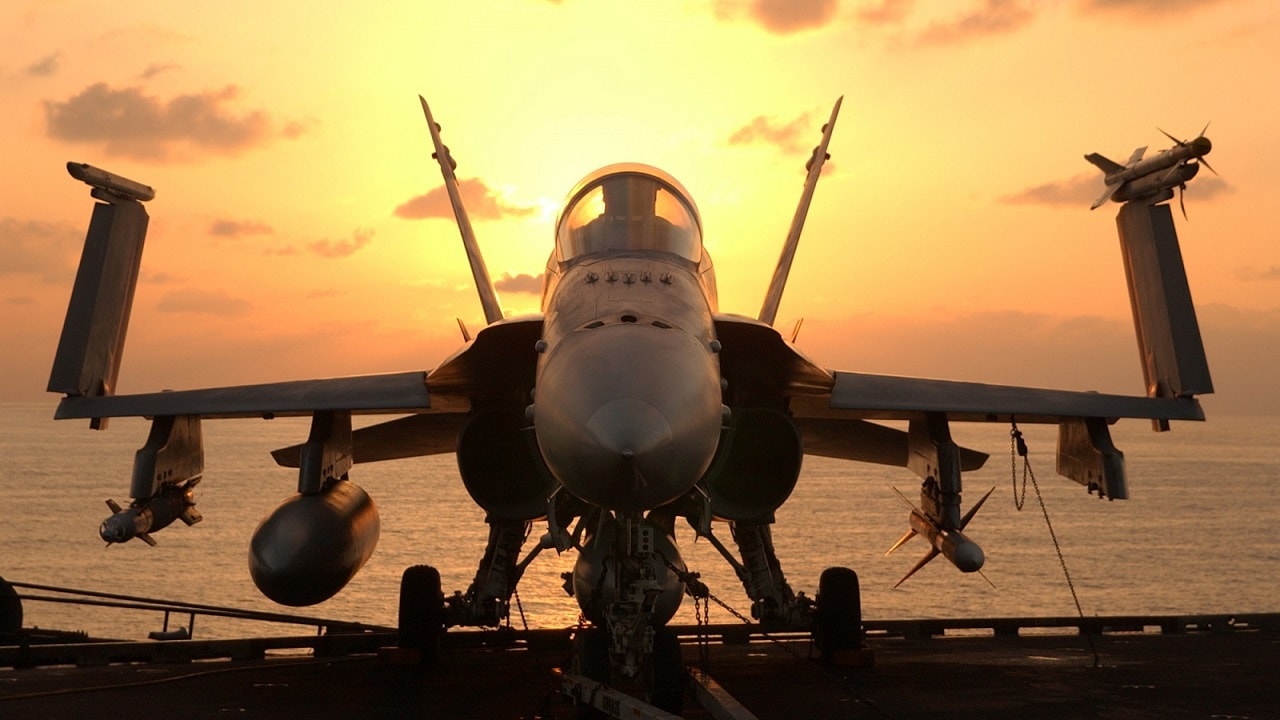
At sea aboard USS John C. Stennis, December 18, 2001 – After an early morning round of flight operations, an F/A-18 Hornet awaits the next round of combat flight operations aboard the USS John C. Stennis (CVN 74). Stennis and her embarked Carrier Air Wing Nine (CVW-9) are supporting Operation Enduring Freedom. U.S. Navy photo by Photographer’s Mate 3rd Class Jayme Pastoric
EA-18G Growler aircraft would jam and blind Venezuelan defense systems and radars, creating safe corridors for strike aircraft and reducing the risk of U.S. losses.
Aircraft such as the E-2D Advanced Hawkeye would provide airborne early warning, command and control, and persistent surveillance to coordinate operations and identify targets. This would be complemented by drones such as the MQ-9 Reaper, and other reconnaissance assets.
The CSG includes Ticonderoga-class guided missile cruisers along with a trailing nuclear attack submarine that could launch Tomahawk cruise missiles from far offshore.
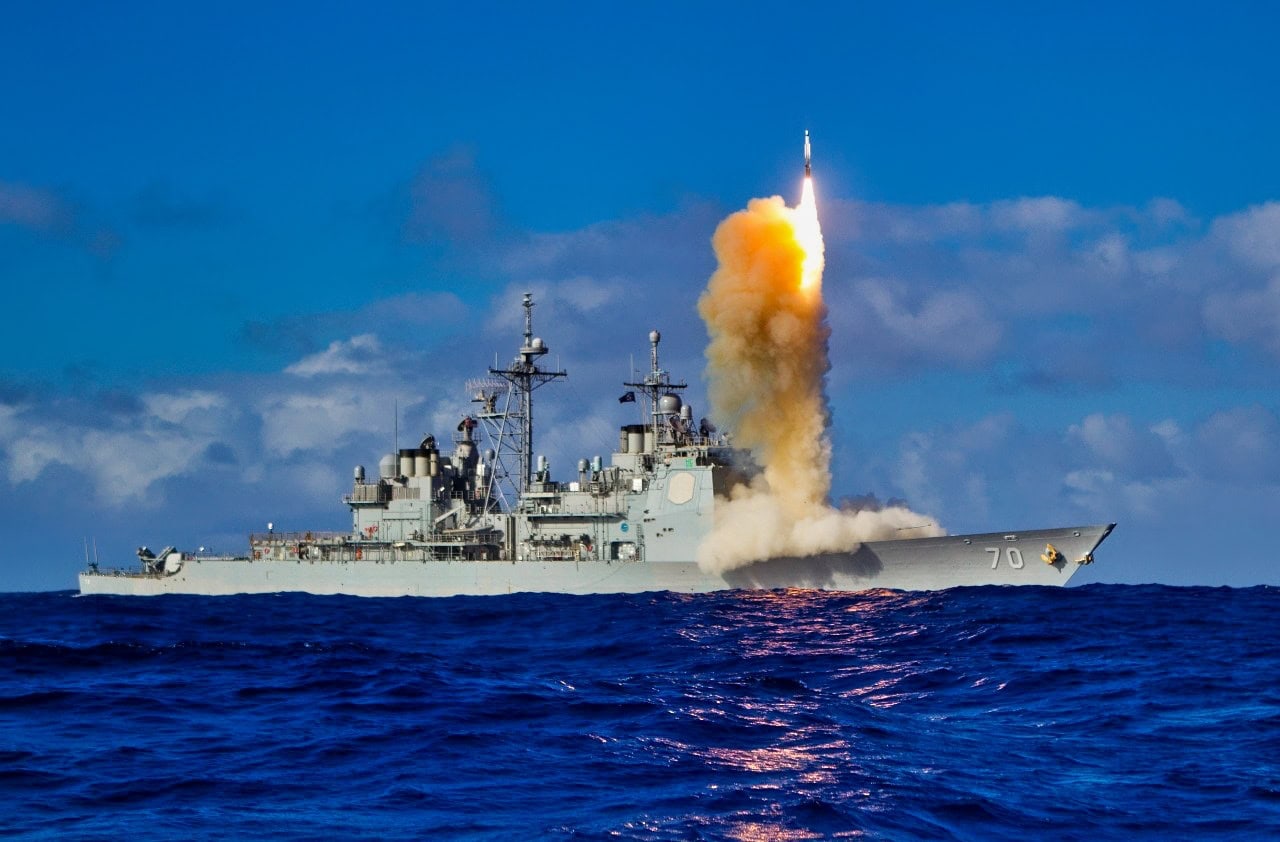
Ticonderoga-Class US Navy. Image Credit: Creative Commons.
These missiles have a range of up to 1,000 miles. They can hit fixed targets anywhere in Venezuela, providing the initial strike capability to disable key infrastructure and neutralize air defenses before risking manned aircraft.
The USS Iwo Jima (LHD-7) could carry an amphibious ready group with a Marine Expeditionary Unit of more than 2,200 Marines. These forces, transported by helicopters, V-22 Osprey tilt-rotor aircraft, and CH-53E Super Stallion helicopters, could conduct coastal raids or support clandestine special operations forces on the ground to target specific individuals or facilities.
An oil tanker was recently seized in international waters while carrying 1.85 million barrels of Venezuelan crude oil. A federal judge had previously issued a warrant for its seizure, alleging links to Iran-backed terror groups.
The Maduro regime condemned the seizure.
“It is not migration. It is not drug trafficking. It is not democracy. It is not human rights. It has always been about our natural wealth, our oil, our energy, the resources that belong exclusively to the Venezuelan people,” a government statement said.
In an effort to further combat Maduro’s efforts to evade oil sanctions, the United States has imposed fresh sanctions on six more ships said to be carrying Venezuelan oil, according to the BBC.
The U.S. Treasury Department sanctioned the seized vessel in 2022, CBS reported, for alleged involvement in oil smuggling that generated revenue for Hezbollah and the Islamic Revolutionary Guard Corps-Quds Force.
About the Author: Steve Balestrieri
Steve Balestrieri is a National Security Columnist. He served as a US Army Special Forces NCO and Warrant Officer. In addition to writing on defense, he covers the NFL for PatsFans.com and is a member of the Pro Football Writers of America (PFWA). His work was regularly featured in many military publications