
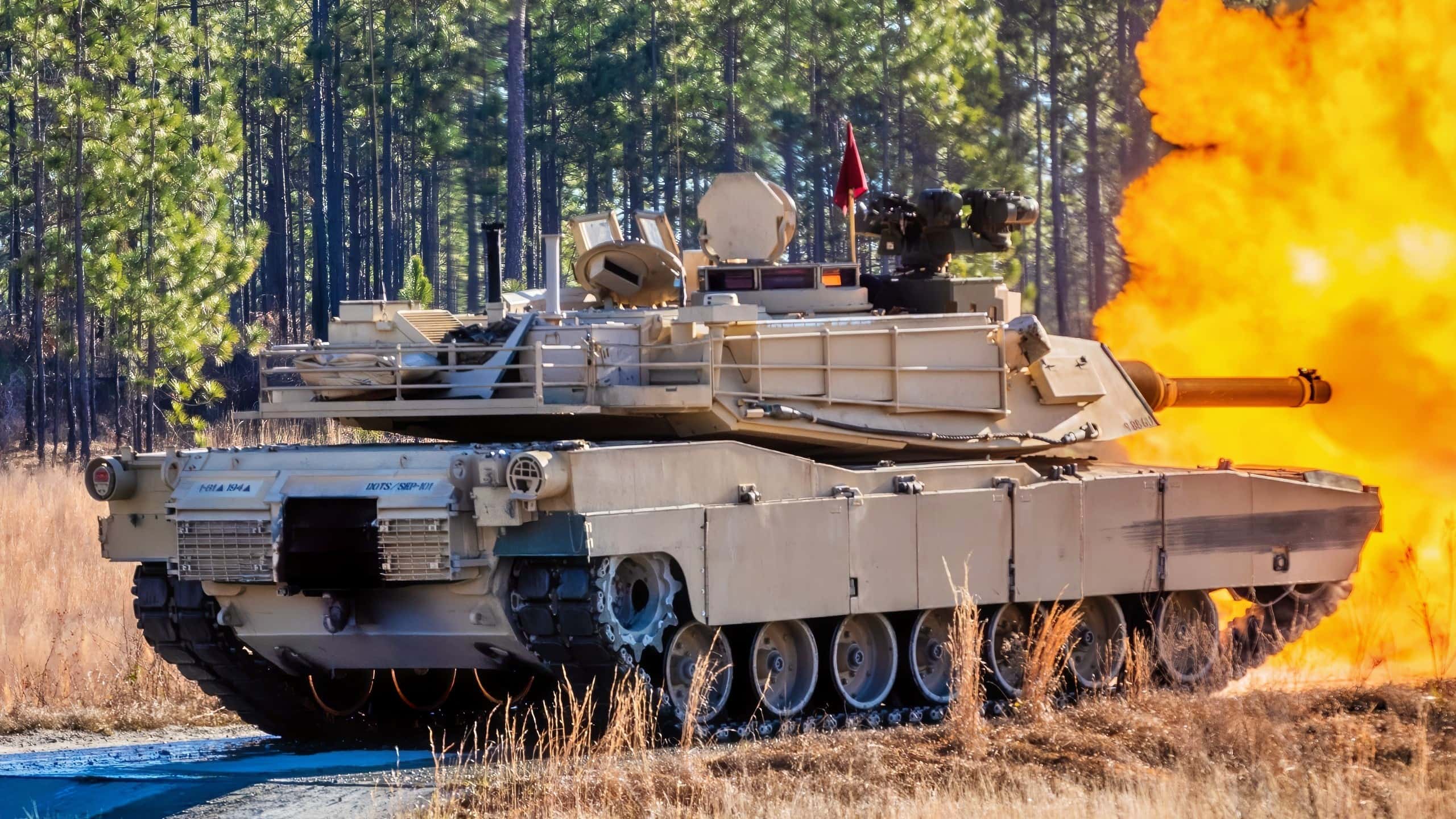
Summary and Key Points: Dr. Robert Farley, a Patterson School security professor and defense author, evaluates the “fraught danger” of a U.S. ground invasion of Iran in 2026.
-As Operation Epic Fury goals remain unmet, this report analyzes the collapse of regional logistical hubs in Afghanistan and Iraq, leaving a high-risk amphibious assault as the only conventional entry point.
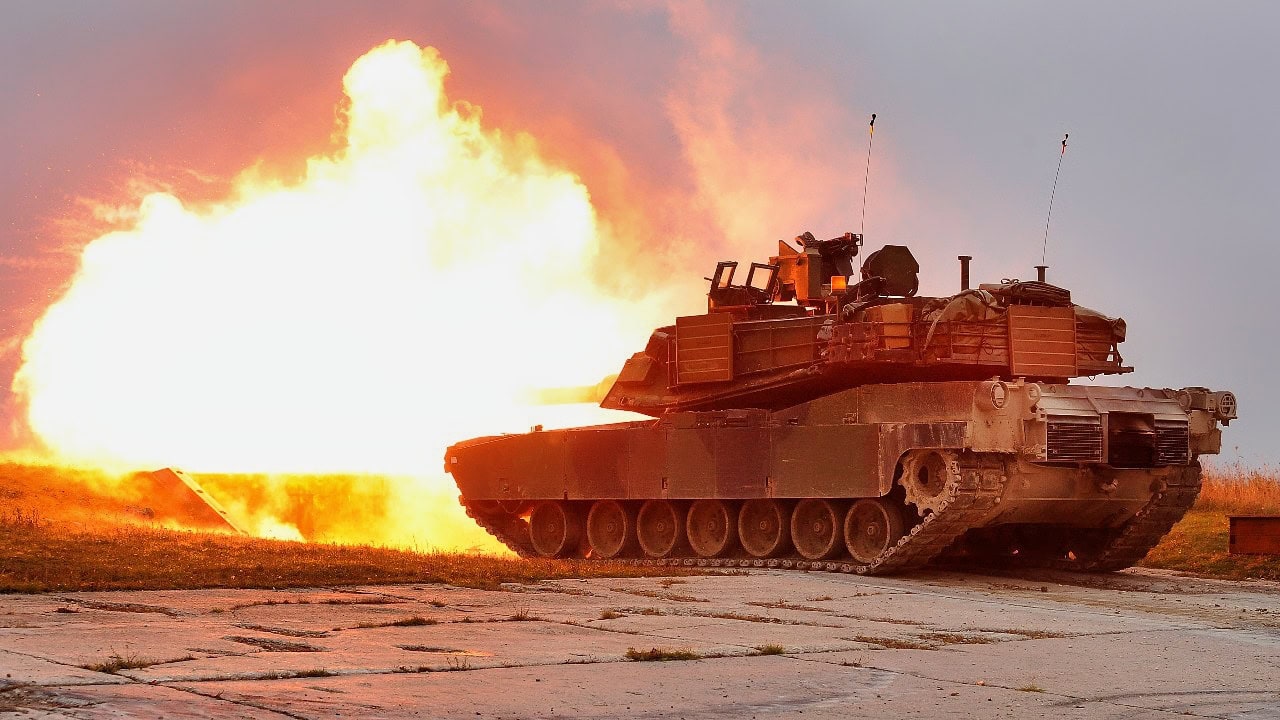
U.S. Soldiers, assigned to the 1st Battalion, 64th Armor Regiment, 1st Armored Brigade Combat Team, 3rd Infantry Division, conduct gunnery with M1A2 Abrams tanks during exercise Combined Resolve V at 7th Army Joint Multinational Training Command in Grafenwoehr, Germany, Oct. 8, 2015. Combined Resolve is designed to exercise the U.S. Army’s regionally aligned force to the U.S. European Command area of responsibility with multinational training at all echelons. Approximately 4,600 participants from 13 NATO and European partner nations will participate. The exercise involves around 2,000 U.S. troops and 2,600 NATO and Partner for Peace nations. Combined Resolve is a preplanned exercise that does not fall under Operation Atlantic Resolve. This exercise will train participants to function together in a joint, multinational and integrated environment and train U.S. rotational forces to be more flexible, agile and to better operate alongside our NATO Allies. (U.S. Army photo by Visual Information Specialist Gertrud Zach/released)
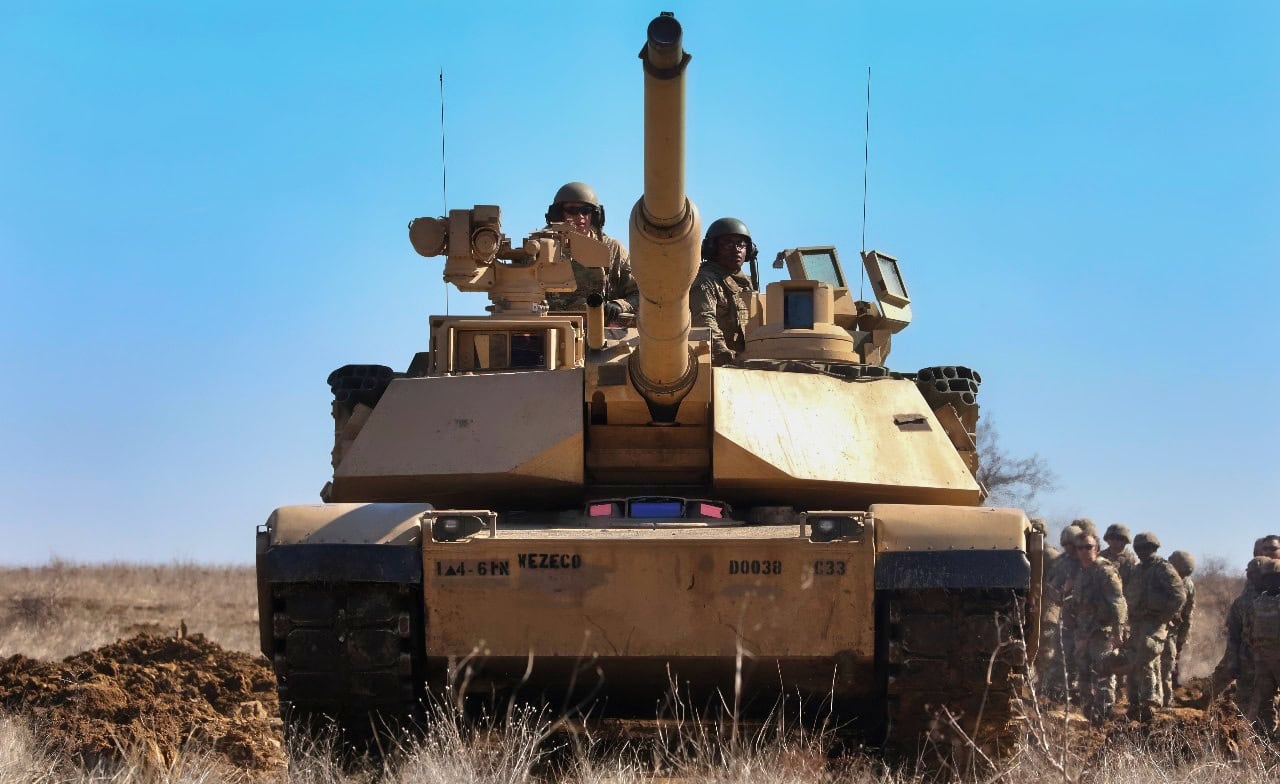
A U.S. Army M1 Abrams, assigned to 4th Battalion, 6th Infantry Regiment, 3rd Armored Brigade Combat Team, 1st Armored Division, fully emerges from the tank firing point to engage the simulated enemy at Novo Selo Training Area, Bulgaria, March 5, 2025. 1st Armored Division, a rotational force supporting V Corps, conducts training with engineers and tank operators in the European Theatre to maintain readiness and instill fundamental Soldier skills that are vital in maintaining lethality. (U.S. Army photo by Spc. Kyle Kimble)
-Farley explores the “Afghan Model” of using Kurdish proxies supported by Special Operations Forces and precision airpower to distract the IRGC.
-He concludes that while Secretary Marco Rubio and Pete Hegseth weigh these options, the geographic scale of Iran remains a massive tax on U.S. military capabilities.
The “From Where” Dilemma: Why the Loss of Afghanistan and Iraq Bases Makes an Iran Invasion a Logistic Nightmare
Why would the United States want to invade Iran?
The short answer is that it doesn’t; invading Iran is not the act of sane men, or even of the senior national security leadership of the Trump administration.
However, the United States has established conditions for the end of the war that the Iranian government may not be able to meet in any kind of meaningful way.
If the US does not relax its war aims and the Islamic Republic does not collapse, the Trump administration may find itself contemplating the deployment of ground troops in an effort to directly induce Tehran’s collapse.
Such an effort would be enormously expensive and fraught with danger.

M2 Bradley. Image Credit: Creative Commons.
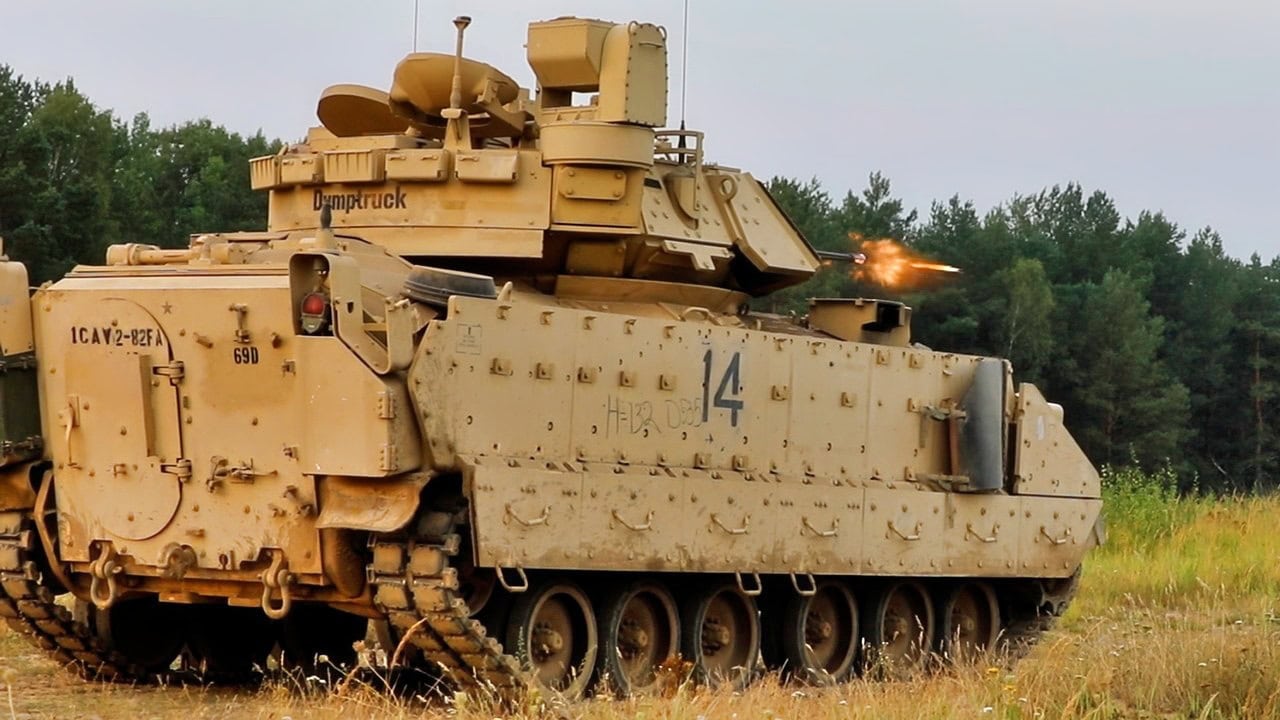
Troopers with 3rd Armored Brigade Combat Team, 1st Cavalry Division firing the 25mm canon on a Bradley fighting vehicle in order to zero the vehicles weapons systems at a range in Poland. Ranges such as these familiarize troopers with the vehicles systems in order to ensure combat readiness.
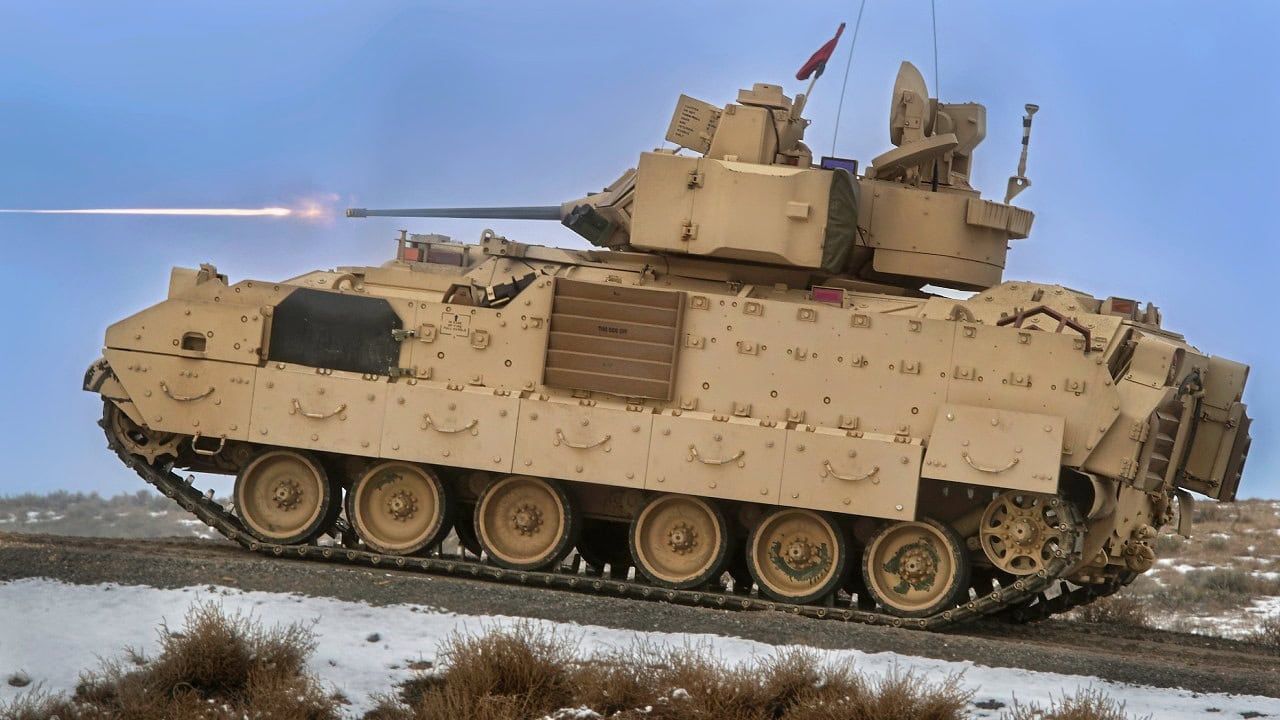
The Bradley Fighting Vehicle cuts loose several rounds from the 25mm main gun on the orchard Combat Training Center Range.
Soldiers completed training this week of the Bradley Commanders Course with the 204th Regional Training Institute, (RTI), of the Idaho Army National Guard on Gowen Field. The course is designed to train active duty, reserve and national guard officers and non-commissioned officers in combat critical M3 Bradley Fighting Vehicle Commander Skills. Field exercises were conducted on the newest Range 10, the Digital Air Ground Integrated Range (DAGIR), on the Orchard Combat Training Center grounds.
From Where?
The first and biggest question for any invasion of Iran is “from where?” At the peak of the War on Terror, the United States maintained a substantial deployment of ground forces in both Iraq and Afghanistan.
While these troops were busy with internal problems within each host country, they nevertheless formed the nucleus of a force that could threaten Iran with a ground invasion. Moreover, the logistical infrastructure needed to supply high-intensity military operations was at least to some degree present in both countries.
Those conditions no longer exist. The United States left Afghanistan in 2021, shortly after the collapse of the Kabul government. While the Taliban have no love for Iran, there is little chance that they would tolerate the deployment of US troops in or the supply of US forces through their country.
Iraq continues to host a small US contingent (some 2000 soldiers, scheduled to drop further in 2026), but Iraq’s delicate domestic political situation does not seem ideal for the deployment of troops on a scale that would be necessary for an invasion of Iran.
Turkey similarly seems extremely unlikely to welcome a significant US deployment, and in any case, the Iran-Turkey border is hardly ideal from a geographic perspective for a quick invasion of Iran.
It is difficult to see how the US would have any other option for introducing and supporting substantial ground forces other than an amphibious assault.
Such an assault would be a massive undertaking that would severely strain US seapower and airpower for an extended period.
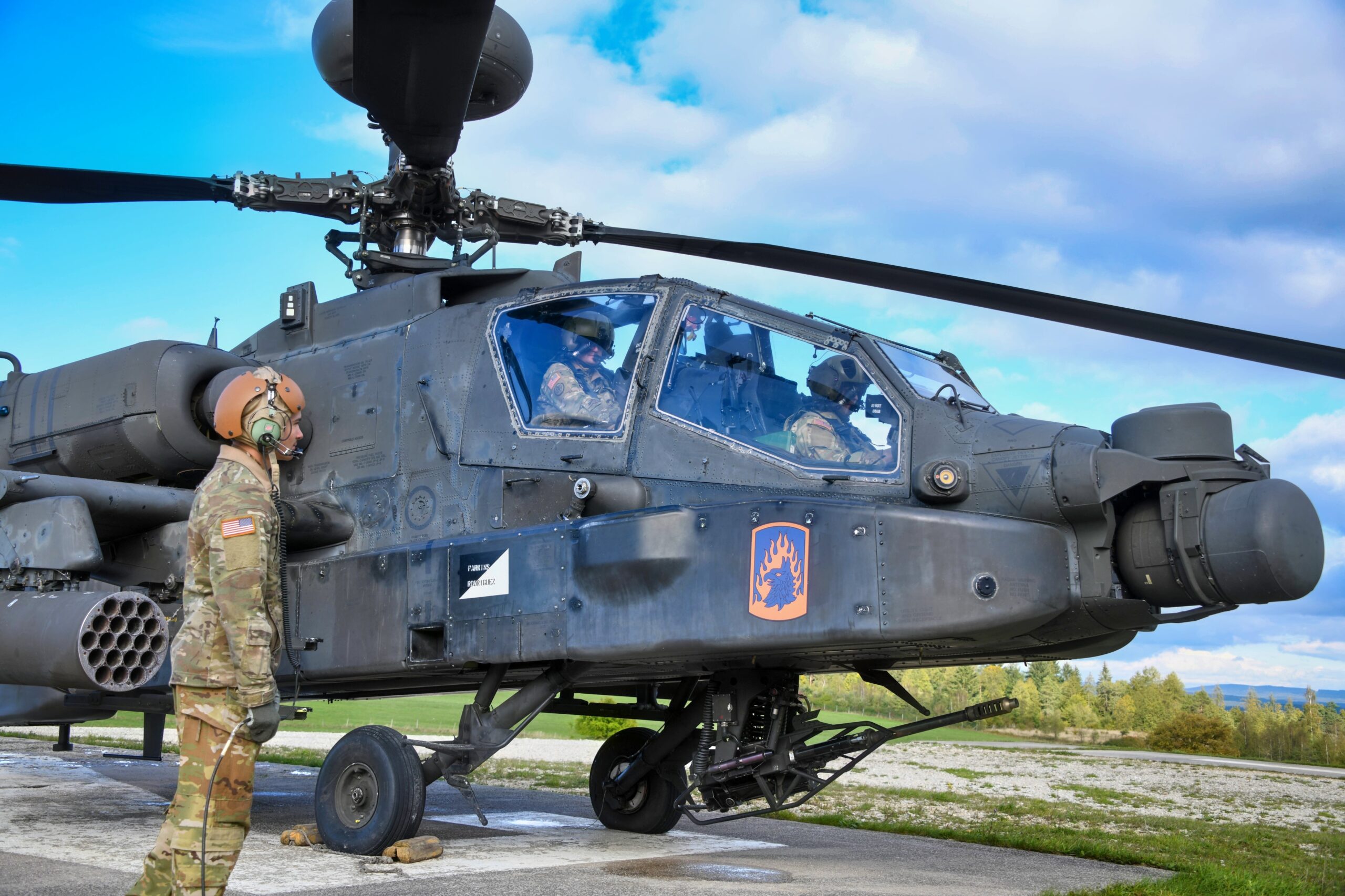
U.S. Soldiers assigned to 12th Combat Aviation Brigade conduct pre-flight checks on an AH-64D Apache longbow helicopter at the Grafenwoehr Training Area, Germany, Sept. 28, 2022. 12th CAB is among other units assigned to V Corps, America’s Forward Deployed Corps in Europe. They work alongside NATO Allies and regional security partners to provide combat-ready forces, execute joint and multinational training exercises, and retain command and control for all rotational and assigned units in the European Theater. (U.S. Army photo by Sgt. Randis Monroe)
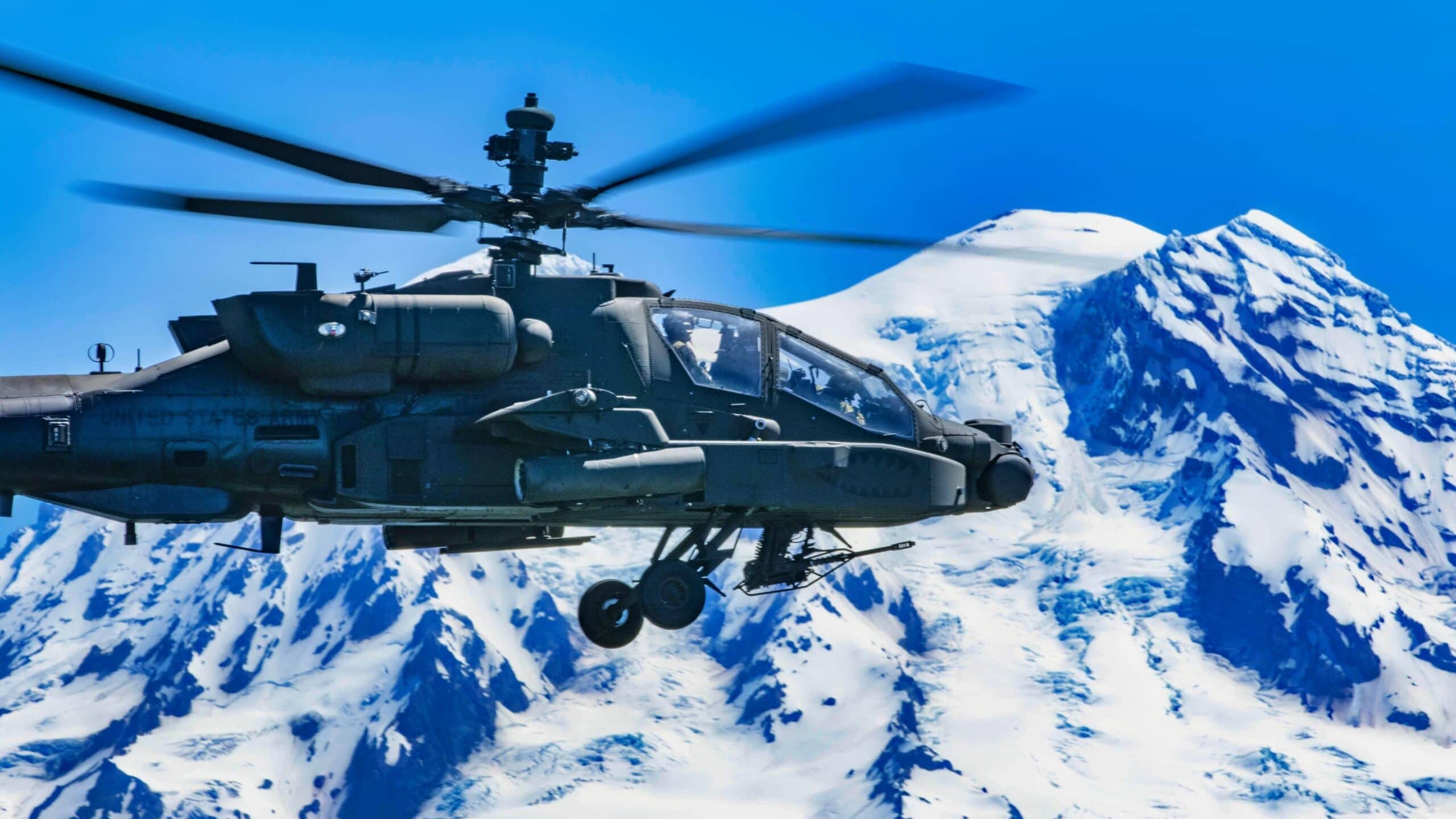
Apache Helicopter U.S. Army. Image Credit: Creative Commons.
It is not impossible- a few things are impossible for the US military given enough money and time- but it would require a degree of commitment that the Trump administration has not evinced thus far and has not prepared the US public to undertake.
In 2002, the Department of Defense famously ran the “Millennium Challenge” exercise, built on a scenario very similar to what would be needed to invade Iran.
The exercise caused extended controversy over adjudicator decisions after some US forces were “resurrected” despite being mauled by Red Team anti-access forces.
While the lessons of the Millennium Challenge hardly prove that an invasion of Iran is impossible, they do emphasize the difficulties such an operation would face.
Proxies
A proxy fight supported by US airpower and special operations forces would seem to be the most plausible scenario for introducing ground troops into Iran.
Reportedly, the US intelligence community began cultivating Kurdish communities in the north and west of Iran several months ago. Reports over the past few days have lacked detail as to the composition of any Kurdish units, although evidently Iranian security services have taken the threat sufficiently seriously to launch attacks against Kurdish bases in Iraq.
Operations against Iran would then presumably follow something similar to the “Afghan Model,” with a combination of precision airpower, high-end communications and surveillance technology, special operations forces, and Kurdish troops engaging Iranian ground forces.
However, the Army of the Islamic Republic of Iran is much larger and is believed to be far more professional that the militias this model was used against in Afghanistan, Syria, and Libya.
It’s not obvious how much headway Kurdish units could make even with assistance, and the demands upon US airpower assets for close air support and battlefield interdiction would be enormous. While Kurdish forces supported by American troops fought effectively in Syria, they never attempted to march on Damascus.
One theory of victory suggests that Kurdish forces could distract Iran’s armed forces sufficiently to allow a popular uprising in Iran’s largest cities, but this seems to discount the nature of Iran’s multi-layered and multi-faceted security services (the Army is not primarily responsible for urban pacification) and rely upon magical thinking with regard to the capabilities of protestors.
Just Say No to Invading Iran
Iran is large, heavily populated, and geographically diverse. Even with minimal resistance and invasion would be a massive undertaking that would severely tax US military capabilities for the foreseeable future, even assuming that some kind of successor force could take control of the country.
Reports of conflict between Secretary of State Marco Rubio and Secretary of Defense Pete Hegseth over the deployment of ground troops indicate that the administration is taking the idea seriously, although we do not know if this represents serious planning, a bluff, or a desperate effort to come up with a theory of victory in a war that currently has none.
In any case, responsible people in Congress, in the US armed forces, and in the media should be asking extremely pointed questions of the administration about what it plans to do with US ground forces and how it plans to bring this war to a close.
About the Author: Dr. Robert Farley, University of Kentucky
Dr. Robert Farley has taught security and diplomacy courses at the Patterson School since 2005. He received his BS from the University of Oregon in 1997, and his Ph. D. from the University of Washington in 2004. Dr. Farley is the author of Grounded: The Case for Abolishing the United States Air Force (University Press of Kentucky, 2014), the Battleship Book (Wildside, 2016), Patents for Power: Intellectual Property Law and the Diffusion of Military Technology (University of Chicago, 2020), and most recently Waging War with Gold: National Security and the Finance Domain Across the Ages (Lynne Rienner, 2023). He has contributed extensively to a number of journals and magazines, including the National Interest, the Diplomat: APAC, World Politics Review, and the American Prospect. Dr. Farley is also a founder and senior editor of Lawyers, Guns and Money.