
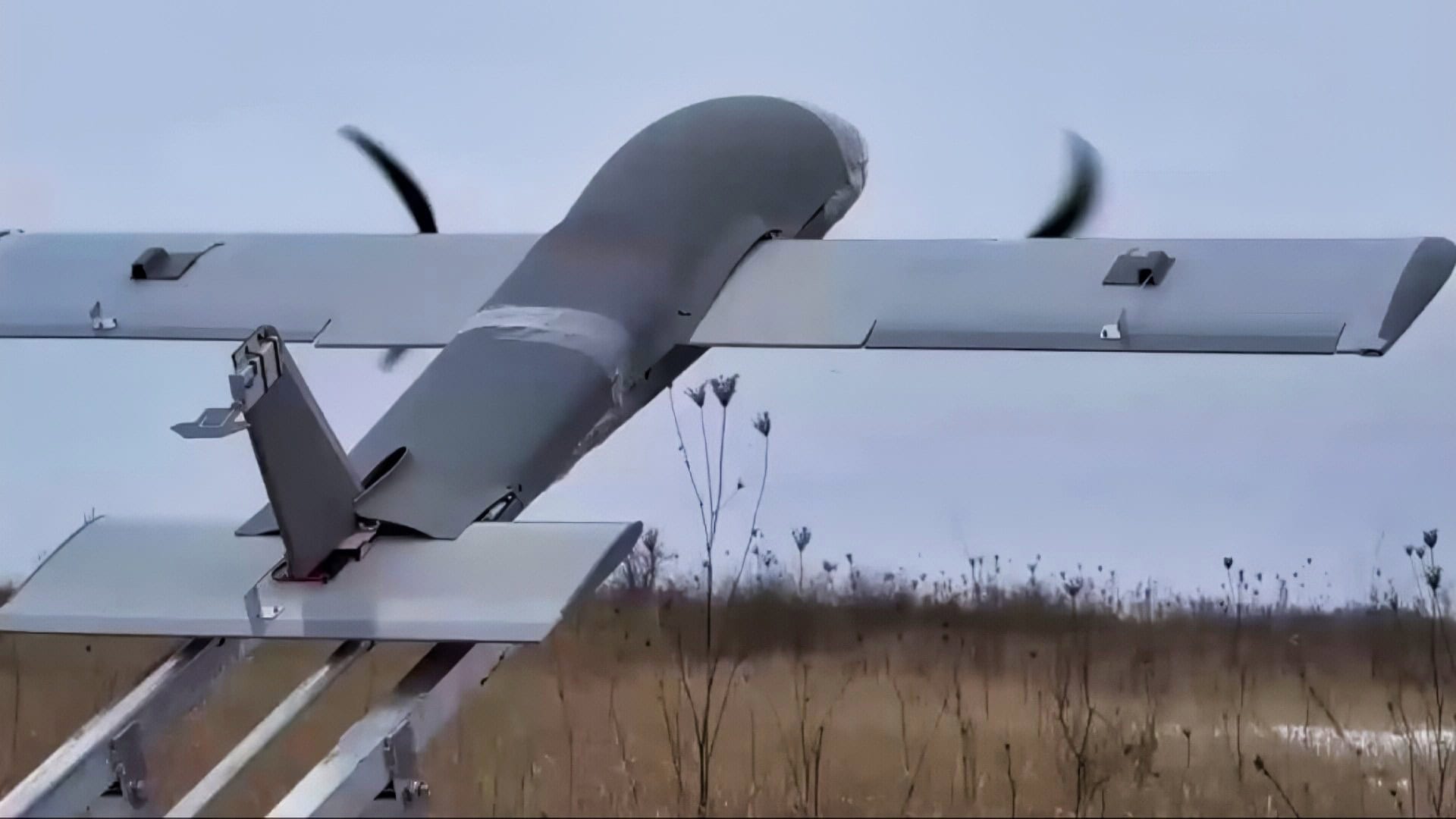
The War in Ukraine has sparked an accelerated arms race between Russia and Ukraine to field the most drones possible.
Much focus has been devoted to Ukraine and its impressive drone operations; however, Russia has also been making strides to improve its drone forces in the skies.
The Molniya (lightning) system is one of many systems currently in use by the Russian Armed Forces in the skies of Ukraine.
Easy to assemble and cheap to procure, the Molniya drone has been used extensively throughout this conflict. Recently, the system was modified to conduct reconnaissance and surveillance missions, adding a new layer of versatility.
Russia’s Cheap Strike/Reconnaissance Platform
The earliest versions of the Molniya were built as simple one-way attack drones launched by catapult and guided via first-person view.
These systems carried relatively small warheads weighing around 5 kilograms and had an operational range of about 40 kilometers.
Their construction from lightweight materials such as plywood, foam, and aluminum made them extremely inexpensive to produce, allowing Russia to manufacture them in large numbers without the financial burden of more sophisticated UAVs.
The platform’s low cost contributed to its mass deployment.
Reports indicate that the price of a single high-end reconnaissance drone, such as an Orlan-10 or Supercam S-350, could cover the production of ten to fifteen Molniya drones. This economic advantage became particularly relevant as drone attrition rates rose throughout the conflict.
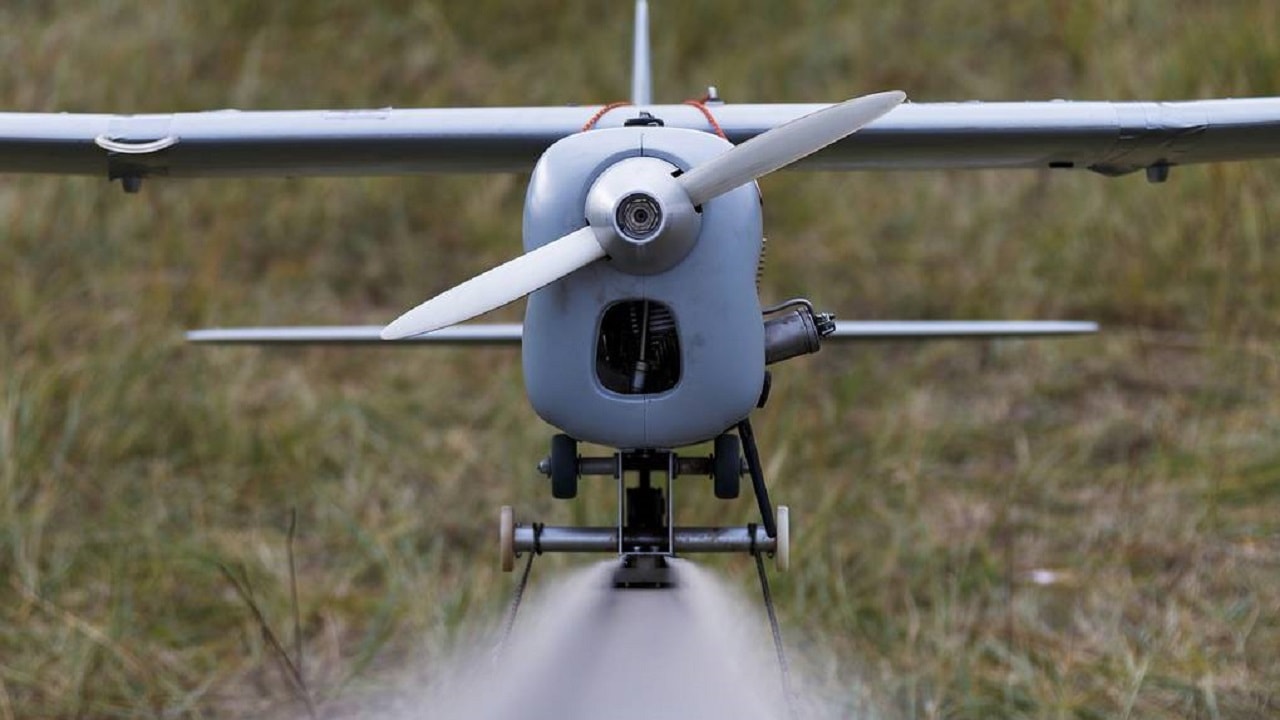
Russia’s Orlan-10 drone. Image Credit: Russian State Media.
By late 2025 and early 2026, Russia began substantially modifying the Molniya to address new battlefield challenges, especially the growing presence of Ukrainian interceptor drones and the extensive use of electronic warfare.
These adaptations turned the Molniya into a reconnaissance asset by equipping it with additional batteries for extended range, high-definition cameras, and mesh modems that improved communication reliability.
The enhanced versions abandoned their warheads in favor of microcomputers and rotating cameras capable of tenfold optical zoom, enabling operators to gather intelligence, surveil troop movements, and identify targets more effectively.
Ukrainian defense advisor Serhii “Flash” Beskrestnov observed that these modified drones had been in use for at least two months by March 2026 and were being increasingly deployed as Russia sought affordable ISR capabilities without risking more expensive aerial platforms.
Small but Terrifying
The Molniya platform then evolved into more sophisticated variants, namely Molniya-2 and Molniya-2R. The Molniya-2 introduced structural improvements, including two wing-mounted engines, a redesigned fuselage, increased range, and a larger warhead.
The Molniya-2R, however, represented an even more radical transformation into a dedicated reconnaissance drone. Investigations conducted by Ukrainian intelligence revealed that Russian developers had integrated a Raspberry Pi 5 microcomputer and a Chinese-made Mini PC, branded “Raskat.”
This variant also ran a licensed version of Windows 11. It carried a SIYI ZR10 camera with 10x optical zoom and a three-axis stabilization system, providing significantly enhanced surveillance and target-correction capabilities.
One of the most notable upgrades to the Molniya-2R was the addition of a Starlink satellite terminal, which enabled long-range communication, telemetry exchange, and video transmission far beyond the limits of traditional radio control systems. This adaptation allowed operators to maintain command over the drone even in dense electronic warfare environments.
Machine-vision guidance became another critical addition to the Molniya’s capabilities. Reports from Ukrainian electronic warfare specialists and defense analysts indicated that Russia had begun equipping Molniya drones with onboard computer-vision systems originally developed for FPV munitions.
These systems enabled the drone to automatically lock onto and visually track targets, allowing missions to continue even if radio communication was disrupted. Machine-vision systems provided a decisive advantage in contested environments by allowing the UAV to maintain accuracy and guidance after signal loss, especially during low-altitude or long-range operations.
The Evolving Nature of Drone Warfare in Ukraine
Further developments included Russian experimentation with fiber-optic datalinks, which offered an alternative to traditional radio-based communication. Fiber-optic spools had already been deployed in smaller FPV drones, and extending this technology to larger platforms like the Molniya could mitigate the effects of Ukrainian jamming systems.
Whereas radio links can be disrupted or disabled entirely by electronic warfare, fiber-optic connections are physically shielded from interference and provide a stable, unjammable guidance method. Reports suggest that such adaptations were underway as part of Russia’s effort to maintain control over its drones even in highly contested airspace.
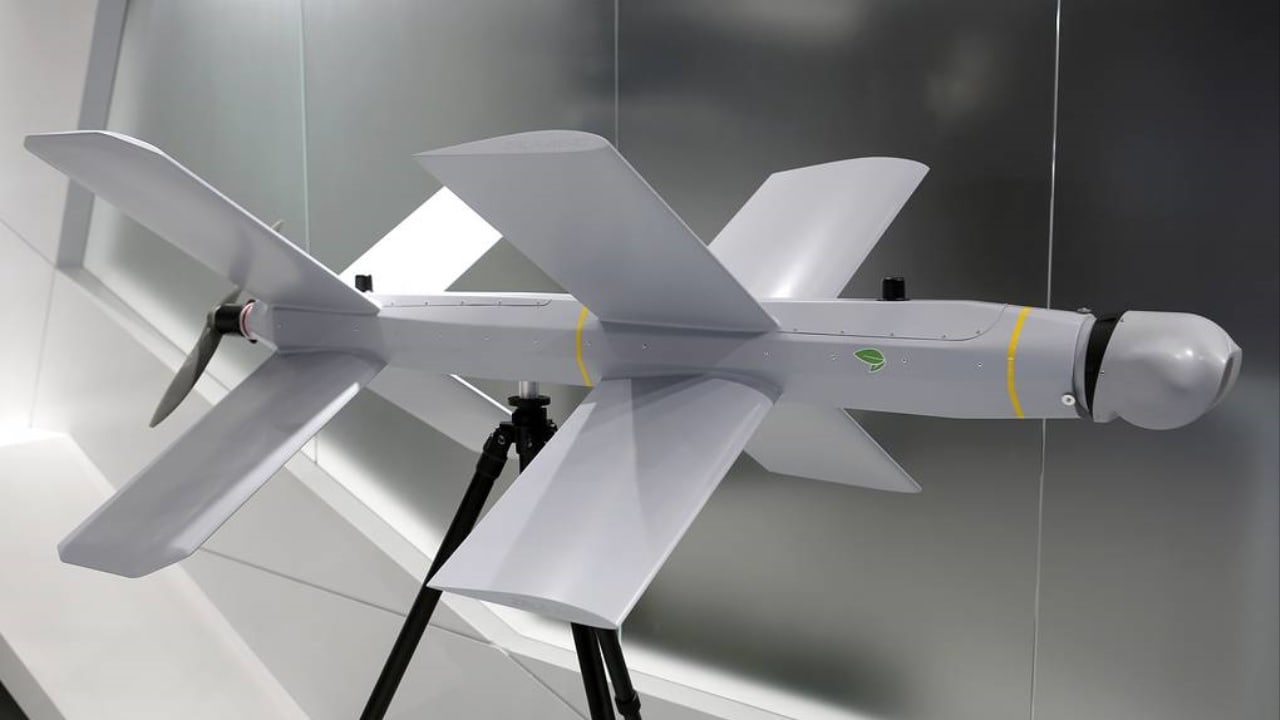
Lancet Drone. Image Credit: Russian State Media.
Alongside its roles in reconnaissance and strike operations, the Molniya also gained relevance as a so-called “mother-drone,” capable of carrying and deploying smaller FPV drones against frontline targets.
Ukrainian sources documented instances in which Molniya-type UAVs served as carriers for multiple FPV munitions, enabling Russia to extend the effective range of its short-duration FPV systems by transporting them closer to the battlefield before release.
This tactic extended the battery life of the smaller drones, increased their survivability, and added a new dimension to the Molniya platform’s flexibility.
About the Author: Isaac Seitz
Isaac Seitz, a Defense Columnist, graduated from Patrick Henry College’s Strategic Intelligence and National Security program. He has also studied Russian at Middlebury Language Schools and has worked as an intelligence Analyst in the private sector.