
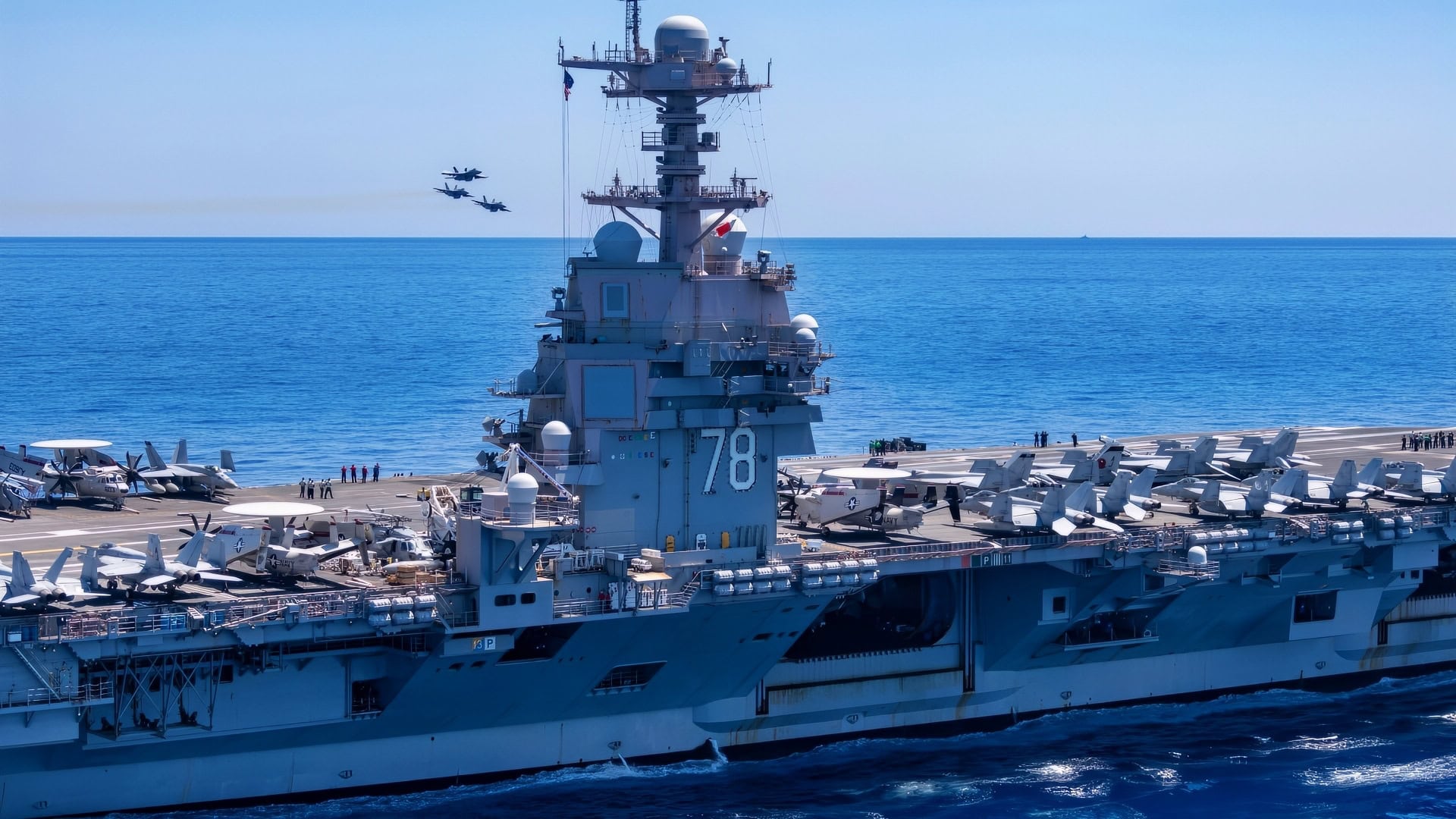
Aircraft Carrier USS Gerald R. Ford 11-Month Deployment Rivals USS Nimitz’s 341-Day Record
The USS Gerald R. Ford (CVN-78) is expected to complete an 11-month tour that will mark one of the longest U.S. carrier deployments since the Vietnam War.
The Ford’s deployment began in June 2025, and the carrier’s mission was extended into early 2026 to support operations in the Middle East.
The USS Gerald R. Ford carrier strike group (CSG) was operating in the Caribbean during the Operation Absolute Resolve mission to capture Venezuelan dictator Nicolás Maduro.
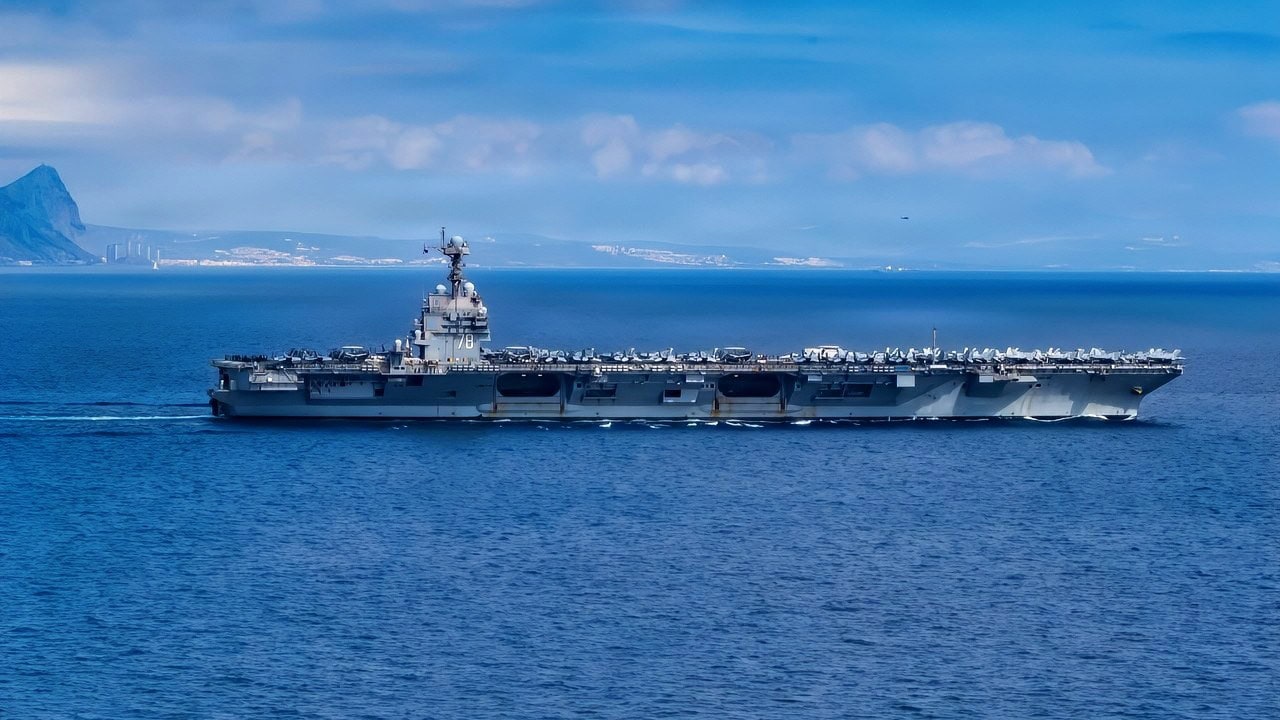
The world’s largest aircraft carrier, USS Gerald R. Ford (CVN 78), transits the Strait of Gibraltar, Oct. 1, 2025. Gerald R. Ford, a first-in-class aircraft carrier and deployed flagship of Carrier Strike Group Twelve, is on a scheduled deployment in the U.S. 6th Fleet area of operations to support the warfighting effectiveness, lethality and readiness of U.S. Naval Forces Europe-Africa, and defend U.S., Allied and partner interests in the region. (U.S. Navy photo by Mass Communication Specialist Seaman Apprentice Alyssa Joy)
The CSG was then sent to the Middle East, where it took part in air operations against Iran until the Ford was pulled away for repairs in Crete. It then moved to Split, Croatia, on March 28, for a port visit.
The carrier has been at sea since leaving its homeport of Norfolk on June 24, 2025.
When the Navy plans its force employment timelines, it prioritizes current force demands along with the ability to meet future contingencies.
The service routinely deploys forces around the globe, including to participate in the current war against Iran.
Typically, the USS Gerald R. Ford would be scheduled for 4-6 months in a shipyard after a standard 6-7-month deployment. Delaying maintenance by continually extending a carrier’s deployment often leads to spiraling costs.
Chief Of Naval Operations Addresses The Ford’s Long Deployment:
Admiral Daryl Caudle, the Chief of Naval Operations (CNO), addressed this situation at the Center for Strategic Studies in Washington, D.C., stating that the Ford’s deployment will stretch into an 11th month.
“For those that are not in the Navy, that’s an extraordinary thing to even think about something of that kind of deployment length,” Caudle said.
“So my hat’s off to the Ford.”
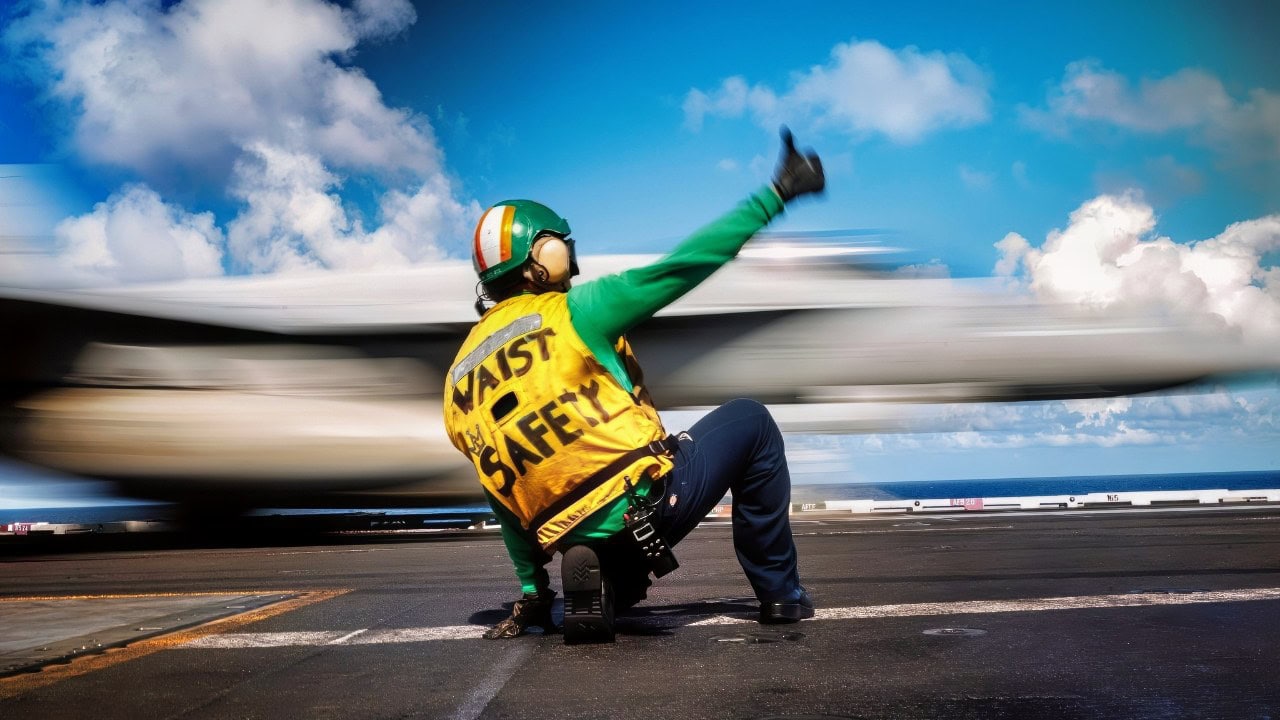
USS Gerald R. Ford Aircraft Carrier or Supercarrier
The USS Gerald R. Ford’s extended deployment has included numerous challenges, such as persistent plumbing and sewage issues, and a March 12 laundry fire that damaged sleeping quarters hosting dozens of crew.
Caudle mentioned that the Ford began flying sorties against Iran again only two days after the fire, saying, “I’m very proud of that crew.” After the fire, the Ford sailed to the Naval Support Activity Souda Bay in Crete for repairs, then on to Croatia.
“She’s gonna be back on station again here soon, on some much-deserved leave,” Caudle added.
CENTCOM Has 16 Warships Still In The Region:
Currently, there are 16 U.S. Navy warships in the U.S. Central Command (CENTCOM) area of operations, including at least two CSGs operating in the region as of late March 2026—the USS Abraham Lincoln (CVN-72) and the USS Gerald R. Ford.
Reports indicated a third carrier, the USS George H.W. Bush (CVN-77), departed Norfolk on March 31 toward the region.
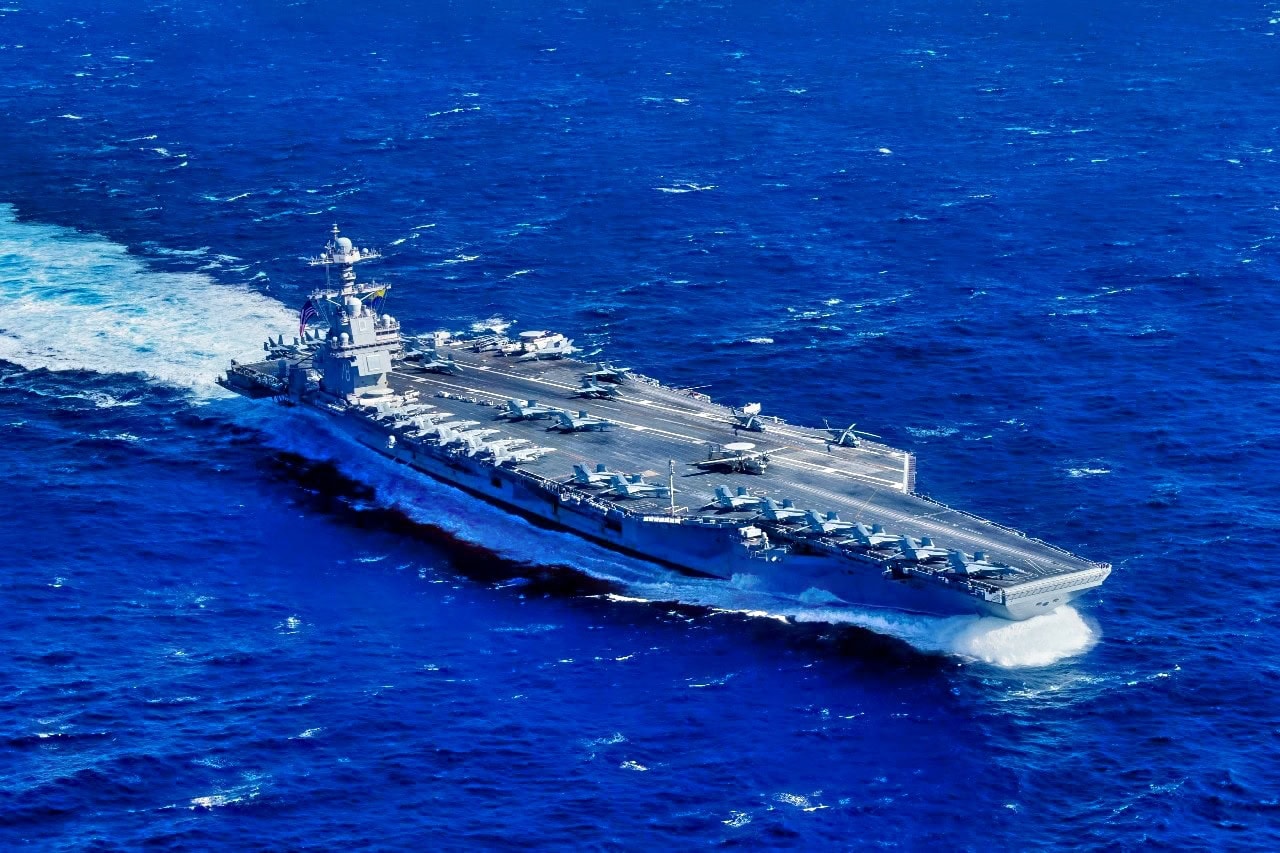
The world’s largest aircraft carrier, USS Gerald R. Ford (CVN 78), sails in formation with the Arleigh Burke-class guided missile destroyers USS Winston Churchill (DDG 81), USS Mitscher (DDG 57), USS Mahan (DDG 72), USS Bainbridge (DDG 96), and USS Forrest Sherman (DDG 98) in the Atlantic Ocean, Nov. 12, 2024. The Gerald R. Ford Carrier Strike Group is underway in the Atlantic Ocean completing Group Sail. Group Sail is the first at-sea integrated phase training event during a routine deployment training cycle. It is designed to challenge the Gerald R. Ford CSG’s ability to use the capabilities of the USS Gerald R. Ford (CVN 78), USS Winston S. Churchill (DDG 81), Carrier Air Wing (CVW) 8, Destroyer Squadron (DESRON) 2, and embarked Information Warfare team as a cohesive Strike Group to meet Navy and Joint Warfighting requirements that increases warfighting capability and tactical proficiency across all domains. (U.S. Navy photo by Mass Communication Specialist 2nd Class Maxwell Orlosky)
The USS Tripoli (LHA-7) Amphibious Readiness Group, including the 31st Marine Expeditionary Unit, arrived in the CENTCOM area of responsibility by March 27.
The forces currently in the Middle East include more than a dozen Arleigh Burke-class guided-missile destroyers and littoral combat ships. These vessels are arrayed in the Persian Gulf and Arabian Sea.
Long Sea Deployments Hurt Readiness, Maintenance, And Morale:
Long naval deployments may strain sailors’ morale and harm retention and well-being. They also lead to increased material readiness issues (faster wear and tear, larger maintenance backlogs) and significant disruption to meticulously planned ship maintenance and workforce schedules. This may create a detrimental cycle of crisis and remediation, impacting overall fleet readiness.
Extended time away from family increases stress, which can affect mental health and discourage re-enlistment. Engaging in combat operations during a long deployment adds more stress to an already tired crew.
Research shows longer deployments correlate with adverse health and mental health effects, as noted by the National Institutes of Health.
Pushing ships harder than planned also stresses the maintenance workforce and disrupts the balance of available personnel.
The Ford’s long 11-month deployment would mark one of the longest carrier deployments since the end of the Vietnam War. The USS Nimitz (CVN-68) spent 341 days at sea in 2021 during the pandemic. Prior to that, the USS Abraham Lincoln was at sea for 294 days between 2019 and 2020.
Effects Of Extended Deployments on Ships And Readiness for USS Gerald R. Ford
Long, extended deployments often accelerate wear and tear on operating systems and equipment. Operating ships beyond their planned cycles leads to faster deterioration and more unexpected breakdowns.
Maintenance backlogs pile up. Critical components need unexpected repairs, increasing the maintenance workload and delaying return-to-service dates.
Extended deployments disrupt planned maintenance periods, affecting the readiness of the entire fleet rather than just the deployed ship. In the case of the USS Ford’s extended deployment, it doesn’t just affect the carrier; it affects the entire CSG. All ships will suffer from the lack of maintenance due to downtime.
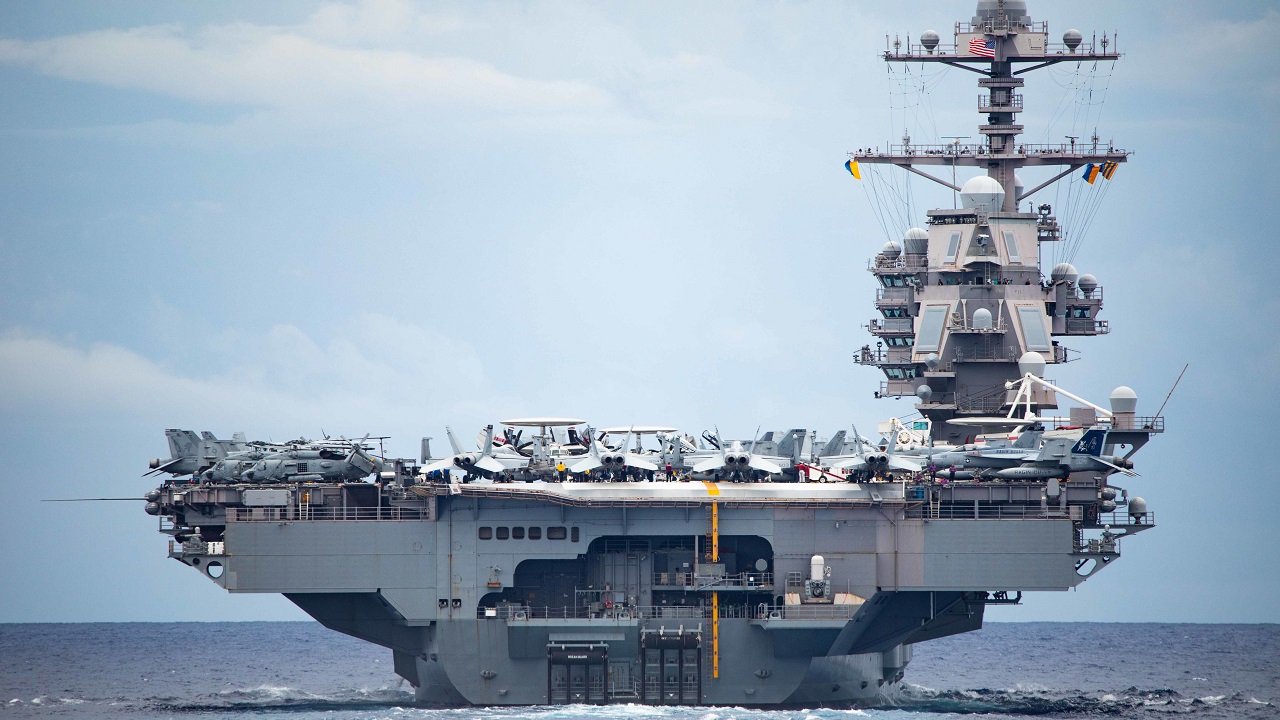
A view of the first-in-class aircraft carrier USS Gerald R. Ford (CVN 78) from aboard the Ticonderoga-class guided-missile cruiser USS Normandy (CG 60) as Normandy participates in a Tactical Force Exercise as part of the Gerald R. Ford Carrier Strike Group, Oct. 13, 2022. Ford is on its inaugural deployment conducting training and operations alongside NATO Allies and partners to enhance integration for future operations and demonstrate the U.S. Navy’s commitment to a peaceful, stable and conflict-free Atlantic region. (U.S. Navy photo by Mass Communication Specialist 2nd Class Malachi Lakey)
Strategic And Operational Concerns:
As the Rand Corporation reports, “Similar solutions with similar problems arise for nearly all elements of readiness, creating a spiral that becomes increasingly difficult to reverse. The impacts can rapidly cascade into persistent problems for force development, threatening the Navy’s ability to meet projected wartime surge needs.”
While necessary for global commitments, these disruptions challenge the Navy’s ability to sustain forward presence and meet wartime surge needs.
The Navy thus faces a difficult trade-off between immediate mission demands and long-term fleet health, crew sustainability, and maintenance capacity—with serious consequences for overall readiness.
Navy Sending The USS George H.W. Bush (CVN-77) To The Gulf?
The George H.W. Bush departed its homeport in Virginia this week to begin operations for its scheduled deployment as the United States weighs a potential ground offensive against Iran.
The carrier left Naval Station Norfolk on Tuesday, the Navy said in a statement. Its CSG includes Carrier Air Wing 7 and more than 5,000 sailors and military personnel, according to the service.
Addressing the assembled media at the pier, Carrier Strike Group 10 commander Rear Admiral Alexis Walker was elusive in answering whether the ship was indeed headed to the Middle East.
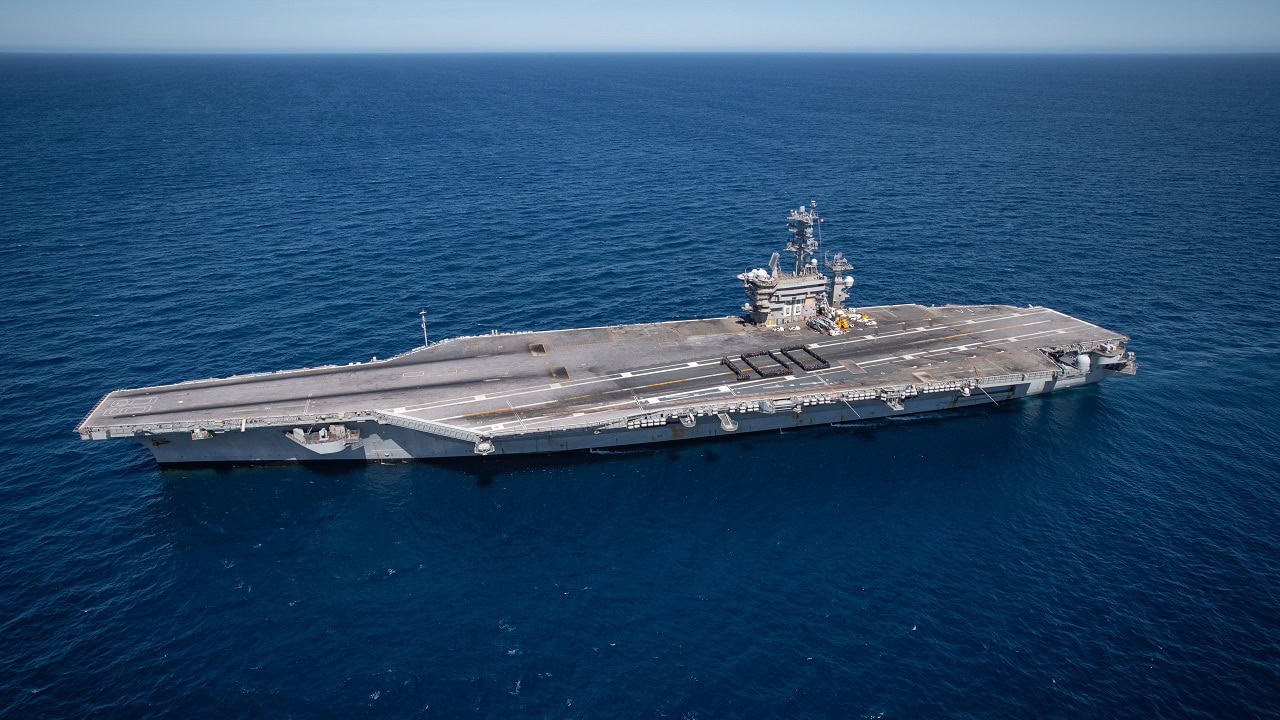
(Mar. 12, 2022) Sailors aboard USS Nimitz (CVN 68) assemble on the flight deck and form a human ‘100’ to commemorate the centennial of the aircraft carrier. On March 20, 1922 the former USS Jupiter (Collier #3) recommissioned as the USS Langley (CV 1), the U. S. Navy’s first aircraft carrier. One hundred years later, Nimitz and Ford-class aircraft carriers are the cornerstone of the Navy’s ability to maintain sea control and project power ashore. Nimitz is the first in its class and the oldest commissioned aircraft carrier afloat., carrying with it a legacy of innovation, evolution and dominance. Nimitz is underway in the 3rd Fleet Area of Operations. (U.S. Navy photo by Mass Communication Specialist 3rd Class Elliot Schaudt)
“There is a published length of deployment, but who knows how long it’s going to take, and when our job is done around the world, then we’ll come home,” he said.
The Bush commander, Captain Robert Bibeau, said, “I use the firefighter analogy. If you call the fire station and ask the firefighters where the fire will be tomorrow, they don’t know. But they do know that they’re ready, they want to be there, and they’re going to solve the problem.”
The carrier is being deployed with its strike group, including guided-missile destroyers USS Mason (DDG-87), USS Donald Cook (DDG-75), and USS Ross (DDG-71).
“We do know where we’re going, but as always, we will go where the nation needs us,” Walker said. “Depending on what pops up in the world, we’ll be responsive and flexible and ready to go wherever we’re needed.”
About the Author: Steve Balestrieri
Steve Balestrieri is a National Security Columnist. He served as a US Army Special Forces NCO and Warrant Officer. In addition to writing on defense, he covers the NFL for PatsFans.com and is a member of the Pro Football Writers of America (PFWA). His work was regularly featured in many military publications.