EMALS: The Ford-class Aircraft Carrier Just Might Be the Best on Earth
The Electromagnetic Aircraft Launch System, also known as EMALS, pioneered by the Gerald R. Ford-class aircraft carriers, has been both a promise-filled and controversial aircraft launching system.
Though it has promised to greatly improve sortie rates for American aircraft carriers — some have called it a technological shift in carrier-based combat aviation — the system has experienced significant teething issues.
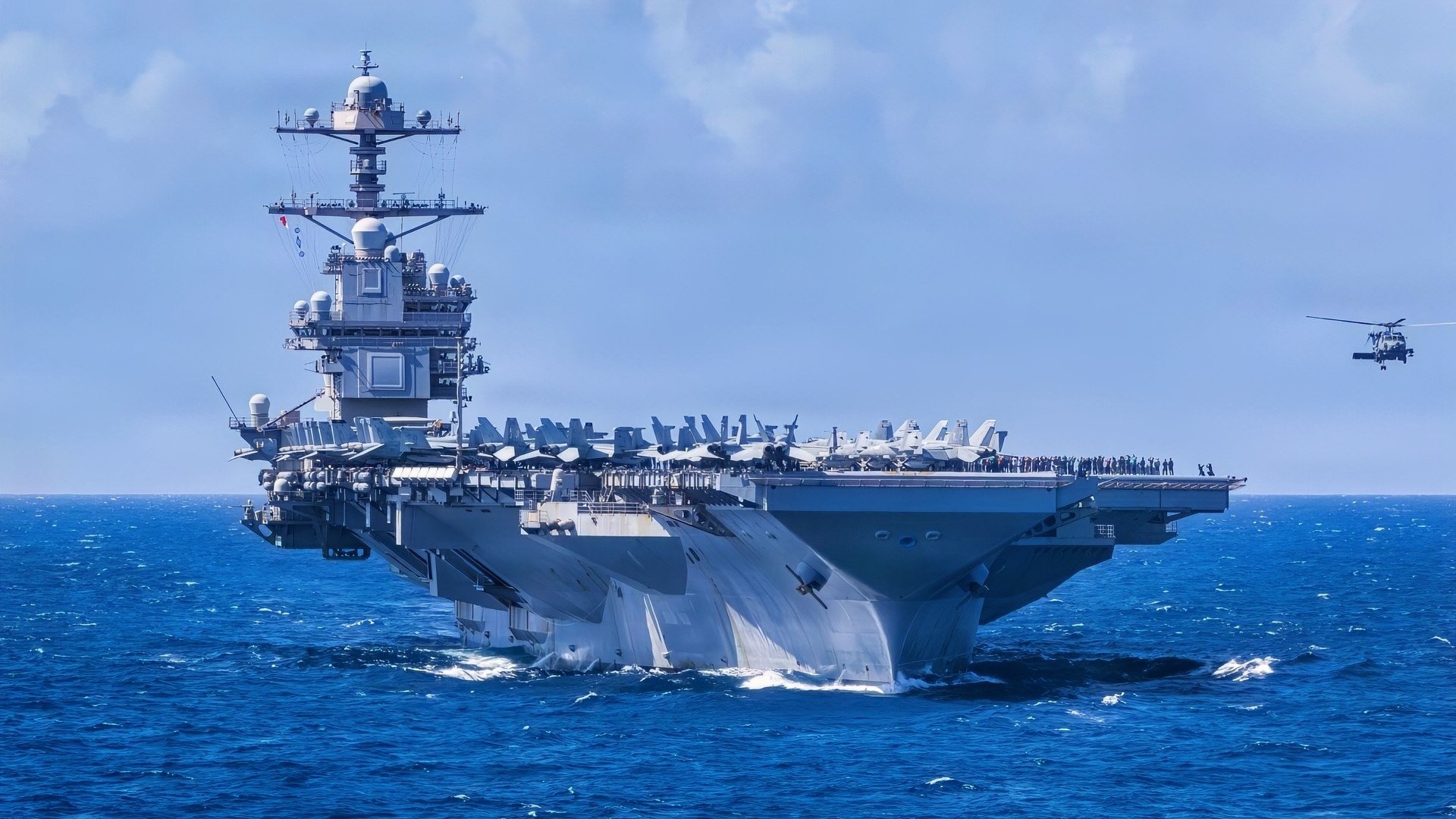
U.S. Navy Carrier Air Wing 8 aircraft fly in formation over the world’s largest aircraft carrier, Ford-class aircraft carrier USS Gerald R. Ford (CVN 78), during Carrier Air Wing 8’s aerial change of command ceremony while underway in the Caribbean Sea, Jan. 19, 2026. U.S. military forces are deployed to the Caribbean in support of the U.S. Southern Command mission, Department of War-directed operations, and the president’s priorities to disrupt illicit drug trafficking and protect the homeland. (U.S. Navy photo)
Traditional aircraft launch systems have relied on steam pressure generated via heat siphoned from the carrier’s nuclear reactors to drive a piston down a lined track, and in effect, yanking the aircraft forward and off the flight deck into the air.
The allure of the EMALS system was tantalizing to senior Navy officials: it promised to fundamentally change how aircraft took off from aircraft carriers, with technology rooted in pre-Second World War technology.
EMALS: 5 Letters That Transform the Ford-Class Aircraft Carrier
Rather than steam, EMALS used a linear induction motor to launch aircraft, in essence, a long electromagnetic rail system.
EMALS operates by generating electrical energy from the ship’s nuclear reactors, which is stored via motor generators, flywheels, and capacitors, and then released in a controlled electrical pulse.
A moving electromagnetic field then accelerates a shuttle attached to the flight deck, which, in turn, is attached to naval fighters.
One of the great advantages offered by EMALS was a reduction of wear and tear on fighter aircraft. Instead of aircraft launching off the deck with a single, full-steam-ahead push from the steam-powered system EMALS replaces, aircraft could be more slowly accelerated to maximum speed before launching.
In essence, traditional steam catapults are all-or-nothing systems that lack the fine-tuned control offered by EMALS. By attuning EMALS launches to different aircraft — even to different combat weights, depending on weapon loadout and amount of fuel carried — aircraft service lives can be extended.
Launch overload was a real danger with steam launch, particularly with lighter aircraft. EMALS, crucially, avoids aircraft overload.
Steam catapults that the U.S. Navy has relied on for decades struggle with the extreme sides of launches. For relatively small and light-weight UAVs or other light aircraft, launches could be singularly violent events.
Conversely, particularly heavy or burned aircraft could, in some circumstances, struggle to take off. Cognizant of the technological limitations of steam technology, the Navy opted to lean into electromagnetic aircraft launches with EMALS.
In the future, EMALS can seamlessly operate with a variety of aircraft across different flight weights. Very light-weight drones, heavily burdened strike aircraft, and future aircraft, like the U.S. Navy’s upcoming F/A-XX sixth-generation fighter, could all be compatible with EMALS.
In theory, the system offers a faster sortie generation rate. To start with, EMALS eliminates the need to build up and manage high steam pressure.
And without the need to generate steam power, the rest of the large mechanical systems necessary to harness it are also eliminated. In theory, at least, EMALS offers mechanical simplicity and increased reliability.
But the name of the game while launching and recovering aircraft while at sea is speed. EMALS offers faster reset between aircraft launches and potentially higher sortie rates — both of which contribute to enhanced combat power. More aircraft in the air, and more often.
Futureproofing
A crucial aspect of the new Ford-class carriers is their electric generation capacity — and the Ford is designed around electrical power rather than steam generation.
Part of that benefit is tangential — less internal space taken up by steam generation equipment, more space for other carrier subsystems — but more directly, the Ford’s electric generation capacity, in essence, future-proofs the carrier for future technologies.
Though still in development, the U.S. Navy has invested significant time and resources in next-generation directed-energy (laser) weapons.
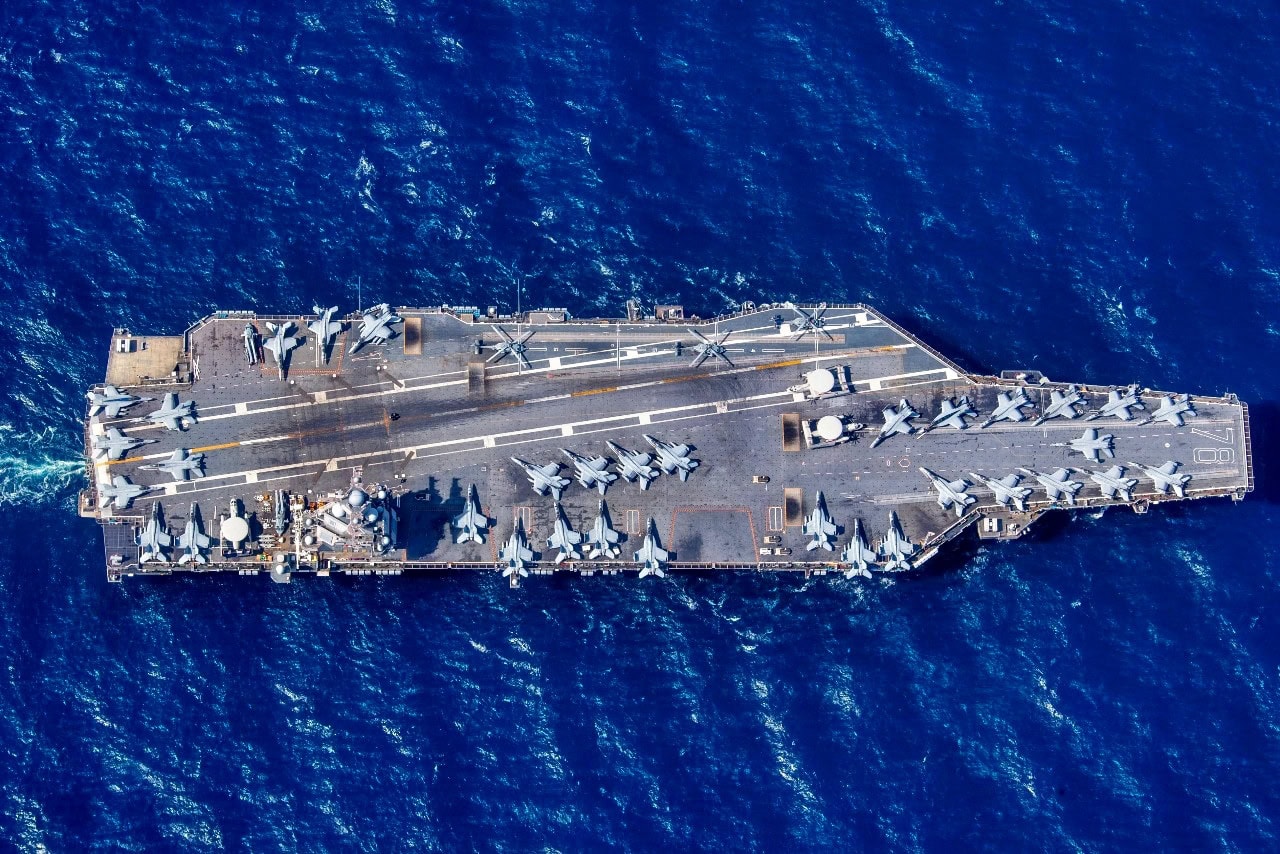
The first-in-class aircraft carrier USS Gerald R. Ford (CVN 78) transits the Atlantic Ocean, March 19, 2023. Ford is underway in the Atlantic Ocean executing its Composite Training Unit Exercise (COMPTUEX), an intense, multi-week exercise designed to fully integrate a carrier strike group as a cohesive, multi-mission fighting force and to test their ability to carry out sustained combat operations from the sea. As the first-in-class ship of Ford-class aircraft carriers, CVN 78 represents a generational leap in the U.S. Navy’s capacity to project power on a global scale. (U.S. Navy photo by Mass Communication Specialist 2nd Class Jackson Adkins)
With war raging in the Middle East and in Ukraine, the question of air interceptor development and production arises. Slow to manufacture and quick to expend, air interceptors are also expensive. Laser weapons could change that calculus, however.
Aircraft carriers’ nuclear reactors can generate near-limitless energy, offering carriers an almost-infinite magazine capacity. Directed defensively, at incoming missiles or warplanes, laser weapons have the potential to greatly enhance carrier defense — if the technology can mature affordably.
Teething Issues
Though the EMALS system has already been installed on the USS Ford, the lead carrier of the Ford-class, it faced significant teething issues, with reliability one significant obstacle. Hundreds of launch failures occurred during testing, and overall reliability was just a small fraction of what it should have been.
Part of the EMALS issues stemmed from installing the system on the Ford before it had completed extensive land trials. Delays and cost overruns caused by retrofits were extensive.
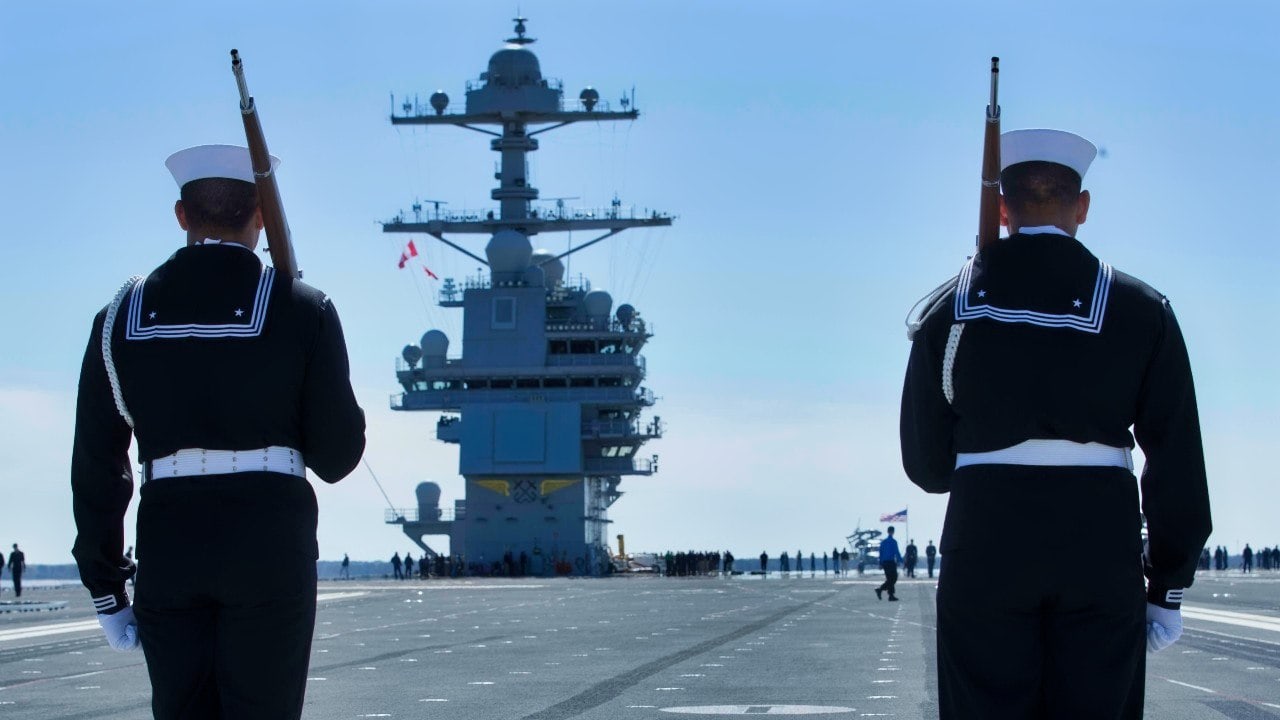
(April 8, 2017) — Logistics Specialist 3rd Class Miguel Monduy, from Miami, Florida, and Aviation Ordnanceman Airman Michael Valdez, from Pheonix, Arizona, assigned to Pre-Commissioning Unit Gerald R. Ford (CVN 78), stand on the flight deck for shifting colors. The future USS Gerald R. Ford (CVN 78) is underway on its own power for the first time. The first-of-class ship — the first new U.S. aircraft carrier design in 40 years — will spend several days conducting builder’s sea trials, a comprehensive test of many of the ship’s key systems and technologies. (U.S. Navy photo by Mass Communication Specialist Seaman Gitte Schirrmacher)
Performance has improved over time, and recent deployments highlight that thousands of successful launches are now the norm.
However, achieving the desired reliability targets might not occur until sometime next decade. High-risk, but high-payoff, it seems likely that EMALS will permanently change U.S. Navy aviation.
MORE – Russia Has Built 30 Su-57 Stealth Fighters: The F-35 is 1,300 Strong and Adding More by the Day
MORE – The U.S. Navy’s New $15,000,000,000 Columbia-Class Nuclear Submarine Is Way Behind Schedule
About the Author: Caleb Larson
Caleb Larson is an American multiformat journalist based in Berlin, Germany. His work covers the intersection of conflict and society, focusing on American foreign policy and European security. He has reported from Germany, Russia, and the United States. Most recently, he covered the war in Ukraine, reporting extensively on the war’s shifting battle lines from Donbas and writing on the war’s civilian and humanitarian toll. Previously, he worked as a Defense Reporter for POLITICO Europe. You can follow his latest work on X.