
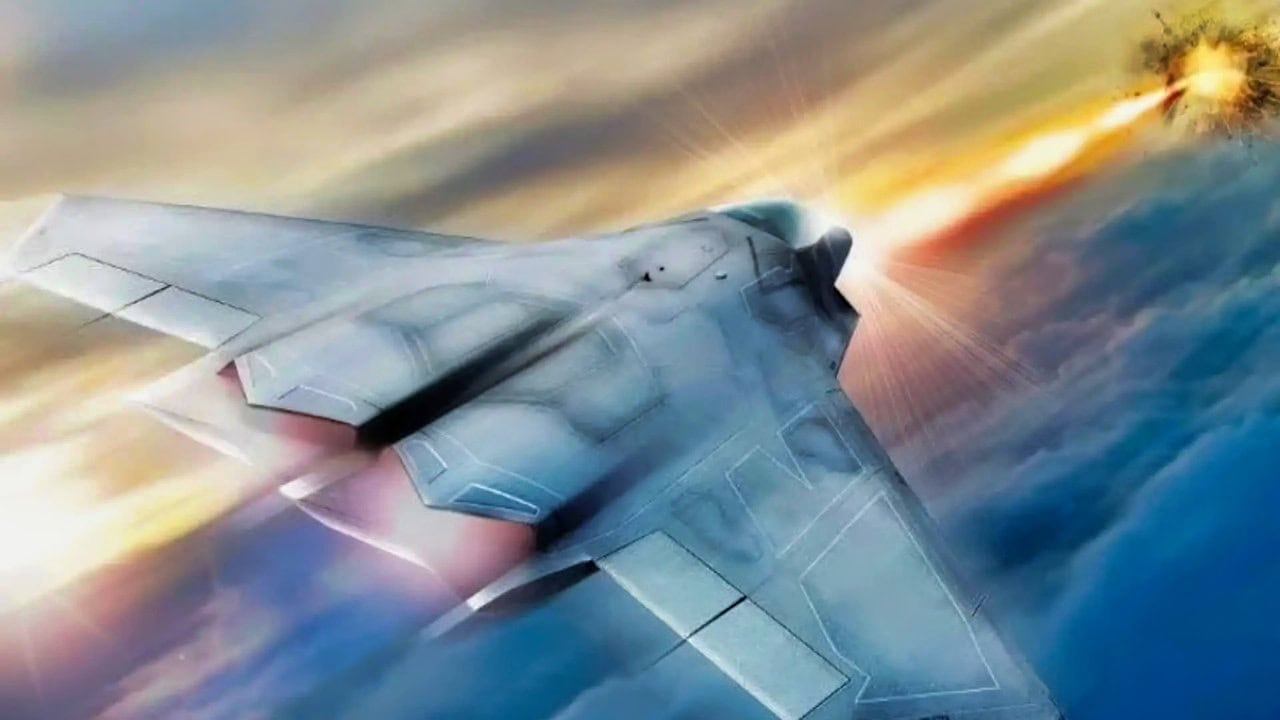
Summary and Key Points: Brent M. Eastwood — PhD, former U.S. Army Infantry officer, author of over 3,000 defense articles, former legislative fellow to Senator Tim Scott, and past professor at American University and George Washington University — reports that House Armed Services Committee tactical air subcommittee chair Representative Rob Wittman has warned the Boeing F-47 Next Generation Air Dominance fighter will not be operationally available until the mid-2030s, despite Air Force claims of a 2028 first flight.
-With China already flying sixth-generation aircraft and Russia developing the MiG-41, the decade-long production timeline forces the U.S. Air Force to bridge with F-22 Raptors and F-35s while the Navy’s F/A-XX program simultaneously awaits a green light to replace the F/A-18E/F Super Hornet.
-Eastwood warns that presidential transitions and shifting Congressional priorities could defund both programs before serial production begins, even as Air Force General Dale White emphasizes a new government-owned reference architecture designed to avoid the cost overruns and schedule delays that plagued the F-35 program.
F-47 and F/A-XX May Not Be Ready Until the Mid-2030s
I remember seeing the Air Force announcement last year that the F-47 NGAD would fly in 2028.
I remarked on X that seemed optimistic and declared that it would likely be 2029 or 2030 before the F-47 would take to the skies for the first time.
Now a U.S. Congressman shares my pessimism. Representative Rob Wittman of Virginia says the new sixth-generation fighter will not be “available” until the mid-2030s.
This is disappointing, as the Pentagon and Air Force were expected to make the F-47 a priority arms system with so much buy-in from President Donald Trump. Indeed, the president announced that the F-47 would be produced by Boeing, to much fanfare, at an Oval Office event last year.
We Are Waiting With Bated Breath
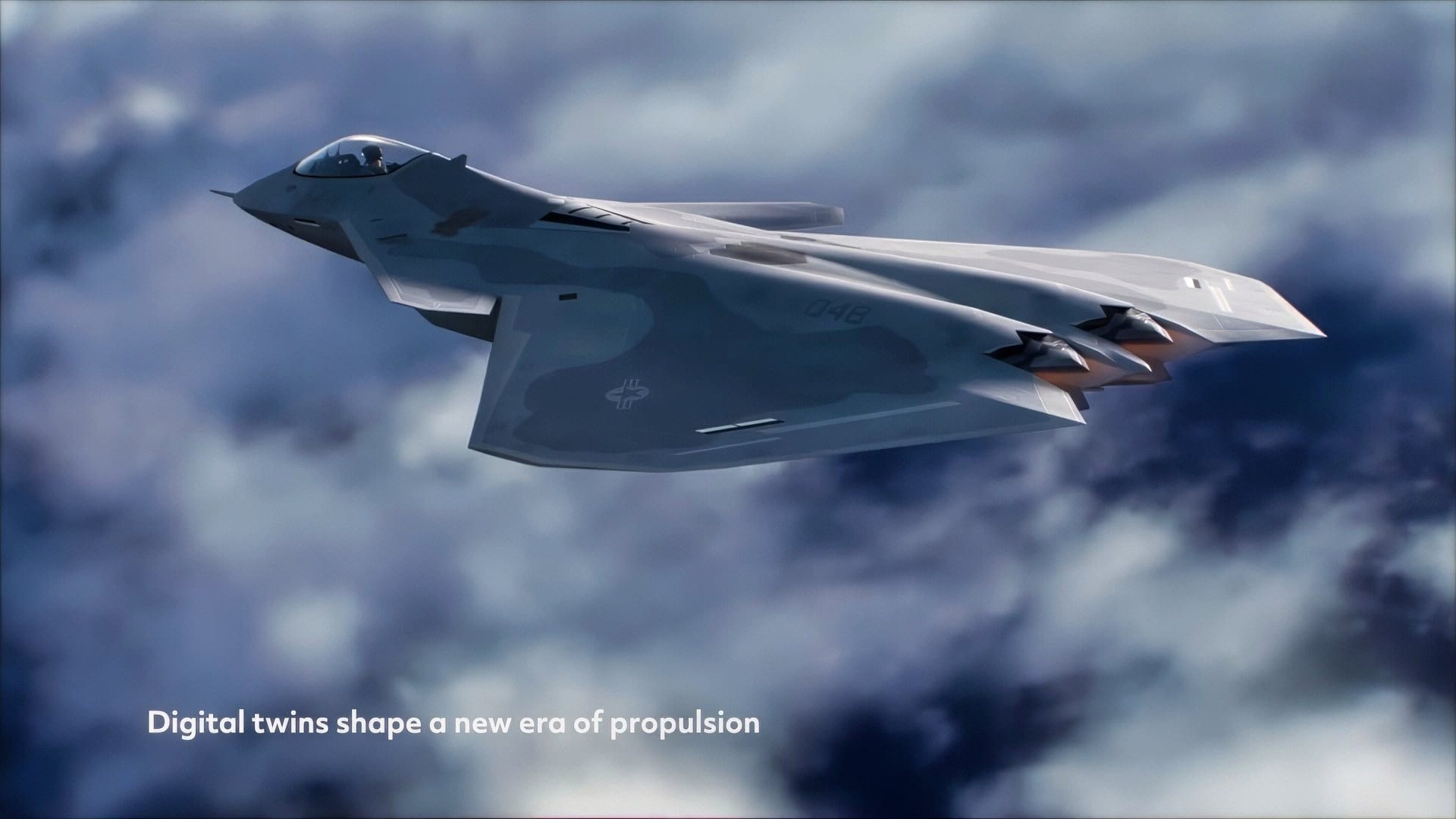
F-47 NGAD Fighter Possible Image. Image Credit: Screenshot.
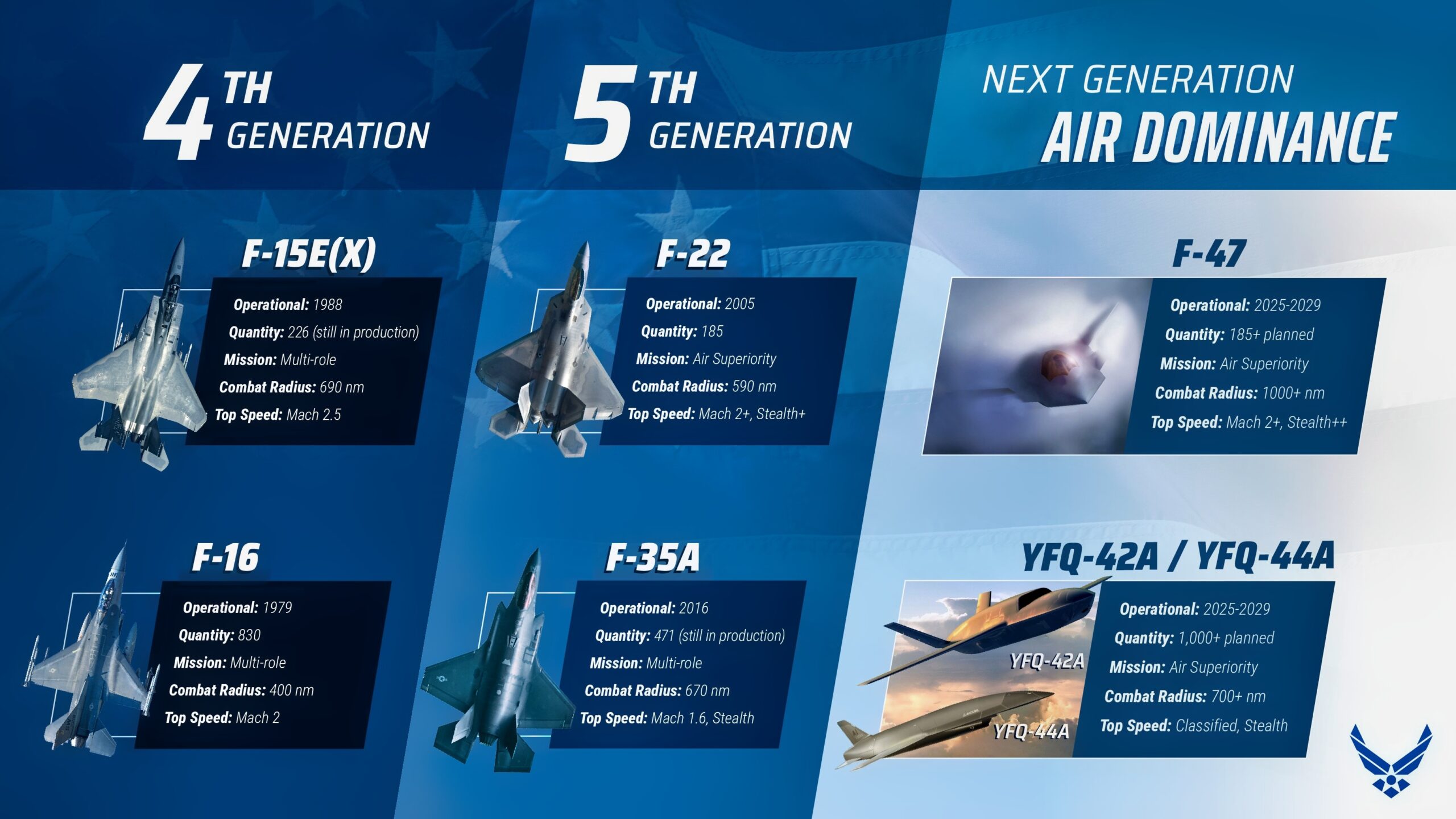
F-47 Infographic. Image Credit: U.S. Air Force
Now, it appears older jets will have to serve as transition aircraft until the F-47 is ready for serial production and active duty.
“The question then becomes, what do we do in the meantime?” Wittman said at the McAleese Defense Programs Conference.
Wittman is chair of the House Armed Services Committee’s tactical air and land forces subcommittee. “We have to maintain a fleet of [Navy] F-18s, and then we have to maintain the F-22 [Raptors]. … That’s the only way we create that bridge to the sixth-generation aircraft,” like the Air Force’s F-47 and the Navy’s planned F/A-XX.
More Information About the Two Airplanes
The F-47 and the proposed F/A-XX will both have ultra-stealth coatings with speeds between MACH 2 and MACH 3.
They will likely have artificial intelligence in the cockpit and serve as flying “supercomputers.” The two next-generation warbirds will also be able to conduct manned-unmanned teaming missions with the Collaborative Combat Aircraft (CCA) drone. This will help the two fighters with intelligence, surveillance, and reconnaissance data collection. The F-47 and F/A-XX will also be able to launch hypersonic weapons.
Transition Will Not Be Easy
Boeing F-47 will replace the aging F-22 Raptor in the middle of the next decade, and the F/A-XX is planned to take over from the F/A-18 E/F Super Hornet if it gets the green light. But this 10-year production cycle is disappointing for an Air Force and Navy that are dealing with Russia and China’s own sixth-generation aircraft, such as the MiG-41 and J-36. China is already flying its sixth-generation airplanes.
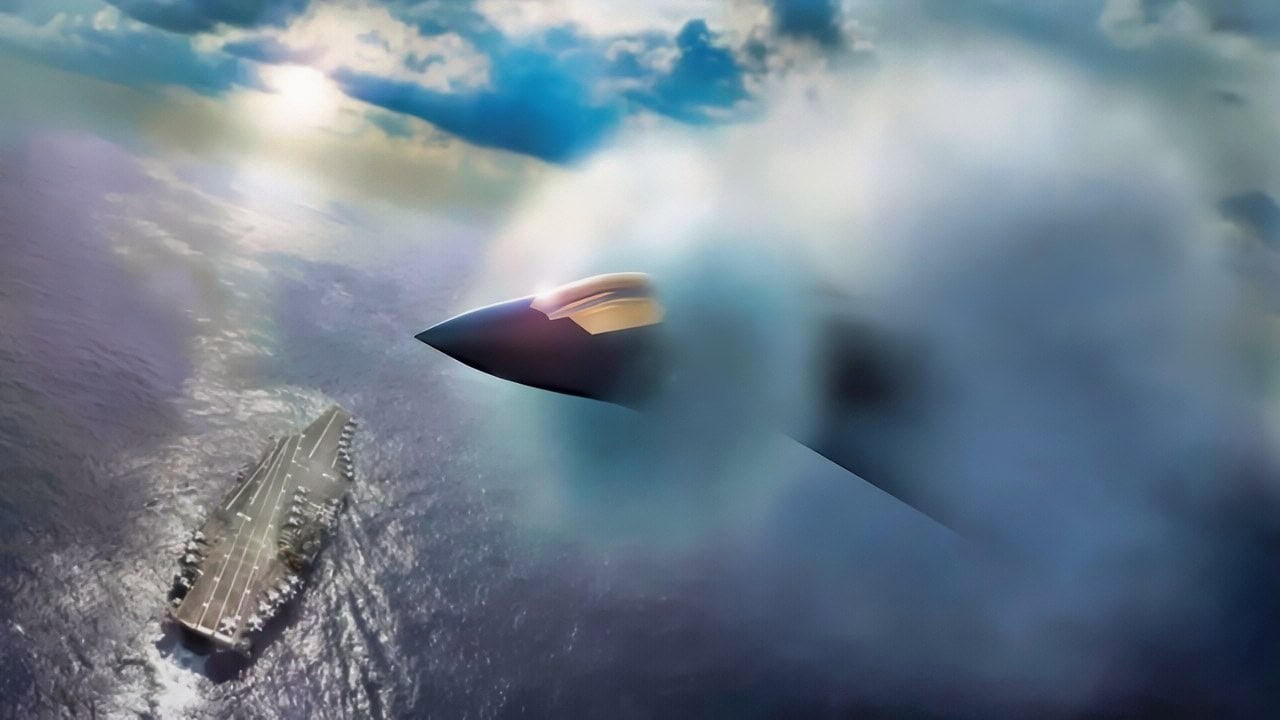
F/A-XX Boeing Image.
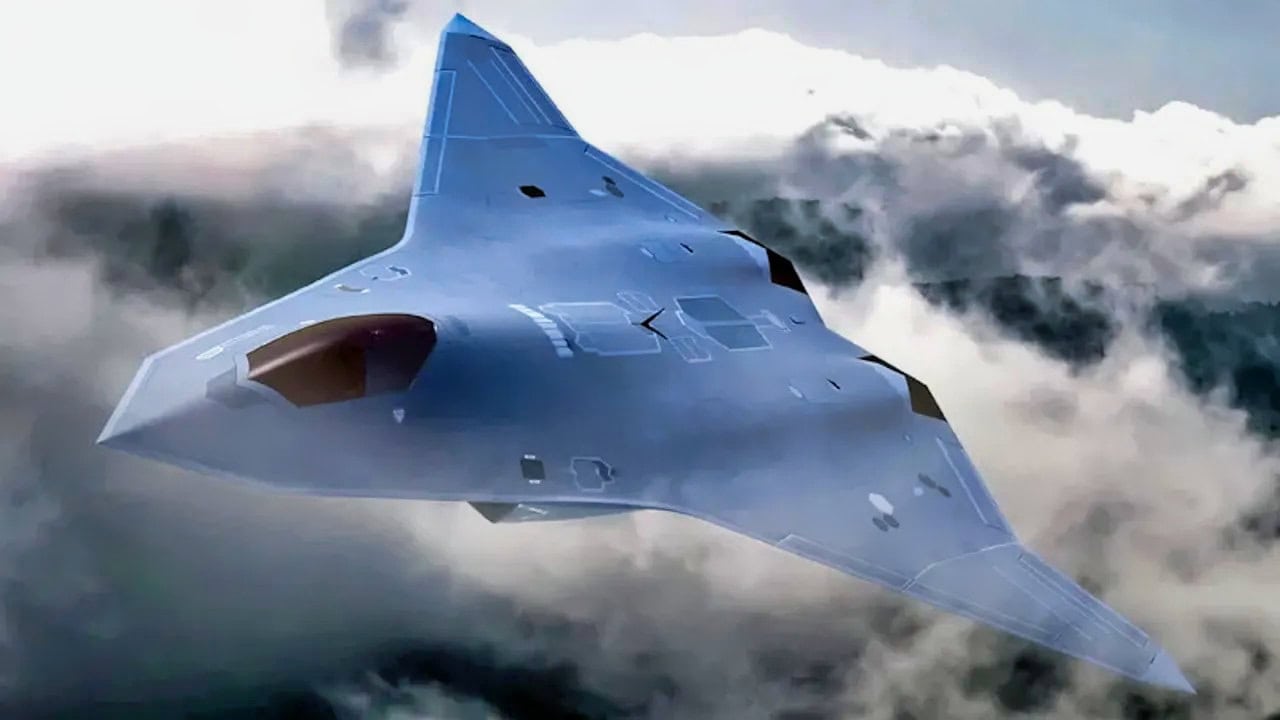
F/A-XX. Image Credit: Creative Commons.
The Air Force still maintains that the F-47 will make its first flight in 2028, but it will take a long time to develop until it’s fully ready. That means the F-22, F-35, and F/A-18 E/F will have to dominate the skies until the NGAD and F/A-XX can pick up the torch.
So Far So Good During War Against Iran
All three of the existing legacy airframes are having a good war in the skies over Iran.
They are making numerous ground strike missions to destroy Iranian air defenses, missile launchers, and missile production facilities. They have dominated the skies, and there have been no reports of difficulties despite the high operational tempo and large number of sorties.
Air Force Wants Us to Be Patient
Air Force General Dale White is the chief of the Direct Reporting Portfolio Manager for Critical Major Weapon Systems. White will be overseeing the F-47’s development. He says the Air Force has a detailed plan to bring NGAD into existence. This will depend greatly on how well the engineering and design teams will work with government priorities.
“We needed to bring the government back into engineering,” White said. “We had outsourced engineering for so long. And so being able to do that, actually have a government reference architecture in partnership with industry … allowed us to have more continuous competition, avoiding vendor lock. But at the same time, we now have a contract by which we can evolve capability.”
Getting the Department of Defense to Work with Industry Better
One aspect of the F-47 program will be the ownership of critical mission architecture. The Pentagon wants to avoid the delays and cost overruns that plagued the F-35. The NGAD project will include government-owned architecture rather than relying solely on defense contractors to provide development data to inform lawmakers and the Department of Defense.
As Air and Space Forces noted, “Industry’s cooperation was critical to building the foundation needed to define the F-47’s government reference architecture,” White said. “And that architecture can be used by other programs, he said, including other services’ systems.”
“That’s going to be the foundation of our future,” White said. “The architecture we use on CCA, we use on F-47, [and] the other services are leveraging it. So, you’re going to see more of it.”
The Fighter Jet Gap
That’s all fine and should keep schedule slips and cost overruns from happening, but could there be a fighter jet gap with Russia and China?

J-XX From China. Image Credit: Social Media Screenshot.
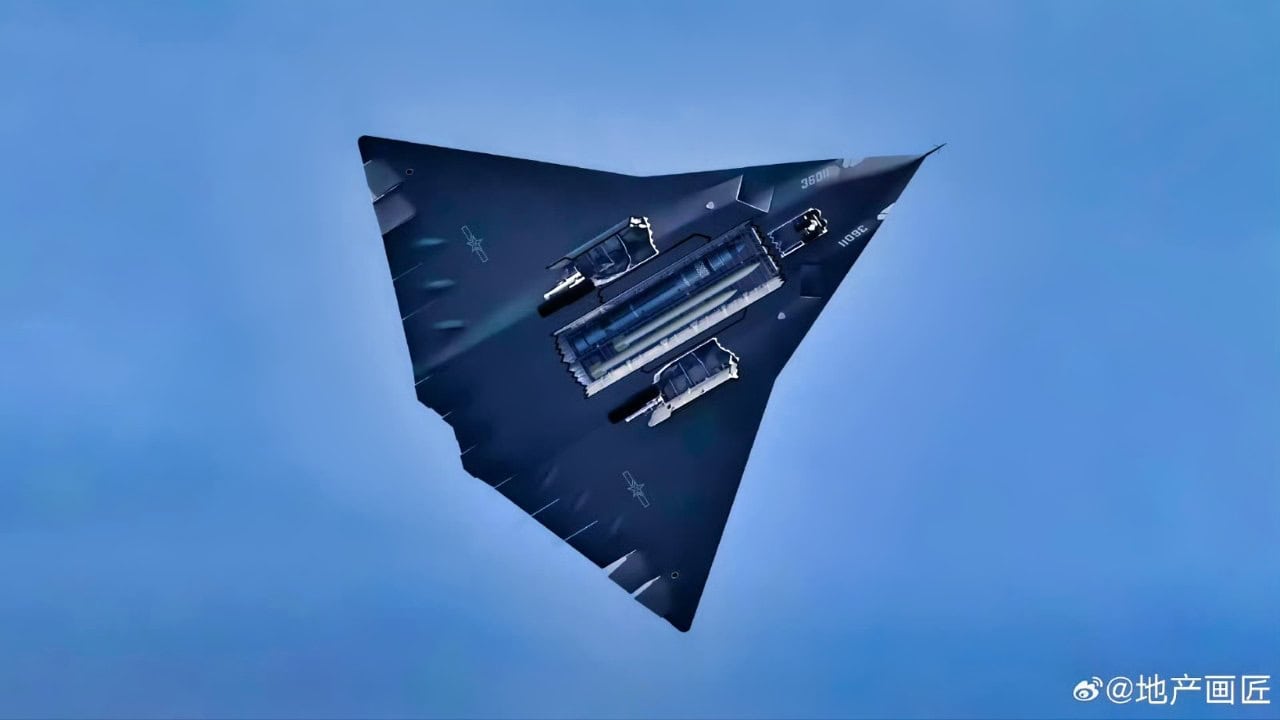
J-36 or JH-XX from China. Screenshot for Chinese Social Media.
A quicker transition to sixth-generation flight is badly needed to keep up with these new airplanes developed by Moscow and Beijing. It seems the United States is falling behind. The CCA program is on track, as are some hypersonic weapons, but the design of the F-47 and its first flight need to be bumped to a higher priority.
Domestic Political Pressures Could Doom the New Programs
The F-47 and F/A-XX will be exciting airplanes, but the long lead time of about 10 years is disappointing. President Trump will be out of office by then, and Congress could be under different leadership. Budget size is not assured, and the two airplanes could die on the vine before they undergo serial production.
These new programs must have strong oversight from lawmakers on Capitol Hill and government watchdogs to ensure they are on time and under budget.
There is no room for mistakes or delays as Russia and China work on their sixth-generation fighter jet programs, which already appear to be moving more quickly than the F-47 and F/A-XX. It is time for the United States government to refocus its efforts and resources on the two new fighter jet programs before China and Russia leap ahead further.
About the Author: Dr. Brent M. Eastwood
Author of now over 3,000 articles on defense issues, Brent M. Eastwood, PhD is the author of Don’t Turn Your Back On the World: a Conservative Foreign Policy and Humans, Machines, and Data: Future Trends in Warfare plus two other books. Brent was the founder and CEO of a tech firm that predicted world events using artificial intelligence. He served as a legislative fellow for US Senator Tim Scott and advised the senator on defense and foreign policy issues. He has taught at American University, George Washington University, and George Mason University. Brent is a former US Army Infantry officer. He can be followed on X @BMEastwood.