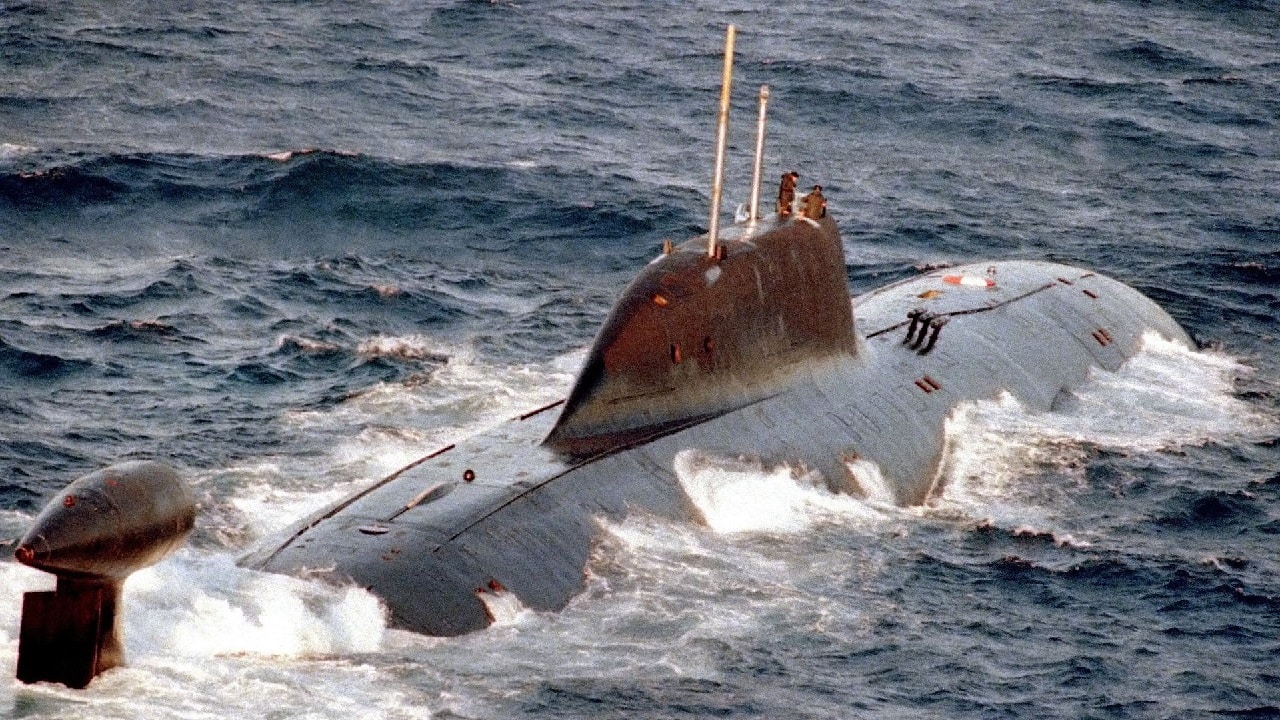
A Russian Akula-Class Submarine Went On a Grand Tour of the Gulf of Mexico In a Very Stealth Way
In 2012, it was a security breach of concerning proportions: one of the Russian Navy’s nuclear-powered attack submarines — armed with long-range missiles — had patrolled in the Gulf of Mexico for several weeks. The real embarrassment for the United States, however, was that the submarine’s presence so close to the American homeland had not been detected until after it left the area.
The submarine in question was thought to be an Akula-class submarine. The Washington Free Beacon was first to report on the incident, and noted that the Russian submarine entered U.S. territorial waters at around the same time that Russian strategic bombers entered American airspace, near Alaska and California, that summer.
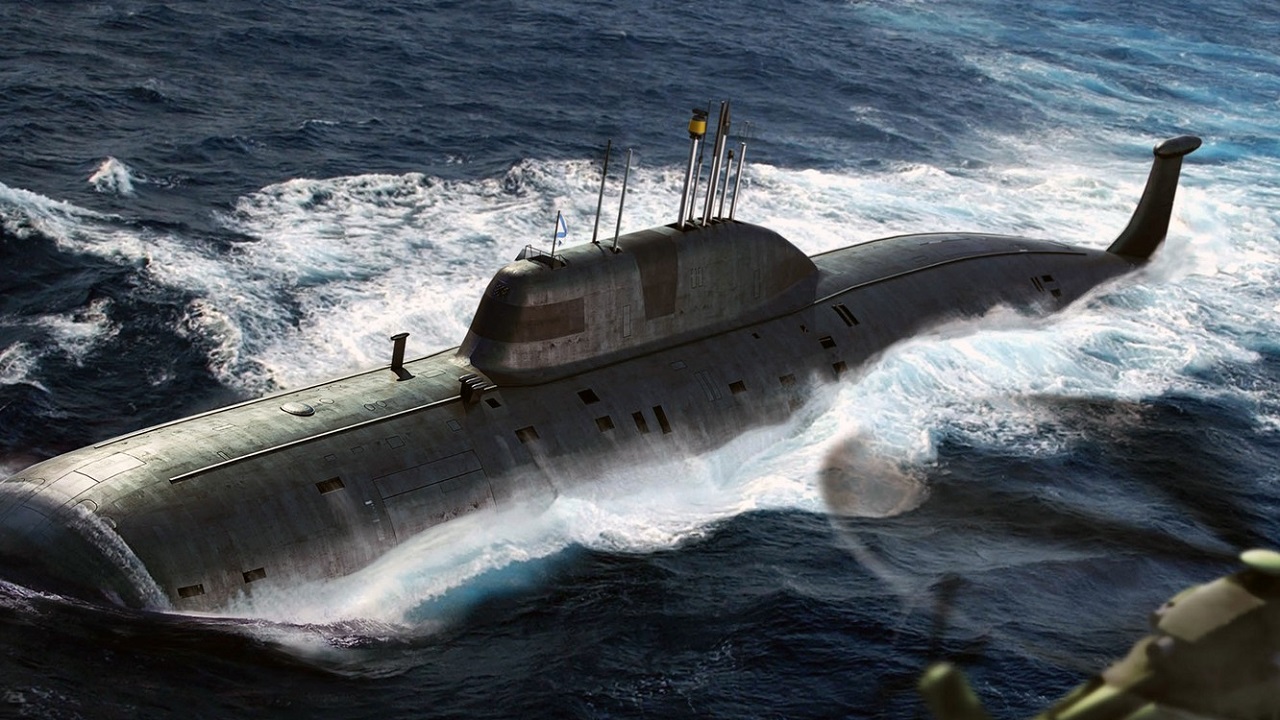
Akula-Class Submarine. Image Credit: Computer Generated Image, Screenshot.
The incidents came at the same time that the Obama administration sought to significantly reduce the Pentagon’s defense budget, part of what was then seen as an opportunity for a reset in relations with the United States.
As part of that attempted reset of relations, the United States ability to conduct anti-submarine warfare had atrophied significantly following the end of the Cold War.
Anti-submarine Warfare
Writing at around the same time, Admiral Jonathan W. Greenert of the United States Navy explained why the Navy’s ASW capabilities had atrophied, and partially explained why some of Russia’s most advanced class of submarines had managed to get so close to the United States.
“Navy missions since the Cold War have evolved to include defeating terrorists, pirates, and illegal traffickers; preparing to counter mines and armed small boats; providing humanitarian assistance/disaster relief; and building partnership capacity to take on maritime-security missions. Those operations show one limitation of a highly integrated luxury-car platform,” the admiral wrote.
“While the ship, aircraft, and crew might flex to new or different missions, it does so at a cost,” the admiral added. “Destroyer crews are challenged to maintain proficiency in core missions such as ASW, SUW, and IAMD when engaged in months-long counterpiracy operations. Amphibious ships are in high demand for counterterrorism and humanitarian-assistance operations and have had limited opportunity to practice amphibious assault. And P-3C crews had their ASW capabilities atrophy after a decade of high-tempo intelligence, surveillance, and reconnaissance operations over land.”
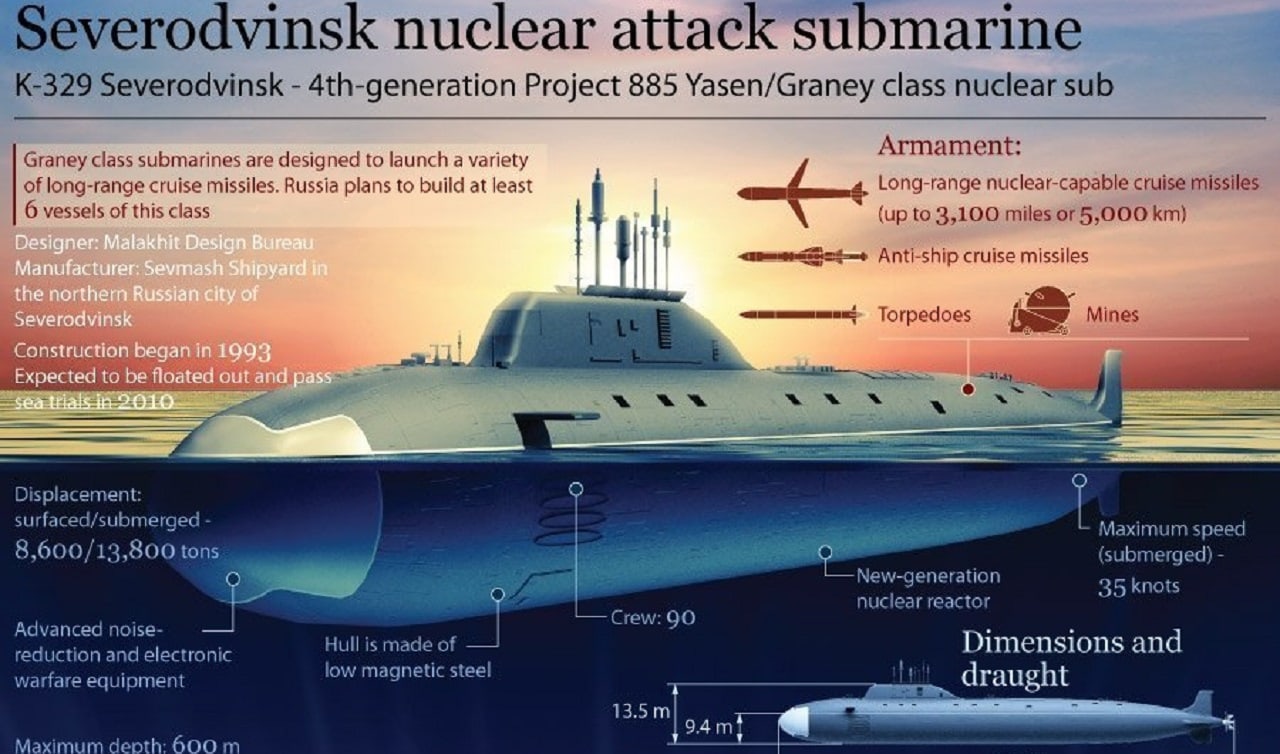
Yasen submarine diagram from Russian state media.
The Akula-class first entered service with the Soviet Navy in the mid-1980s and, since its introduction, has been produced in several variants, each increasingly capable.
“The Akula was built for one reason and one reason only: To kill U.S. Navy ballistic missile submarines and their crews,” a second U.S. official told the Free Beacon. “It’s a very stealthy boat, so it can sneak around and avoid detection and hope to get past any protective screen a boomer might have in place,” the official also said in reference to strategic missile submarines.
It was, however, not the first time that some of Russia’s most advanced submarines had been detected near the United States — two of Russia’s more advanced submarines had also been spotted near the United States just a few years before the
Seen in the Water
A pair of Akula-class submarines had been detected patrolling off the United States East Coast during the summer of 2009.
The incident was one of the first times that Russia had patrolled that close to the continental United States since the end of the Cold War and the collapse of the Soviet Union.
Speaking to The New York Times about the incident, Norman Polmar, a naval historian and expert, said he believed it marked the first time in about 15 years that a pair of nuclear-powered submarines had been stationed that close to the United States.
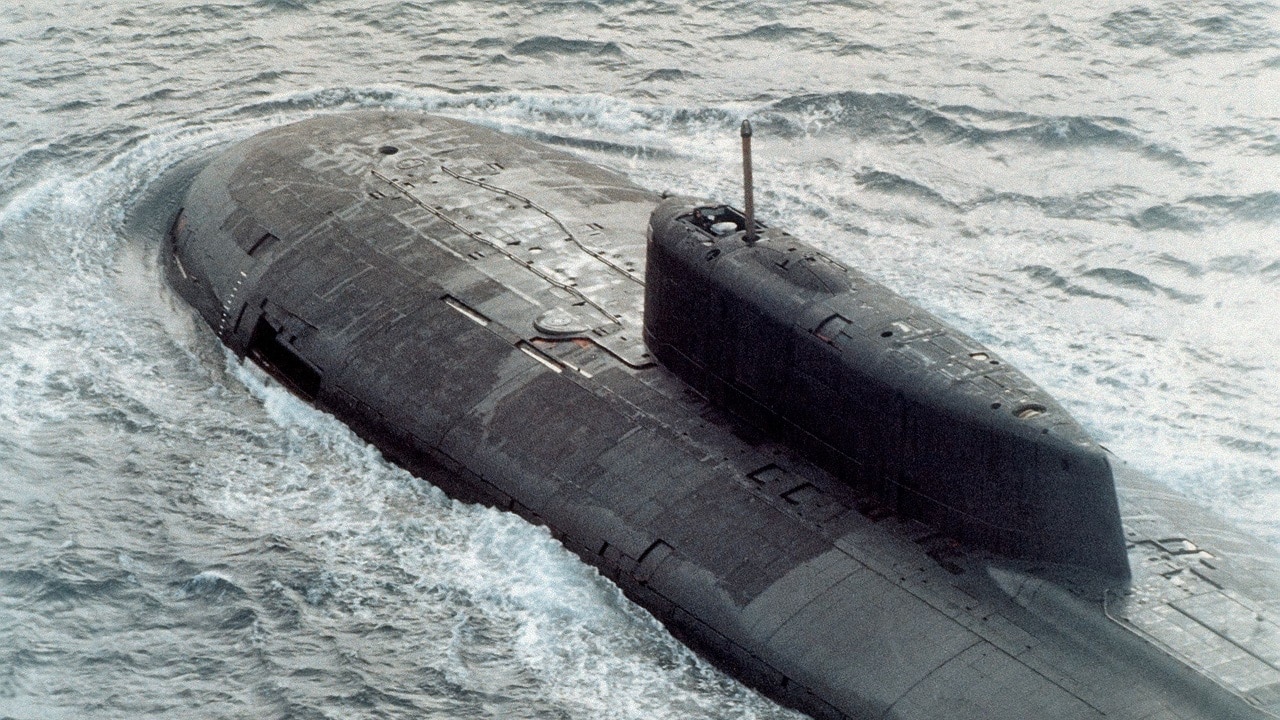
Oscar-class Submarine from Russia.
One of the submarines was thought to be an Akula II-class submarine, an upgraded, quieter variant of the original Akula-class design. The incident came at a difficult time for the Russian Navy.
Just a couple of months before the sighting, the Russian Navy attempted a test launch of the Bulava, a submarine-launched nuclear missile and the sea-based leg of Russia’s nuclear triad.
Although now in service with the Russian Navy, that missile’s development was marred by a number of high-profile test failures, the sixth of which happened in mid-summer of 2009, just a couple of months before the Akulas were tracked off the American East Coast.
Long-range Russian Navy deployments were, at the time, rather unusual and marked a departure from Russia’s post-Soviet defense collapse.
Transitioning from a centrally managed to a market economy had proven particularly difficult for Russia, with many businesses and entire industries captured by a class of oligarchs.
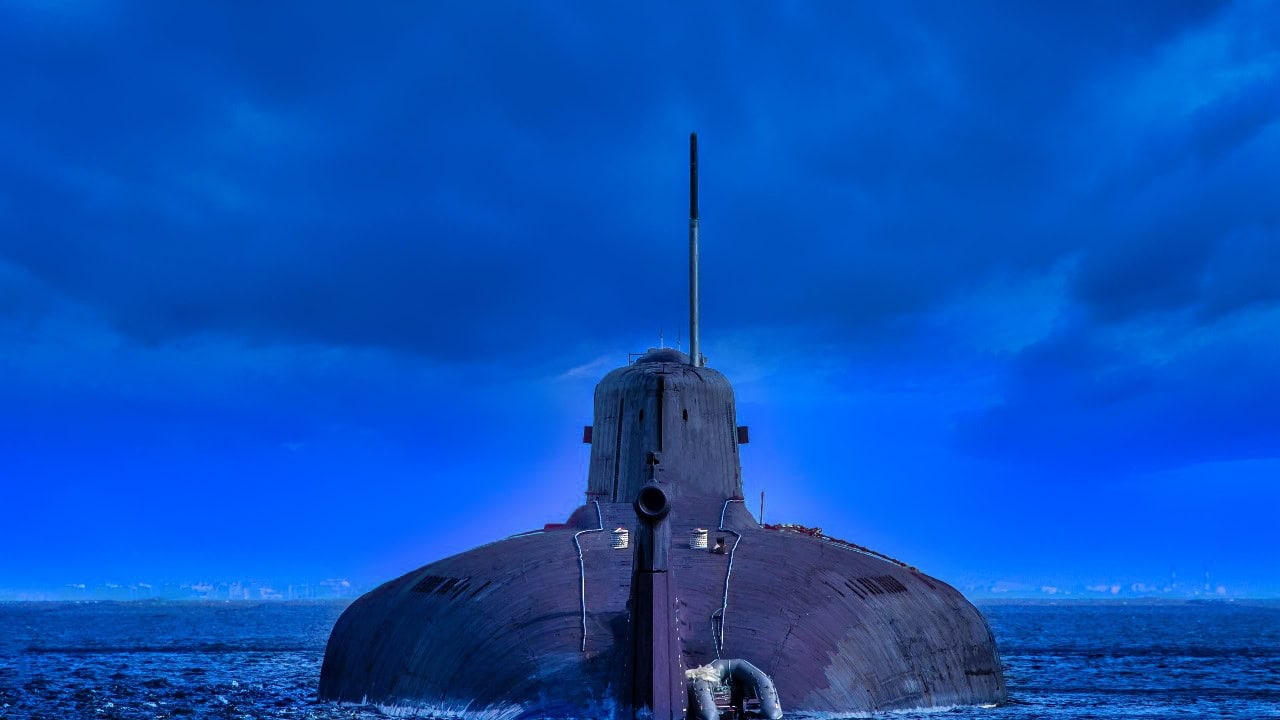
Russian Submarine. Image Credit: Creative Commons.
Precious little capital was available for defense projects, and many high-profile — and highly expensive — platforms sat unfinished for decades following the end of the Cold War.
Today, that script has flipped considerably, with the Russian economy geared toward sustaining its grinding invasion of Ukraine, primarily a land and air campaign. But with the Russian Black Sea Fleet pushed out of the Black Sea, that conflict’s naval component is minimal.
About the Author: Caleb Larson
Caleb Larson is an American multiformat journalist based in Berlin, Germany. His work covers the intersection of conflict and society, focusing on American foreign policy and European security. He has reported from Germany, Russia, and the United States. Most recently, he covered the war in Ukraine, reporting extensively on the war’s shifting battle lines from Donbas and writing on the war’s civilian and humanitarian toll. Previously, he worked as a Defense Reporter for POLITICO Europe. You can follow his latest work on X.