
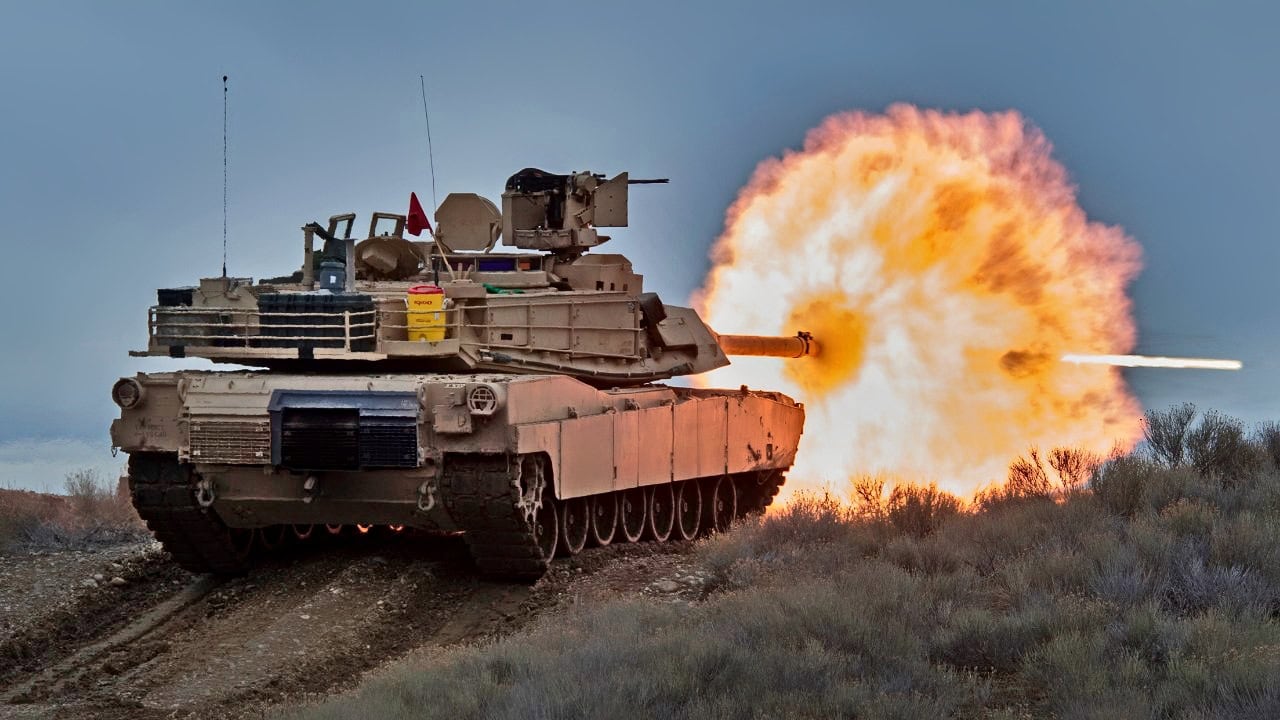
The last time that China and America fought a major ground battle was in the Korean War, almost 75 years ago.
But that Chinese army of poorly equipped peasants, who still came perilously close to ejecting U.S. forces from the Korean peninsula, is long gone. If U.S. troops were to fight the People’s Liberation Army of today, they would encounter a foe that is far more technologically and tactically sophisticated than in 1950.
The PLA’s evolution can be seen in a scenario recently tested by U.S. Army experts: what would happen if a Chinese Heavy Combined Arms Brigade (HCAB) fought a U.S. Army Brigade Combat Team (BCT)? These are roughly equivalent units of about 5,000 soldiers each.
The answer is that the Chinese brigade would use tanks, drones, artillery, missiles, electronic warfare, and aggressive tactics to disrupt and destroy its American counterpart, according to an analysis by the U.S. Army’s Transformation and Training Command (T2COM).
In other words, the Chinese Army would mirror the U.S. Army’s approach. Conduct a joint battle in which a variety of forces would combine to first paralyze the U.S. brigade, and then encircle and destroy the confused and helpless American troops.
When A Chinese Brigade Attacks an American Brigade
Chinese doctrine calls for prepping the battlefield a week before the Chinese heavy brigade begins its attack. Special forces teams would infiltrate American lines and launch small drones to locate the defender’s positions, while artillery, missiles, and commandos would strike U.S. supply dumps, command posts, and artillery positions.
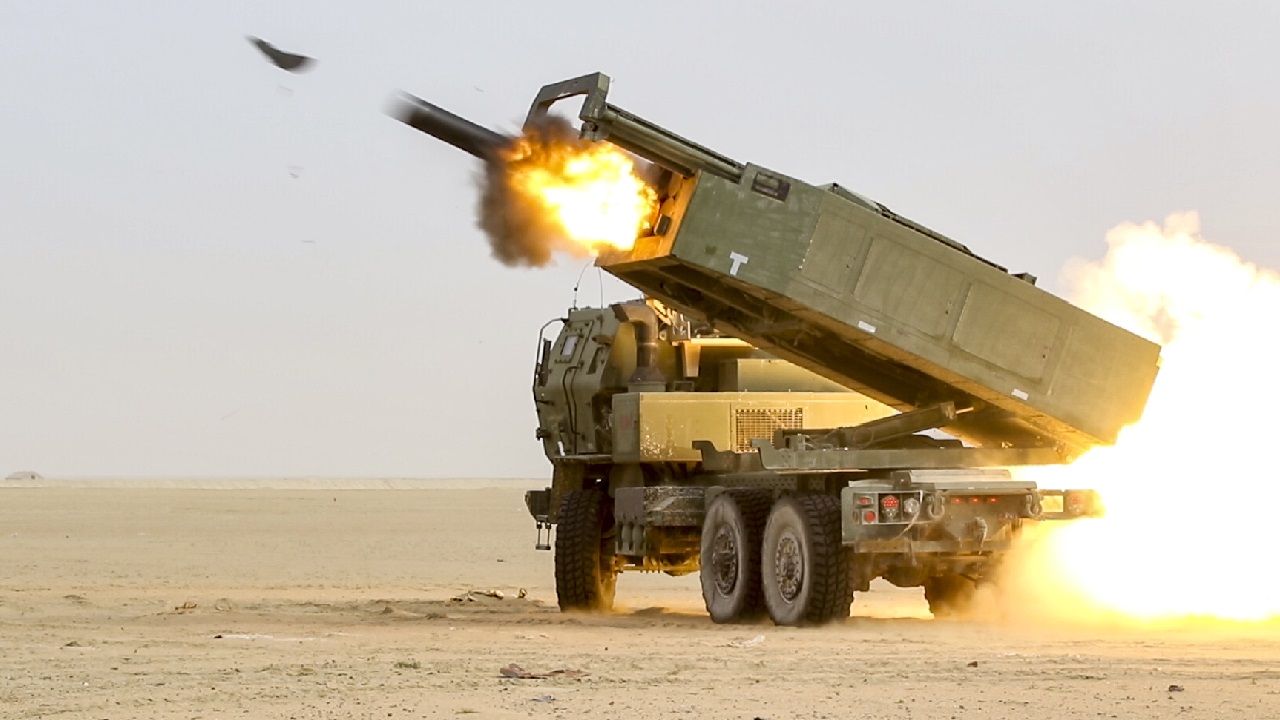
U.S. Soldiers assigned to the 65th Field Artillery Brigade fire a High Mobility Artillery Rocket System (HIMARS) during a joint live-fire exercise with the Kuwait Land Forces, Jan. 8, 2019, near Camp Buehring, Kuwait. The U.S. and Kuwaiti forces train together frequently to maintain a high level of combat readiness and to maintain effective communication between the two forces. (U.S. Army photo by Sgt. Bill Boecker)
H-Hour would mark the start of the ground assault, aimed at destroying the U.S. brigade within 24 hours. The attack would commence with a feint by two or three heavy combined arms battalions, supported by 120-mm mortars, kamikaze drones, air defense weapons, and attack helicopters, and including 30 to 50 Type 96 main battle tanks and Type 04A troop carriers. This force would seek to divert American attention from the real point of attack.
By H + 8, if all goes according to plan, U.S. troops will be pinned down, their artillery suppressed, communications disrupted, and drones neutralized. That’s when the main attack force begins its assault.
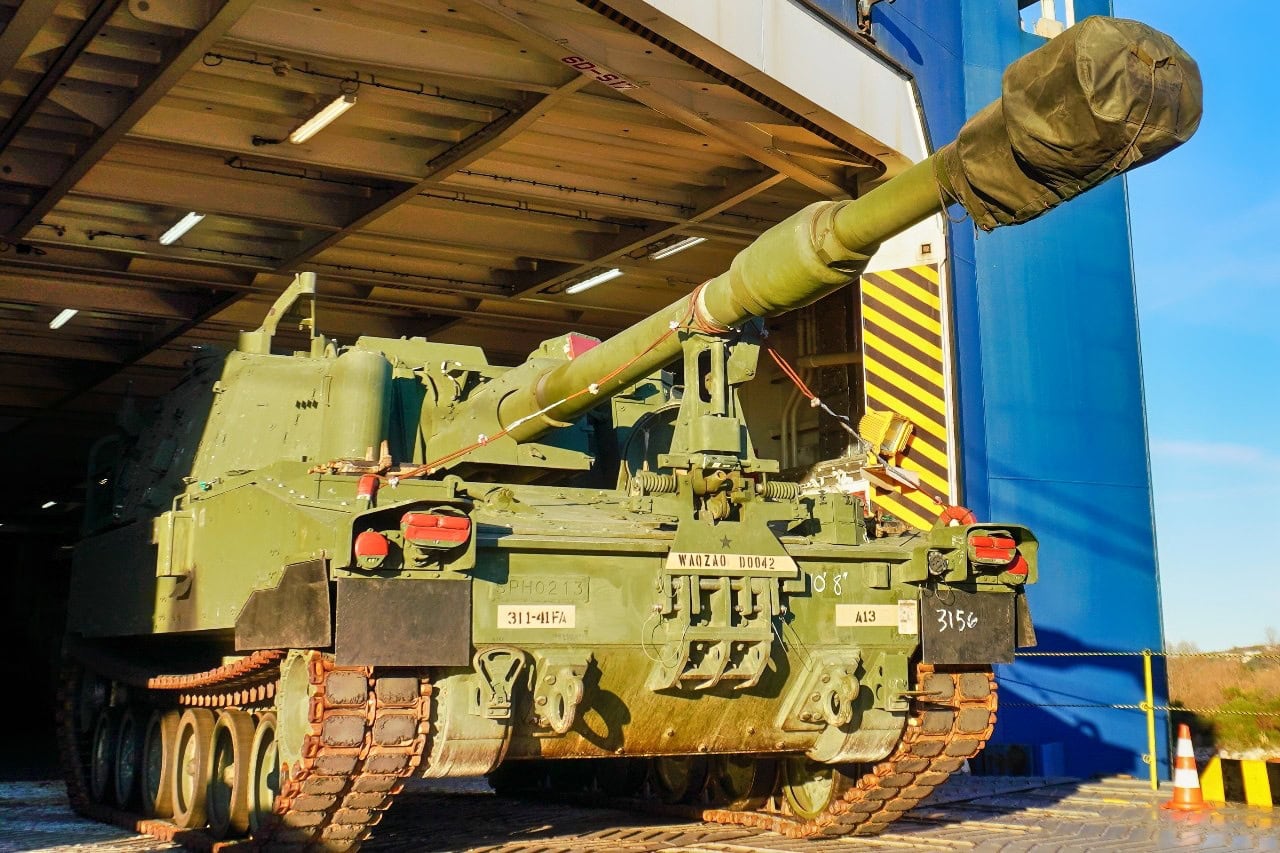
A U.S. M109 Paladin howitzer drives off the vessel Liberty Peace during offloading operations at the port of Koper, Slovenia on December 28, 2024. This Reception, Staging, and Onward Movement (RSOM) operation in the port of Koper is bringing in 1-3ID, the next Regionally Aligned Force (RAF), into the European Theater. These forces will be then transported by the 21st Theater Sustainment Command to their forward operating sites across NATO where they will conduct interoperability training with Allies and partners. The intent of these RAFs is to assure our allies and deter all adversaries.
Tanks and troop carriers will advance, preceded by combat engineers, mine-clearing vehicles, and mobile bridging systems to overcome obstacles. Assault troops would be screened by smoke and supported by intensive bombardment.
If a breakthrough is achieved, then comes the coup de grace. By H + 20 hours, the Chinese brigade would have advanced deep into American defenses, overrunning support units and isolating and mopping up the defenders. Then Chinese forces will dig in to withstand any U.S. counterattack.
When A U.S. Brigade Attacks a Chinese Brigade
On the defense, a Chinese Heavy Combined Arms Brigade would rely on artillery, drones and aggressive counterattacks to repel an assault by a U.S. brigade. “A U.S. Army BCT attacking a PLA Army HCAB would encounter an active, elastic, and deep system designed to lure, attrit, and ambush an attacking force before destroying it with a decisive counterstrike,” said the T2COM study.
As U.S. troops approached to within 13 to 20 kilometers (7 to 12 miles) of Chinese lines, they would be tracked by Chinese special forces teams with small drones, and harassed by artillery fire and ambushes. As they entered the outer Chinese defensive zone – about 3 to 5 kilometers (2 to 3 miles) from the main defensive belt – they would encounter “complex obstacles, antitank and antipersonnel minefields, trenches, mutually supporting positions, and strongpoints” intended to funnel the attacker into kill zones.
But this would only be a prelude to the meatgrinder as the attacker comes under heavy fire from the main Chinese defensive zone, which would be supported by artillery, drones, and attack helicopters. American fire would be hampered by decoy targets such as inflatable tanks, and thermal blankets to frustrate heat sensors.
With the attackers worn down and off balance, the counterattack will come from one or two battalions to eject them from Chinese positions. Or if the American attack is successful, the Chinese brigade will conduct an orderly retreat screened by rearguard units.
Will Chinese Combat Tactics Work?
All military doctrine sounds good on paper. In 2022, Russian doctrine suggested the Russian military had been transformed into an agile, modern 21st-century force. Instead, the force that invaded Ukraine resembled the clumsy, rigid armies of World War II and the Cold War.
Nonetheless, what’s significant is that Chinese doctrine doesn’t sound like that of a nation that feels militarily inferior to America. China went to war in 1950 knowing that it would have to use mass, maneuver, and surprise to compensate for superior American firepower.
Today’s Chinese doctrine suggests a belief that Chinese troops can defeat America in straightforward combined-arms warfare. As in the Korean War, Chinese forces would also exploit what it sees as U.S. weaknesses, particularly American reliance on elaborate command and communications systems.
After two decades of focusing on small-unit counterinsurgency, there are legitimate questions today about the U.S. Army’s ability to conduct major combat operations. The last time the U.S. Army faced a serious opponent in mechanized warfare was against Hitler’s panzer divisions at the Battle of the Bulge in 1944.
On the other hand, China hasn’t fought any war since it conducted a small, brief invasion of Vietnam in 1979. Nor does it have any history of conducting large-scale mechanized operations. The 3 million PLA “volunteers” who fought in Korea were mainly foot soldiers. Today’s Chinese military is plagued by corruption and constant purges of senior officers.
Whether the PLA’s battle plan would be effective remains to be seen. But either way, American troops would face a new kind of Chinese foe.
About the Author: Michael Peck
Michael Peck is the Editor of Uncommon Defense on Subtack, where this first appeared. You can sign up for his publication here.