
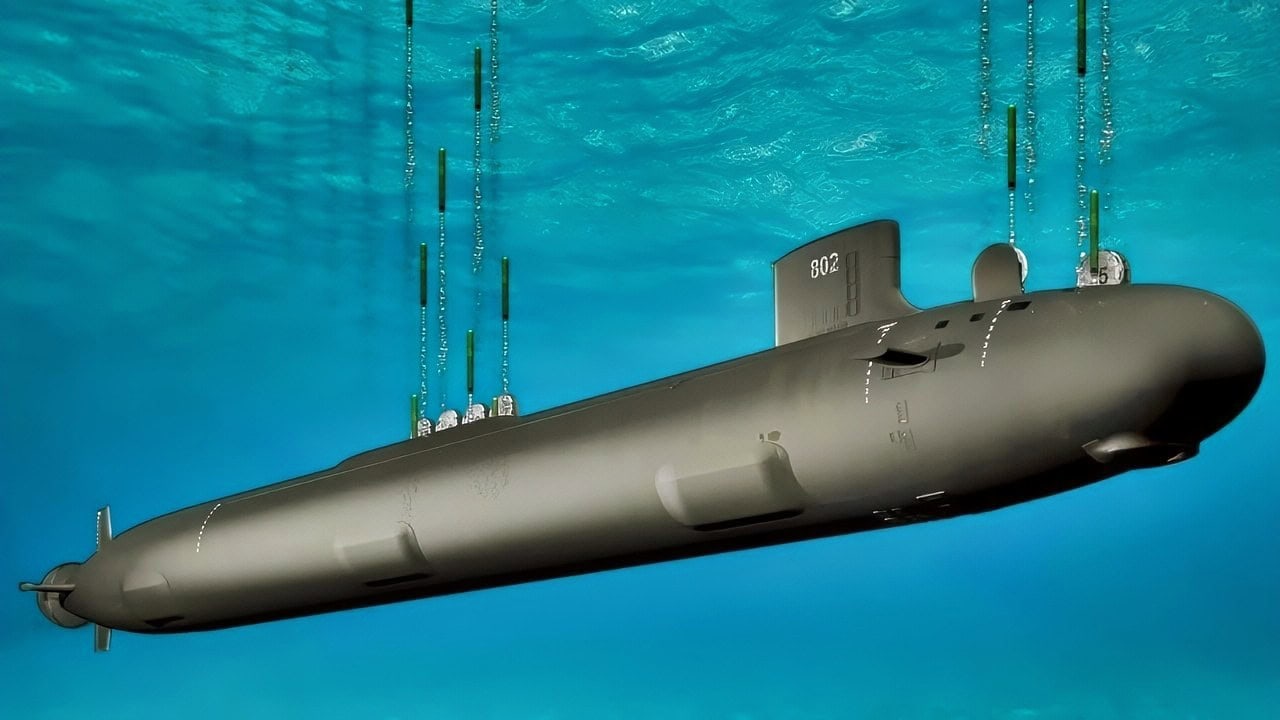
The US Navy is planning to build a dozen of the new Columbia SSBN guided-missile submarines, but it’d rather have 16. And they need those. That is a given.
Admiral Richard Correll, the head of U.S. Strategic Command, spoke to the Senate Armed Services Committee at the end of March and told lawmakers about the need to match the current fleet.
“The existing capability we have includes 14 Ohio-class boats with 20 tubes. So that’s 280 launch tubes. The program of record is a minimum of 12 Columbia with 16 tubes each, for a total of 192. So that’s 280 versus 192,” Correll said.
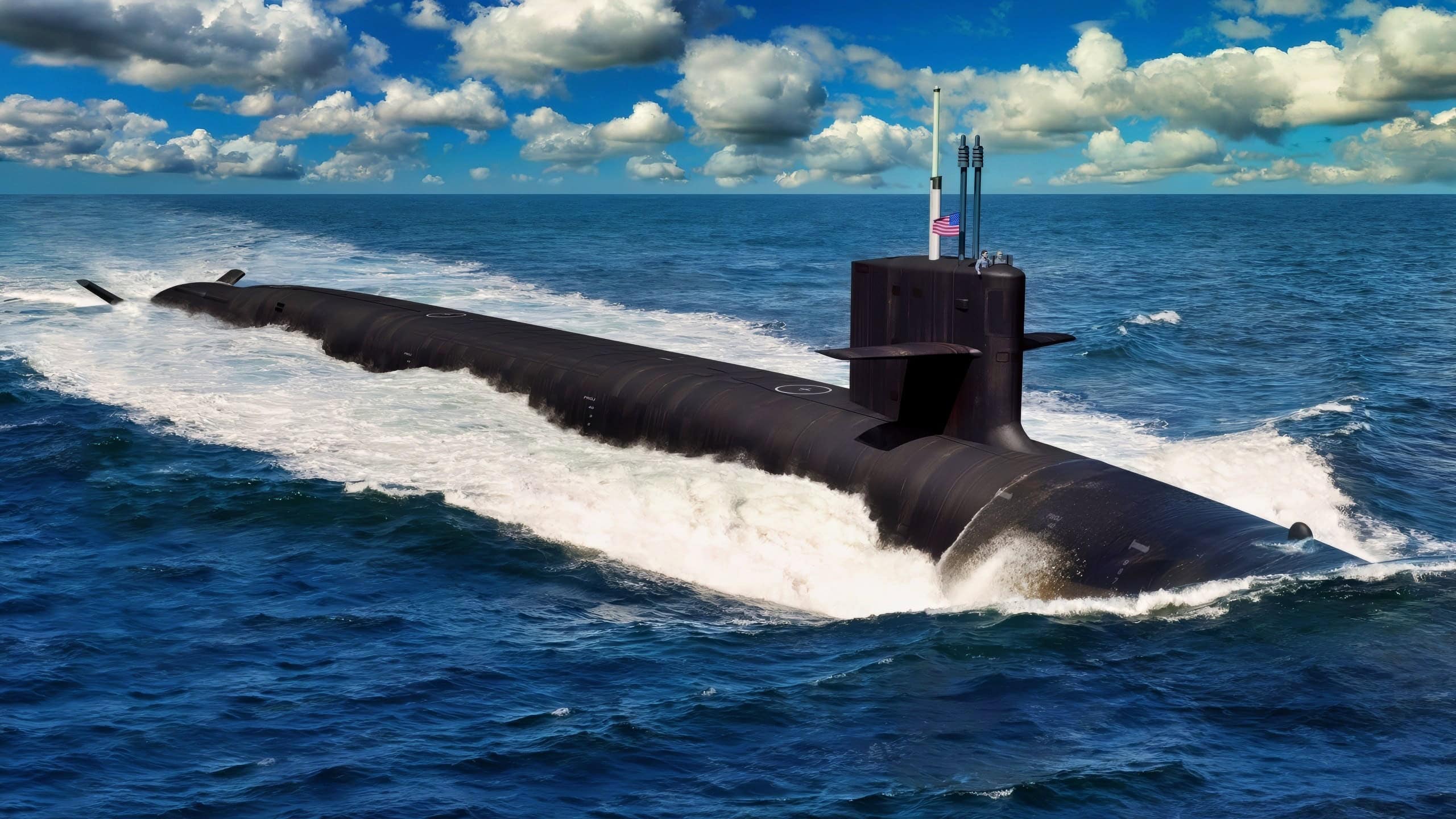
Columbia-Class Submarine SSBN Rendering U.S. Navy Photo
“Additional capacity and capability are very beneficial from my perspective. There’s ongoing work within the department on force sufficiency, and that work will inform any future budget decisions related to Columbia.
“But if you just do the math for what we have and the program of record, I will continue to advocate for additional capability at sea in terms of the Columbia class,” he added.
But the current state of US shipyards is far from satisfactory. Budgets are already stretched too far, and the country’s deficit is reaching the breaking point. With a new attack submarine already on the horizon, how can the US Navy manage to do this?
Why The Navy Needs The “Boomers” Missile Boats?
The big missile boats, the SSBNs (Ship Submersible Ballistic Nuclear), are an enormous part of our nuclear triad. We currently have the Ohio class of nuclear boomers, which were the best in the world when they were introduced. They still are, however, the Navy is expanding their lifespan more than double what was forecast when they entered the fleet.
The Ohio-class boats will be 42 years old, possibly older, when the Columbia-class boats come online. The Navy must keep at least 10 missile boats on patrol at all times to maintain the nuclear deterrent.
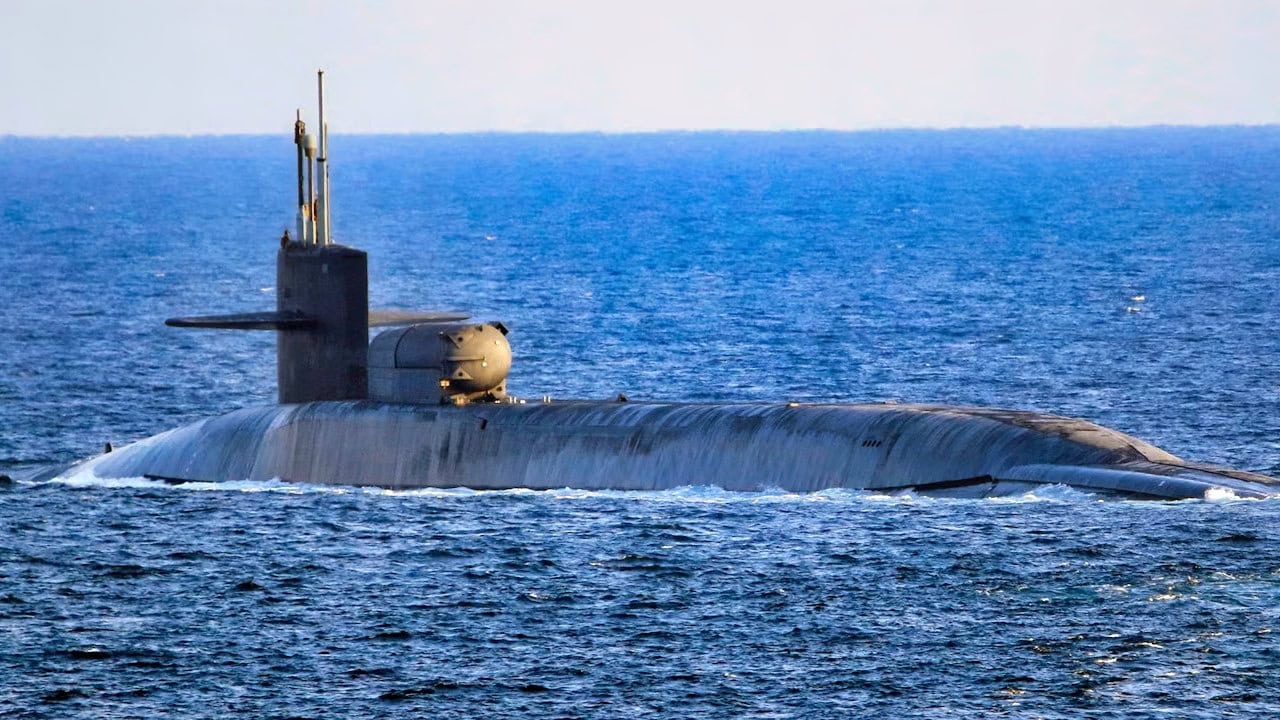
Ohio-Class SSGN Submarine U.S. Navy.
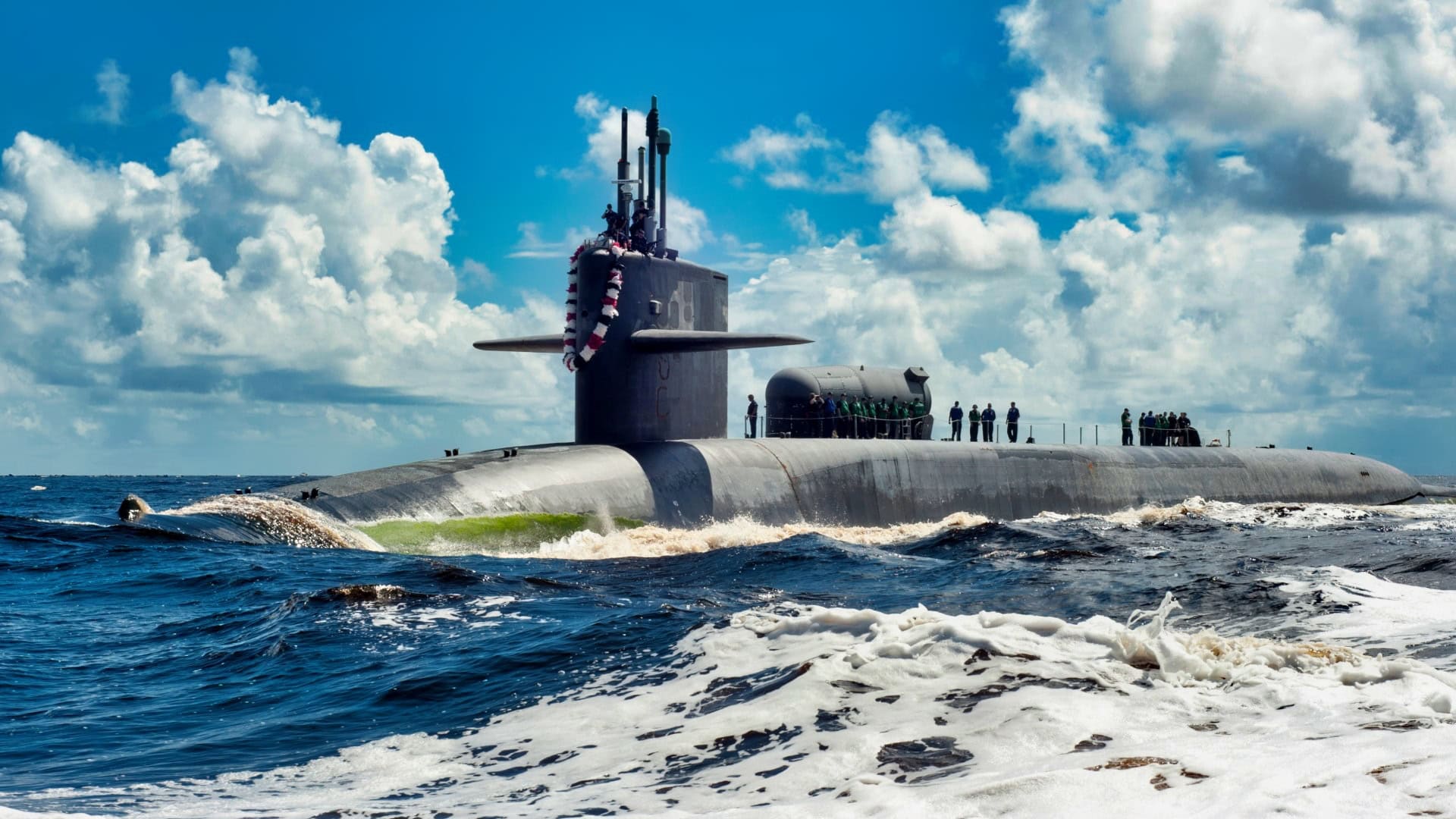
FERNANDINA BEACH, Fla. – The Ohio-class guided missile submarine USS Georgia (SSGN 729) transits the Saint Marys River July 15. Georgia returned to Kings Bay after spending more than a year forward deployed. (U.S. Navy photo by Mass Communication Specialist 1st Class(SW) James Kimber)
The Ohio-class will begin to be retired in 2027. To support the deterrent threat, the first Columbia SSBN, “The District of Columbia,” must be added to the fleet by 2030.
The first Columbia-class submarine is about a year behind schedule, with expected delivery in 2028. The Navy has a maintenance plan to extend the life of Ohio-class submarines so they can continue to serve until the Columbia-class submarines are built.
The remaining 11 Columbia-class boats are scheduled for delivery annually until the fleet is complete in the early 2040s. The planned number of 12 Columbia-class submarines has been in place for quite some time and has not changed significantly.
The Ohio-class boomers must be closely monitored for hull-weakening and metal fatigue. The radioactive fuel that runs the reactors must be replaced, and the reactors themselves must eventually be refurbished or replaced at considerable cost.
Senator Tuberville On Board With Adding Four More Submarines:
Sen. Tommy Tuberville (R-AL) asked what the commander of STRATCOM would do if Congress could fund more Columbia-class submarines—16 instead of the planned 12.
“Submarines are the tip of the spear for our nuclear capabilities. The problem is we can’t seem to build them fast enough,” Tuberville said. “What flexibility and capability does STRATCOM gain if we were able to field 16 Columbia-class submarines versus 12?”
Correll said that adding four more new Columbia-class missile boats would maximize “flexibility and options to present to the president should the need arise.”
“The importance to our deterring capability, I can’t overstate that—all three legs are vitally important. They complement each other, and the sum of the parts is much greater than the whole.
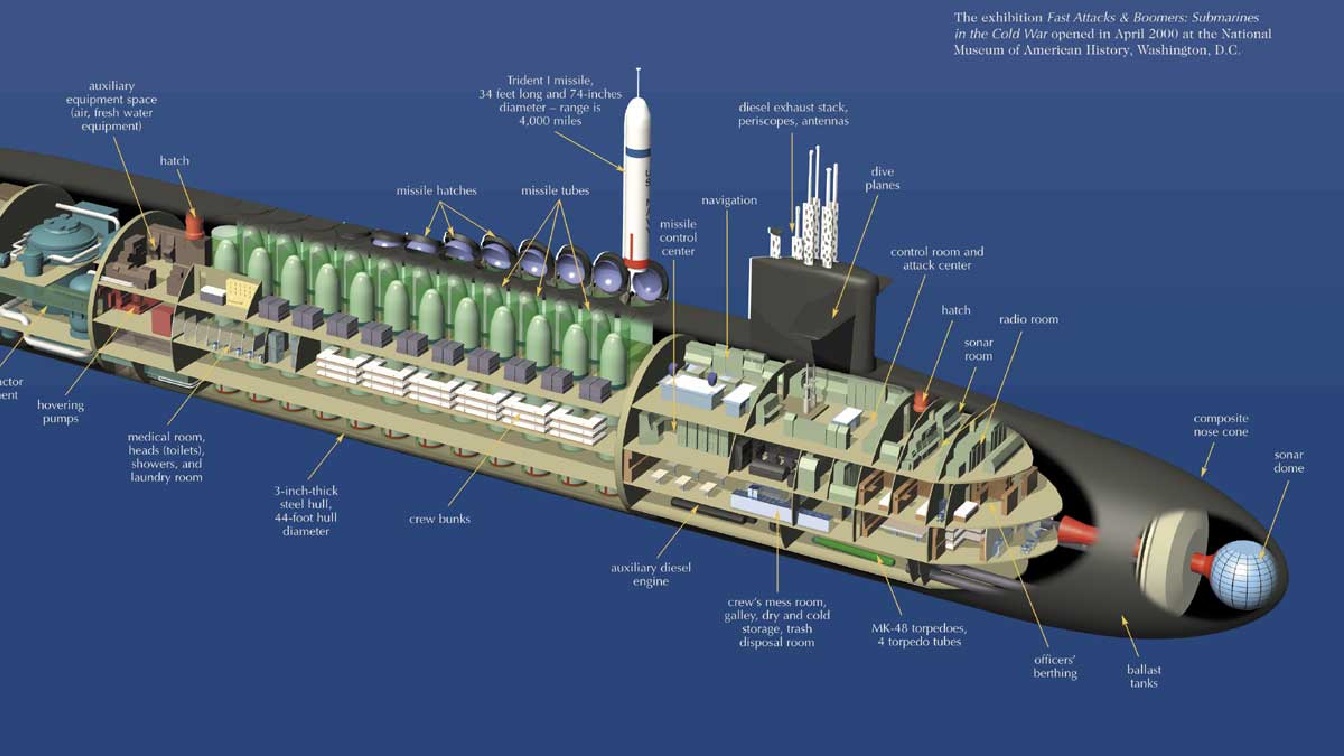
Ohio-Class SSBN. Image Credit: Creative Commons.
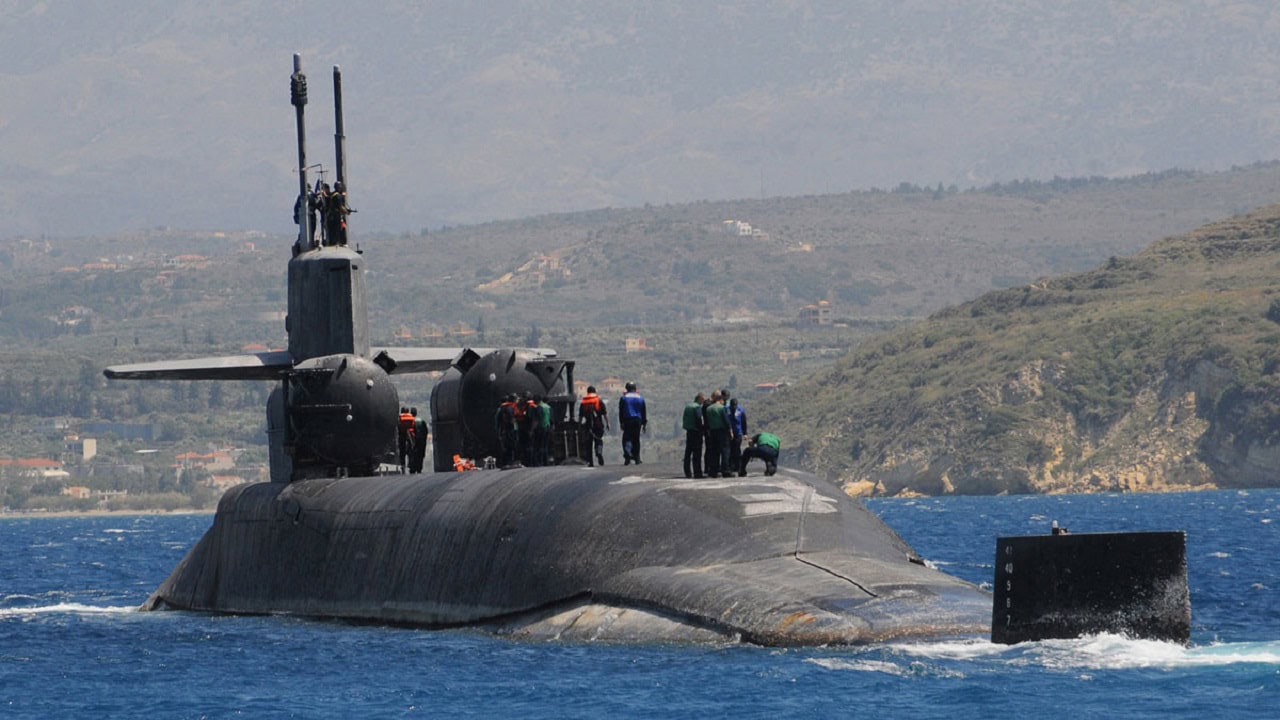
Ohio-Class SSGN. Image Credit: U.S. Navy.
“For the SSBN, that assured second strike capability that’s always at sea, always ready to respond, deters effectively. And I see that in the intel reporting record.”
China, Russia, and North Korea Adding Nuclear Weapons:
Identifying the nuclear threat as “significantly greater” than it was in an earlier era, former Stratcom commander retired Air Force General Anthony Cotton said last year, “the Navy’s new Columbia-class ballistic missile submarine also likely needs to be built in greater numbers.” The US is facing significant threats from China, Russia, and North Korea, and as a result, it must modernize.
Russia is expanding its nuclear arsenal and number of dual-use, nuclear-capable missiles, but China plans to double the number of its nuclear warheads in just the next five years. Also in recent years, China has been building land-launched ICBM silos across its mainland, something which greatly multiplies the nuclear threat posed by the PRC. And if Iran becomes a nuclear power, the issues will increase even more.
The Columbia-class Missile Boats Are Large and Complex:
Each of the boomers will be 560 feet long and displace 20,810 tons, making them the largest submarines to come out of a U.S. shipyard. Their nuclear reactors will not require refueling during the entire planned service life. The new boats will represent roughly 70 percent of the nation’s nuclear deterrent.
Each new Columbia-class submarine will have 16 missile tubes for deploying 16 Trident II D5 nuclear-tipped ballistic missiles. Each Trident D5 missile will carry eight Thermonuclear Multiple Independently Targetable Reentry Vehicles (MIRVs) but could hold up to twelve MIRV Warheads. The Columbia-class boats will also deliver Mk 48 heavyweight torpedoes.
From the ninth boat onward, the Navy will be installing Trident D5LE2 missiles.
The D5LE2 “won’t look like the D5 that we’ve got today, it won’t be completely new, it will be somewhere in the middle,” said Vice Admiral Johnny Wolfe, director of Strategic Systems Programs (SSP).
The three-stage missile is promoted as the most advanced ballistic missile in the world. The D5LE2 can carry multiple independently targeted reentry vehicles and features a celestial-aided inertial navigation system.
The SSBN’s strategic weapon is the Trident II D5 missile, which offers increased range and accuracy compared to the now-out-of-service Trident I C4 missile. SSBNs are part of the US nuclear triad, with land-based silos and aircraft.
Can the US build Columbia missile boats according to the time schedule? It is a complex question, as the submarine industrial base has already been asked to massively expand its capacity to build Virginia-class submarines on a much faster timeline.
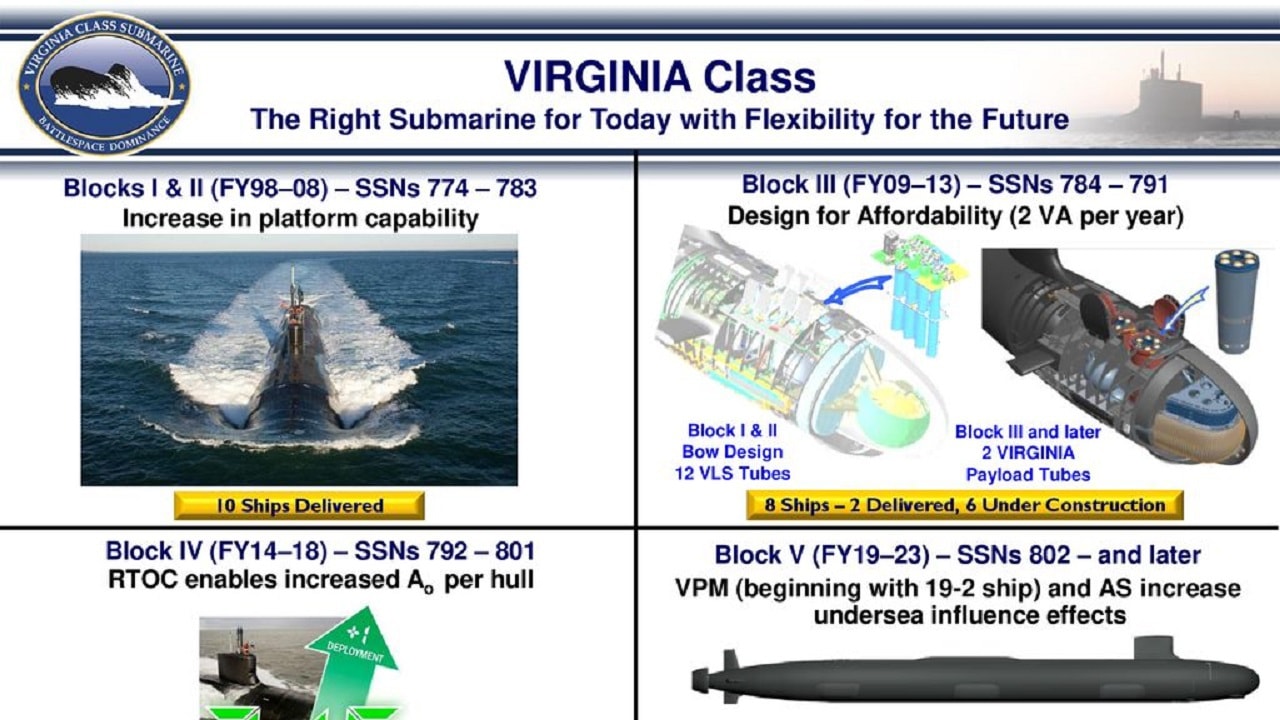
(FY98–08) – SSNs 774 – 783. Block III (FY09–13) – SSNs 784 – 791. Increase in platform capability. Design for Affordability (2 VA per year) Block I & II Bow Design. 12 VLS Tubes. Block III and later 2 VIRGINIA Payload Tubes. 10 Ships Delivered. 8 Ships – 2 Delivered, 6 Under Construction. Block IV (FY14–18) – SSNs 792 – 801. Block V (FY19–23) – SSNs 802 – and later. RTOC enables increased Ao per hull. VPM (beginning with 19-2 ship) and AS increase undersea influence effects. 10 Ships – 5 Under Construction, 5 Under Contract. In Design Phase, FY19 Construction Start. 16.
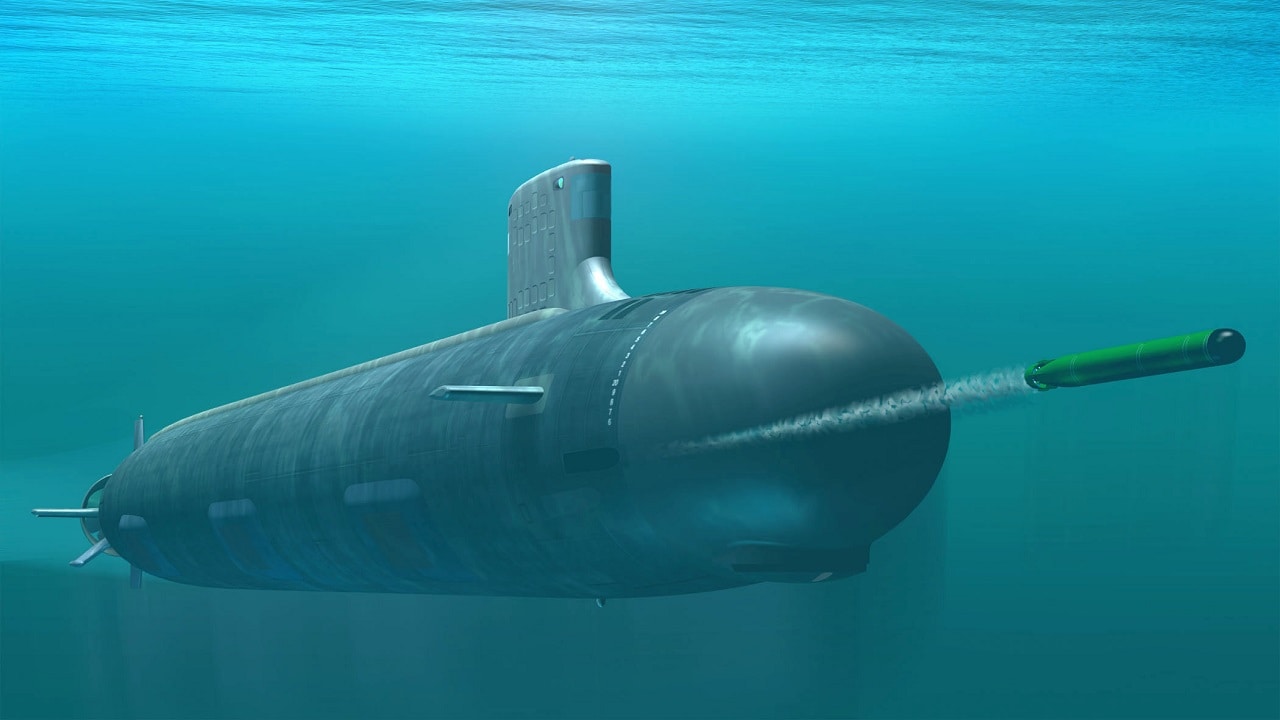
(May 21, 2003) — This conceptual drawing shows the new Virginia-class attack submarine now under construction at General Dynamics Electric Boat in Groton, Conn., and Northrop Grumman Newport News Shipbuilding in Newport News, Va. The first ship of this class, USS Virginia (SSN 774) is scheduled to be delivered to the U.S. Navy in 2004. U.S. D.O.D. graphic by Ron Stern. (RELEASED)
In recent years, the Navy has consistently analyzed and studied its industrial base capacity to assess its ability to accommodate a more ambitious production schedule.
As part of this process, the Navy has been working with congressional lawmakers to increase funding for Virginia-class submarine production by at least one additional submarine per year. Adding Columbia-class boats to the equation would likely further stress it.
Electric Boat Builder Is Confident It Can Be Done:
Eric Snider, vice president of the Columbia-class program at General Dynamics Electric Boat, expressed confidence in the process, even as construction of the new missile boat is underway at the same shipyard where the company is building the next Virginia-class fast-attack submarines.
“Columbia is two and a half times the size of Virginia,” Snider said to National Defense. “We’re not completely crazy. We’ve learned a lot about the modular-construction business. We’ve gotten off to a good start, tracking actually ahead of where the Virginia was in her build-out as a lead ship.”
The US Congress and the GAO are closely monitoring the program. The construction is currently 16 months behind schedule, and millions, perhaps hundreds of millions, are running over budget.
This is a project whose importance can’t be overstated. Our enemies are building for a nuclear war; they believe they can “win.” If the US loses its deterrence, it will only further embolden them.
The future for our Navy runs under the sea. While our aircraft carriers project airpower anywhere in the world, the future of controlling the oceans so the carriers can project power lies with submarines. And the Navy will be bare-bones, with a dozen Columbia-class guided-missile submarines. Adding four more would ease the burden on the existing boats.
About the Author: Stephen Balestrieri
Steve Balestrieri is a National Security Columnist. He served as a US Army Special Forces NCO and Warrant Officer. In addition to writing on defense, he covers the NFL for PatsFans.com and is a member of the Pro Football Writers of America (PFWA). His work was regularly featured in many military publications.