

Russia announced plans for a 100,000-ton nuclear-powered supercarrier in May 2015. Eleven years later, the keel still hasn’t been laid. The Project 23000 Shtorm exists entirely on paper — and Russian officials have now pushed its delivery into a future they cannot credibly describe.
Russia’s Mystery Nuclear Aircraft Carrier: Meet Project 23000 Shtorm
The Russian Navy’s Project 23000 Shtorm (“Storm”) aircraft carrier embodied the American philosophy of “If at first you don’t succeed, try again.”
Both the Soviet Union and the post-Cold War Russian Federation built their fair share of impressive military machines, from assault rifles to tanks, fighter jets, nuclear submarines, and spacecraft. Yet when it comes to aircraft carriers, the Soviet Union and post-Soviet Russia alike failed miserably. The carrier Admiral Kuznetsov, which has been plagued by persistent defects, will probably never sail again. So, assuming the Shtorm ever becomes a reality, will it finally succeed where the Kuznetsov and the Kiev-class carriers failed?
Project 23000E “Shtorm” Initial Premise and Presumptive Promise
The Shtorm project traces its roots back to May 2015, when it was notionally revealed. Fourteen months later, a Russian diplomatic delegation traveled to India to offer the notional warship for sale to that South Asian nation’s navy, even though the keel hadn’t even been laid yet—it still hasn’t.
At the time, it was described by an anonymous Russian navy official as a “multipurpose aircraft carrier [that] is designed to conduct operations in remote and oceanic areas, engage land-based and sea-borne enemy targets, ensure the operational stability of naval forces, protect landing troops, and provide anti-aircraft defense.”

Shtorm Aircraft Carrier. Image Credit: Artist Rendering/Creative Commons.
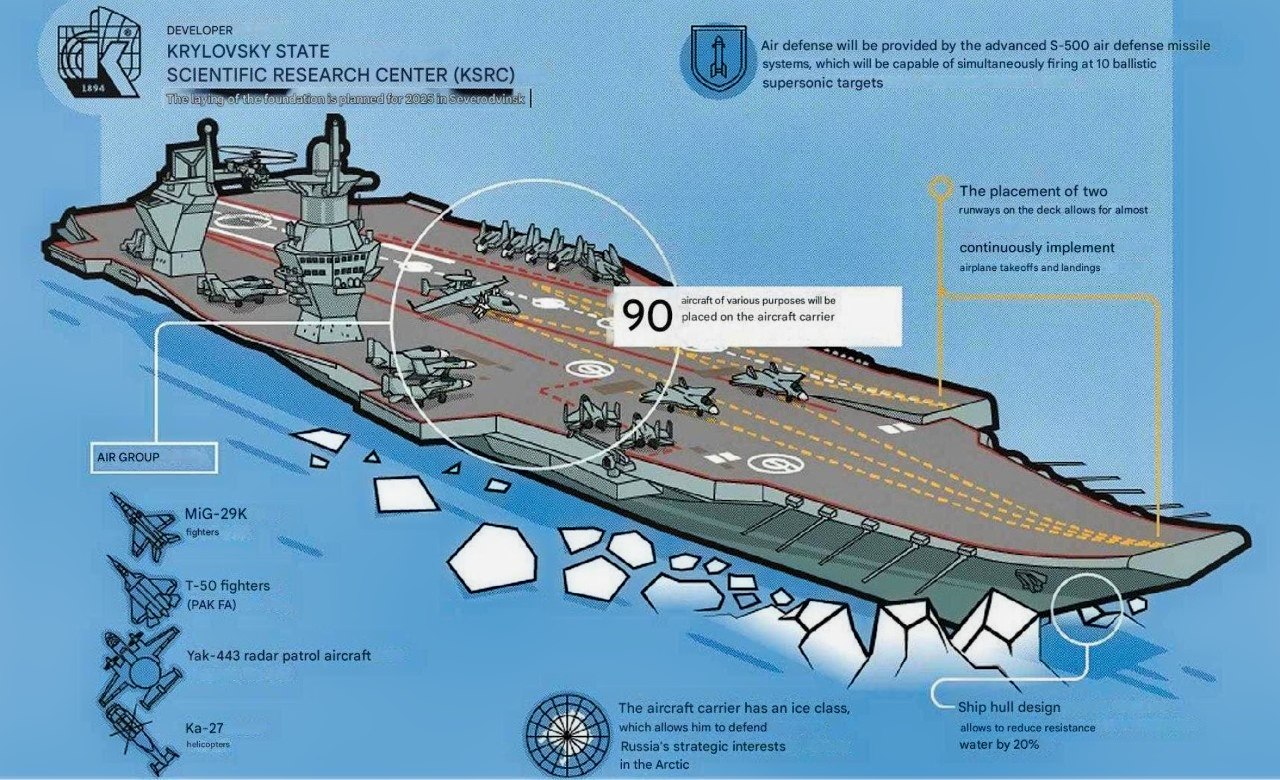
Shtorm Russian Navy Aircraft Carrier. Image Credit: Russian Social Media.
In May 2017, it was mentioned in Russia’s State Armament Program for 2018–2027, along with the prospective Project 23560 Lider-class (aka Shkval-class) stealth nuclear-powered guided-missile destroyers. At that time, Russian President Vladimir Putin decided to postpone Project 23000, instead refurbishing the Kuznetsov and continuing to focus on strengthening Russia’s nuclear triad.
Shtorm Features and Vital Stats
If this ship class ever becomes a reality, the Krylov State Research Center, a Russian shipbuilding research and development institute headquartered in St. Petersburg, will be the presumptive manufacturer.
The Shtorm will be powered by a Russian-made RITM-200 or RITM-400 nuclear reactor, combined with four propellers, providing the vessel with an estimated top speed of more than 30 knots. Approximate displacement will be 100,000 tons fully laden, hull length will be 1,083 feet, beam width will be 131 feet, and draught will be 36 feet.
Crew complement is to be determined, and its aircraft capacity will be in the neighborhood of 100 airframes. Aircraft on deck will include the Mikoyan MiG-29K and Sukhoi Su-33 fourth-generation jet fighters, the Sukhoi Su-57 stealth fighter, and the Kamov Ka-27 antisubmarine warfare helicopter.
As for the launching system, it is not yet known whether the carrier would employ an old-school steam catapult like the U.S. Navy’s Nimitz-class carriers or something closer to the electromagnetic aircraft launching system seen on the Ford-class supercarriers.
Reviving the Project 23000E?
Fast-forward to June 2024, and Dave Malyon of Knewz.com reported that Vladimir Pospelov, a member of Russia’s Military-Industrial Commission, had noted new plans for the 100,000-ton supercarrier.
Maylon noted (based upon an artist’s rendering) that the aspiring ship bore at least a passing resemblance to the British Royal Navy’s Queen Elizabeth-class with its twin island design.
The expected price tag is $5.84 billion, although Mr. Pospelov caveated that cost estimate by noting that the vessel could have a smaller displacement range of 70,000–80,000 tons.
However, he also warned of the possibility of cost overruns and production delays (which goes to show that it’s not just the U.S. Department of War that runs afoul of weapon system acquisition maladies), allowing for a 10-20 percent margin of error.
Maylon goes on to quote Vladimir Pepeliaev, a former vice admiral of the Russian Navy, who opines that “Today, strike missile weapons are not relevant for a ship like an aircraft carrier. It must solve aviation tasks, and the crew must be focused on the aviation component.”
The problem? Given the large amount of blood and treasure spent to continue Putin’s “special military operation” in Ukraine, there is little room left in the budget for an aircraft carrier, especially when you also factor in the crimp from global economic sanctions placed upon Moscow.
Therefore, the prospects for Project 23000 seem grim. But then again, given Putin’s pride and hardheadedness, he might attempt to go through with the project anyway, if for no other reason than to restore the Russian Navy’s wounded prestige.
About the Author: Christian D. Orr
Christian D. Orr is a Senior Defense Editor. He is a former Air Force Security Forces officer, Federal law enforcement officer, and private military contractor (with assignments worked in Iraq, the United Arab Emirates, Kosovo, Japan, Germany, and the Pentagon). Chris holds a B.A. in International Relations from the University of Southern California (USC) and an M.A. in Intelligence Studies (with a concentration in Terrorism Studies) from American Military University (AMU). He is also the author of the book “Five Decades of a Fabulous Firearm: Celebrating the 50th Anniversary of the Beretta 92 Pistol Series,” the second edition of which was recently published.