
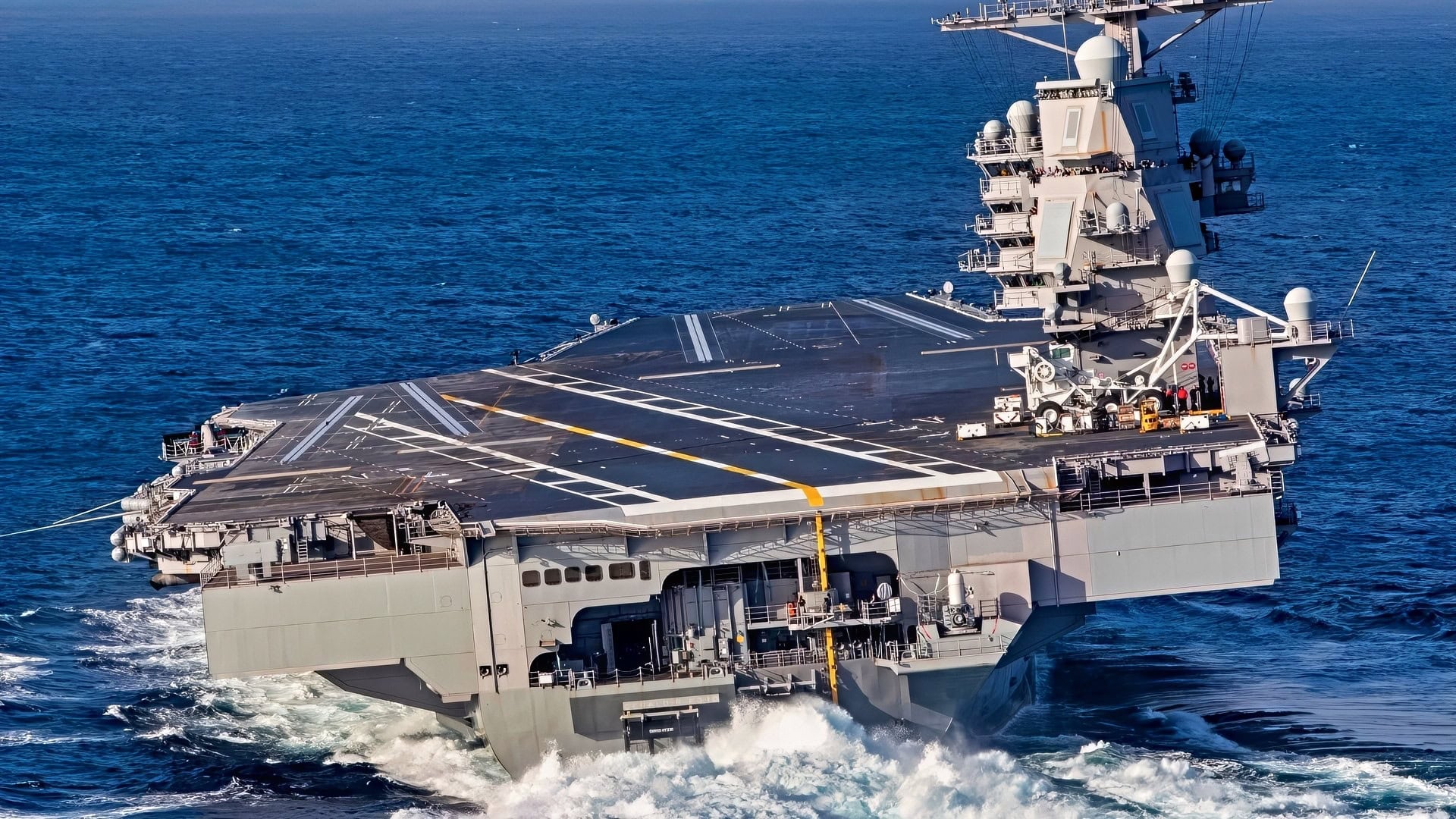
The Gerald R. Ford-class carrier was supposed to be the evolutionary successor to the 50-year-old Nimitz, but instead of replacing one major system at a time, the U.S. Navy tried to reinvent nearly everything at once — steam catapults, arresting gear, weapons handling, reactor design, automation, radar, and electrical architecture. The result has been years of debugging. The new electromagnetic catapult fails. The advanced arresting gear has software issues. Some weapons elevators still don’t work after delivery. Crew cuts of 500 to 700 sailors created new software vulnerabilities. The Ford is finally becoming operational, but the lesson is clear: incrementalism matters.
The Ford-Class Changed Too Much, Too Fast for Navy Aircraft Carriers
The Ford-class carrier replaced the catapults, arresting gear, and weapons elevators all at once — and the elevators still don’t work years after delivery.
The Gerald R. Ford-class carriers were intended to be the evolutionary replacement for the Nimitz-class. Instead, the Ford attempted to redesign multiple major systems simultaneously.
The result has been delays, cost growth, and years spent debugging the various systems. Congress, the Pentagon, and the public—all have criticized the new carrier platform, asking whether it was a mistake to try to introduce too many revolutionary systems into one ship at once.
The answer is likely yes—the Ford features so many cutting-edge systems at once that the platform may serve as a case study in technological ambition outpacing project management capabilities.
Nimitz vs. Ford
The Nimitz featured a series of gradual evolutions, with mostly proven systems and incremental improvements. The result was a cornerstone platform that has served for fifty years and counting as arguably the ultimate power projection tool in military history.
The Ford, meanwhile, replaced multiple core systems simultaneously, including steam catapults, arresting gear, weapons handling, reactor design, ship automation, radar systems, and electrical architecture—basically everything.
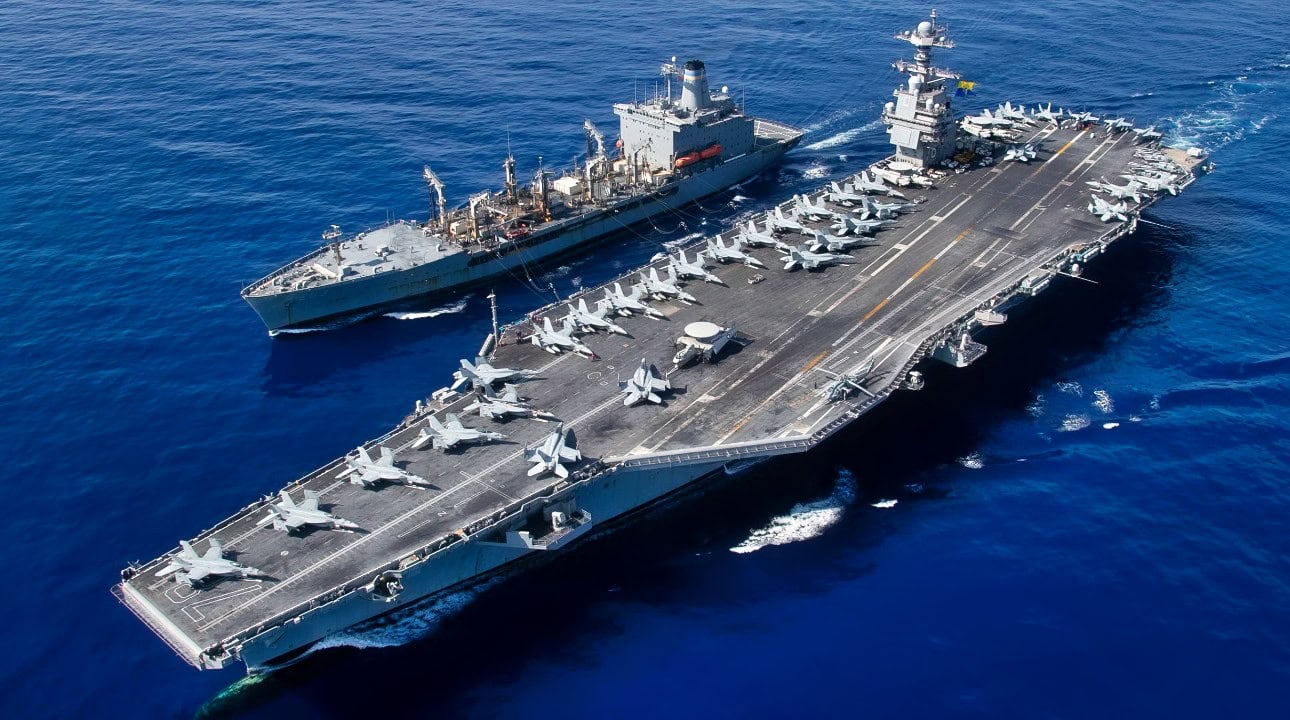
The world’s largest aircraft carrier USS Gerald R. Ford (CVN) 78 and the USNS Laramie (T-AO-203) conduct a refueling-at-sea in the Eastern Mediterranean Sea, Oct. 11, 2023. USS Gerald R. Ford is the Navy’s newest and most advanced aircraft carrier, representing a generational leap in the U.S. Navy’s capacity to project power on a global scale. The Gerald R. Ford Carrier Strike Group is currently operating in the Eastern Mediterranean Sea, at direction of the Secretary of Defense. The U.S. maintains forward deployed ready and postured forces to deter aggression and support security and stability around the world.(U.S. Navy photo by Mass Communication Specialist 2nd Class Jackson Adkins)
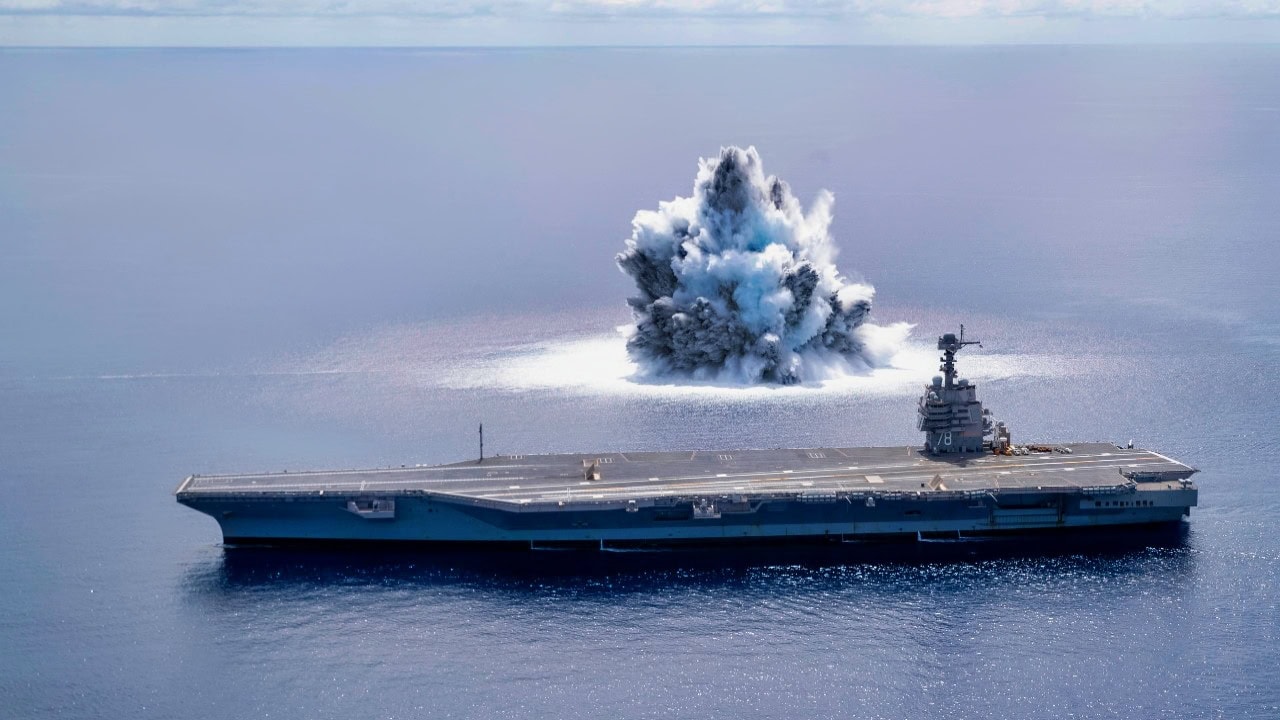
The aircraft carrier USS Gerald R. Ford (CVN 78) completes the first scheduled explosive event of Full Ship Shock Trials while underway in the Atlantic Ocean, June 18, 2021. The U.S. Navy conducts shock trials of new ship designs using live explosives to confirm that our warships can continue to meet demanding mission requirements under harsh conditions they might encounter in battle. (U.S. Navy photo by Mass Communication Specialist 3rd Class Riley B. McDowell)
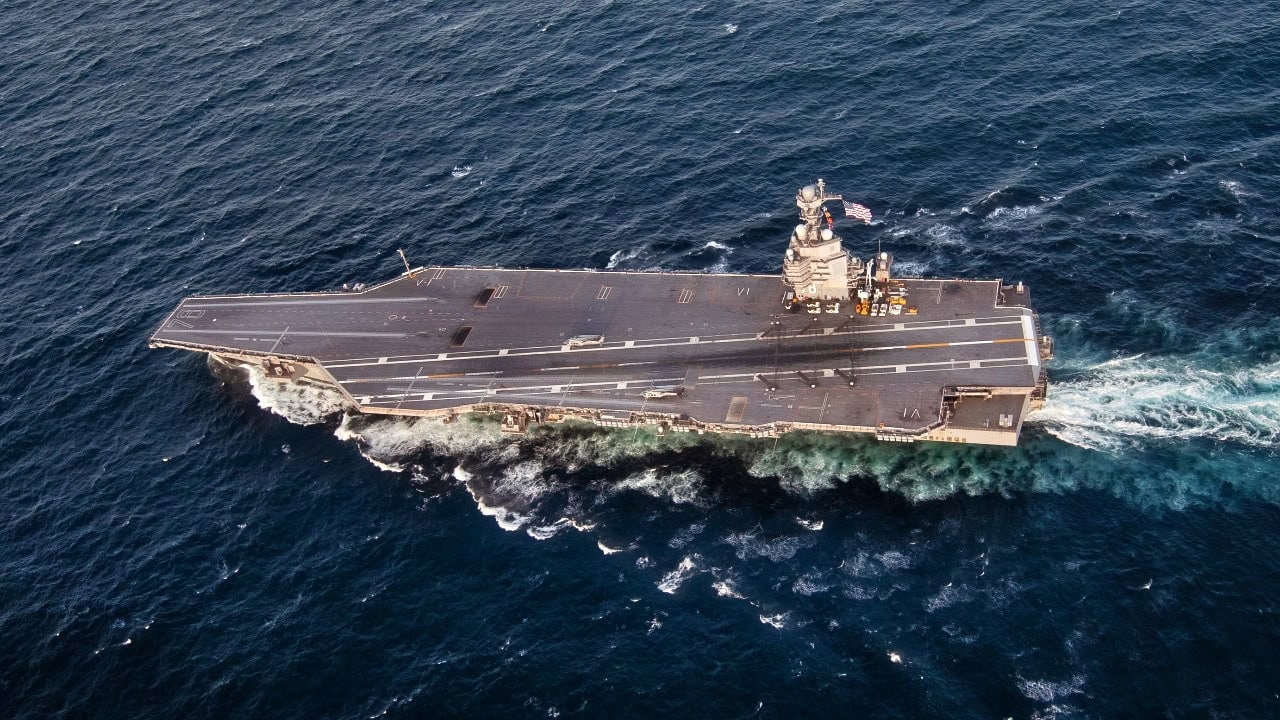
The Ford-class aircraft carrier USS Gerald R. Ford (CVN 78) and the Italian aircraft carrier ITS Cavour (CVH 550) transit the Atlantic Ocean March 20, 2021, marking the first time a Ford-class and Italian carrier have operated together underway. As part of the Italian Navy’s Ready for Operations (RFO) campaign for its flagship, Cavour is conducting sea trials in coordination with the F-35 Lightning II Joint Program Office’s Patuxent River Integrated Test Force to obtain official certification to safely operate the F-35B. Gerald R. Ford is conducting integrated carrier strike group operations during independent steaming event 17 as part of her post-delivery test and trials phase of operations.
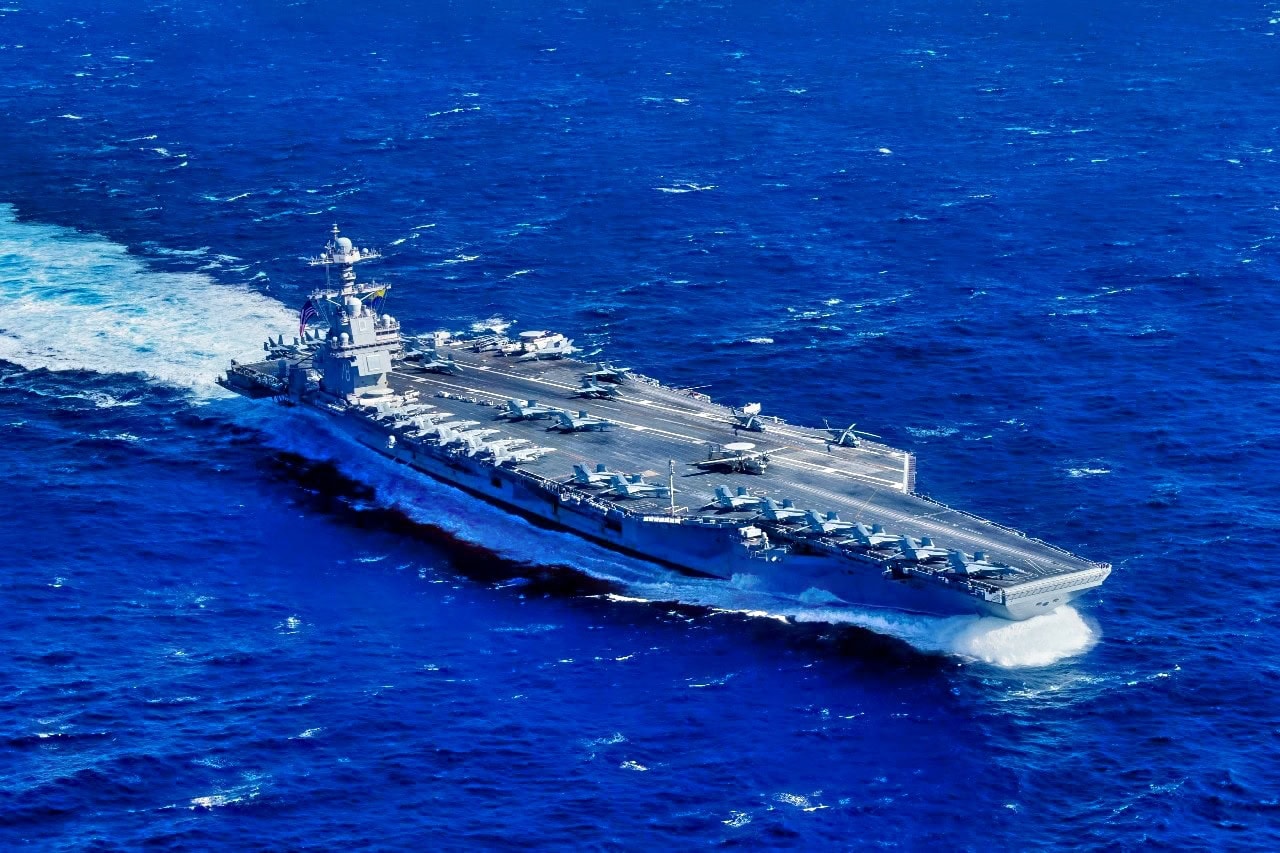
The world’s largest aircraft carrier, USS Gerald R. Ford (CVN 78), sails in formation with the Arleigh Burke-class guided missile destroyers USS Winston Churchill (DDG 81), USS Mitscher (DDG 57), USS Mahan (DDG 72), USS Bainbridge (DDG 96), and USS Forrest Sherman (DDG 98) in the Atlantic Ocean, Nov. 12, 2024. The Gerald R. Ford Carrier Strike Group is underway in the Atlantic Ocean completing Group Sail. Group Sail is the first at-sea integrated phase training event during a routine deployment training cycle. It is designed to challenge the Gerald R. Ford CSG’s ability to use the capabilities of the USS Gerald R. Ford (CVN 78), USS Winston S. Churchill (DDG 81), Carrier Air Wing (CVW) 8, Destroyer Squadron (DESRON) 2, and embarked Information Warfare team as a cohesive Strike Group to meet Navy and Joint Warfighting requirements that increases warfighting capability and tactical proficiency across all domains. (U.S. Navy photo by Mass Communication Specialist 2nd Class Maxwell Orlosky)
The consequence of that ambition has been that instead of debugging one major revolutionary system, the Navy has been mired in debugging nearly the entire ship, because problems are interconnected rather than isolated.
The EMALS
Of all the changes in the Ford-class, the most significant is the EMALS, or Electromagnetic Aircraft Launch System.
While traditional carriers, like the Nimitz, use a steam catapult to launch aircraft with pressurized steam, the EMALS uses electromagnetic energy to accelerate the aircraft.
The intended advantages of the EMALS are smoother acceleration, less stress on the airframe, the ability to launch a wider range of aircraft, reduced maintenance, and more efficient sortie generation. But in the field, the EMALS has had reliability issues, including outright failures.
Of course, a carrier’s overall effectiveness depends heavily on aircraft launch rates, so if the catapults are struggling or out of commission, the entire carrier is struggling or out of commission.
The AAG
The arresting system from the Nimitz, a hydraulic mechanism that absorbed the landing force, was replaced, too; the Ford uses the AAG, or Advanced Arresting Gear, which uses an electric motor and digital controls to absorb energy from landings.
The intended benefits were the ability to recover everything from heavier aircraft to lighter drones, with higher adaptability than traditional systems. But the AAG has been plagued with software issues and mechanical reliability problems, resulting in testing delays.
So between the EMALS and the AAG, both launching and recovering aircraft have encountered development problems; the Navy reinvented both ends of carrier flight operations at the same time and has paid the price.
The Weapons Elevators
The Ford even features a new, advanced weapons elevator system that rapidly moves bombs and missiles through the ship. With an electromagnetic design and greater capacity, the new elevators were intended to reduce the manpower needed to move ordnance.
But the elevators have become a notorious problem, with issues including software integration, sensor alignment, and precision tolerances. Years after delivery, some elevators are still not working.
This is important because carrier striking power depends on weapons magazines, which are moved from the depths of the ship to the flight deck (where they are attached to aircraft) via the weapons elevator. The failure of Ford’s weapons elevators has reduced the ship’s ability to equip aircraft for strike roles.
Automation
Ford introduced broad automation efforts to reduce crew size, lower long-term operating costs, and reduce the manpower burden. Relative to the Nimitz, the Ford reduced its crew size by roughly 500–700 sailors.
Over the carrier’s 50-year lifespan, that crew reduction was projected to save billions of dollars. But fewer people have led to less redundancy and greater dependence on software. So what the Navy is learning is that automation saves money when it functions correctly, yes, but it creates vulnerabilities when it doesn’t.
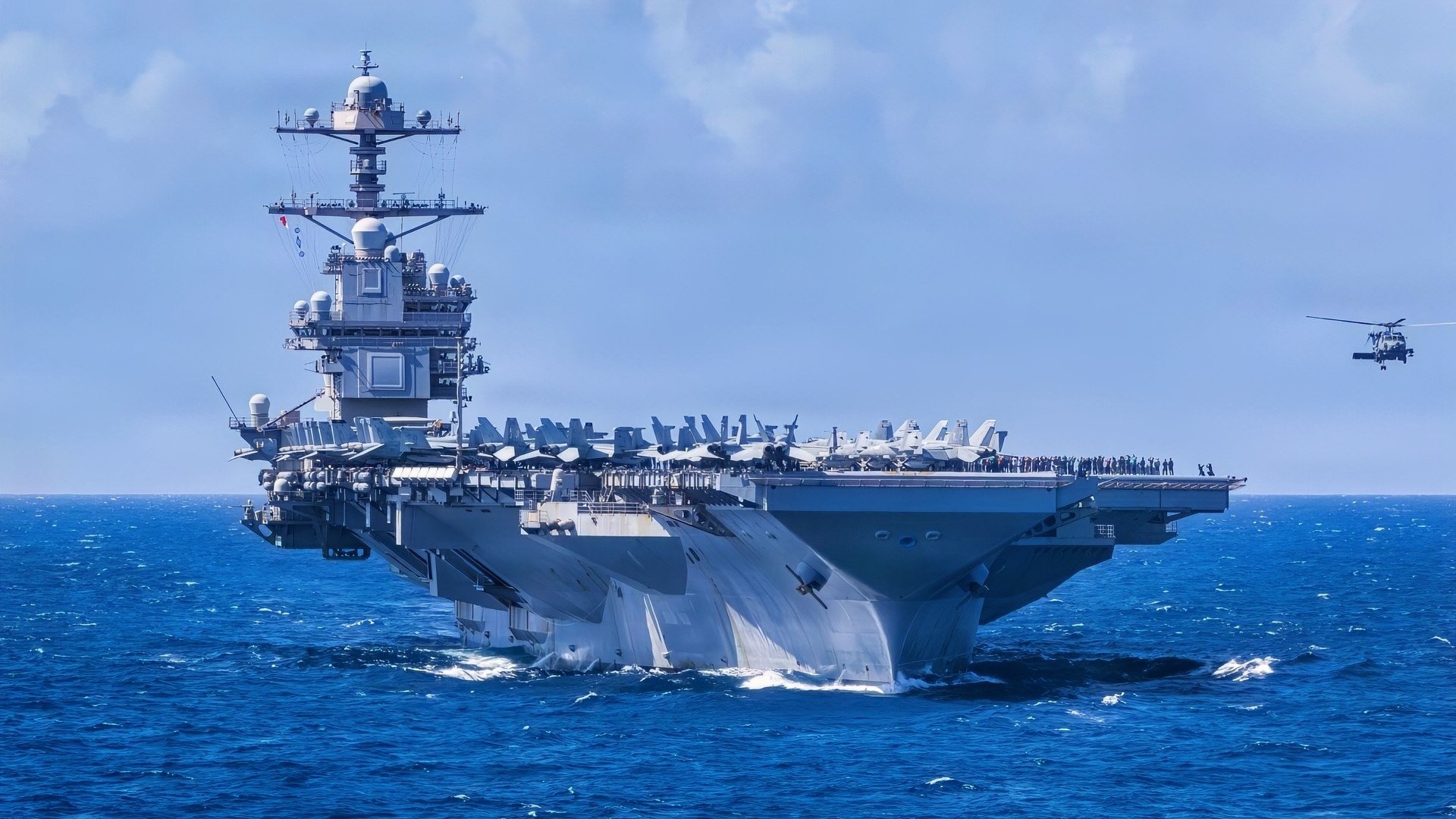
U.S. Navy Carrier Air Wing 8 aircraft fly in formation over the world’s largest aircraft carrier, Ford-class aircraft carrier USS Gerald R. Ford (CVN 78), during Carrier Air Wing 8’s aerial change of command ceremony while underway in the Caribbean Sea, Jan. 19, 2026. U.S. military forces are deployed to the Caribbean in support of the U.S. Southern Command mission, Department of War-directed operations, and the president’s priorities to disrupt illicit drug trafficking and protect the homeland. (U.S. Navy photo)
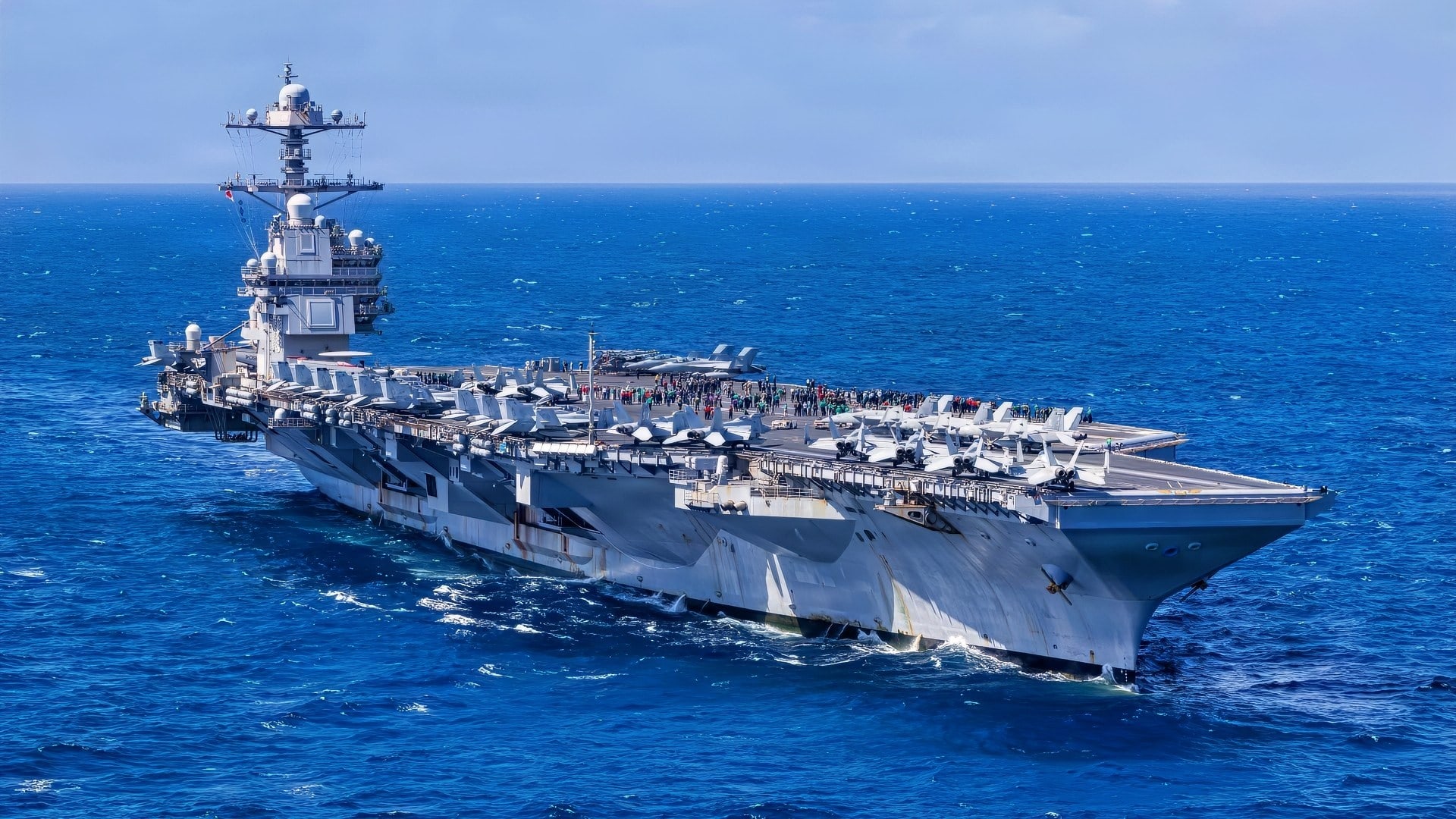
The world’s largest aircraft carrier, Ford-class aircraft carrier USS Gerald R. Ford (CVN 78), transits the Caribbean Sea during Carrier Air Wing 8’s aerial change of command ceremony, Jan. 19, 2026. U.S. military forces are deployed to the Caribbean in support of the U.S. Southern Command mission, Department of War-directed operations, and the president’s priorities to disrupt illicit drug trafficking and protect the homeland. (U.S. Navy photo)
Smooth Sailing
The Ford-class is increasingly becoming operationally effective and will likely enjoy a multi-decade run as a competent supercarrier.
The lessons, however, the early hiccups, will hopefully be applied to upcoming next-generation programs, like NGAD and CCA, which also face the temptation to stack multiple new technologies together. As Ford’s history suggests, sometimes incrementalism is necessary.
About the Author: Harrison Kass
Harrison Kass is a writer and attorney focused on national security, technology, and political culture. His work has appeared in City Journal, The Hill, Quillette, The Spectator, and The Cipher Brief. He holds a JD from the University of Oregon and a master’s in Global & Joint Program Studies from NYU. More at harrisonkass.com.