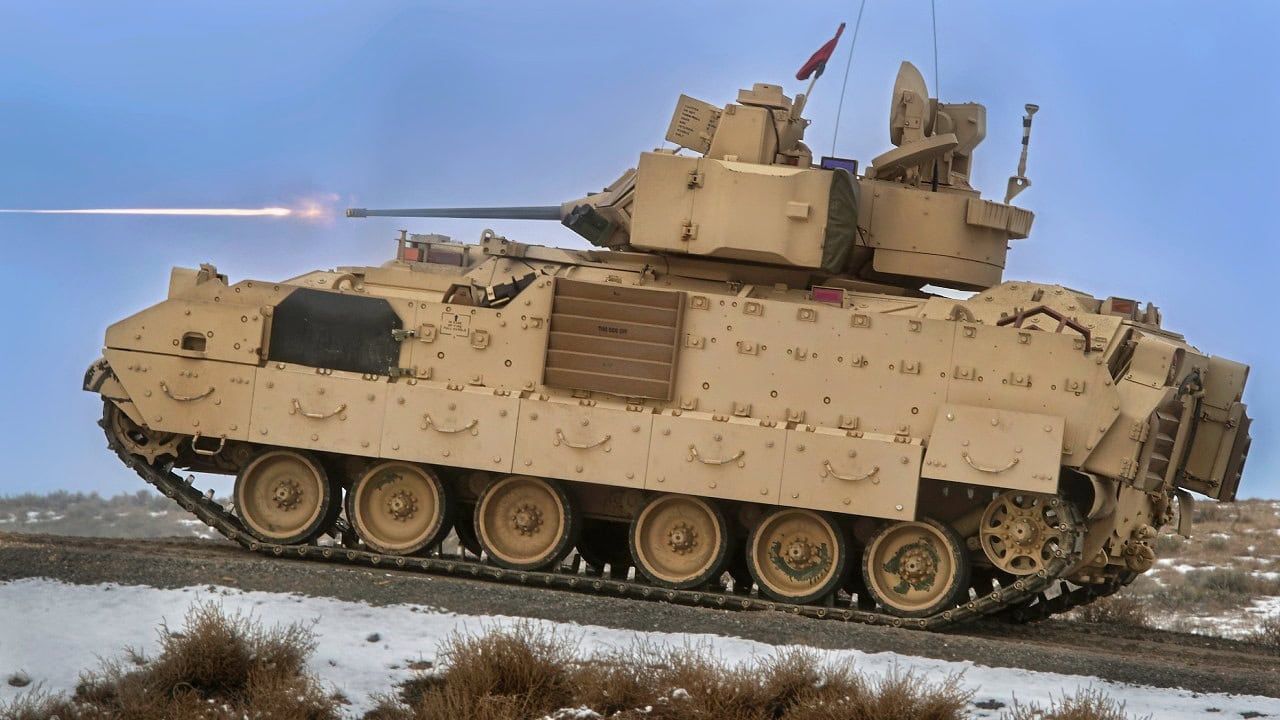
The U.S. Army has spent 40 years and five failed programs trying to replace the Bradley Fighting Vehicle. It just opened the competition to startups because the defense primes haven’t been able to get it done either.
The Bradley Fighting Vehicle Won’t Go Away
Buried within the U.S. Army’s Fiscal Year 2027 budget request is an item listed in the tracked combat vehicles section: the XM30 Mechanized Infantry Combat Vehicle. Only 19 XM30s are requested.
Though still in its infancy, that platform exists today as two distinct prototypes built by two different companies. In the end, neither may win the Army’s competition.
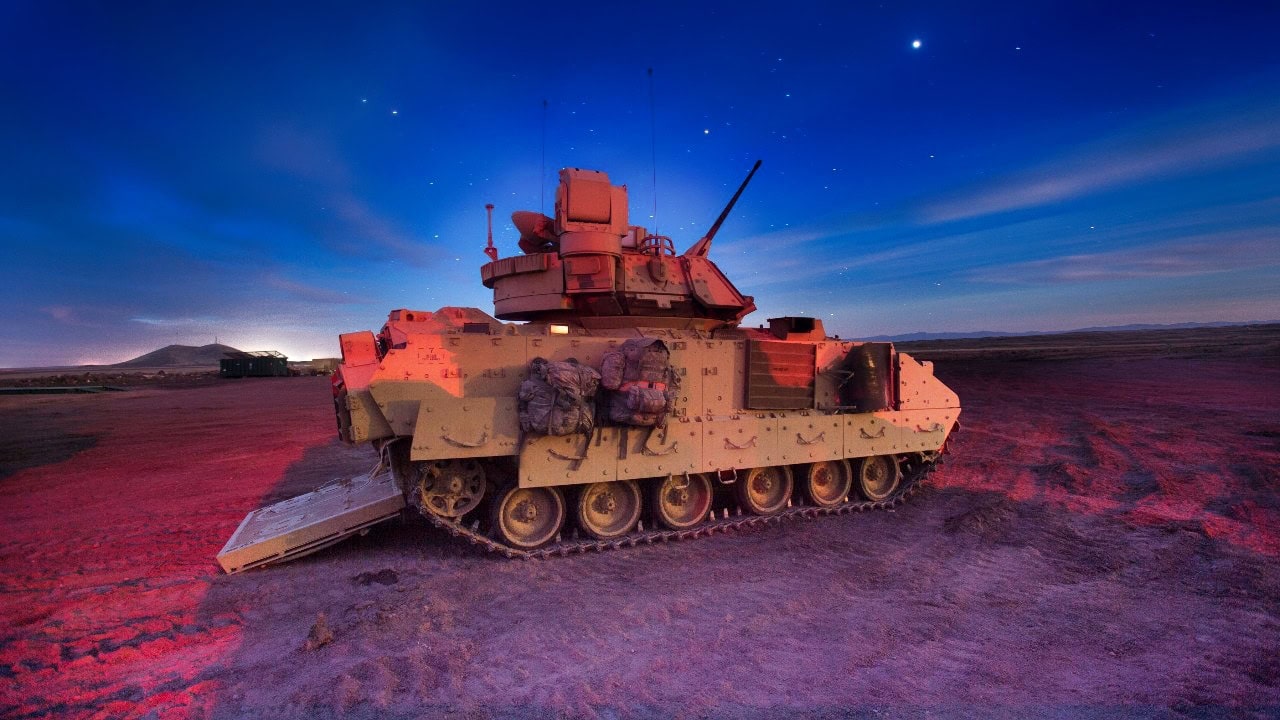
Engineers with the 116th Brigade Engineer Battalion conduct M2A3 Bradley fighting vehicle gunnery qualification on March 27, 2018, Orchard Combat Training Center, south of Boise, Idaho. Combat engineers with the 116th BEB trained through gunnery table XII, evaluating their ability to execute collective platoon-level tasks in a tactical live-fire environment; including integrating dismounted soldiers with their assigned BFV. (U.S. Army National Guard photo by 1LT Robert Barney)
False Starts
Over the summer, senior Army leaders met to greenlight the Bradley Fighting Vehicle’s replacement program, the XM30, and move forward to the Engineering and Manufacturing Development phase, also known as Milestone B. Consensus was reached, but there was a problem: two of the most senior members of the Army, then-Chief of Staff General Randy A. George, and Secretary of the Army Dan Driscoll, wanted other potential Bradley replacements to be explored.
“The Army is not going to rubber-stamp a process that has consistently failed to deliver the capabilities our warfighters need at the speed of relevance or locks us into a specific design that decreases flexibility,” a U.S. Army spokesperson explained to Breaking Defense. “Gen. George is fully aligned with [Defense] Secretary [Pete] Hegseth’s vision: we must break the cycle of slow, bureaucratic acquisition.”
“We are actively assessing multiple, competing designs for the XM30 to foster a truly competitive environment,” the spokesperson added. “We continue to look for partners who can deliver cutting-edge solutions now, not decades from now. This is a deliberate and necessary step to ensure we assess and select the best approach to deliver a world-class vehicle today and into the future.”

M2 Bradley. Image Credit: Creative Commons.
Army leadership put out a request for information for what it called the exploration of “innovative solutions” that could “design, production, and delivery of ground combat vehicles” at speed. The request was not very detailed, but that may have been the point—giving entrants the space to be creative.
The move cracks the XM30 program ajar, allowing other competitors to gain entrance by submitting innovative, untested tech to compete with more mature Bradley replacement platforms. In theory, smaller firms, including start-ups, have a chance to compete with the defense primes—perhaps not an invitation to take pole position, but certainly an opportunity to compete.
Sixth Time the Charm?
This latest push to phase out the Bradley is not the first time the Army has eyed that armored Cold War-era workhorse with concern. Since the 1980s, the Army has run several competitions to find a replacement. First, there was the Armored Systems Modernization, which gave way to the Future Combat System. Then came the Future Fighting Vehicle, which was followed by the Ground Combat Vehicle initiative. Eventually, the Army decided to run the Optionally Manned Fighting Vehicle competition.
Fast-forward to now, and there are two horses in the race to build the XM30 Mechanized Infantry Combat Vehicle: Rheinmetall and General Dynamics Land Systems, the two survivors of an initial competitive group of five defense primes. They’re chomping at the bit to lead what could shape up to be one of the Army’s biggest acquisition programs in decades.
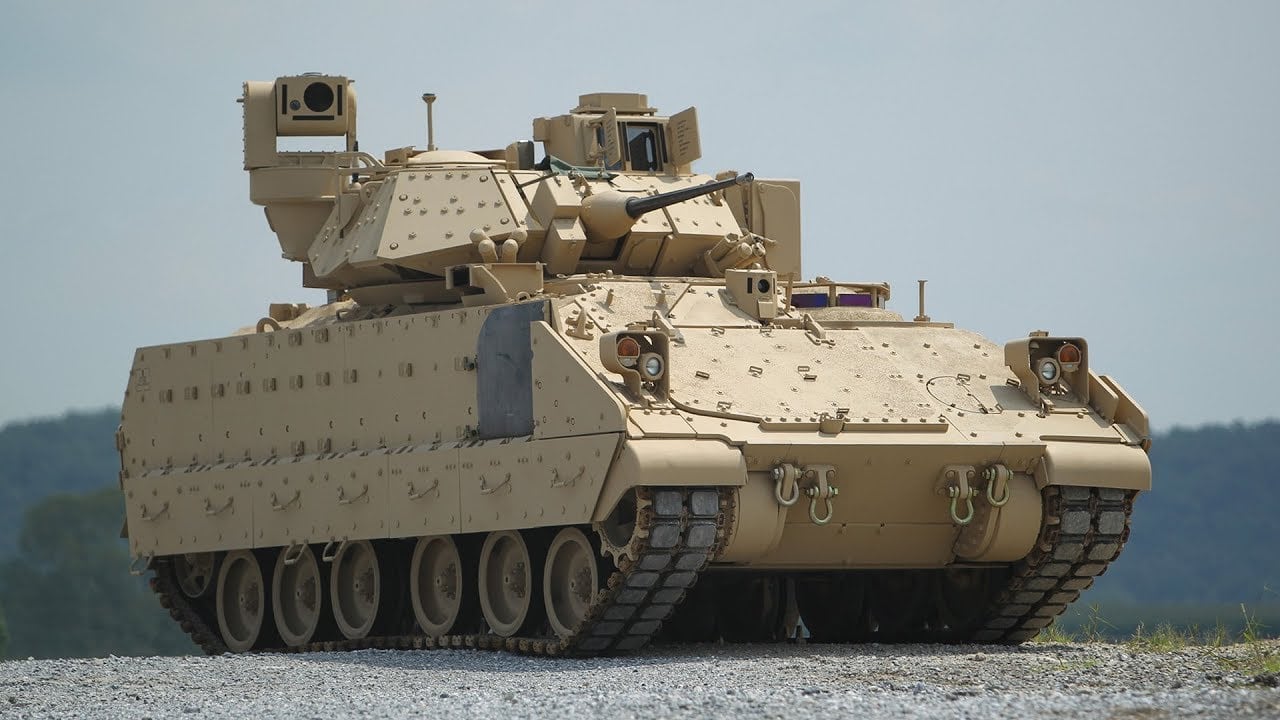
M2 Bradley
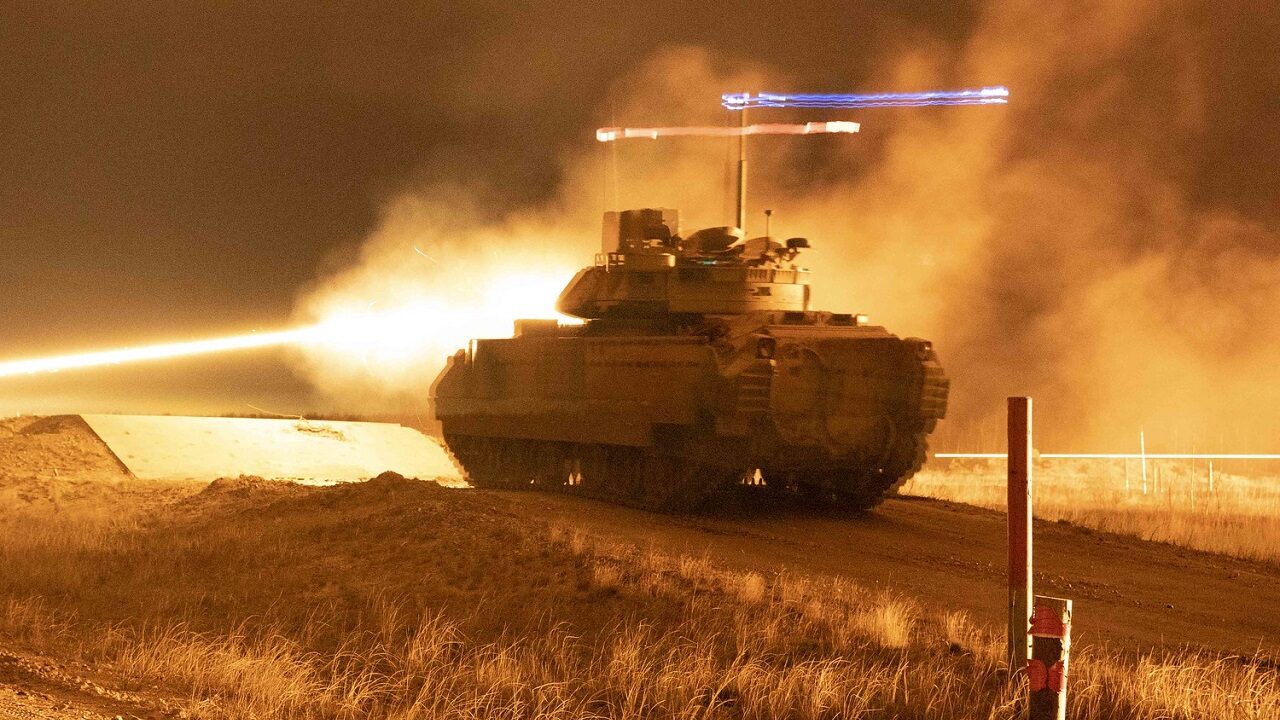
Soldiers fire a 25mm tracer round from an M2A3 fighting vehicle during an integrated night live-fire exercise at Camp Adazi, Latvia, Nov. 25, 2021.
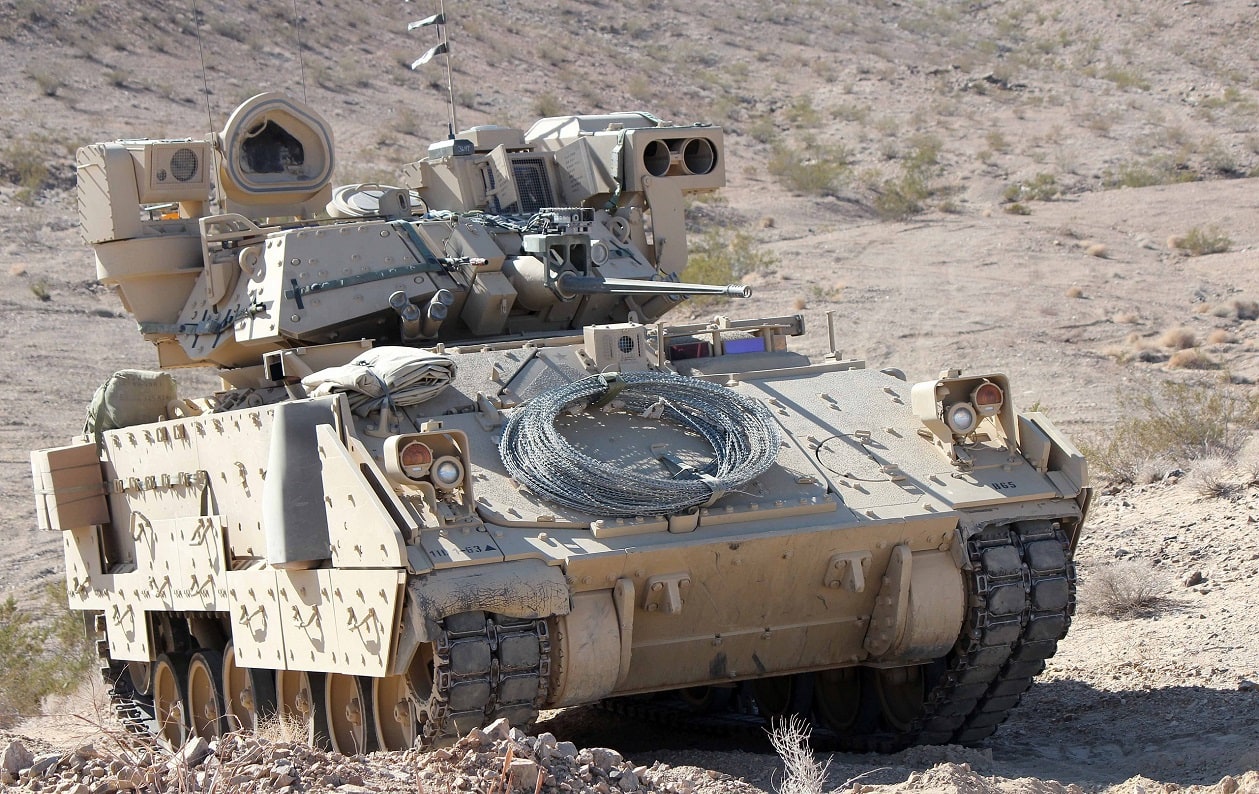
An M2 Bradley Fighting Vehicle is on display during a training exercise at the National Training Center in Fort Irwin, Calif., Feb. 18, 2013. The live, virtual and constructive training environment of the National Training Center is designed to produce adaptive leaders and agile forces for the current fight, which are responsive to the unforeseen contingencies of the 21st century. (U.S. Army photo by Sgt. Eric M. Garland II/Released)
In a post on LinkedIn, Rheinmetall’s American subsidiary wrote that “the Lynx XM30 isn’t being designed in a vacuum.”
“At American Rheinmetall, many of the people shaping this vehicle have served in armored formations and understand what it means to operate in contested environments. That experience directly informs how the Lynx XM30 is built, from survivability to mission effectiveness.”
“It’s a philosophy rooted in the realities of how Soldiers fight, not just what’s written in requirements,” the company added—perhaps a nod to the ups and downs that the XM30 program has gone through over the years of its prolonged development.
A Competitive Market: XM30 Coming
The Army’s decision to open the XM30 program seems to acknowledge the failure of its previous Bradley-replacement programs.
The two major competitors, GDLS and Rheinmetall, have the space to move forward with their own initiatives, but the move also puts a fire to their backs.
One of the Army’s much-anticipated projects recently went up in flames: the M10 Booker, a tracked assault gun meant to support infantry. Although that program successfully completed the prototyping stage, the Army ultimately decided not to acquire the platform, citing a lack of survivability and operational need.
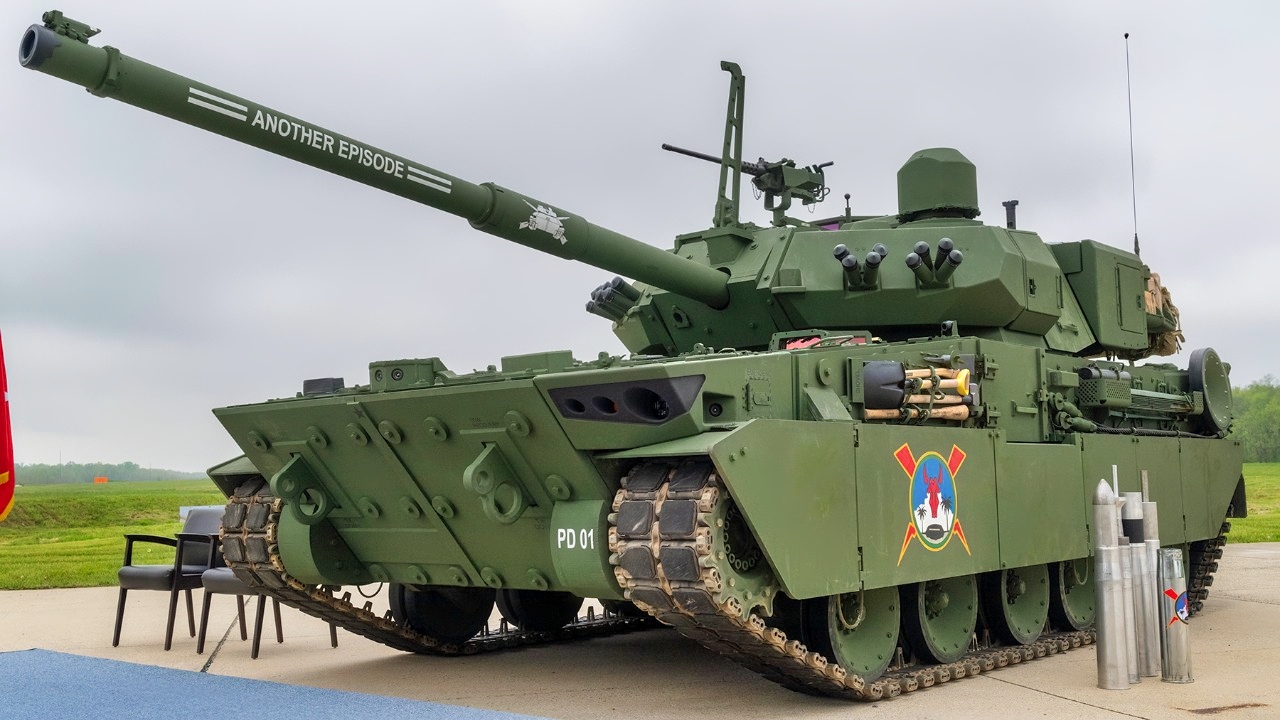
The M10 Booker displayed at it’s dedication ceremony at Aberdeen Proving Ground in Aberdeen, Md., April 18, 2024. As part of the dedication of the M10 Booker Combat Vehicle in their name, Pvt. Booker, a Medal of Honor recipient, and infantryman, assigned to the 133rd Infantry Regiment, 34th Infantry Division, during World War II, and Staff Sgt. Stevon A. Booker, a Distinguished Service Cross recipient, and tank crewman, assigned to Alpha Company, 1st Battalion, 64th Armor Regiment, 3rd Infantry Division, in support of Operation Iraqi Freedom, will be recognized and honored for their ultimate sacrifice, heroism and commitment to service and the country, represented by family members during the ceremony. (U.S. Army photo by Christopher Kaufmann).

M10 Booker is part of a static display while a live segment for FOX and Friends is being filmed at Fort Liberty, N.C., May, 21, 2024. The M10 Booker Combat Vehicle is named after two American service members: Pvt. Robert D. Booker, who posthumously received the Medal of Honor for actions in World War II, and Staff Sgt. Stevon A. Booker, who posthumously received the Distinguished Service Cross for actions during Operation Iraqi Freedom. Their stories and actions articulate the Army’s need for the M10 Booker Combat Vehicle, an infantry assault vehicle that will provide protection and lethality to destroy threats like the ones that took the lives of these two Soldiers. (U.S. Army Photo by Sgt. Jacob Bradford)
Needless to say, the pressure is on GDLS, Rheinmetall, and the U.S. Army to find a Bradley Fighting Vehicle replacement on time and under budget.
About the Author: Caleb Larson
Caleb Larson is an American multiformat journalist based in Berlin, Germany. His work covers the intersection of conflict and society, focusing on American foreign policy and European security. He has reported from Germany, Russia, and the United States. Most recently, he covered the war in Ukraine, reporting extensively on the war’s shifting battle lines in Donbas and writing about its civilian and humanitarian toll. Previously, he worked as a Defense Reporter for POLITICO Europe. You can follow his latest work on X.