
“There are no secrets to success. It is the result of preparation, hard work, and learning from failure.” – Colin Powell
That quote belongs to Colin L. Powell, former U.S. Army 4-star general, National Security Advisor, U.S. Secretary of State, bestselling author, and one of the most admired and beloved American public figures of all time. We now take a brief look at the remarkable life and career.

Secretary of Defense Richard Cheney; Gen. Colin Powell, Chairman Joint Chiefs of Staff; and Gen. Norman Schwarzkopf, Commander, U.S. Central Command, during an award ceremony prior to the Welcome Home parade honoring the coalition forces of Desert Storm.

GEN Colin Powell, chairman of the Joint Chiefs of Staff, slautes during the Sunset Ceremony for Pearl Harbor survivors at t he Arizona Memorial Visitores Center. The ceremony is part of day-long observances commemorating the 50th anniversary of the Japanese attack on Pearl Harbor.
Early Life of Colin Powell
Colin Luther Powell was born on April 5, 1937, in Harlem, New York City, to Jamaican immigrants Maud Ariel (née McKoy) and Luther Theophilus Powell. He was raised in the South Bronx and graduated from the now-defunct Morris High School. As a schoolboy, Powell worked at a local baby furniture store, learning Yiddish from the Eastern European Jewish shopkeepers.
Army ROTC
Young Colin didn’t obtain his military education and commission at the United States Military Academy at West Point, but rather via Army Reserve Officers’ Training Corps (ROTC), doing so at the City College of New York (CCNY), whereupon became company commander of the Pershing Rifles, attained ROTC’s highest rank of cadet colonel, and was named a “distinguished military graduate”—thus going to show you don’t have to be a service academy “ring-knocker” in order to reach the highest ranks of the armed service. Powell graduated in l958 with a Bachelor of Science in geology and was commissioned a second lieutenant in the Regular Army.
Junior Officer and Vietnam War Years
The timing of 2LT Powell’s commissioning was impeccable, as the Army was still fairly newly desegregated. He completed Infantry Officer Basic, Ranger, and Airborne schools. He joined the 3rd Armored Division in West Germany as a platoon leader.
He then transferred to Fort Devens, Massachusetts, to command a company of the 5th Infantry Division and, in 1962, was promoted to captain. 1962 was a double-celebration year for CPT Powell, as he married his beloved Alma Johnson on August 25 of that year; the couple had one son, Michael, and one daughter, Linda.
It was whilst he was still a Captain that Powell was first “blooded” in combat, both literally and figuratively: he did his first Vietnam War tour as a South Vietnamese Army (ARVN) advisor from 1962 to 1963, whereupon he was wounded in action (WIA) when he stepped on a punji stake and was awarded a Purple Heart for his sacrifice.
In June 1968, Powell was back in Vietnam, now a major. This time, he received the Soldier’s Medal for repeatedly returning to a burning helicopter to rescue three fellow soldiers (including division commander Major General Charles M. Gettys) despite his own injuries.
NSA and JCS
Powell spent the 1970s and 1980s working in numerous high-level offices; he was promoted to Brigadier General (1-star) on June 1, 1979.
From November 23, 1987, to January 20, 1989, Powell served as National Security Advisor to President Ronald Reagan.
As impressive as that stint was, it set the stage for even bigger and better things.
In April 1989, he received his fourth star, and, as noted by the official Joint Chiefs of Staff info page, “Within months of his appointment as CINCFOR [Commander in Chief of Force Command], President George H. W. Bush selected General Powell to be the twelfth Chairman of the Joint Chiefs of Staff. When Powell became Chairman on 1 October 1989, he was the first African-American, the first ROTC graduate, and, at fifty-two, the youngest officer to serve in the position.”
The newly minted JCS Chairman had barely settled into his seat when the U.S. Armed Forces embarked upon Operation Just Cause, the December 1989 invasion of Panama that overthrew strongman Manuel Noriega.
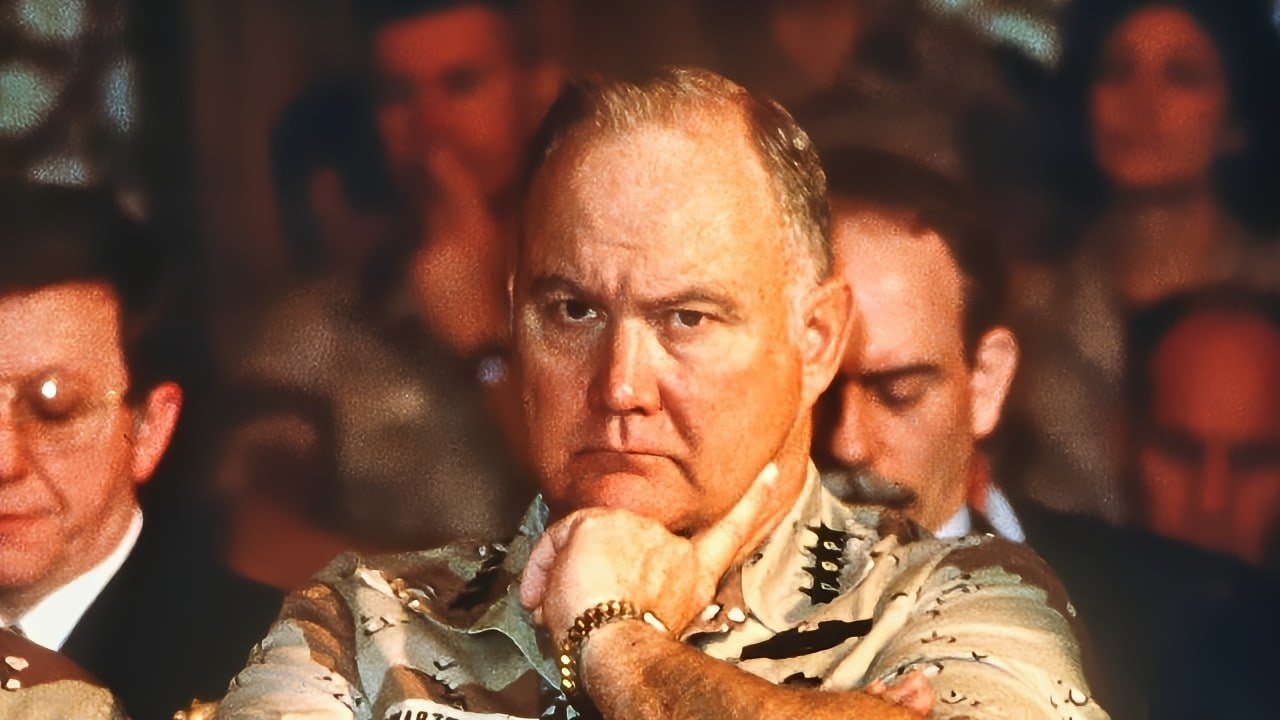
Paul D. Wolfowitz, under secretary of defense for policy, right, takes notes while Gen. Colin Powell, chairman, Joint Chiefs of Staff, and Gen. Norman Schwarzkopf, commander-in-chief, U.S. Central Command, listen to Secretary of Defense Richard Cheney answer questions from the media. The men are taking part in a press conference held by U.S. and Saudi Arabian officials during Operation Desert Storm.
This, in turn, set the stage for Gen. Powell’s greatest moment of triumph, the one that would make him a household name and national hero. In response to then-Iraqi dictator Saddam Hussein’s invasion of Kuwait in August 1990, Powell became the driving force behind Operations Desert Shield and Desert Storm, the latter being the 1991 Gulf War that evicted Saddam’s forces from Kuwait.
Post-Military Life
Gen. Powell retired from the Army on September 30, 1993, and two years later published his bestselling autobiography, “My American Journey.” He eschewed multiple calls to run for President of the United States, even though he would’ve almost certainly won the election in a bipartisan landslide.
However, he didn’t completely avoid a post-military political career, as he would return to work for another President Bush, this time as Secretary of State under George Walker Bush. Secretary Powell served in that position from January 20, 2001, to January 26, 2005, during which time he famously made remarks to the United Nations Security Council describing Saddam’s weapons of mass destruction (WMD) program and providing the rationale for the eventual 2003 Iraq War.
Colin Powell died of complications from COVID-19 on October 18, 2021, while being treated for a form of blood cancer that damaged his immune system. He was laid to rest at Arlington National Cemetery, in Section 60, Grave 11917.
Personal Memories of Powell
I had the honor and privilege of attending Powell’s speech at my undergraduate alma mater, the University of Southern California (USC), back in 1998, the year after my graduation from that hallowed institution. His speech was well attended and rousingly received, regardless of the political ideologies of the students and faculty members in attendance. (Coincidentally, USC was also the postgraduate alma mater of Powell’s fellow Desert Storm hero, Gen. H. Norman Schwarzkopf.)
A few months later, I was attending the U.S. Air Force Officer Training School (OTS), and within our student handbook, known as “The Talon,” there was an entire page dedicated to Gen. Powell’s leadership principles. The one our upperclassmen especially harped upon was “It ain’t as bad as it looks. It will be better in the morning.” Other nuggets of wisdom from that list that stick with me all these years later are “Get mad, then get over it” and “Never take counsel of your fears or your naysayers.”
About the Author: Christian D. Orr
Christian D. Orr is a Senior Defense Editor. He is a former Air Force Security Forces officer, Federal law enforcement officer, and private military contractor (with assignments worked in Iraq, the United Arab Emirates, Kosovo, Japan, Germany, and the Pentagon). Chris holds a B.A. in International Relations from the University of Southern California (USC) and an M.A. in Intelligence Studies (with a concentration in Terrorism Studies) from American Military University (AMU). He is also the author of the book “Five Decades of a Fabulous Firearm: Celebrating the 50th Anniversary of the Beretta 92 Pistol Series,” the second edition of which was recently published.