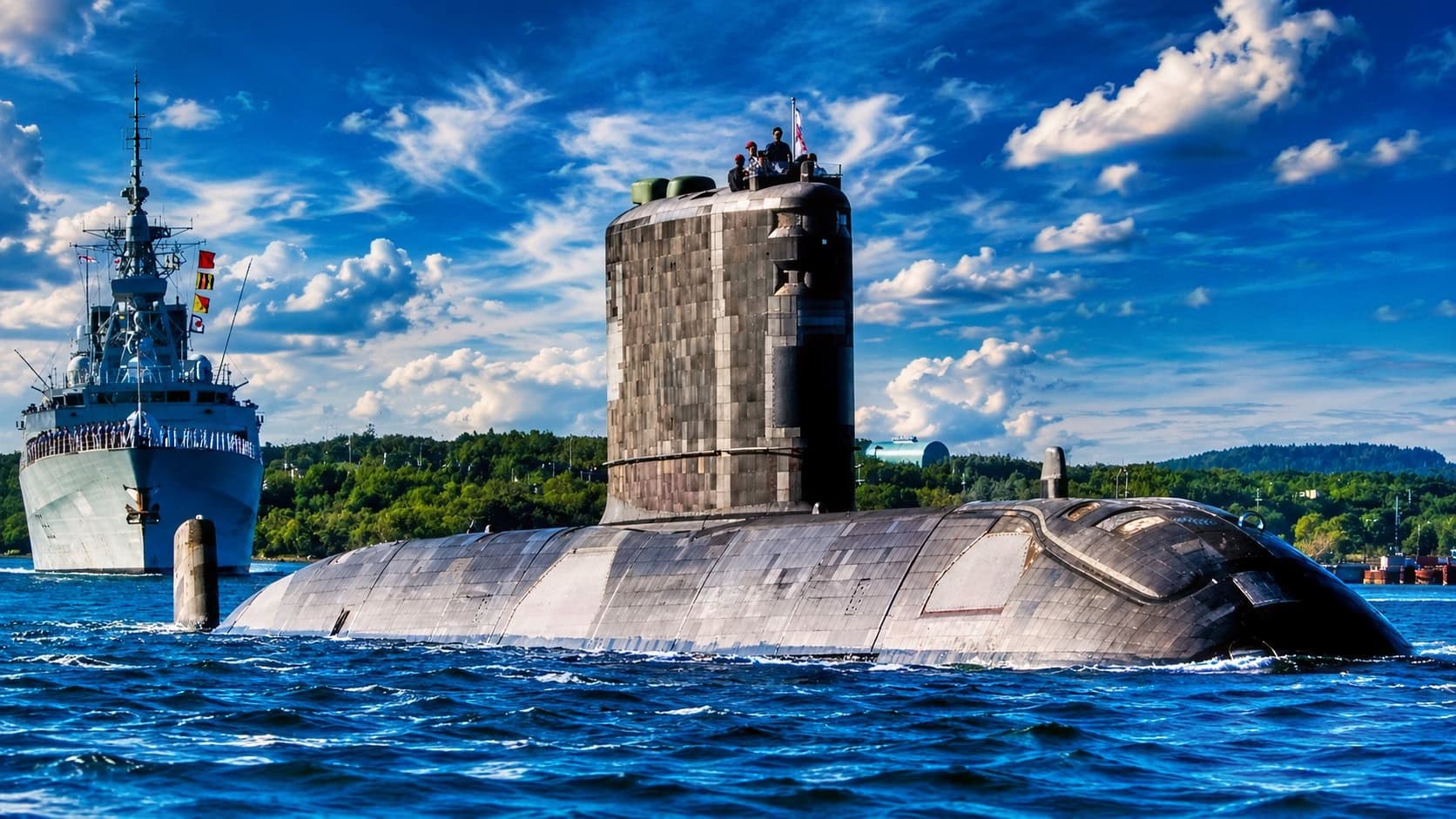
It will only be a matter of weeks before Ottawa chooses the next class of submarine for the Royal Canadian Navy.
The decision would be weighty for any national government, but for Canada, it could well be the most expensive procurement program in the country’s history.
The Victoria-class
Canada currently sails just four Victoria-class submarines, purchased from the British Royal Navy in 1998. But those submarines are aged vessels.
And in today’s heightened security environment, a paltry four submarines are insufficient to meet Canada’s maritime security needs.
Ottawa needs submarine coverage in the Atlantic, Pacific, and, increasingly, the Arctic, where a high-north scramble to secure newly emerging natural resources is shaping up.
Several of the Nordic countries are interested in the area, but so too are Russia and, despite its remoteness from the Arctic, China.
Canada’s Victoria-class does not enjoy a positive reputation. The four-sub-class has been affected by several readiness issues.
Limited operational availability and long maintenance and refit periods have hit the class particularly hard.
And while senior Royal Canadian Navy officials have voiced repeated concerns about the class, Ottawa has grappled with finding a replacement for years.
Two Contenders from Germany and South Korea
The Victoria-class replacement is for now provisionally called the Canadian Patrol Submarine Project, and two bidders are competing for this enormous contract: South Korea’s Hanwha Ocean and Germany’s TKMS.
Both shipbuilders have extensive experience building world-class submarines and have gone to great lengths to convince Canadians why their submarines should be chosen.
Both companies are positioning themselves as the right choice for Canada’s soon-to-be-announced decision.
In late May, Seoul’s Chief of Naval Operations, Admiral Kim Kyung-ryul, arrived in Canada as part of a broader pitch for the Canadian submarine project.
There, the airmail met with his counterpart, the then newly-promoted Vice-Admiral Angus Topshee.
The heat is certainly on.
Canada recently awarded Thyssenkrupp Marine Systems, the German defense prime that would build Canada’s submarines, a separate contract for building up Canada’s own space launch capability.
The Canadian Patrols Submarine Project
Naturally, the precise details of what Canada’s upcoming class of submarines is capable of is a closely-guarded secret.
But some of the project’s general contours have been clearly outlined by Ottawa.
As the Canadian government previously explained, the submarines are to “be deployable in the Arctic with extended range and endurance that will provide stealth, persistence, and lethality as key capabilities.”
Additionally, “the future Canadian Patrol Submarine will employ a unique combination of these attributes to ensure that Canada can detect, track, deter and, if necessary, defeat adversaries in all 3 of Canada’s oceans.
It will enable the Government of Canada to contribute to international security through deployments alongside allies and partners, while creating opportunities to strengthen Canada’s defense and marine sectors.”
Germany’s Type 212CD
TKMS’s offering for the Canadian Patrol Submarine Projects is its Type 212CD, a variant of the submarine that is currently being procured for both the German and Norwegian navies.
Tasked with patrolling the Baltic waters and beyond for Oslo and Berlin, that submarine is relatively small and compact compared to the globe-trotting blue-water submarines fielded by the likes of the United States Navy.
But it is technologically sophisticated, prioritizes sonar neutralization to remain undetected, offers respectable underwater endurance despite its lack of nuclear propulsion, and — in what may be the key to the German bid — is ready for interoperability with the naval standards of the NATO alliance, of which both Germany and Norway are members.
Submarines from Seoul
South Korea’s Hanwha Ocean and its contender for Canada’s next submarine are significantly different than the German bed.
Hanwha’s KSS-III is a larger platform, a reflection of its role for South Korea.
There, in the vast wastes of the Pacific Ocean, the KSS-III would patrol for long periods and boasts the internal volume to support extended patrols. However, the platform may have more room to grow, too, thanks to its larger internal volume, which may more easily accommodate future technologies.
The South Korean defense industry has notched several notable wins in Europe in recent years, including a massive sale of K2 Black Panther main battle tanks, K9 howitzers, rocket launchers and missiles, as well as FA-50 aircraft to Poland.
Those sales bolstered South Korean arms manufacturers’ reputation for the speedy build and delivery of major equipment, a reputation that Hanwha would like to leverage.
Both Sides Grappling for an Advantage
There is, however, some worry in South Korea about the NATO angle.
One South Korean industry leader sought to tie in additional industrial addenda to the Hanwha pitch, explaining that while South Korea’s submarine offering was, in his mind, superior, Ottawa may favor fellow NATO member Germany.
In a sign of how hot the competition has become, Germany and Norway have both offered to give up one Type 212 submarine each to ensure that TKMS can build four submarines for the Royal Canadian Navy by 2035, when the Victoria-class is set to retire.
“We are absolutely convinced that it is in our joint interest in NATO and between Europe and Canada to strengthen all the capabilities of our Canadian allies,” German Minister of Defense Boris Pistorius said.
“It is about reliability among partners and allies. It’s about a shared perspective on the threats we all face together.
And this is about focusing on the areas where the threat is most relevant and present. And this, of course, for example, the High North, the Arctic, the North Atlantic.”
About the Author: Caleb Larson
Caleb Larson is an American multiformat journalist based in Berlin, Germany. His work covers the intersection of conflict and society, focusing on American foreign policy and European security. He has reported from Germany, Russia, and the United States. Most recently, he covered the war in Ukraine, reporting extensively on the war’s shifting battle lines from Donbas and writing on the war’s civilian and humanitarian toll. Previously, he worked as a Defense Reporter for POLITICO Europe. You can follow his latest work on X.