
Rather than appearing to want to wrap up the war in Iran, the United States is surging a variety of resources towards the Middle East, including “forces, medics and weaponry,” the Wall Street Journal reported.
Those new resources, the story said, will provide the president with “more muscular military options as he considers expanding the conflict against Iran.”

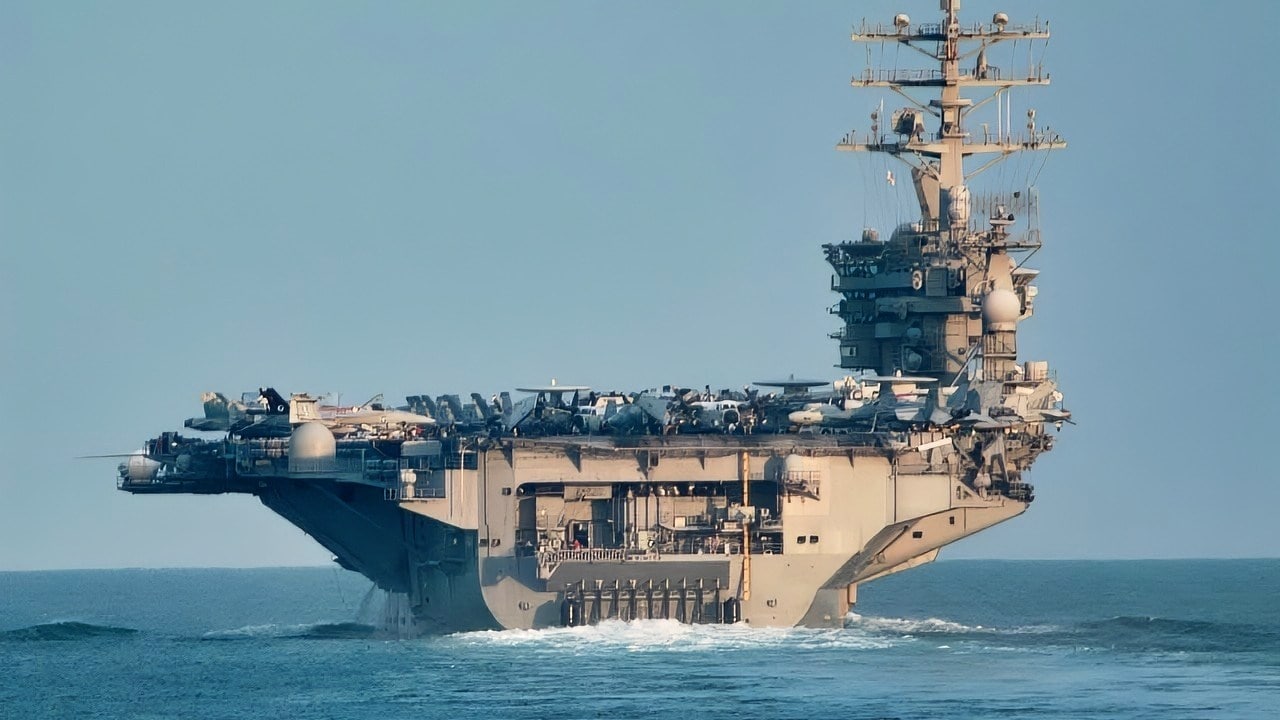
210618-N-JW440-2001 STRAIT OF MALACCA (June 18, 2021) As seen from the Ticonderoga-class guided-missile cruiser USS Shiloh (CG 67), the Navy’s only forward-deployed aircraft carrier USS Ronald Reagan (CVN 76) transits the Strait of Malacca with the Arleigh Burke-class guided missile destroyer USS Halsey (DDG 97). The ships are part of Task Force 70/Carrier Strike Group 5, conducting underway operations in support of a free and open Indo-Pacific. (U.S. Navy Photo by Mass Communication Specialist 1st Class Rawad Madanat)
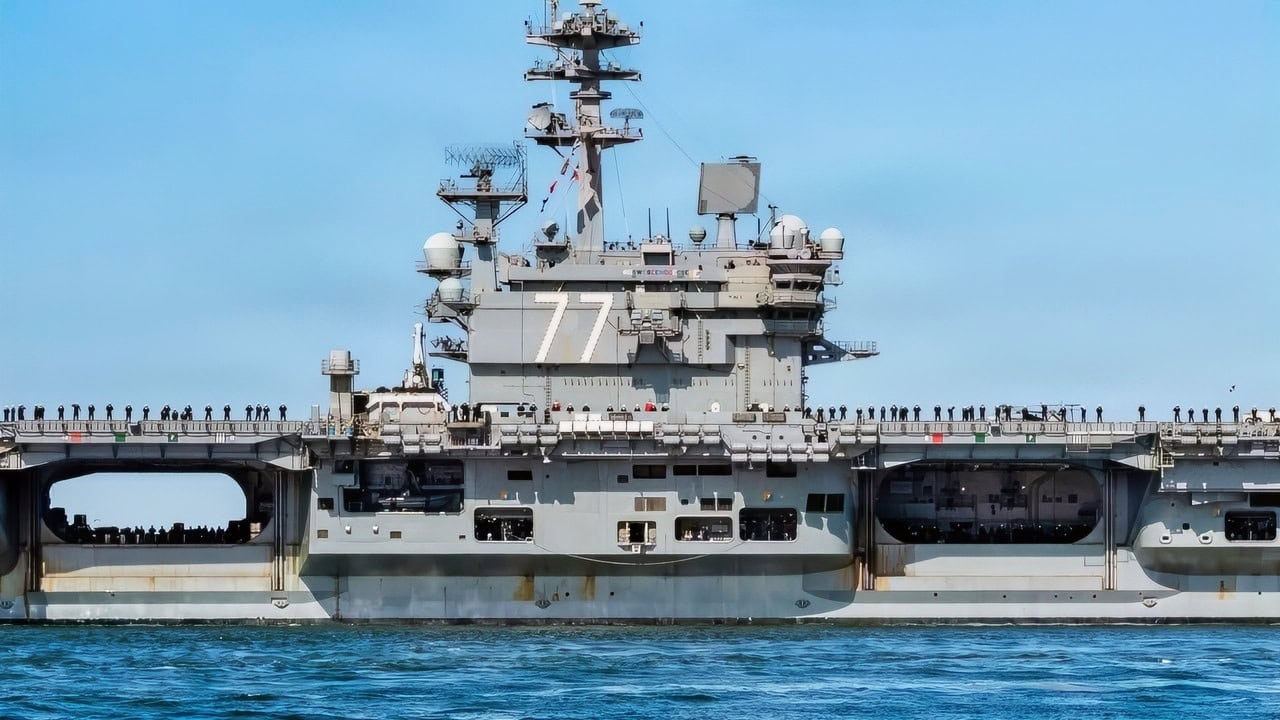
NAVAL STATION NORFOLK (March 31, 2026) The Nimitz-class aircraft carrier USS George H.W. Bush (CVN 77), the flagship of the George H.W. Bush Carrier Strike Group, departs Naval Station Norfolk to begin operations in support of its scheduled deployment, March 31, 2026. More than 5,000 personnel are assigned to the George H.W. Bush Carrier Strike Group. The George H.W. Bush Carrier Strike Group provides combatant commanders and America’s civilian leaders increased capacity to underpin American security and economic prosperity, deter adversaries, and project power on a global scale through sustained operations at sea. (U.S. Navy photo by Mass Communication Specialist 2nd Class Derek Cole)
The report added that special-operations forces have been heading to the region from U.S. bases, with jet fighters staging across the Middle East.
Also, per one official, “bomber aircraft at bases in the U.S. and U.K. are on high alert to ramp up operations.”
Landstuhl Regional Medical Center in Germany, meanwhile, has welcomed 150 medics to treat troops injured in combat.
U.S. Central Command said on Wednesday that “U.S. forces began launching more strikes against Iranian military targets at the Commander in Chief’s direction. The mission will continue to further degrade Iran’s ability to threaten civilian mariners and commercial vessels transiting regional waters.”
An Expanded War, or Just More Options?
Does this mean the war is expanding?
Retired Gen. Joseph Votel told the Journal that this might not be the case.
“The big idea here is to give the president and the secretary [of defense] the most flexibility, and the force the most options to present to them,” Votel said.
No matter what, there’s no question that the war is starting to get expensive.
$37 Billion and Counting
When he testified this week before a Congressional committee, Defense Secretary Pete Hegseth stated that the Iran operation so far has a price tag of $37 billion, with a lot more to come.
According to CNN, Hegseth and White House Gen. Dan Caine came to Congress asking for an $87.6 billion supplemental request, including “$67 billion for the war and other Pentagon spending.”
In their questioning, Democrats on the Senate Appropriations Committee had tough questions for Hegseth.
“You will not answer whether your statement made on the 14th day of the war that Iran’s military had been quote destroyed and made combat ineffective was a truthful statement to the American people as you sit here and ask for tens of billions (of dollars) more,” Sen. Jon Ossoff (D-GA) asked of the Defense Secretary.
“Secretary Hegseth, you’re requesting billions of dollars in supplemental funding for a war that you said would last for weeks and that the president has no plan or ability to end,” Sen. Kirsten Gillibrand (D-NY) said in the hearing.
“(Voters) have seen their grocery and gas bills rise, and this unpopular and unauthorized war abroad is a higher priority to this administration than their ability to feed their families and provide healthcare to their loved ones who are sick.”
Per The Hill, Hegseth warned in his testimony that soldiers’ training would need to be cut if immediate funding wasn’t passed.
“There is training — training right now and training in the future — that would have to be curtailed if we do not get our budget needs met and met urgently,” the secretary said.
A new NDAA?
On Wednesday, the House of Representatives passed a $1.1 trillion National Defense Authorization Act, ahead of its month-long recess. The bill passed the House 216 to 212, with six Democrats joining the Republicans.
It’s not clear if the bill has the votes to pass the Senate, which has some controversial provisions. It will need support from some Democrats to beat the 60-vote threshold to overcome the filibuster.
“The problem with this year’s defense authorization bill is that it comes with the inclusion of $1.15 trillion in discretionary spending,” Rep. Adam Smith of Washington state, the top Democrat on the House Armed Services Committee, said in a statement. “I cannot and do not support meeting these needs by making massive cuts to critically important domestic programs and slashing taxes.”
The House also advanced a different bill, the $95 billion budget blueprint, which “outlines more than $70 billion for the Iran war, $12 billion in assistance for farmers and money to implement provisions of the SAVE America Act, President Trump’s signature election overhaul bill.”
That bill passed even more narrowly, 216 to 214.
About the Author: Stephen Silver
Stephen Silver is an award-winning journalist, essayist, and film critic, and contributor to the Philadelphia Inquirer, the Jewish Telegraphic Agency, Broad Street Review, and Splice Today. The co-founder of the Philadelphia Film Critics Circle, Stephen lives in suburban Philadelphia with his wife and two sons. For over a decade, Stephen has authored thousands of articles that focus on politics, national security, technology, and the economy. Follow him on X (formerly Twitter) at @StephenSilver, and subscribe to his Substack newsletter.