

House Democrats have introduced articles of impeachment against Secretary of Defense Pete Hegseth. The effort, led by Rep. Yassamin Ansari (D-AZ) and Rep. John Larson (D-CT), charges Hegseth with “high crimes and misdemeanors.” The charges, tied to Hegseth’s conduct relating to the Iran war, are being dismissed by Republicans as a political charade.
War Without Authorization
The main allegation against Hegseth is that he led an unauthorized war in Iran, expanding military operations without congressional approval, thereby violating the War Powers Resolution of 1973, which holds that Congress alone has the power to declare war.

Secretary of Defense Pete Hegseth hosts a bilateral exchange with Australian Deputy Prime Minister Richard Marles at the Pentagon, Washington, D.C., Feb. 7, 2025. (DoD photo by U.S. Air Force Senior Airman Madelyn Keech)
Congress did not authorize Operation Epic Fury, so the question is whether it qualifies as war.
While some officials have dubbed Epic Fury a “campaign,” the legal standing of the conflict would more appropriately be classified as a “war of choice.”
The facts here are clear: Epic Fury involved a major 40-day air and naval campaign against Iran that meets several critical criteria for the definition of war, i.e., scale, casualties, rhetoric, public consensus, and the Geneva Convention.
Civilian Strikes
Hegseth is also facing claims that US strikes caused significant civilian deaths. One February 28th strike against a school in Minab is reported to have killed between 148 and 168 civilians, mostly schoolgirls. Another strike, against the Lamerd Sports Hall, killed 21 people—mostly children and teenagers at volleyball practice.

Secretary of Defense Pete Hegseth participates in a live virtual interview with “Fox and Friends” from the Pentagon, Washington, D.C., Jan. 31, 2025. (DoD photo by U.S. Navy Petty Officer 1st Class Alexander Kubitza)
Beyond Epic Fury, Hegseth faces allegations that he issued “kill everybody” orders against a civilian boat from Venezuela, which many believe qualifies as an extrajudicial assassination.
Signalgate
Hegseth is also involved in “Signalgate,” a major national security scandal centered on the Secretary’s use of the encrypted messaging app Signal to discuss sensitive military operations on his personal device.
The controversy centers on two main group chats where sensitive, non-public DoD information was shared. The first is the “Houthi PC Small Group,” where Hegseth and top officials, including Vice President J.D. Vance and Secretary of State Marco Rubio, coordinated airstrikes in Yemen.
The chat likely would have remained a secret had then-National Security Advisor Mike Waltz not accidentally added Jeffrey Goldberg, the editor-in-chief of The Atlantic.
The second Signal chat in question is the “Defense | Team Huddle,” within which Hegseth shared details about the Yemen strikes with his wife, brother, and personal lawyer—none of whom had security clearance.
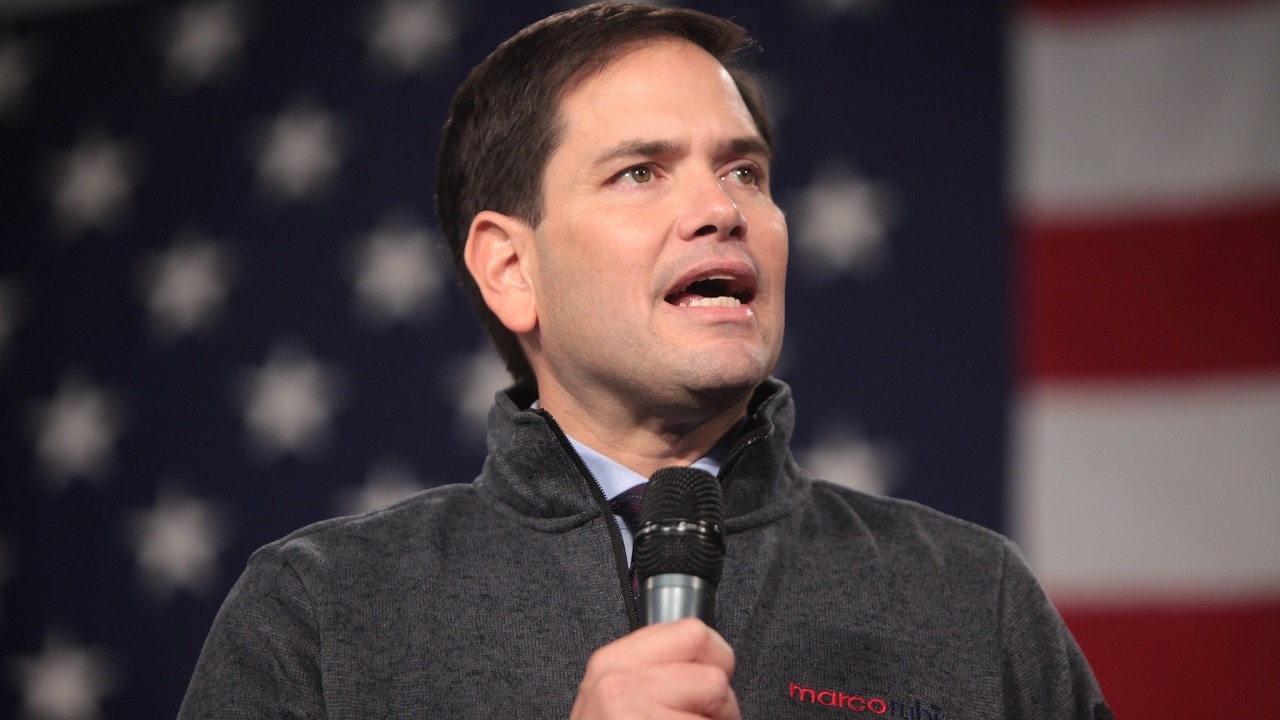
By Gage Skidmore: Then U.S. Senator Marco Rubio speaking with attendees at the 2015 Iowa Growth & Opportunity Party at the Varied Industries Building at the Iowa State Fairgrounds in Des Moines, Iowa.
The Impeachment Process
Impeachment means a formal charge by the House, not a removal from office; it’s the equivalent of an indictment and applies to federal officials, including Cabinet members.
To be removed from office, a separate Senate process is required. First, after a House member submits impeachment articles, the House Judiciary Committee must investigate, hold hearings, and then vote by majority to advance the articles to a full House vote.
If the House reaches a simple majority (50 percent plus one), then Hegseth will officially be impeached in the House.
Right now, the articles against Hegseth are in the very early stages with the House Judiciary Committee. Were the articles to reach the Senate, a two-thirds vote (67 of 100) would be required to remove Hegseth from office.
How Does This End for Pete Hegseth?
Given that the articles of impeachment must make it through a Republican-majority House before receiving a two-thirds majority in the Republican-majority Senate, the statistical likelihood of Hegseth being impeached is low—not zero, but very nearly zero.
Whether he should be impeached is another story, but given the legislature’s political composition, it’s not happening.
The representatives who filed the impeachment articles understood this political reality; the filing was symbolic.
Historical Context of Impeachment
Cabinet impeachments are rare. William Belknap remains the only cabinet secretary in history to be both impeached by the House and tried by the Senate. He was impeached unanimously for accepting bribes in connection with a trading post scandal at Fort Sill.
Though Belknap resigned just minutes before the vote, the Senate conducted a trial that resulted in an acquittal.
Hegseth isn’t the first Secretary of Defense against whom articles of impeachment were introduced. Lloyd Austin faced similar articles relating to the 2021 withdrawal from Afghanistan and a 2024 failure to promptly disclose a hospitalization.
MORE – A Second U.S. Navy Nuclear Aircraft Carrier Has Caught Fire
Those resolutions never advanced to a full House vote.
And before Austin, Donald Rumsfeld faced articles of impeachment relating to the Iraq War; the resolution died in a subcommittee.
About the Author: Harrison Kass
Harrison Kass is a writer and attorney focused on national security, technology, and political culture. His work has appeared in City Journal, The Hill, Quillette, The Spectator, and The Cipher Brief. He holds a JD from the University of Oregon and a master’s in Global & Joint Program Studies from NYU. More at harrisonkass.com.